

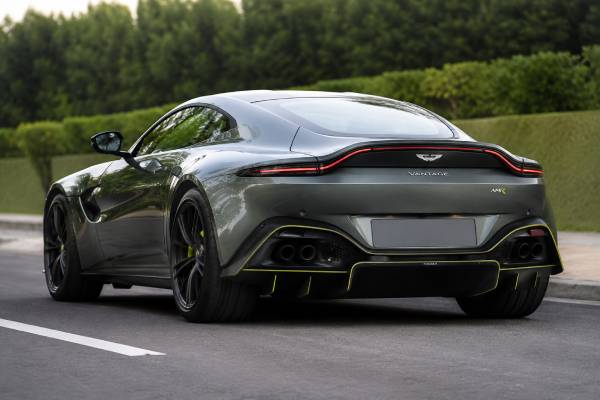
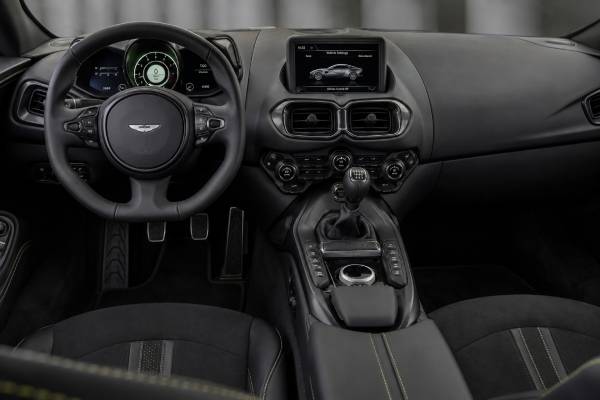
The 2019 Aston Martin Vantage AMR is the limited-production manual version that transformed the second-generation Vantage from a fast automatic sports car into a more deliberate driver’s machine. Its 4.0-litre twin-turbo M177 V8 retained 503 hp, but torque was capped at 625 Nm for the seven-speed Dana Graziano transaxle. A dogleg first gear, conventional H pattern for second through seventh, selectable AMSHIFT rev matching, a mechanical limited-slip differential, carbon-ceramic brakes, and a 95 kg weight reduction created a car with its own engineering identity. Aston Martin built only 200, including 59 Vantage 59 examples commemorating the company’s 1959 Le Mans victory. Those numbers make specification and provenance as important as mechanical condition. Buyers must confirm whether a car is a genuine AMR, which factory theme it carried, and whether its unique gearbox, lightweight hardware, carbon ceramics, and original parts remain intact. This guide covers the single-year 2019 AMR series, its unusual control layout, technical data, maintenance priorities, and the checks that distinguish a sound collectible driver from an expensive correction project.
Table of Contents
- Why Aston built the AMR
- AMR technical data
- Learning the dogleg seven-speed
- Weight, brakes, and chassis balance
- M177 engine and cooling care
- Limited-series inspection
- Buying and living with an AMR
Why Aston built the AMR
The Vantage AMR was created to restore manual involvement to Aston Martin’s new twin-turbo sports car without pretending that a clutch pedal alone made a special edition. The transmission, differential, brakes, weight, calibration, and production strategy were developed as one package.
The standard 2018-on Vantage launched with an eight-speed ZF automatic and electronically controlled rear differential. It was quick, broad-shouldered, and modern, but enthusiasts associated the nameplate with the manual transaxles of the VH generation. For the AMR, Aston Martin installed a seven-speed manual developed with Dana Graziano. First gear sits down and left in a dogleg position; second through seventh occupy the main double-H layout. The pattern keeps frequently used road gears aligned and recalls competition transmissions in which first is primarily a launch ratio.
The gearbox imposed a torque limit. The M177-based 4.0-litre twin-turbo V8 continued to produce 510 PS, or 503 bhp, at 6,000 rpm, while peak torque was set at 625 Nm between 2,000 and 5,000 rpm rather than the automatic car’s higher figure. Claimed acceleration to 62 mph was 4.0 seconds and maximum speed rose to 200 mph. The AMR therefore traded a small amount of launch performance and torque for direct control, lower mass, and greater driver participation.
A mechanical limited-slip differential replaced the standard electronic unit. Carbon-ceramic brakes reduced unsprung mass, and the complete car was quoted as 95 kg lighter than the regular Vantage. The underlying bonded-aluminium structure, front-mid engine position, rear transaxle, double-wishbone suspension, and near 50:50 weight distribution remained fundamental to the design.
Production was capped at 200 units. Five curated specifications were announced, with 59 cars wearing the Vantage 59 theme inspired by the DBR1’s victory at the 1959 24 Hours of Le Mans. Those cars used a distinctive Stirling Green and Lime exterior treatment with coordinated interior details. Other schemes were called Sabiro Blue, Onyx Black, China Grey, and White Stone, though market terminology and optional personalisation require VIN-level confirmation.
The manual later became available in the broader Vantage range in some markets, but that does not make a regular manual car an AMR. The limited edition is identified by its build record, production allocation, factory finish, brakes, weight-saving content, and period documentation. A badge or repaint cannot recreate that provenance.
AMR technical data
The tables summarise the launch specification for the 2019 Vantage AMR coupé. Individual equipment may vary by country, factory theme, and options, so parts and settings should always be checked from the VIN.
Engine and output
| Configuration | Front-mid-mounted 4.0-litre twin-turbocharged V8 |
|---|---|
| Displacement | 3,982 cc |
| Valvetrain | 32 valves, dual overhead camshafts |
| Maximum power | 510 PS / 503 bhp / 375 kW at 6,000 rpm |
| Maximum torque | 625 Nm from 2,000–5,000 rpm |
| Induction | Twin turbochargers with charge-air cooling |
| Fuel requirement | Premium unleaded according to regional handbook |
Manual drivetrain and performance
| Transmission | Seven-speed Dana Graziano manual rear transaxle |
|---|---|
| Shift layout | Dogleg first; second through seventh in double-H pattern |
| Driver aid | Selectable AMSHIFT rev matching and no-lift-shift support |
| Differential | Mechanical limited-slip differential |
| Final-drive ratio | 3.727:1 |
| 0–60 mph | Approximately 3.9 seconds |
| 0–62 mph | 4.0 seconds |
| Maximum speed | 200 mph |
Structure and mass
| Platform | Bonded aluminium structure with aluminium and composite body panels |
|---|---|
| Engine location | Front-mid, low and behind the front axle line |
| Gearbox location | Rear transaxle connected by torque tube |
| Weight distribution | Approximately 50:50 |
| Minimum dry weight | Approximately 1,499 kg |
| Reduction versus automatic Vantage | Quoted 95 kg |
| Production | 200 units, including 59 Vantage 59 cars |
Suspension, brakes, wheels, and tyres
| Front suspension | Independent double wishbones with adaptive damping |
|---|---|
| Rear suspension | Independent multi-link arrangement with adaptive damping |
| Front brakes | 410 mm carbon-ceramic discs |
| Rear brakes | 360 mm carbon-ceramic discs |
| Wheel diameter | 20 inches |
| Front tyres | 255/40 ZR20 |
| Rear tyres | 295/35 ZR20 |
Dimensions and capacities
| Length | 4,465 mm |
|---|---|
| Width excluding mirrors | 1,942 mm |
| Height | Approximately 1,274 mm |
| Wheelbase | 2,704 mm |
| Fuel capacity | Approximately 78 litres |
| Seating | Two |
| Body style | Two-door hatchback coupé |
The assignment’s AM6 designation identifies the model context, while workshop and parts systems may use platform, engine, and market codes differently. Always anchor technical decisions to the actual VIN and official documentation rather than relying on a code in an advertisement.
Learning the dogleg seven-speed
The seven-speed manual is the AMR’s defining component and the system most likely to be misunderstood during a short test drive. It rewards a calm, accurate technique rather than hurried imitation of a conventional six-speed.
First gear is down and left, isolated from the main pattern. Once moving, the driver works primarily across second to seventh. This makes the common ratios accessible, but the gate is dense and cable operation can feel unfamiliar. The lever should enter each plane positively without excessive lateral uncertainty. A buyer needs enough time to learn the spring bias before deciding that normal unfamiliarity is a fault—or overlooking a genuine linkage problem.
AMSHIFT uses clutch, gear-position, propshaft, and engine-management information to automate throttle blips on downshifts. It can also facilitate full-throttle upshifts when conditions permit. The system is selectable, so the car can be driven with traditional heel-and-toe technique. Verify that both states work and that the dashboard reflects the chosen mode. Software or sensor faults may affect the feature even when the transmission remains mechanically usable.
The clutch carries substantial turbocharged torque. Test engagement from cold, low-speed manoeuvring, hill starts, warm take-up, and full-load acceleration in a high gear. Slip, persistent judder, an abnormal release noise, fluid leaks, or a changing bite point need specialist attention. Do not repeatedly provoke a suspected clutch during an inspection. Diagnostic records, previous replacement invoices, and a careful road test are more useful than abuse intended to “prove” its condition.
The mechanical limited-slip differential gives the AMR a more traditional rear-axle response than the electronic differential in the automatic Vantage. Some driveline sound and low-speed mechanical sensation may be normal, but grinding, severe chatter, whining that changes with load, or impact-like clunks are not explained simply by the word “mechanical.” Correct fluid, tyre matching, mount condition, and transaxle calibration all influence refinement.
Cable linkage, gearbox mounts, engine mounts, clutch hydraulics, and the torque tube work as one system. A vague shift may originate outside the gearbox. Likewise, vibration can result from tyres, mounts, propeller components, clutch imbalance, or exhaust contact. A specialist familiar with the AMR should diagnose the whole driveline before expensive parts are ordered.
Driving technique protects the car. Select first deliberately while stationary, avoid resting a hand on the lever, do not hold the car on the clutch, and complete shifts rather than forcing the synchronisers. The broad torque curve allows an owner to skip ratios when appropriate, but the character comes from using the seven-speed arrangement rather than treating sixth and seventh as irrelevant decoration.
The AMR is slower off the line than the automatic on paper, yet its performance feels interactive. The driver decides when the turbocharged torque arrives at the rear axle and must coordinate throttle, clutch, and steering. That responsibility is precisely why the car exists.
Weight, brakes, and chassis balance
The AMR’s 95 kg reduction changes more than acceleration. Less mass, especially in the braking system and driveline, improves response, while the manual power delivery asks the chassis to manage torque in a different rhythm.
Carbon-ceramic discs are a major contributor. Their size and thermal capacity support repeated high-speed use, and their lower rotating mass benefits steering and suspension response. Their cost makes condition assessment mandatory. Inspect both disc faces for chips, grooves, impact, heat damage, oxidation, and abnormal surface change. Use the official wear-assessment method, which may include weight or condition criteria rather than a simple thickness measurement.
Pads must be correct for the ceramic material. An invoice should identify part numbers, mileage, and installer. Contamination, unsuitable friction material, careless wheel work, or a stone trapped near a shield can damage a disc. Brake judder can also come from deposits, hub runout, wheel imbalance, or suspension play, so a seller’s statement that “ceramics all do that” should not end the investigation.
The 20-inch tyres are wide and highly influential. Four matching, recent, factory-appropriate tyres are essential to steering, stability control, braking, and differential behaviour. Inspect inner shoulders with the car raised. Check age codes, flat spotting, repairs, sidewall damage, and evidence of overheating. The tread can look excellent on a stored car whose rubber has hardened.
Adaptive dampers should produce distinct, usable changes across drive modes without warning messages. The body should settle after a bump, not bounce or crash. Look for leakage, damaged wiring, corroded fasteners, bent links, and uneven ride height. Alignment should follow mechanical repair; adjusting geometry around worn joints only masks symptoms temporarily.
The AMR’s front-mid engine and rear transaxle create balanced static distribution, but the car still has a powerful front-mounted V8 and substantial overall width. It responds best to measured inputs. Load the front tyres progressively, release the brake cleanly, then apply torque as the steering opens. An abrupt clutch release or full boost on cold tyres can create rear slip more suddenly than the naturally aspirated VH cars.
Stability-control modes are tools, not guarantees. Verify their operation but leave reduced-intervention settings for suitable conditions and trained drivers. A car’s previous owner may have used track modes frequently; that is not disqualifying if tyres, brakes, fluids, cooling, and alignment were managed properly. Evidence matters more than assumptions.
Body inspection should include the low front splitter, side sills, diffuser, undertrays, wheel-arch liners, and rear hatch edge. The AMR is vulnerable to ramps and kerbs. Damage underneath can be hidden from normal standing height, while incorrect recovery can harm aero before the car reaches a workshop.
M177 engine and cooling care
The Aston-calibrated M177 V8 delivers broad torque and strong reliability when serviced correctly, but heat, turbocharger plumbing, electronics, and limited engine-bay space require disciplined inspection.
Begin with oil history. Confirm the correct specification, interval, filter, and level procedure. Low annual mileage does not justify leaving aged oil indefinitely, especially in a turbocharged engine. Check for leakage around covers, lines, filter housing areas, turbo oil and coolant connections, and the underbody. A clean tray immediately before sale should lead to a second inspection after a full-temperature drive.
Cooling performance is critical. Examine radiators, condensers, charge-air coolers, ducts, and grille openings for debris and damage. Verify electric fan operation and stable temperatures in traffic after load. Check hoses, tanks, caps, connectors, and dried coolant residue. Any repeated top-up history needs a pressure test and root-cause diagnosis rather than acceptance as normal consumption.
Turbocharger symptoms include smoke, oil contamination, abnormal siren-like noise, boost inconsistency, and related fault codes, but these signs can have other causes. Inspect intake hoses and clamps, charge pipes, vacuum or electronic controls, and exhaust joints. A modified engine calibration or exhaust can alter boost, heat, emissions readiness, warranty history, and insurance. Establish the exact software state before purchase.
Ignition faults may come from plugs, coils, injectors, wiring, fuel quality, air leaks, or low voltage. Scan every control module and save the report. Clearing a fault immediately removes useful evidence. A proper diagnosis records when it occurred, whether it returns, and how engine data behaves under the relevant load.
The exhaust’s sound is part of the Vantage, but rattles, valve faults, heat-shield contact, or leaks should be isolated. Inspect the rear silencer, mounts, central sections, and areas close to composite panels. Aftermarket systems may be desirable to some owners yet can introduce resonance or regulatory problems. Original parts and reversible installation help preserve value.
Battery condition affects the entire car. Test capacity, charging output, terminals, ground points, and storage practices. Low voltage can create warning cascades involving engine, transmission, differential, suspension, infotainment, and security systems. The correct maintainer is cheap insurance, but it does not rescue a battery that has lost capacity.
Annual service should include software and campaign checks, not only fluid replacement. The AMR is rare enough that a general performance workshop may never have seen one. Use an Aston-capable specialist with diagnostic access and direct experience of the manual drivetrain, carbon ceramics, and bonded structure.
Limited-series inspection
An AMR should be authenticated before its condition is valued. The sequence is identity, factory specification, originality, structural health, mechanical health, and only then cosmetics.
Obtain the VIN and factory build record. Confirm production status, original colour theme, Vantage 59 allocation where claimed, trim, wheels, carbon options, market equipment, and delivery date. Compare the record with the numbered plaque, registration documents, period photographs, and sales invoice. Plaques and decals alone are not proof.
Create an ownership timeline that includes service dates, mileage, storage, accidents, paintwork, track use, software, tyres, brakes, clutch, battery, and modifications. A complete file should explain why components changed. Missing original parts matter on a 200-car edition, especially wheels, exhaust pieces, trim, badges, brake hardware, and factory-themed panels.
Inspect paint and body in dry daylight. Look for mismatched metallic or pearl orientation, overspray, inconsistent panel gaps, tool marks, replaced fasteners, and protective film edges. Aluminium and composite panels require informed paint-depth interpretation. Examine structural bonding and mounting areas from below rather than assuming an attractive exterior proves an undamaged structure.
Inside, check whether seats, stitching, embroidery, carbon trim, sill plates, steering wheel, shift knob, and colour accents match the build. Test every electrical function and ensure all warning lamps perform their self-test. Look for dampness in carpets, hatch area, and module locations. Wear should be plausible for mileage, but a low odometer does not guarantee original surfaces if parts have been replaced.
A cold-to-hot road test must include first-gear selection, all seven ratios, AMSHIFT on and off, clutch behaviour, differential response, every chassis mode, full braking, air conditioning, boost delivery, and low-speed parking. Recheck the car on a lift after the drive for leaks, exhaust contact, hot smells, and newly revealed faults.
The specialist report should include diagnostic scans, clutch assessment, brake-disc condition, pad measurement, tyre dates, wheel checks, suspension play, damper operation, cooling pressure where indicated, battery health, fluid history, underbody photographs, and repair estimates. It should distinguish between ordinary Vantage parts and AMR-specific items whose availability may be limited.
Market price should be adjusted for restoration difficulty, not just the invoice total. A missing factory theme component or damaged ceramic disc may be harder to correct than a routine service item. Conversely, sympathetic paint correction or a recent set of appropriate tyres can be straightforward. Prioritise authenticity and structural integrity because those are the least replaceable qualities.
Buying and living with an AMR
The Vantage AMR suits a driver who wants modern turbo performance but is prepared to engage with an unconventional manual every time the car moves. It is neither the quickest version nor the easiest commuter, and that is its point.
In traffic, the dogleg first gear and substantial clutch demand attention. On an open road, keeping second through seventh in the main pattern becomes logical, the torque removes any need to chase every ratio, and AMSHIFT can add precision without taking the lever away from the driver. Learning the car is part of ownership; a ten-minute demonstration cannot reveal whether the layout will become satisfying.
Regular use is healthier than static display when the car is warmed fully and maintained. Exercise the air conditioning, brakes, dampers, differential, exhaust valves, and all electronics. Avoid repeated short starts that create condensation without bringing the oil and exhaust to temperature. Store the car in a dry, ventilated space with the appropriate conditioner and tyre management.
Plan costs at the car’s original engineering level. Carbon-ceramic brakes, a rare transaxle, wide tyres, adaptive dampers, bonded-body repair, and specialist diagnostics do not become inexpensive because depreciation occurred. Agreed-value insurance, suitable recovery, and a first-year maintenance reserve should be arranged before purchase.
The Vantage 59 may carry an additional provenance premium, but a standard-theme AMR can be equally rewarding to drive. Colour rarity is secondary to a complete build record and intact unique parts. Avoid paying collector money for a car that cannot prove its identity, and avoid rejecting a well-used example solely because it has covered meaningful mileage with excellent records.
Compared with the automatic Vantage, the AMR is lighter, manually controlled, mechanically differentiated, and far scarcer. Compared with the older V12 and V8 manual Vantages, it adds turbo torque, contemporary structure, adaptive systems, and a broader performance envelope. Its blend of old and new is unusual: a modern emissions-era twin-turbo engine connected to a motorsport-inspired dogleg transaxle.
Buy one because that combination appeals, not because every limited Aston must appreciate. The strongest ownership case is emotional use supported by technical discipline. An authenticated AMR with healthy ceramics, a clean drivetrain, correct software, current tyres, and transparent history can be driven without apology while retaining the qualities that make the 200-car series significant.
References
- VANTAGE AMR: PURE, ENGAGING, MANUAL PERFORMANCE (2019)
- VANTAGE AMR: PURE, ENGAGING, MANUAL PERFORMANCE | Aston Martin UK (2019)
- 2019 Aston Martin Vantage AMR Manual review (2019)
- New Aston Martin Vantage AMR 2019 review (2019)
- Aston Martin Vantage AMR review: it’s a manual! (2019)
- The Manual Aston Martin Vantage AMR Pulls Effortlessly (2019)
Disclaimer
Specifications, production allocation, software, option content, service requirements, and performance can vary by market and individual VIN. This article is general educational information, not authentication, valuation, repair instruction, or a substitute for the owner’s handbook, factory build record, official workshop information, professional diagnostics, and a specialist pre-purchase inspection. Verify all parts, fluids, wheel procedures, brake-assessment methods, torque settings, lifting points, and safety-critical work with current Aston Martin information for the specific vehicle.
Please share this guide on Facebook, X/Twitter, or an Aston Martin enthusiast community if it helps another buyer understand and preserve the Vantage AMR.