


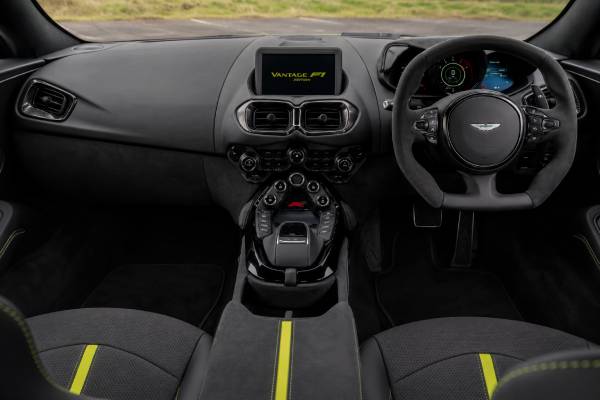
The 2021–2023 Aston Martin Vantage F1 Edition is the road-going result of work originally carried out for the Vantage Formula 1 safety car. Its appeal is not limited to a badge, green paint, or a large rear wing. Aston Martin raised output to 535 PS, sharpened the eight-speed transmission, stiffened key chassis areas, retuned the dampers and rear suspension, fitted model-specific 21-inch Pirelli tires, and added an aerodynamic package that produces substantially more downforce than the regular Vantage. It was offered as both a Coupe and a Roadster.
Official output is 527 bhp, commonly rounded to 528 hp in listings. That modest increase over the standard car tells only part of the story: the F1 Edition’s quicker responses, stronger high-speed body control, and more stable aero balance create the larger difference. For used-car shoppers, authenticity, condition of the aero pieces, tire specification, brake life, and evidence of track use deserve as much attention as mileage.
Table of Contents
- Why Aston Martin created the F1 Edition
- F1 Edition technical data
- The engineering changes that matter
- Coupe or Roadster
- Road and track use
- Service, wear, and preservation
- How to buy a genuine, healthy example
A safety-car project turned into a production model
The F1 Edition exists because Aston Martin needed a Vantage capable of performing official Formula 1 safety-car duties, then chose to transfer much of that development into a customer car. The production version became the most track-focused core Vantage of its period without using semi-slick competition tires or becoming a stripped-out special.
That distinction is important. The name does not mean the road car is identical to the FIA safety car, which carries lights, communications hardware, screens, and role-specific equipment. It means the road model received a related package of powertrain, chassis, steering, wheel, tire, and aerodynamic upgrades developed from the same objective: improve sustained pace, driver confidence, and lap-time capability.
The standard AM6 Vantage was already a front-mid-engine, rear-drive sports car with a rear transaxle and electronic differential. Aston Martin did not replace that architecture. Instead, engineers concentrated on many smaller changes that work together. Power increased by 25 PS, peak torque remained at 685 Nm but stayed available across a broader band, and shift control was revised. Front structural stiffness increased, damper internals changed, the rear spring rate rose, steering feedback was sharpened, and the car moved from 20-inch wheels to specially developed 21-inch Pirelli P Zero tires.
Aerodynamics provide the clearest visual difference. A full-width splitter, dive planes, underfloor turning vanes, and a fixed rear wing create a claimed 200 kg more downforce than the regular Vantage at top speed. This is a difference in aerodynamic load, not a claim that the complete car produces only 200 kg of downforce. The package was designed to add front and rear stability while maintaining balance.
The F1 Edition was a core production offering rather than a strictly numbered final-run model. It nevertheless occupies a distinct point in the AM6 family: more focused than the standard V8, less extreme and rare than the later V12, and closely linked to Aston Martin’s return to Formula 1. That combination gives it collector interest, but condition and originality determine whether an individual car deserves a premium.
Exact specifications for Coupe and Roadster versions
The F1 Edition is a gasoline internal-combustion vehicle built around a 3,982 cc twin-turbo V8. Both body styles use the same power rating, eight-speed rear transaxle, electronic differential, and 21-inch tire package. Their key differences are mass, acceleration, maximum speed, roof construction, and the Coupe-only availability of certain options such as a carbon-fiber roof and carbon-ceramic brakes.
| Specification | F1 Edition value |
|---|---|
| Engine type | All-alloy 4.0-liter twin-turbo V8 |
| Displacement | 3,982 cc |
| Power | 535 PS / 527 bhp (approximately 528 hp) at 6,000 rpm |
| Torque | 685 Nm (505 lb-ft) from 2,000–5,000 rpm |
| Compression ratio | 10.5:1 |
| Charge cooling | Water-to-air |
| Exhaust | Electronically controlled quad-outlet system |
| Measure | Coupe | Roadster |
|---|---|---|
| 0–60 mph | 3.5 seconds | 3.6 seconds |
| 0–100 km/h | 3.6 seconds | 3.7 seconds |
| Maximum speed | 314 km/h (195 mph) | 305 km/h (190 mph) |
| Minimum dry mass | 1,570 kg (3,461 lb) | 1,645 kg (3,627 lb) |
| Weight distribution | 50:50 | 50:50 nominal figure |
| System | Specification |
|---|---|
| Transmission | Rear-mounted ZF eight-speed automatic |
| Final drive | 2.93:1 |
| Differential | Electronically controlled limited-slip differential |
| Driveshaft | Carbon-fiber propeller shaft within an alloy torque tube |
| Steering ratio | 13.09:1 |
| Turns lock-to-lock | 2.4 |
| Damping modes | Sport, Sport Plus, and Track |
| Rear suspension change | Stiffer springs and revised damping calibration |
| Component | Front | Rear |
|---|---|---|
| Wheel diameter | 21 inches | 21 inches |
| Tire | 255/35 ZR21 Pirelli P Zero A6A | 295/30 ZR21 Pirelli P Zero A6A |
| Steel brake disc | 400 mm ventilated two-piece | 360 mm ventilated co-cast |
| Brake control | ABS, EBD, emergency and hydraulic brake assist, dynamic torque vectoring | |
| Carbon-ceramic option | Available on Coupe only when new | |
| Specification | Value |
|---|---|
| Length | 4,490 mm (176.8 in) |
| Width including mirrors | 2,153 mm (84.8 in) |
| Height | 1,274 mm (50.2 in) |
| Wheelbase | 2,704 mm (106.5 in) |
| Fuel tank | 73 liters (19.3 US gal) |
| WLTP combined consumption | 11.6 L/100 km (24.3 imperial mpg), manufacturer estimate |
| WLTP combined CO2 | 264 g/km Coupe; 263 g/km Roadster, manufacturer estimate |
| Area | Typical production specification |
|---|---|
| Aerodynamics | Front splitter, dive planes, unique underfloor elements, fixed rear wing |
| Exterior trim | Dark vaned grille, carbon-fiber upper pack, gloss-black lower body elements |
| Exhaust | Matte-black quad finishers |
| Wheels | 21-inch Satin Black Diamond Turned design as standard |
| Cabin | Sports Plus seats, leather and Alcantara, contrast stripe and stitching |
| Graphics | Matte dark-grey graphic standard, with deletion possible when ordered |
Where the F1 Edition gains its sharper behavior
The power increase is useful, but the F1 Edition’s identity comes from response and control. Aston Martin deliberately avoided relying on track-biased tires to create the improvement, so the engineering package had to make the road car more precise without making it unusable away from a circuit.
The revised engine calibration raises maximum output from 510 PS to 535 PS. Torque remains 685 Nm, yet the plateau extends farther through the rev range. In practical terms, the car pulls more consistently as speed rises rather than delivering a dramatic extra shove only near the limiter. This suits fast road driving and repeated circuit acceleration because the driver spends less time outside the engine’s strongest zone.
Transmission software changes reduce the torque interruption during upshifts. A conventional torque-converter automatic briefly manages engine torque to protect the shift and produce smooth engagement. By optimizing that event, Aston Martin made full-throttle changes feel shorter and more direct. Downshifts under braking were also tuned to improve control when the driver is approaching the tire’s grip limit.
Underbody reinforcement increases front structural stiffness. That gives the steering and suspension a more stable platform, helping inputs translate into wheel movement rather than being absorbed by compliance. Damper internals gained a wider operating range, improving control during rapid compressions and over crests while preserving some low-speed ride quality.
At the rear, a higher spring rate and greater lateral stiffness sharpen initial turn-in and support traction over uneven surfaces. These are not isolated changes. A stiffer rear response would be undesirable if the front end, dampers, steering, tires, and electronic controls were left untouched. The F1 Edition works because Aston Martin tuned the complete balance.
The 21-inch Pirelli package reduces sidewall height compared with the standard 20-inch setup. This can improve immediacy and steering feedback, but it also makes correct pressure, alignment, wheel condition, and tire specification more critical. A replacement tire with the correct nominal size but a different construction can alter the car’s breakaway behavior, noise, and steering feel.
The aero package becomes meaningful at speed. The splitter and dive planes increase front load, while the wing provides rear stability. Underfloor vanes manage airflow rather than serving as visible decoration. A damaged, poorly repaired, or non-original aero component can affect both value and behavior. Replacement fasteners, mounting brackets, and alignment should match factory practice.
Choosing between the Coupe and Roadster
The Coupe is the purer F1 Edition because it is lighter, faster, structurally simpler, and available with the optional carbon-ceramic brakes. The Roadster trades some of that focus for open-air sound and a more theatrical driving experience.
At the official minimum dry-mass figures, the Roadster carries a 75 kg penalty. It is one tenth slower to 60 mph and has a 5 mph lower maximum speed. Those differences are small on public roads, but a regular track driver will notice the Coupe’s lower mass, fixed roof, and greater option potential.
The Coupe also wears a carbon-fiber roof as part of the standard specification listed at launch. That lowers some mass high in the body and visually distinguishes the car. Inspect the roof carefully for impact marks, cloudy lacquer, edge damage, or evidence of refinishing. Carbon components can be repaired, but the quality and documentation of that repair matter.
The Roadster uses a black fabric hood and the fast Z-fold mechanism familiar from the standard convertible. Its fixed rear wing and other aero pieces make it much more assertive than the regular Roadster. Because the car was engineered as a convertible rather than cut down after development, it retains impressive rigidity, yet roof seals, drains, glass indexing, and mechanism operation add inspection points the Coupe does not have.
Cabin space is essentially the same two-seat arrangement in both. The Roadster’s roof storage reduces some flexibility, while the Coupe offers a more useful rear luggage shelf and quieter high-speed travel. Neither is a practical family car. Both work best as sports cars for one or two people using soft luggage.
Market desirability varies. Aston Martin Racing Green with lime accents is the signature specification, but Jet Black, Lunar White, gloss finishes, alternative stitching colors, and graphic-delete cars were legitimate factory choices. A non-green example is not necessarily less authentic. The build record matters more than whether the color matches press photographs.
Getting the best from it without abusing it
The F1 Edition can tolerate occasional circuit use when prepared correctly, but road-car consumables and temperatures still set the limits. A track day should begin with inspection, suitable fluid condition, adequate brake material, healthy tires, and a plan for cooling laps.
On the road, Sport or Sport Plus often provides a better result than selecting the hardest setting everywhere. Track damper calibration is intended for smooth, high-load operation. On broken pavement it can reduce compliance and cause the tires to skip, making the car feel busy rather than fast. Separate powertrain and chassis choices allow the driver to tailor response to the surface.
Before a circuit session, inspect the inside and outside shoulders of all four tires. Confirm cold pressures, then adjust based on hot readings and the tire manufacturer or specialist’s guidance. Do not copy pressure targets from a different vehicle. The F1 Edition’s mass, Pirelli construction, alignment, ambient temperature, session length, and driving style all affect the correct value.
Steel brakes are capable, but repeated high-energy stops can consume pads quickly and create heat cracks or deposits. Carbon-ceramic-equipped Coupes reduce unsprung mass and resist fade, yet replacement discs are expensive and can be damaged by impact or incorrect wheel handling. Measure ceramic disc condition using the approved method; appearance alone is not enough.
Use a warm-up phase for engine oil, transmission fluid, differential, tires, and brakes. After hard laps, reduce pace rather than stopping immediately with maximum brake temperature. Avoid holding the car stationary with the service brake clamped hard after a hot session because pad material can transfer unevenly. Follow the circuit’s safety rules and Aston Martin’s vehicle guidance.
Track use should be disclosed and documented when selling. It is not automatically harmful; a carefully maintained car driven by a competent owner can be healthier than a neglected garage queen. Evidence of repeated overheating, mismatched tires, improvised alignment, removed undertrays, chipped carbon, scorched calipers, or overdue fluid changes is a different matter.
For fast road use, the electronic differential and stability systems offer a safety margin, not immunity from physics. Cold tires and wet roads dramatically reduce available traction. The broad torque band can break rear grip in a higher gear than expected. Leave the stability control active until conditions, tire temperature, and driver familiarity are appropriate.
Maintenance priorities unique to this version
Preserving an F1 Edition requires ordinary Vantage maintenance plus careful attention to its wheels, aero, calibration-dependent systems, and performance consumables. The car’s special status does not eliminate age-related needs.
Follow the VIN-specific Aston Martin schedule and maintain annual records even with low mileage. Engine oil, brake fluid, coolant condition, battery health, diagnostic scans, software status, and leak inspection all matter. A complete dealer or qualified-specialist history also supports value because buyers cannot assess a complex car from odometer mileage alone.
The 21-inch wheels are vulnerable to cosmetic damage and bending. Inspect the inner barrels, not just the visible faces. Vibration at motorway speed can come from a bent wheel, tire flat spot, poor balance, or damaged tire carcass. Repeatedly adding wheel weights without diagnosing the cause is not a repair.
Use the model-specific Pirelli fitment when maintaining original behavior. Check the A6A marking and exact load and speed rating. Tires older than six years deserve especially close examination regardless of tread depth, and hard-driven cars may heat-cycle tires into reduced grip long before the grooves are worn away.
The front splitter and dive planes sit low. Minor underside scuffing is common, but cracks near mounting holes, loose edges, distorted brackets, or poorly blended repairs should be corrected. The rear wing needs secure mounts and correct sealing. Water ingress around modified or previously removed hardware can damage surrounding trim.
A satin-painted car demands different care from gloss paint. Satin finishes should not be machine polished in the conventional way because polishing can create shiny patches. Use compatible cleaners and protectants, remove contamination promptly, and document any repaint. Paint-protection film can help, but installation quality and edge placement are visible on a collector-grade car.
Battery voltage affects roof operation on the Roadster, infotainment, parking systems, control modules, and diagnostic behavior. Cars stored for long periods benefit from an approved maintainer. A battery should be registered or initialized according to the correct service process when required; simply fitting a physically similar unit may not be sufficient.
A maintenance reserve should account for large brake discs, specialized tires, carbon trim, alignment, and potentially expensive electronic or roof diagnostics. Buyers should obtain current parts and labor estimates in their region rather than relying on old forum figures or standard-Vantage assumptions.
Authenticity, condition, and value checks
A strong purchase has three qualities: its F1 Edition identity is documented, its special parts remain correct, and its mechanical condition survives a specialist inspection. A badge, wing, and green wrap are not proof of a factory car.
Request the original build specification and match it to the VIN. Confirm body style, paint finish, graphic choice, wheel type, interior accent, brake system, roof material, audio, and regional equipment. Graphic deletion, alternative colors, and optional trim were legitimate, so authenticity requires records rather than a visual stereotype.
Inspect every aerodynamic component from above and below. Look for consistent carbon weave, correct finish, secure mounting, even gaps, and evidence of impact. Check whether the rear hatch or deck lid opens and supports correctly because the added wing required modified gas struts and bump stops. A heavy wing fitted to a standard hatch without the correct supporting parts can create operational and alignment problems.
Examine tires and brakes as a set. Four cheap replacement tires undermine the engineering purpose of the model and suggest cost-cutting. Uneven shoulder wear can reveal aggressive alignment or worn suspension. Brake discoloration, cracked dust boots, cooked paint, or a large disc lip may indicate repeated hard use.
A cold-start inspection should include idle quality, exhaust smoke, warning-light sequence, fluid odors, and diagnostic codes. During the drive, verify clean shifts at light and heavy throttle, stable braking, centered steering, quiet suspension, and consistent differential behavior. The car should not hop, bind, or produce warning messages in tight low-speed turns.
Check the cabin carefully. Alcantara wear, polished steering-wheel surfaces, crushed seat bolsters, and scratched carbon can conflict with a claimed ultra-low mileage. Test the 360-degree camera, parking assistance, blind-spot system, navigation, Bluetooth, keyless entry, seat adjustment, climate control, and every screen. Replacement of obsolete infotainment components can be disproportionately expensive.
For a Roadster, add a full roof and water-leak test. For a Coupe with carbon-ceramic brakes, obtain a specialist measurement of disc condition. For either body, run a VIN campaign check through Aston Martin and the relevant national recall database.
Do not pay a large premium solely for low mileage. Storage quality, service frequency, battery management, tire age, and exercise history are more informative. A car driven regularly and maintained after track events can be a safer purchase than one parked for years on original fluids and tires.
The F1 Edition is best for an owner who wants the sharpest factory V8 AM6 experience before moving into V12 rarity. Its value proposition rests on the integration of its changes. Buy one because the whole package—transmission response, chassis control, steering, tires, and aero—appeals to you, not because the rear wing photographs well. A documented, original, correctly serviced example has the strongest chance of remaining both rewarding to drive and desirable to the next buyer.
References
- Introducing the Vantage F1® Edition: race-track performance on the road 2021
- Aston Martin Vantage F1® Edition 2021
- F1 DBX707 Medical Car & Vantage Safety Car | Aston Martin USA 2026
- Owner’s Guides | Car Ownership | Aston Martin (UK) | Aston Martin UK 2026 (Owner’s Guide Portal)
- Aston Martin Luxury Car Servicing | Aston Martin (UK) | Aston Martin UK 2026
- Check for Recalls: Vehicle, Car Seat, Tire, Equipment | NHTSA 2026 (Recall Database)
Disclaimer
This article is for informational purposes only and does not replace professional inspection, diagnosis, or repair. Specifications, torque settings, maintenance intervals, approved fluids, software, and procedures can differ by VIN, market, body style, options, and model year. Confirm all details with the official owner’s guide and current Aston Martin workshop documentation.
Please share this article on Facebook, X/Twitter, or a relevant Aston Martin community if you found it useful.