


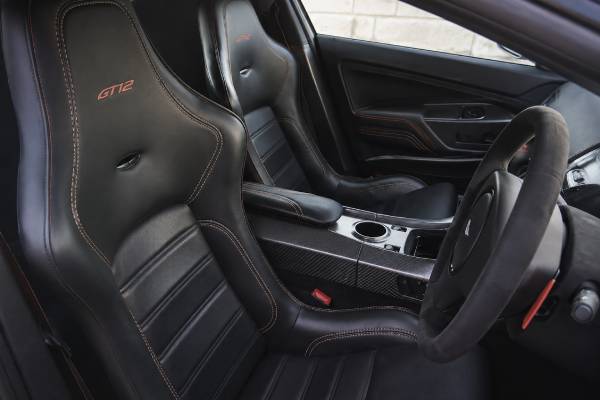
The Aston Martin Vantage GT12 is a 100-car, road-legal interpretation of the company’s GT-racing experience, built around the familiar VH-era coupé but changed in almost every area that matters at speed. Its 5.9-litre naturally aspirated V12 produces 592 bhp, the body is wider, the track is broader, the aero package is functional, and extensive carbon-fibre work cuts roughly 100 kg compared with a regular V12 Vantage S. The headline is not its 0–100 km/h time. It is the way the GT12 combines a large, responsive engine with serious downforce, carbon-ceramic brakes, adjustable damping, and a seven-speed single-clutch transaxle in a shape that still carries the proportions of the original 2005 Vantage. Because every car is rare and highly specified, buying one requires forensic attention to originality, accident history, carbon components, brake condition, software, and documentation. This guide covers the 2015–2016 production coupé, not the one-off GT12 Roadster or track-only derivatives.
Table of Contents
- From GT3 name to GT12 production car
- GT12 numbers and hardware
- Where the weight went
- Aero, grip, and driving behaviour
- Preserving a limited-series car
- Authentication and pre-purchase checks
- Collectability versus usability
From GT3 name to GT12 production car
The GT12 began as the Vantage GT3 special edition, but Aston Martin renamed it before customer production to avoid a naming conflict. The replacement name was more than administrative: “GT12” clearly identified the V12 road car while separating it from homologated GT3 racing machinery.
Aston Martin had already proved that the compact Vantage body could accept a V12. The GT12 brief went much further than the 2009 V12 Vantage or the 2013 V12 Vantage S. Engineers increased power, reduced mass, widened both tracks, changed suspension geometry and spring rates, fitted Michelin Pilot Sport Cup 2 tyres, added carbon-ceramic brakes, and developed a large aerodynamic package. Production was capped at 100 cars, all effectively sold before ordinary road tests could influence demand.
The bodywork is the immediate clue. A deep carbon splitter, dive planes, enlarged grille, vented bonnet, wider front wings, pronounced sills, rear diffuser, and fixed wing create a visual link to endurance racing. These parts are not generic accessories. Their shape, mounting, balance, and interaction with cooling airflow were developed as a package. Removing the rear wing, substituting a replica splitter, or altering ride height can change both authenticity and high-speed behaviour.
The GT12’s 185-mph maximum speed is lower than the V12 Vantage S despite greater power. That is intentional. Added aerodynamic drag is the price of generating meaningful downforce and stability. The gearing, cooling, and seven-speed Sportshift III transaxle also serve acceleration and track use rather than an unrestricted top-speed contest.
For collectors, originality begins at the specification stage. Paint, graphics, exposed carbon, interior materials, lightweight seats, audio equipment, cage or harness options, and bespoke Q by Aston Martin details can differ. A build sheet is therefore essential. Two genuine GT12s may look very different, while a modified ordinary Vantage can imitate the outline from photographs.
GT12 numbers and hardware
The GT12 is a naturally aspirated petrol ICE car using the AM57 development of Aston Martin’s 5,935 cc V12. Power reaches the rear wheels through the seven-speed Sportshift III automated manual transaxle; no conventional torque-converter automatic or dual-clutch gearbox was fitted.
| Specification | Value |
|---|---|
| Engine designation | Aston Martin AM57 |
| Configuration | 60-degree naturally aspirated V12 |
| Displacement | 5,935 cc (5.9 L; marketed as 6.0 L) |
| Valvetrain | DOHC, 48 valves |
| Maximum power | 600 PS / 592 bhp (441 kW) at 7,000 rpm |
| Maximum torque | 625 Nm (461 lb-ft) at 5,500 rpm |
| Induction changes | Magnesium inlet manifolds with revised inlet geometry |
| Exhaust | Titanium system with active bypass control |
| Engine position | Front-mid, behind the front axle line |
| Specification | Value | Condition |
|---|---|---|
| Transmission | Seven-speed Sportshift III automated manual transaxle | Single dry clutch |
| Drive | Rear-wheel drive | Mechanical limited-slip differential |
| 0–100 km/h | 3.5 seconds | Manufacturer claim |
| Maximum speed | 185 mph (297 km/h) | Manufacturer claim; aero-limited context |
| Dry weight | Approximately 1,565 kg (3,450 lb) | Lightweight factory specification |
| Power-to-weight | About 378 bhp per tonne | Using quoted dry weight |
| Specification | Value |
|---|---|
| Structure | Bonded aluminium VH architecture |
| Front suspension | Independent double wishbones with revised geometry |
| Rear suspension | Independent double wishbones with GT12 calibration |
| Damping | Three-stage adaptive dampers: Normal, Sport, Track |
| Steering | Hydraulically assisted rack and pinion |
| Track width | Increased front and rear relative to V12 Vantage S |
| Stability systems | Multi-mode DSC and traction control |
| Specification | Value |
|---|---|
| Front brakes | 398 mm carbon-ceramic discs, six-piston calipers |
| Rear brakes | 360 mm carbon-ceramic discs, four-piston calipers |
| Wheels | 19-inch forged lightweight alloy wheels |
| Front tyres | Michelin Pilot Sport Cup 2, 265/35 ZR19 |
| Rear tyres | Michelin Pilot Sport Cup 2, 325/30 ZR19 |
| Tyre character | Track-capable summer tyre requiring temperature and dry-road care |
| Specification | Value |
|---|---|
| Body style | Three-door, two-seat liftback coupé |
| Length | Approximately 4,510 mm (177.6 in), aero dependent |
| Width | About 1,980 mm (78.0 in) excluding mirrors |
| Height | Approximately 1,250 mm (49.2 in) |
| Wheelbase | 2,600 mm (102.4 in) |
| Production | 100 coupés |
| Related open car | One GT12 Roadster commissioned separately |
Published dimensions can differ according to whether aero projections and mirrors are included. For transport, storage lifts, trailers, or enclosed garages, measure the individual car at its widest and lowest points rather than relying on a base Vantage figure.
Where the weight went
The GT12’s weight reduction was achieved through many linked changes, not by stripping the cabin to bare metal. It remains a road car, but expensive materials replace heavier standard components throughout the body, exhaust, wheels, and interior.
Carbon fibre is used for the bonnet, front wings, door casings, splitter, diffuser, rear wing, and other exterior pieces. The titanium exhaust removes mass from the rear and reduces thermal inertia. Forged wheels cut unsprung and rotating mass. Lightweight seats and simplified trim contribute inside. Depending on options, the audio system, air conditioning, and additional comfort features could remain, so the exact weight of a customer car may differ from the headline minimum.
The carbon bonnet and front wings are particularly valuable. Their weave, finish, attachment points, heat shielding, and panel fit should match factory construction. Repairs are possible, but they require specialist skill and may remain visible under close inspection. A panel that has been replaced should have a documented reason, ideally with photographs and an Aston Martin or recognized composite-repair invoice.
Weight reduction changes response as much as acceleration. Less mass in the wheels and exhaust helps the car change direction and allows the dampers to control movement more precisely. Wider Cup 2 tyres add grip but also steering effort and sensitivity to standing water. The GT12 can therefore feel alive and accurate on warm, dry pavement while becoming nervous on cold, wet roads.
The reduced sound insulation and titanium exhaust increase noise in the cabin. This is expected. Metallic resonance, gear whine, tyre roar, and exhaust boom can be part of the model’s character. New or worsening vibrations, rattles from the wing supports, loose underbody panels, or contact between exhaust and structure are not normal and should be traced.
A roll cage or harness arrangement, where fitted, deserves special attention. Check that it matches the build specification, uses the correct mounting points, and has not been altered for competition. Harnesses have age limits for sanctioned motorsport even when they remain cosmetically clean. For road use, seating and restraint compatibility must comply with local law.
Aero, grip, and driving behaviour
The GT12 feels more like a road-going track car as speed rises. At low speed the large wing and splitter mainly complicate parking; at higher speed the aero package, wider track, firm damping, and tyres create the stability that distinguishes it from a cosmetic special edition.
The V12 remains the emotional centre. Revised inlet manifolds improve breathing, while the titanium exhaust gives the engine a harder edge than the V12 Vantage S. Throttle response is immediate, and the final rush toward 7,000 rpm is the reason to use the gearbox manually rather than let it choose early shifts.
Sportshift III is fast enough under load but never hides its single-clutch design. During an upshift, the clutch opens and torque is interrupted. The cleanest result comes from a brief throttle easing, particularly in ordinary driving. Full-throttle changes in the most aggressive mode are dramatic and can feel like a physical event. Crawling, repeated reversing, and holding the car on the clutch generate heat and wear.
The front tyres provide tremendous bite when warm. The steering carries more texture and effort than a standard V12 S, and the car resists roll. On a smooth road or circuit, that precision is rewarding. On broken surfaces, Track damping can reduce compliance and make the tyres skip, so the stiffest setting is not automatically the fastest or safest.
Carbon-ceramic brakes deliver strong repeated stopping with low unsprung mass. Their initial response changes with temperature, pad condition, and surface cleanliness. A driver moving from steel brakes should build familiarity before relying on them in wet or cold conditions.
Cup 2 tyres are a critical operating limitation. They are designed for high dry grip, not standing water or near-freezing weather. Tread depth, heat cycles, age, storage, and previous track use affect performance. A GT12 on old original tyres may be more collectible in appearance but unsafe to drive hard. Preserve the originals separately if provenance matters and fit a correct fresh set for use.
Aerodynamic parts reduce approach and departure clearance. The front splitter should be treated as a structural-value component, not a consumable lip. Use ramps carefully, avoid automatic car washes, and confirm lift-arm placement before workshop work. A small scrape can propagate into delamination if ignored.
Preserving a limited-series car
Preservation means maintaining function and provenance together. A GT12 that starts, stops, and looks presentable but has missing records, substitute carbon parts, expired tyres, or unresolved module faults is not a properly preserved example.
Powertrain care
Service the V12 by time, not only distance. Use the exact oil grade and procedure specified for the VIN, inspect coolant and oil lines, replace ageing belts and filters, and investigate misfires immediately. A failed coil or plug can overheat a catalyst if driven under load. The titanium exhaust and surrounding heat shields should be checked for cracks, loose fixings, and evidence of impact.
The gearbox needs correct clutch calibration and healthy hydraulic actuation. A specialist diagnostic report should show clutch data, stored faults, and adaptation status. Repeated slow-speed manoeuvring is best minimized. On a slope, use the brake rather than balancing the clutch with throttle.
Carbon-ceramic brakes and wheels
Carbon-ceramic discs are a major part of the car’s value. Inspect for chips around the circumference, scoring, surface changes, contamination, and impact marks. Obtain weights or other approved measurements where the service documentation requires them. Pads must be the correct material and should be changed before they damage the discs.
Forged wheels should be checked for inner-barrel cracks, bends, incorrect refinishing, and damaged fastener seats. Tyre shops must understand the cost of the discs behind them and use protected tools. Wheel-nut torque should be set with calibrated equipment to the official value for the car.
Storage and cosmetic condition
A battery conditioner is essential for infrequently used cars. Low voltage can create faults across the transmission, restraint, damper, and body systems. Store the car dry, ventilated, and away from sunlight that can shrink leather or fade Alcantara. Avoid placing a cover over a dusty car because movement can mark paint and exposed carbon lacquer.
Keep the fuel fresh and bring the car fully to operating temperature when used. Starting it briefly for display does not heat the oil, evaporate moisture, or exercise seals properly. If long-term storage is planned, follow a written preservation routine for tyre pressure, fuel, battery, fluids, and periodic inspection.
Authentication and pre-purchase checks
Authentication is the first buying task because ordinary Vantages can wear GT12-style panels and graphics. The VIN, build sheet, numbered documentation, original sales invoice, factory options, and service history must agree with the physical car.
Begin with provenance. Trace owners, registration markets, export dates, dealer services, auction appearances, and any periods when the car was off the road. Ask for original books, keys, tools, tyre equipment, covers, battery conditioner, plaques, and removed factory parts. Photographs from delivery are useful evidence of original graphics and exposed-carbon configuration.
Then inspect body and aero. View panel weave in bright indirect light. Compare lacquer texture and colour across the bonnet, wings, splitter, sills, diffuser, and wing. Look beneath the car for repaired mounts, ground damage, missing fasteners, and non-factory sealants. Measure alignment at the rear wing supports and inspect the hatch around their load paths.
Check paintwork with methods appropriate to aluminium, composite, and steel; a single magnetic gauge cannot assess every panel. Accident damage is especially important because the wide-body components are scarce. A documented professional repair may be acceptable for a usable car, but it changes value and must be priced honestly.
Commission a full diagnostic scan and clutch report. Road-test the car from cold through full temperature, including all damper modes, stability settings under safe conditions, repeated gear selections, hot restart, low-speed steering, and firm braking. Warning lamps must illuminate during the self-test and then extinguish normally.
Inspect consumables without assuming low mileage protects them. Tyres can age, carbon discs can be chipped, pads can crumble, dampers can leak, batteries can sulfate, and fuel can degrade. Obtain quotations for anything due because GT12-specific components may have long lead times as well as high prices.
Finally, evaluate modifications. A factory-supported or reversible change with retained original parts is different from drilled bodywork, altered software, de-catted exhausts, replica aero, or nonstandard suspension geometry. On a 100-car model, reversibility and documentation carry real financial weight.
Collectability versus usability
The GT12 can be both collectible and usable, but owners must decide which priority leads. A museum-style car should retain original finishes and components; a frequently driven car needs fresh tyres, current fluids, and preventive maintenance even when that means replacing date-coded parts.
Market value is influenced by colour, graphics, exposed carbon, lightweight options, mileage, location, tax status, and provenance. The strongest cars tend to have complete factory documentation, no structural repairs, original numbered components, and maintenance from recognized specialists. Celebrity ownership or unusual Q specifications may add interest, but they do not erase mechanical neglect.
Compared with a V12 Vantage S, the GT12 is louder, firmer, wider, less discreet, and more expensive to repair. Compared with a true racing car, it retains road registration, climate control availability, conventional service access, and luggage capacity. That middle ground is the point: it gives a skilled driver a concentrated track-influenced experience without requiring a trailer for every journey.
The car is not ideal for urban errands. Visibility is limited, the splitter is low, the clutch dislikes creeping, the turning circle is substantial, and Cup 2 tyres demand respect in bad weather. A clear rural route or circuit suits it far better. Transporting it to events may be sensible, but trailer ramps and tie-down points must be chosen carefully to avoid carbon damage.
Road legality deserves the same attention as originality. Retain import approvals, inspection certificates, emissions records, and dated photographs with the permanent history file. The GT12 was homologated with specific exhaust, glazing, lighting, tyre, restraint, and emissions equipment, and a car imported across borders may have been altered to satisfy local registration. Confirm that any change is documented, technically sound, and acceptable to the insurer. A competition-style appearance does not make race-only parts lawful on the road.
Transport planning is another ownership issue unique to the extreme bodywork. Record the minimum ramp angle, identify safe tie-down locations, and brief recovery operators before a failure occurs. The extended splitter, diffuser, side elements, and wide tyres can be damaged by equipment suitable for a normal Vantage. Owners who attend circuits should carry the correct centre-lock or wheel tools, towing information, and contact details for a workshop capable of handling carbon bodywork and ceramic brakes.
Use does not automatically destroy value. Sympathetic miles with documented servicing can demonstrate that systems work and fluids circulate. The greater risk is casual use: cold revving, poor washing, unsecured public parking, incorrect lifting, and unrecorded track days. Each drive should be treated as operation of a rare machine rather than an ordinary used sports car.
The GT12’s lasting significance comes from timing. It arrived near the end of the naturally aspirated VH Vantage era, before turbocharged engines and torque-converter automatics changed Aston Martin’s entry sports car. Its huge wing attracts attention, but the deeper appeal is mechanical: a high-revving V12, hydraulic steering, rear transaxle, carbon brakes, and purposeful weight reduction. An authenticated, correctly maintained example is one of the most distinctive modern Aston Martins; an incomplete or damaged one can be extraordinarily difficult to return to factory standard.
References
- Bonhams announces 18th annual Aston Martin sale 2017 (Manufacturer Heritage Release)
- AMR – taking Aston Martin to new extremes 2017 (Manufacturer Engineering Context)
- Aston Martin Vantage GT12 review – prices, specs and 0-60 time 2015 (Road and Track Review)
- Driven: Aston’s 595bhp, hardcore Vantage GT12 2015 (First Drive)
- Aston Martin Vantage GT12 review 2015 (Road Test)
- Aston Vantage GT3 becomes Vantage GT12 2015 (Model Naming Background)
Disclaimer
This article provides general information, not professional diagnosis, valuation, or repair instruction. Specifications, torque settings, service requirements, software, and approved procedures may differ by VIN, market, production build, and factory options. Verify every safety-critical or value-sensitive decision with official Aston Martin documentation and an experienced GT12 specialist.
Please share the guide on Facebook, X/Twitter, or a suitable collector and motorsport forum when it can help another owner preserve one of these cars correctly.