


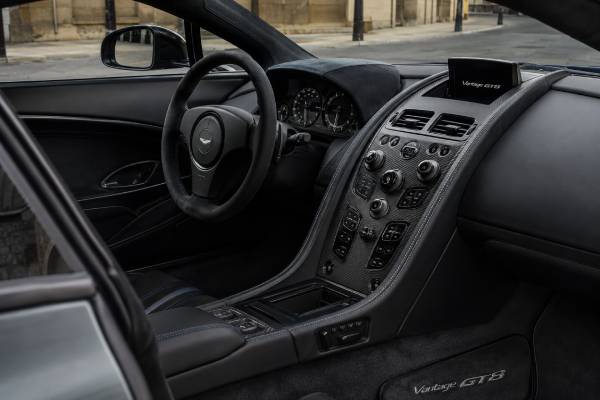
The Aston Martin Vantage GT8 is the final, most concentrated road-going expression of the naturally aspirated V8 Vantage. Limited to 150 cars, it translated the visual language and weight-saving logic of the V8 Vantage GTE racer into a usable coupé with number plates, air conditioning, and—depending on specification—either a six-speed manual or seven-speed Sportshift II transaxle. Power rose only to 440 hp, so the GT8 was never a straight-line numbers exercise. Its value lies in a lighter body, carbon-fibre panels, polycarbonate glazing, a titanium exhaust, revised aerodynamics, Michelin Pilot Sport Cup 2 tyres, and a chassis calibrated to exploit those changes. Optional aero, wheel, roof, and interior packages mean two GT8s can differ materially despite sharing a production number. That variation makes originality and factory documentation essential. Accident repairs, damaged exposed carbon, old track-oriented tyres, brake wear, clutch condition, and missing lightweight parts can transform an apparently attractive car into a costly restoration. This guide explains the GT8’s engineering, specification choices, driving behaviour, preservation needs, and purchase checks.
Table of Contents
- A road car shaped by GTE racing
- GT8 technical specification
- Carbon, aero, and weight reduction
- Manual versus Sportshift character
- Track use without abuse
- Preservation and service planning
- Buying a numbered GT8
A road car shaped by GTE racing
The GT8 was conceived as a V8 counterpart to the V12-powered GT12, but its personality is lighter, more agile, and more analogue. Aston Martin used the mature VH Vantage platform as a base and concentrated on mass, airflow, grip, and sensory involvement rather than adding a large power increase.
The 4.7-litre AM15 V8 gained revised intake and exhaust breathing to produce 440 bhp, 10 bhp more than a Vantage S. That small increment is deliberate context: the titanium exhaust, reduced mass, shorter gearing, and more direct chassis make the engine feel more urgent than the output figure suggests. Peak performance still arrives high in the rev range, so the driver must use the gearbox and allow the naturally aspirated engine to build speed. The reward is linear throttle response and an exhaust note that changes from hard-edged mechanical induction to a race-car-like upper-register howl.
Production was limited to 150 examples worldwide. The numbered series status is part of the car’s identity, but the build number alone does not describe the specification. Buyers could choose a six-speed manual or Sportshift II, several paint and graphic schemes, carbon-fibre options, and different levels of aerodynamic hardware. Some cars wear the large rear wing and extended front aero package; others have a cleaner silhouette. Lightweight magnesium centre-lock wheels were available, while other cars use conventional wheel fastening. Carbon roof, carbon interior details, deleted or retained convenience equipment, and regional requirements further affect mass and appearance.
This breadth of factory choice means the phrase “full GT8 specification” should be treated cautiously. A heavily optioned car is not necessarily more authentic than a restrained one. The correct question is whether the present configuration matches the factory build record. Parts may have been changed after delivery for road use, track use, cosmetic preference, or repair. Original components supplied with the sale can materially improve provenance.
The GT8 also arrived near the end of VH-platform production, when Aston Martin had accumulated more than a decade of Vantage development. Its steering, brakes, transaxle layout, and naturally aspirated V8 preserve the original car’s mechanical character, while the carbon bodywork and Cup 2 tyres reveal how far the platform could be pushed. It is consequently both a driver’s car and a preservation-sensitive limited edition.
GT8 technical specification
GT8 data can vary with market, options, gearbox, and measuring convention. The tables below describe the representative production coupé and identify the systems that should be verified against the individual factory build sheet.
Engine and driveline
| Engine | Front-mid-mounted naturally aspirated 90-degree V8 |
|---|---|
| Displacement | 4,735 cc |
| Maximum power | 440 bhp / 446 PS at approximately 7,300 rpm |
| Maximum torque | Approximately 490 Nm at 5,000 rpm |
| Lubrication | Dry sump |
| Drive | Rear-wheel drive |
| Differential | Mechanical limited-slip differential |
Gearbox and performance
| Manual | Six-speed rear transaxle |
|---|---|
| Automated manual | Seven-speed Sportshift II rear transaxle |
| 0–60 mph | Approximately 4.4 seconds, dependent on specification and test method |
| Maximum speed | Approximately 190 mph |
| Power delivery | Naturally aspirated, with peak output near the upper rev range |
Structure and weight-saving content
| Core structure | Bonded and riveted aluminium VH architecture |
|---|---|
| Exterior panels | Extensive carbon-fibre front and rear body components |
| Glazing | Polycarbonate rear and rear-quarter windows |
| Exhaust | Titanium system |
| Battery | Lightweight lithium-ion type |
| Minimum quoted mass | About 1,510 kg in a light factory configuration |
| Production | 150 cars worldwide |
Suspension, brakes, and tyres
| Front suspension | Independent double wishbones with GT8-specific spring and damper tuning |
|---|---|
| Rear suspension | Independent double wishbones with GT8-specific calibration |
| Steering | Hydraulically assisted rack and pinion |
| Front brakes | Large ventilated steel discs with six-piston calipers |
| Rear brakes | Ventilated steel discs with four-piston calipers |
| Tyre type | Michelin Pilot Sport Cup 2 in factory-approved sizing |
| Wheels | 19-inch designs; optional lightweight centre-lock magnesium wheels |
Body and packaging
| Length | Approximately 4,385 mm before aero-dependent variation |
|---|---|
| Wheelbase | 2,600 mm |
| Seating | Two |
| Luggage area | Rear hatch compartment; capacity affected by equipment |
| Road equipment | Air conditioning and infotainment retained on many cars |
| Aero variation | Standard and optional extended packages alter overhangs and clearance |
Do not use a generic V8 Vantage parts listing for a GT8 without confirmation. Carbon panels, glass, exhaust, suspension, wheel hardware, underbody parts, and aerodynamic components can be unique or specification dependent. The production number and VIN should accompany every parts enquiry.
Carbon, aero, and weight reduction
The GT8’s engineering story is told by what Aston Martin removed or replaced. Carbon-fibre body parts, thin glazing, lighter seats, a lithium-ion battery, and a titanium exhaust reduce mass while the aero package adds stability and visual drama.
Carbon construction changes inspection priorities. A conventional painted panel may reveal repair through filler depth, sanding marks, or corrosion. Carbon can hide impact damage beneath paint or clear coat, and a superficially attractive repair may not restore the original laminate structure. Examine exposed weave for distortion, clouding, cracks, resin whitening, edge damage, and mismatched finish. Inspect mounting points, fastener holes, splitter corners, diffuser fins, wheel-arch outlets, and the underside of low aero elements. A specialist familiar with composite repair should assess any suspicious area.
The optional large rear wing and front corner extensions are functional components as well as collectible features. Their mounts transfer aerodynamic load into the body, so loose hardware, stress marks, or incorrect installation matter. Check that every bracket and spacer matches the build specification. A car converted from subtle road aero to the more dramatic package may use genuine parts yet no longer reflect its delivery configuration. That is not automatically undesirable for driving, but it must be disclosed and documented for valuation.
Polycarbonate rear glazing saves weight but scratches more easily than glass and can haze, craze, or suffer from unsuitable cleaning chemicals. Look through it in oblique light. Fine marks may be expected, while deep scratches, edge cracking, delamination, or distorted visibility can demand expensive replacement. The seals and bonding should be secure, with no evidence of water entry. Never treat the surface with an abrasive glass polish unless the product is specifically approved for the material.
The titanium exhaust reduces mass behind the rear axle and is a defining part of the GT8 experience. Inspect it cold for dents, cracks, loose heat shields, damaged hangers, poor aftermarket welding, and contact with the diffuser. Once warm, listen for leaks and verify valve operation where fitted. Replacement with a non-original system may change noise, legality, thermal behaviour, and value. If the factory exhaust has been removed, its presence as a spare is significant.
Optional magnesium wheels deserve particular care. Magnesium is light but vulnerable to corrosion and demands correct inspection and refinishing techniques. Centre-lock hardware adds procedural requirements: the threads, mating faces, locking direction, torque method, and security marking must be correct. Damage caused by the wrong tools or casual tyre fitting can be costly. Ask who serviced the wheels and whether the owner has the correct equipment and records. Conventional multi-lug wheels are simpler but still need crack, runout, and finish checks.
Weight reduction is easily undone. An aftermarket battery, heavier exhaust, audio additions, replacement seats, incorrect glass, or repaired bodywork can move a car away from its original mass and balance. For a normal used sports car this may be minor; for a 150-car lightweight edition it affects both character and provenance. Inventory the unique parts rather than assuming the GT8 badge guarantees their presence.
Manual versus Sportshift character
The manual and Sportshift II versions are equally legitimate GT8s, but they ask the driver to engage with the powertrain differently. The six-speed emphasises tactile control; the seven-speed emphasises momentum and rapid ratio selection.
With the manual, the driver manages a relatively heavy clutch, a mechanical shift path, and the V8’s need for revs. The long bonnet and rear transaxle make each gear change feel part of the car’s structure. Check for clutch slip under load, judder when hot, noisy release hardware, poor first or reverse selection, and synchroniser resistance. Driveline lash can be audible, but violent clunks or vibration require investigation. A documented twin-plate conversion may improve pedal effort and response, although originality, installation quality, and replacement-part support should be considered.
Sportshift II is a single-clutch automated manual. It can change gear rapidly when the driver keeps the engine loaded and uses the paddles, but it will not imitate a torque-converter automatic at parking speed. Smooth operation requires a brief torque reduction while the clutch disengages and re-engages. Drivers who force it to creep or hold the car on slopes with accelerator input create unnecessary clutch heat. A test should include a cold start, reverse, repeated low-speed manoeuvres, warm traffic, full-load upshifts, and commanded downshifts.
Diagnostic clutch readings are useful but not absolute. Adaptation values, actuator behaviour, driving history, software, and measured wear all need specialist interpretation. Warning messages, unrequested neutral, severe engagement delay, burning odour, or inconsistent shifts are not “all Sportshift cars do that.” A correctly set-up car can be deliberate at low speed but should remain predictable.
The GT8’s short, closely used ratios suit the AM15 engine. Below the upper rev range it is tractable rather than explosive; above it, the combination of induction, titanium exhaust, and reduced insulation becomes the central event. The car rewards a driver who selects the right gear before a corner and carries speed cleanly. It does not rely on a torque surge to repair a poor line.
For collectability, rarity within the 150-car total may influence demand, but condition and factory specification remain more important than slogans about the “right” gearbox. A manual with a damaged carbon package and weak history is not automatically preferable to a pristine, correctly calibrated Sportshift car. Buy the transmission that makes sense for the intended use and verify it more carefully than a conventional test drive allows.
Track use without abuse
The GT8 was designed to tolerate serious driving, but track capability is not the same as immunity from wear. Heat cycles, kerbs, gravel, high brake temperatures, and sustained lateral load leave evidence even when the car remains mechanically sound.
Before track use, establish a baseline. Brake fluid should be fresh and appropriate, pads must have adequate thickness, discs should be measured, tyres must be within date and free from repairs or cracking, and wheel torque procedures must be understood. Inspect all fluid levels, cooling surfaces, hoses, undertrays, tow points, and suspension joints. A road service stamp does not confirm track readiness.
Cup 2 tyres provide high dry grip once warm but are compromised in cold standing water and can age out before their tread disappears. Count heat cycles where records exist, inspect shoulders and inner edges, and look for pickup, graining, flat spots, and small cuts. A car used gently on old Cup 2s may be less safe than one driven hard on fresh, correctly managed tyres. Owners who fit a more road-biased tyre should retain records of the approved sizes and understand that steering response and stability-control behaviour may change.
Brakes reveal driving history. Steel discs are less costly than the GT12’s carbon-ceramic equipment, yet repeated high-temperature use can create surface cracks, deposits, taper wear, cooked dust boots, and discoloured paint. Examine cooling ducts and backing plates. Aftermarket pads may be appropriate for circuit work but noisy, dusty, or unsuitable when cold. Invoices should identify the friction material and installation date.
Look beneath the car for flattened jacking points, diffuser contact, splitter abrasion, gravel damage, leaking dampers, damaged wheel liners, and heat-affected wiring or hoses. Track excursions can mark the inner faces of wheels and suspension components without leaving obvious exterior damage. A geometry printout is valuable because a car can drive acceptably while carrying a bent arm or shifted alignment.
After a circuit session, a careful owner allows temperatures to stabilise, avoids holding hot pads against one disc area, checks pressures, inspects fluids and fasteners, and records any changes. Frequent oil service and regular analysis may be sensible for repeated hard use. There is no reason to reject every tracked GT8; a correctly prepared and documented car may be healthier than a static collector example. The concern is unrecorded use combined with cosmetic preparation for sale.
Ask direct questions: which circuits, how often, which tyres and pads, whether the car was transported or driven, whether it left the track, and what post-event inspection was performed. Honest track records can support confidence. Evasive answers, mismatched dates, fresh underseal, or recently refinished wheels justify deeper examination.
Preservation and service planning
Preserving a GT8 means maintaining its mechanical readiness and its limited-series components. Storage without exercise can degrade it as surely as careless use.
The AM15 engine requires the same fundamentals as other late 4.7 Vantages: correct oil, regular changes, cooling-system health, clean radiators, sound ignition, and attention to leaks. Its dry-sump system should be checked according to the factory procedure because oil level varies with temperature and operating state. Persistent misfire, smoke, abnormal mechanical noise, coolant residue, or low-pressure warnings require diagnosis before further high-rpm driving.
Battery condition is especially important because the lightweight lithium-ion installation may require an appropriate charger and operating procedure. Do not connect an unsuitable maintainer. Verify the fitted battery type, age, health, and factory guidance. Low voltage can trigger multiple module faults and complicate transmission diagnosis. Both keys, alarm, central locking, windows, seats, air conditioning, navigation, and all warning-lamp self-tests should work.
Carbon and polycarbonate surfaces need material-specific cleaning. Use soft tools, approved products, and low pressure near edges and seals. Clear protective film can reduce stone damage but may yellow, lift, trap contamination, or damage aged clear coat during removal. Record when and by whom it was installed. Inspect beneath accessible edges before assuming film guarantees pristine paint.
Drainage and moisture control matter. Check door and hatch seals, scuttle drains, rear compartment, carpets, and module areas. A dehumidified, ventilated garage is preferable to a sealed damp space. The car should be driven long enough to warm the engine, gearbox, exhaust, brakes, and cabin rather than merely started at idle. Fuel should not remain indefinitely without a storage strategy appropriate to local composition.
Service records should identify GT8-specific work. Generic descriptions such as “annual service” or “brakes checked” are inadequate for a valuable limited edition. Useful invoices include diagnostic scans, clutch data, disc measurements, tyre dates, wheel inspections, composite repair reports, alignment values, battery details, and photographs. Retain replaced original parts where practical and safe.
Insurance should reflect agreed value, rare carbon components, limited parts availability, transport requirements, and the intended road or track use. Establish who can recover the car without damaging the splitter or diffuser. A conventional tow truck with steep ramps can create a four-figure problem before a technician sees the original fault.
A sensible annual plan combines routine service with a provenance audit. Confirm that the numbered plaque, books, keys, tools, charger, tyre kit, covers, certificates, and loose original parts remain together. Digital photographs of panel condition and underside provide a reference for future inspections. Preservation is easier when changes are detected early rather than reconstructed years later.
Buying a numbered GT8
A GT8 purchase should be handled like the acquisition of a low-volume performance car, not a more expensive V8 Vantage S. Identity, originality, structural condition, and documentation lead the decision.
First, obtain the VIN, production number, factory build specification, original supplying dealer information, and complete ownership chronology. Confirm paint, graphics, gearbox, wheel type, seats, roof, aero package, trim, and market equipment. Compare period photographs and invoices with the current car. Explain every change rather than assuming an upgrade improves value.
Second, commission a specialist inspection with composite expertise. The car should be viewed on a lift with undertrays removed where reasonable. Examine the aluminium structure, subframes, suspension pickups, wheel wells, floors, brake lines, aero mounts, carbon panels, polycarbonate glazing, exhaust, battery, gearbox, differential, and cooling pack. Scan every accessible module and preserve a copy of the report.
Third, assess consumables at limited-edition prices. Four correct tyres, damaged magnesium wheels, a clutch, unique carbon pieces, a titanium exhaust section, dampers, brakes, or missing aero hardware can materially change the transaction. Obtain parts availability and written estimates before agreeing value. A cheap substitute may restore usability but reduce originality.
Fourth, drive the car from cold to full temperature. It should track straight, steer consistently, brake without vibration, maintain stable temperatures, and deliver clean power to the redline. Listen for body contact, exhaust rattles, wheel-bearing noise, differential complaints, and suspension knocks. Test both gentle road operation and decisive shifts without abusing an unfamiliar car. Reinspect it hot.
Finally, evaluate the seller’s stewardship. A coherent file of invoices, photographs, track records, storage details, and retained parts is more persuasive than low mileage alone. Long static periods can mean old tyres, weak batteries, seized exhaust valves, stale fluids, corroded brakes, leaking seals, and scratched glazing. Conversely, regular careful use with documented maintenance may be ideal.
The GT8’s appeal is unusually specific. It is not the most powerful VH Vantage, nor the fastest Aston of its era. It is a scarce combination of naturally aspirated V8 response, hydraulic steering, manual or single-clutch transaxle involvement, carbon construction, real aero, and road usability. Buy the example whose story can be proven and whose configuration you want to preserve. Correcting a compromised GT8 after purchase is likely to cost more than paying properly for the right one at the start.
References
- Aston Martin Vantage GT8 – Lightest and most extreme V8 Vantage yet (2016)
- Review: the Aston Martin Vantage GT8 (2016)
- Aston Martin Vantage GT8 2016 review (2016)
- Aston Martin V8 Vantage | PH Used Buying Guide (2013)
- Aston Martin Vantage buying guide: rolling chassis (2013)
- What to Buy: Aston Martin V8 Vantage (2006–16) (2021)
Disclaimer
Production specifications, option content, performance, dimensions, service requirements, and parts can vary by VIN, market, transmission, factory configuration, and subsequent modification. This guide provides general educational information only. It does not replace the owner’s handbook, workshop information, factory build record, professional composite assessment, diagnostic testing, or a specialist pre-purchase inspection. Verify all fluids, fasteners, wheel procedures, torque values, tyre approvals, lifting methods, and safety-critical work against official Aston Martin information for the individual car.
Please share this article on Facebook, X/Twitter, or a relevant Aston Martin and track-car community if it helps another owner preserve a Vantage GT8 accurately.