


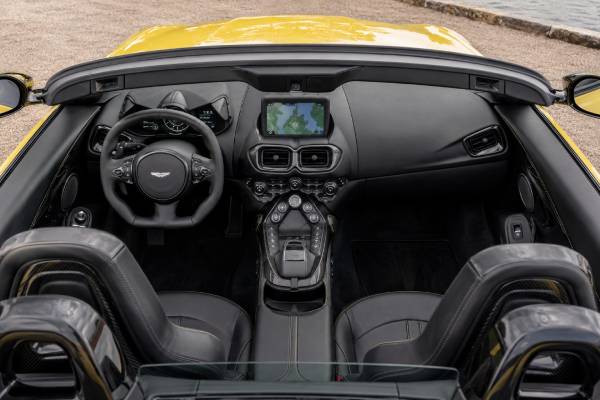
The 2020–2023 Aston Martin Vantage Roadster is the open-air version of the first AM6-generation Vantage, combining a 503 hp twin-turbo V8 with a compact fabric roof and rear-wheel drive. It is not simply a coupe with its roof removed. Aston Martin reinforced and recalibrated the chassis, tuned the rear dampers and stability systems for the convertible body, and developed a Z-fold roof that opens in 6.7 seconds without consuming most of the luggage space. The result is a fast two-seat sports car that can feel relaxed on a long trip and intensely responsive on a winding road.
For a buyer, the main questions are less about headline speed and more about condition, service history, roof operation, tire age, brake wear, and whether software campaigns have been completed. This guide explains the exact 503 hp Roadster, its engineering, real ownership priorities, maintenance needs, and the checks that matter before purchase.
Table of Contents
- Model scope and character
- Roadster specifications and technical data
- Roof and body engineering
- Performance and road manners
- Maintenance and running care
- Problems and inspection points
- Used buying guide
What the 2020–2023 Vantage Roadster is
The 503 hp Roadster is the original convertible version of the AM6 Vantage, sold before the major 2024 redesign. It uses a front-mid-mounted 4.0-liter twin-turbo V8, an eight-speed automatic transaxle at the rear, an electronic limited-slip differential, and an aluminum-intensive two-seat body.
Aston Martin launched the Roadster for 2020 with the same 510 PS output used by the regular automatic Vantage Coupe. In British horsepower that equals 503 bhp, the figure used in this assignment. Peak torque is 685 Nm, or 505 lb-ft. The engine is related to Mercedes-AMG’s M177 family, but Aston Martin specified its own intake, exhaust, cooling, calibration, installation, and vehicle-control strategy.
The Roadster’s personality comes from three ingredients. First, the V8 delivers strong torque from low engine speed, so the car does not need constant high-rpm driving. Second, the rear transaxle helps distribute mass between the axles rather than concentrating the engine and gearbox at the nose. Third, the roof exposes the driver to the exhaust note and surroundings while retaining a properly insulated cabin when closed.
This model should not be confused with later versions. The 2021–2023 F1 Edition has 527 bhp, different suspension tuning, 21-inch wheels, and an extensive aerodynamic package. The 2022–2023 V12 Roadster uses a 5.2-liter engine, carbon-ceramic brakes, wider bodywork, and a radically different price and rarity level. The redesigned 2025-model-year Roadster introduced far more power, a new interior, new electronics, and a revised chassis.
For many owners, the standard 503 hp Roadster is the most usable early AM6 convertible. It is quick enough to feel special, less visually aggressive than the F1 or V12 derivatives, and available in greater numbers. Its age also means depreciation has already created a meaningful gap between original list price and used-market value, although maintenance remains that of an exotic luxury sports car rather than an ordinary used coupe.
Specifications that define the 503 hp Roadster
This is a gasoline-only internal-combustion sports car with no hybrid system. Its V8 sits behind the front axle line, while the eight-speed automatic gearbox and electronic differential are mounted at the rear. The layout supports balanced handling, but it also creates multiple cooling circuits and a more complex driveline than a conventional front-engine car with the transmission directly behind the engine.
| Specification | Value | Notes |
|---|---|---|
| Engine | 3,982 cc twin-turbocharged V8 | All-alloy, 32-valve, quad-cam |
| Power | 503 bhp (375 kW / 510 PS) at 6,000 rpm | Standard 2020–2023 Roadster |
| Torque | 685 Nm (505 lb-ft) from 2,000 rpm | Automatic-transmission specification |
| Compression ratio | 10.5:1 | Direct-injection gasoline engine |
| Engine-speed limits | 7,000 rpm soft cut; 7,200 rpm hard cut | Technical reference values |
| Fuel tank | 73 liters (19.3 US gal) | Premium fuel required by market guidance |
| Specification | Value |
|---|---|
| Transmission | ZF 8HP70 eight-speed automatic transaxle |
| Drive type | Rear-wheel drive |
| Final drive | Electronically controlled limited-slip differential |
| Final-drive ratio | 2.93:1 |
| Propeller shaft | Carbon-fiber shaft inside an aluminum torque tube |
| Gear selection | Shift-by-wire with steering-wheel paddles |
| Specification | Value | Condition |
|---|---|---|
| 0–60 mph | 3.7 seconds | Manufacturer claim |
| 0–100 km/h | 3.8 seconds | Manufacturer technical sheet |
| Maximum speed | 306 km/h (190 mph) | Roof raised |
| Maximum speed | 298 km/h (185 mph) | Roof lowered |
| Roof opening time | 6.7 seconds | Operable up to 50 km/h (31 mph) |
| Roof closing time | 6.8 seconds | Powered Z-fold mechanism |
| Component | Specification |
|---|---|
| Front suspension | Double wishbones, coil springs, adaptive monotube dampers, anti-roll bar |
| Rear suspension | Multi-link layout, coil springs, adaptive monotube dampers, anti-roll bar |
| Front brakes | 400 mm two-piece ventilated steel discs, six-piston calipers |
| Rear brakes | 360 mm ventilated discs, four-piston calipers |
| Standard wheel size | 20 inches |
| Typical summer tires | 255/40 ZR20 front; 295/35 ZR20 rear |
| Steering | Electric assistance, approximately 13:1 ratio |
| Turning circle | 11.8 m (38.7 ft) |
| Specification | Value | Definition |
|---|---|---|
| Body | Two-door convertible, two seats | Bonded aluminum structure |
| Wheelbase | 2,704 mm (106.5 in) | AM6 platform |
| Federal curb weight | 1,750 kg (3,860 lb) | Technical information sheet |
| Rest-of-world kerb weight | 1,745 kg (3,850 lb) | Different weight convention |
| Luggage volume | 200 liters (7.1 cu ft) | Roof design preserves usable boot space |
| Towing | Not approved | Recovery eye only; no trailer equipment |
| Item | Specification | Practical note |
|---|---|---|
| Engine oil grade | SAE 0W-40, API SN or ILSAC GF-5 or better | Use the VIN-specific current approval |
| Oil and filter change quantity | 8.5 liters (9.0 US qt) | Published technical-sheet value |
| Brake fluid | DOT 4 performance fluid | Condition and replacement interval matter |
| Coolant type | Glysantin G40 mixture or current approved equivalent | Separate high- and low-temperature circuits |
| Cold tire pressure | Use door placard values | Wheel, tire, load, and speed dependent |
Why the roof design matters
The Roadster’s compact Z-fold roof is central to the car’s appeal because it minimizes the usual convertible penalties. It opens or closes in less than seven seconds, can operate at city speeds, and folds into a shallow stack behind the seats.
A conventional folding roof can consume much of a car’s luggage compartment or force a tall rear deck. Aston Martin’s arrangement leaves a 200-liter boot and allows the rear bodywork to remain low. That does not turn the Roadster into a practical touring car, but it makes a weekend trip realistic if luggage is packed in soft bags rather than rigid suitcases.
The missing fixed roof still requires structural work. Added shear panels and revised chassis components help the bonded aluminum body cope with torsional loads. The Roadster is approximately 60 kg heavier than the contemporary coupe, and Aston Martin gave it specific rear-damper tuning, adaptive-damping software, stability-control calibration, and chassis-mode settings.
Those changes explain why a healthy Roadster should not feel loose or shaky on normal roads. Minor mirror tremor or body movement over a severe diagonal bump can occur in any open car, but persistent rattles, steering-column movement, water leaks, or obvious scuttle shake deserve investigation. Accident repairs are especially important because the bonded and riveted aluminum structure requires model-specific procedures and equipment.
The fabric roof needs basic care rather than aggressive cleaning. Remove loose dirt with a soft brush or low-pressure rinse, use products intended for automotive convertible material, and avoid directing a pressure washer at seams or seals. Drain channels should remain clear. Rubber seals benefit from inspection for folding, cuts, contamination, and areas where the glass or roof edge no longer compresses evenly.
Before purchase, cycle the roof several times with the engine running. Watch both sides as the frame moves. It should operate symmetrically, latch without repeated attempts, and finish with the expected confirmation. Check the headlining for stains, the parcel area for moisture, and the trunk floor for dampness. A slow roof can reflect low system voltage as well as a mechanical or hydraulic problem, so battery condition should be tested before expensive conclusions are drawn.
How it performs on real roads
The standard Roadster is extremely fast, but its strongest quality is broad, accessible performance rather than a single dramatic peak. Maximum torque arrives from 2,000 rpm, so a modest throttle opening produces immediate acceleration without waiting for the transmission to find a very low gear.
In the calmer drive settings, the eight-speed automatic shifts smoothly and the adaptive dampers give the car useful compliance. Sport+ sharpens the powertrain and chassis, while Track allows more aggressive responses. These modes alter several systems at once, so the hardest setting is not automatically the quickest or most enjoyable on a bumpy public road. A softer damper setting can keep the tires in better contact with uneven pavement and give the driver more confidence.
The rear transaxle and electronic differential contribute to neutral balance. Under power, the differential can progressively lock to improve traction rather than relying only on brake intervention. Dynamic torque vectoring can use individual wheel braking to help the car rotate. The result is a car that turns eagerly but still demands respect: 685 Nm sent only to the rear tires can overwhelm cold, worn, or inappropriate rubber.
The steering is electrically assisted, yet the relatively quick ratio and rigid sports-car structure produce direct responses. Owners moving from a grand tourer may notice road texture and tramlining, especially on heavily crowned pavement or with old tires. A Vantage that pulls, has an off-center wheel, or becomes nervous under braking should receive a four-wheel alignment check, not merely a front toe adjustment.
Roof-down driving changes the sensory balance. The exhaust becomes a major part of the experience, but wind noise rises rapidly above legal motorway speeds. A wind deflector, correct window position, and well-adjusted side glass improve comfort. With the roof raised, the insulated fabric top is suitable for year-round use, although it cannot match a fixed coupe for ultimate quietness.
The steel brakes are powerful and easier to live with than carbon-ceramic systems, but replacement remains costly because the front discs are large two-piece units and the calipers are performance hardware. A light surface film after rain is normal. Heavy scoring, a pronounced outer lip, vibration through the pedal, or steering shake during braking is not. Cars used gently can also develop uneven deposits if the brakes never reach an effective operating temperature.
Maintenance that protects the car
The safest maintenance strategy is time-based, VIN-specific, and supported by a complete digital or paper record. Low annual mileage does not remove the need to replace engine oil, inspect fluids, test the battery, or check rubber components.
Aston Martin service schedules vary by market and model year, so the official owner’s guide and dealer system should control exact intervals. As a practical ownership pattern, plan for an annual inspection even when mileage is low. The visit should include a diagnostic scan, software and campaign check, engine-oil service when due, brake and tire inspection, fluid-level checks, underbody inspection, and confirmation that roof drains and seals are healthy.
The M177-family V8 has several thermal circuits. Correct coolant specification and proper bleeding matter because the engine, charge-air cooling, and driveline systems manage substantial heat. A declining coolant level, sweet smell, dried residue, or repeated temperature warning should not be dismissed. Mixing incompatible coolant types or using stop-leak products can create a much larger repair.
Engine oil should be checked according to the owner’s guide, on level ground and under the specified temperature and timing conditions. Do not assume that a generic dipstick procedure applies. The published oil-and-filter quantity is a service reference, not an instruction to pour the entire amount in without measuring. Overfilling a high-performance turbocharged engine is undesirable, and the final level should be confirmed using the official procedure.
Battery care is unusually important. The Roadster has many control modules, an electric parking brake, powered seats, alarms, keyless systems, and a motorized roof. A weak 12-volt battery can create unrelated warning messages or interrupted roof operation. A compatible maintenance charger is valuable for cars parked for weeks, but it must be connected at the approved points and set for the fitted battery chemistry.
Tires often age out before they wear out. Check the four-digit production date, sidewalls, inner shoulders, and tread across the full width. The rear tires carry high torque and may wear inside where casual inspection cannot see. Replacing only one tire on an axle can upset behavior when the remaining tire is substantially worn or a different specification. The best result comes from matching the Aston Martin-approved type and maintaining similar tread depth across each axle.
Brake fluid absorbs moisture over time, reducing its boiling margin. This matters even for a car driven only on weekends, and it matters more if the car sees mountain roads or track sessions. Ask for evidence of fluid replacement rather than relying on color in the reservoir. Track use also calls for more frequent inspection of pads, discs, tire heat cycles, wheel fasteners, and underbody components.
Common concerns and how to inspect them
No single fault defines every early Vantage Roadster, but several systems deserve focused checks. The goal is not to assume failure; it is to distinguish a well-maintained car from one carrying deferred work.
- Roof operation and water management: Run the roof repeatedly, inspect seals, verify side-glass indexing, and look for damp trim or blocked drains.
- Battery and low-voltage behavior: Multiple intermittent warnings, slow cranking, or modules that behave differently after charging can point to voltage problems. Confirm with a proper battery and charging-system test.
- Infotainment and switchgear: Test navigation, Bluetooth, cameras, parking sensors, audio, steering-wheel controls, seat functions, and every physical switch. Early infotainment technology is functional but dated; faults should not be excused as normal aging.
- Cooling-system evidence: Look around hose joints, reservoirs, radiators, and undertrays for staining or residue. Verify that fans cycle normally and that no temperature message appears in traffic.
- Engine oil leaks or odor: Inspect from above and below with the undertray removed when possible. A clean engine bay immediately after detailing can hide a slow leak.
- Transmission and differential behavior: Shifts should be decisive without harsh engagement, delayed Drive or Reverse selection, or repeated driveline clunks. The electronic differential should not trigger warning messages.
- Suspension and alignment: Listen for knocks at low speed, check tire wear, and confirm that the car tracks straight. Damper leaks and worn joints are expensive enough to justify a specialist inspection.
- Brake condition: Measure remaining pad and disc life rather than accepting a visual guess. Performance brakes may look substantial while still being close to replacement limits.
Recall and service-campaign status must be checked by VIN. Model-year searches are useful, but they cannot prove whether a specific car was included or repaired. Ask an Aston Martin dealer to print the outstanding-campaign record and compare it with invoices. United States buyers should also run the VIN through the NHTSA recall tool.
Cosmetic condition can reveal use patterns. Scraped front splitters and undertrays are common on low sports cars, but damaged mounting points or fresh paint on structural panels deserve closer attention. Inspect wheel rims for cracks or repeated repairs, check the lower edge of the doors, and look at the front radiators through the grille for impact damage and debris.
A pre-purchase inspection should include diagnostic fault history, not just active warning lights. Recently cleared codes may return only after a complete drive cycle. A specialist can also inspect module software levels, roof calibration, battery history, brake measurements, tire dates, fluid leaks, and aluminum body repairs.
How to choose the right used example
Buy the best documented car rather than the cheapest car with the most options. A modestly specified Vantage Roadster with consistent annual servicing, matched tires, clean diagnostics, and an original body is usually a stronger purchase than a highly personalized car needing brakes, tires, roof work, and overdue maintenance.
Start by defining the specification you actually want. The standard 503 hp model was offered with extensive paint, leather, wheel, trim, audio, and comfort choices. Bright colors and unusual interiors can be desirable, but condition and provenance still matter more. Confirm every claimed option from the build sheet because trim pieces and wheels are sometimes changed later.
Then calculate the first-year catch-up budget. Four correct tires, front and rear brake work, annual service, a battery, alignment, and paint protection can turn an apparently inexpensive example into a costly one. Obtain written estimates before negotiating. This approach is more accurate than subtracting an arbitrary amount for “maintenance needed.”
Service history should show dates, mileage, work performed, and the servicing dealer or specialist. Long gaps are concerning even when the odometer barely changed. Cars that sit can develop battery damage, flat-spotted tires, corrosion on brake surfaces, stale fuel, dry seals, and roof creases. Conversely, moderate regular mileage with documented care can be healthier than extremely low mileage with uncertain storage.
During the road test, begin with a cold engine. Confirm that warning lights illuminate and extinguish normally, idle is stable, and no strong fuel, coolant, or oil odor appears. Drive through stop-and-go traffic, rough pavement, motorway speed, and several firm but safe braking events. Use all drive modes, manual shifts, parking sensors, cameras, climate control, and the roof.
After the drive, let the car idle and inspect again. Cooling fans should operate without abnormal noise, no fresh fluid should appear, and the roof should still work at normal system voltage. Recheck the trunk and cabin for moisture. A second diagnostic scan can reveal faults that only set during operation.
The standard Roadster suits a driver who values sound, style, and fast road use more than lap-time status. The F1 Edition is sharper and more visually assertive; the V12 Roadster is rarer and far more expensive; the later redesigned Roadster has a much newer cabin and substantially greater output. The 503 hp car remains compelling because its performance is fully usable, its design has aged well, and the roof adds an experience the coupe cannot reproduce.
The final decision should be conditional on three items: a clean specialist inspection, verified campaign status, and a realistic reserve for maintenance. With those in place, the 2020–2023 Vantage Roadster can be a rewarding modern Aston Martin rather than an attractive car burdened by deferred costs.
References
- VANTAGE ROADSTER: UNCOMPROMISING PERFORMANCE MEETS PURE EMOTION 2020
- Vantage Vehicle Information Sheet 2020 (Technical Information)
- Owner’s Guides | Car Ownership | Aston Martin (UK) | Aston Martin UK 2026 (Owner’s Guide Portal)
- Aston Martin Luxury Car Servicing | Aston Martin (UK) | Aston Martin UK 2026
- Vantage Quick Start Guide | Aston Martin USA 2026 (Quick Start Guide)
- Check for Recalls: Vehicle, Car Seat, Tire, Equipment | NHTSA 2026 (Recall Database)
Disclaimer
This article is for informational purposes and is not a substitute for professional diagnosis, maintenance, or repair. Specifications, torque values, service intervals, fluids, parts, and procedures can vary by VIN, market, model year, and equipment. Verify all work against the vehicle’s official owner’s guide, workshop information, and current Aston Martin service documentation.
Please share this guide on Facebook, X/Twitter, or your preferred enthusiast community if it helped you make a better ownership or buying decision.