
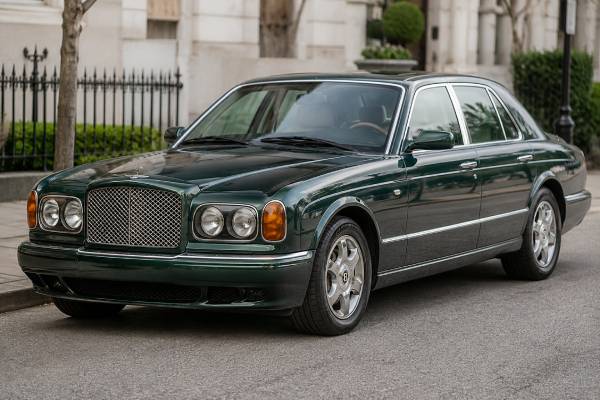
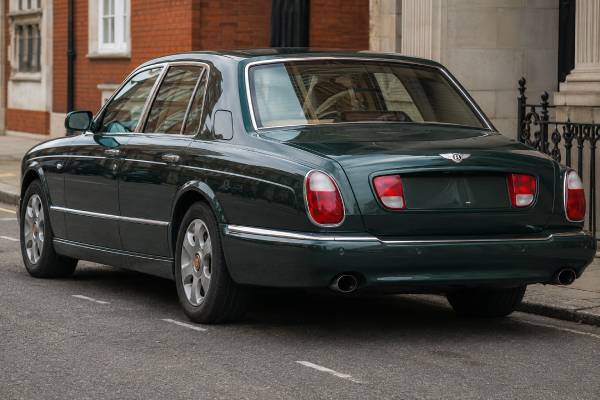
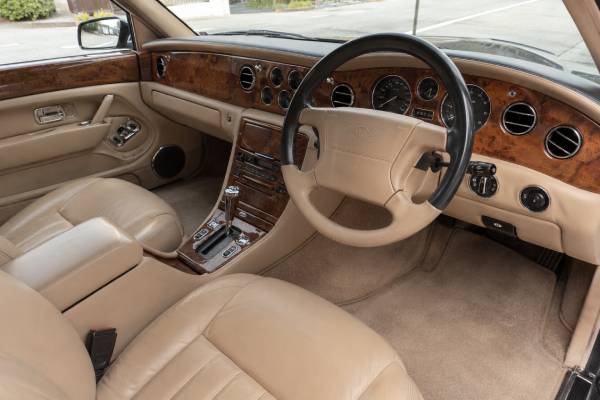
The 1998–1999 Bentley Arnage is the original version of Bentley’s modern flagship saloon, and it is mechanically unlike the 6.75-liter cars that followed. Its defining feature is a 4.4-liter BMW-derived V8 developed for Bentley with twin turbochargers, producing 350 bhp and driving the rear wheels through a five-speed automatic. That combination gives the first Arnage a smoother, more rev-conscious character than the later large-capacity models, while preserving the hand-finished cabin, formal proportions, and long-distance composure expected from Crewe. Today, it is attractive because it is historically important, relatively scarce, and capable of genuine modern-road pace. It is also a complicated, low-volume luxury car whose condition matters far more than odometer mileage. The best examples feel tightly assembled, cool reliably, shift cleanly, and operate every electrical feature without excuses. A cheap car with deferred cooling, suspension, brake, or electrical work can quickly cost more than a carefully maintained one.
Table of Contents
- What Makes the First Arnage Distinct
- How the BMW-Based Twin-Turbo V8 Works
- 1998–1999 Technical Data
- Performance and Road Behavior
- Maintenance Priorities for Long Life
- A Thorough Pre-Purchase Inspection Strategy
- Who This Arnage Suits Best
What Makes the First Arnage Distinct
The first Arnage is best understood as a short-lived engineering bridge: a thoroughly new body and chassis paired with a highly developed German V8, before Bentley returned to its traditional 6.75-liter engine. Cars built for 1998 and 1999 were simply sold as the Bentley Arnage. The “Green Label” name was applied to the BMW-powered version when it remained on sale beside the 6.75-liter Red Label for model year 2000, so calling every early car a Green Label is convenient but not strictly correct.
Bentley introduced the Arnage in 1998 as the replacement for the Brooklands-based saloons. It shared its basic body architecture with the Rolls-Royce Silver Seraph, but the two cars had different powertrains and different personalities. The Rolls-Royce used a naturally aspirated BMW V12. Bentley chose a smaller V8 and added two turbochargers, creating a car that was quicker, more urgent, and more overtly driver-oriented.
This matters when identifying a car. The original 1998–1999 Arnage should have the 4,398 cc V8, a five-speed automatic, 17-inch wheels in standard form, and early styling details. The engine bay is much more densely packaged than that of a later Red Label. Documentation should identify the correct model year and chassis number, and the build record should agree with the car’s color, trim, market, and equipment.
The acquisition of Bentley by Volkswagen during 1998 made this version even more historically significant. The Arnage had been engineered during the previous ownership era, using BMW power at a moment when the future relationship between BMW, Rolls-Royce, Bentley, and Volkswagen was changing rapidly. Volkswagen subsequently invested in returning Bentley’s own large V8 to service. The result is that the first Arnage was produced for only a brief period, with approximately 1,123 examples recorded for 1998–1999.
Rarity alone does not make one valuable, but it changes the buying logic. Originality and evidence of knowledgeable maintenance are especially important. Cosmetic conversion to later badges, wheels, lamps, or trim can blur the car’s identity. A sympathetic owner should preserve the features that make the first-series car unusual rather than trying to make it look like a Red Label or a later Arnage R.
How the BMW-Based Twin-Turbo V8 Works
The 4.4-liter unit gives this Arnage its essential character: it produces less low-speed torque than the later 6.75-liter engine, but it is lighter, more sophisticated in valvetrain design, and happier to build revs. The engine is based on BMW’s M62B44 architecture, with aluminum construction, four overhead camshafts, four valves per cylinder, electronic injection, and chain-driven camshafts.
Bentley’s application was not a simple engine transplant. The installation was developed around the needs of a heavy luxury saloon, and Cosworth was involved in creating the Bentley-specific twin-turbo package. Two turbochargers feed charge-cooled air into the engine, allowing 350 bhp from 4.4 liters while maintaining the subdued operation expected in a Bentley. Maximum torque is available across a useful part of the midrange, so the car does not need to be driven at high rpm to make progress.
The five-speed automatic is an equally important part of the package. It offers closer ratios than the four-speed transmission used with the later 6.75-liter Red Label. In good condition, it selects gears unobtrusively in normal driving and responds promptly when the throttle is opened. Harsh engagement, delayed selection of Drive or Reverse, flare between ratios, or repeated transmission warnings should be treated as faults rather than “old Bentley behavior.”
Thermal management is the system that deserves the most respect. Twin turbochargers, a tightly packed engine bay, a large air-conditioned cabin, and a heavy body place a substantial load on hoses, radiators, fans, pumps, sensors, and electrical connections. A healthy car should hold a stable temperature in traffic with the air conditioning operating. Coolant odor, dried residue, unexplained top-ups, a fan that runs erratically, or a seller who avoids a long idle test all justify further investigation.
The engine also depends on clean oil and correct crankcase ventilation. Long storage periods followed by short runs are not ideal. Oil that never reaches full temperature can accumulate moisture, while aging seals and hoses harden regardless of mileage. A car used regularly and serviced by time can be a safer purchase than a low-mileage example that has sat for years.
Timing-chain guides and tensioning components deserve attention on any aging M62-family engine. They should not be diagnosed casually from internet folklore, but rattling at startup, cam-timing faults, debris in the oil filter, or a vague service history require specialist assessment. Turbocharger condition should be evaluated through boost behavior, smoke, oil consumption, hose integrity, and shaft condition where accessible, not merely by listening for a whistle.
1998–1999 Technical Data
The 1998–1999 Arnage is a conventional petrol-powered, front-engine, rear-wheel-drive saloon. Its technical story is defined by the compact twin-turbo 4.4-liter V8, five-speed automatic, adaptive damping, and a body weighing just over 2.3 tonnes. Period figures vary slightly by market and test method, so the tables distinguish manufacturer-era data from independent measurements.
| Specification | Value |
|---|---|
| Engine family/code | BMW M62B44-based V8, developed for Bentley with Cosworth involvement |
| Layout | Front-mounted, longitudinal 90-degree V8 |
| Displacement | 4,398 cc (4.4 L) |
| Construction | Aluminum block and cylinder heads |
| Valvetrain | DOHC, 32 valves |
| Induction | Two turbochargers with charge-air cooling |
| Fuel system | Electronic multi-point fuel injection |
| Maximum power | 350 bhp (261 kW) at 5,500 rpm |
| Maximum torque | 570 Nm (420 lb-ft), broadly available from about 2,500 rpm |
| Timing drive | Chain-driven camshafts |
| Specification | Value |
|---|---|
| Transmission | Five-speed automatic with adaptive electronic control |
| Drive type | Rear-wheel drive |
| 0–100 km/h | 6.5 seconds, manufacturer-period figure |
| 0–60 mph | 6.4 seconds, independent MotorTrend test |
| Standing quarter mile | 14.7 seconds at 95.9 mph, independent MotorTrend test |
| Top speed | 240 km/h (150 mph) |
| 60–0 mph braking | 132 ft, independent MotorTrend test |
| Specification | Value |
|---|---|
| Body | Four-door luxury saloon; five-seat configuration |
| Length | 5,390 mm (212.2 in) |
| Width without mirrors | About 1,930 mm (76.0 in) |
| Height | 1,515 mm (59.6 in) |
| Wheelbase | 3,116 mm (122.7 in) |
| Kerb weight | 2,302 kg (5,075 lb) |
| Fuel-tank capacity | 100 L (26.4 US gal) |
| Luggage capacity | About 374 L (13.2 cu ft) |
| Specification | Value |
|---|---|
| Front suspension | Independent unequal-length control arms with electronically controlled damping |
| Rear suspension | Independent control-arm layout with self-leveling and electronically controlled damping |
| Steering | Hydraulically assisted rack-and-pinion |
| Front brakes | Ventilated discs with anti-lock braking |
| Rear brakes | Ventilated discs with anti-lock braking |
| Stability systems | Automatic stability control and four-channel ABS |
| Standard wheel size | 7.5J × 17 cast-alloy wheels |
| Typical tire size | 255/55 R17 |
| Turning circle | About 12.6 m (41.4 ft) curb-to-curb |
The numbers explain why the car still feels credible in modern traffic. A 6.4-second independent run to 60 mph was remarkable for a hand-finished saloon of this size in the late 1990s. More important in normal use is the broad midrange: the gearbox can keep the engine in its useful torque band without the abrupt, low-rpm surge associated with the later 6.75-liter cars.
Fuel use depends heavily on traffic, speed, and mechanical condition. Owners should plan around a large appetite for premium unleaded fuel and avoid treating an optimistic period combined figure as a guarantee. A weak oxygen sensor, boost leak, dragging brake, thermostat fault, or repeated short trips can worsen consumption materially. Range is helped by the 100-liter tank, but filling cost is part of the ownership experience.
Performance and Road Behavior
On the road, the first Arnage is fast rather than aggressive. Its strongest qualities are smooth acceleration, stable high-speed travel, accurate steering for its size, and a suspension that isolates rough surfaces without allowing the body to float uncontrolled.
Period testing recorded 0–60 mph in 6.4 seconds and the quarter mile in 14.7 seconds. Those figures are useful evidence of the powertrain’s ability, but they should not encourage repeated launch-style starts in a 25-year-old luxury car. The more revealing test is a rolling acceleration run from moderate speed. A healthy car should build speed evenly, without surging, misfiring, smoking, or hunting between gears.
The electronically controlled dampers were advanced for the period. Sensors monitor vehicle motion and allow the system to firm the damping when needed, while the rear self-leveling function maintains attitude with passengers and luggage. When everything works, the car has an unusual combination of soft initial compliance and disciplined control. When it does not, owners may notice repeated bouncing, a rear that sits unevenly, warning messages, fluid leaks, or an expensive-feeling thump over sharp edges.
Steering effort is light but not empty. The long wheelbase and substantial mass make the car happiest on open roads, yet it can be placed accurately in a lane. The turning circle and width demand planning in older parking structures. Drivers accustomed to modern cameras and proximity graphics should remember that early parking aids, where fitted, are basic by current standards.
Brake performance was strong in period testing, but condition is crucial. A 132-foot stop from 60 mph was respectable for a 5,075-pound car. Today, old tires, corroded discs, tired flexible hoses, sticky calipers, contaminated brake fluid, or incorrect wheel fitment can erase that capability. The pedal should feel consistent, the car should stop straight, and there should be no vibration through the steering wheel.
Tires deserve special emphasis because correct load rating, speed rating, size, and construction influence ride, steering, braking, and damper behavior. A premium tire in the proper 255/55 R17 specification is preferable to a visually impressive but unsuitable large-wheel conversion. Check tire age as well as tread depth; a low-mileage Bentley can easily be wearing old rubber.
Maintenance Priorities for Long Life
Preventive maintenance is cheaper than fault-chasing on this Arnage. The sensible approach is to service by time, inspect the whole car at each visit, and correct small leaks or electrical irregularities before they damage connected systems.
Start with fluids and filters. Engine oil should be changed at a conservative interval using a specification selected by a Bentley specialist for the exact engine, climate, and operating pattern. The transmission, differential, brake, power-steering, and cooling systems should not be assumed “sealed for life.” Their condition and service history should be verified, with fluid type confirmed from the correct workshop information rather than generic BMW or Bentley assumptions.
Cooling-system care is the highest priority. A good baseline service may include pressure testing, checking radiator efficiency, inspecting every accessible hose and clamp, verifying thermostat operation, confirming fan stages, and testing the expansion cap. Replacement decisions should be based on condition and history, but original rubber components on a car of this age deserve skepticism.
The ignition and intake systems also need systematic attention. A small air leak can upset mixture control and create poor idle, fault codes, or extra fuel consumption. Coils, plugs, mass-airflow measurement, oxygen sensors, throttle operation, and boost plumbing should be diagnosed together. Replacing parts at random is expensive and can hide the real cause.
Underneath the car, inspect suspension bushes, ball joints, dampers, self-leveling components, steering hoses, engine mounts, transmission mounts, and exhaust supports. The Arnage is heavy enough to make worn joints noticeable, but its isolation can mask gradual deterioration from an owner. A fresh, properly aligned chassis transforms the car.
Electrical maintenance is partly about keeping voltage stable. A correct, healthy battery and charging system prevent many confusing symptoms. Check for battery drain, poor grounds, corroded connectors, water entry, alarm-system problems, and non-original accessories. Window regulators, seat motors, mirror functions, central locking, audio equipment, climate controls, and instrument displays should all be operated repeatedly.
Body and cabin preservation require more than detailing. Drain paths should be clear, door and trunk seals should keep water out, and the underside should be inspected for corrosion or previous repair. Veneer can crack when exposed to heat and moisture; leather dries where it is not cleaned and conditioned; wool carpet can conceal dampness. Replacement trim is costly, and matching aged wood is difficult.
A practical annual plan is straightforward:
- Perform a full diagnostic scan and road test before routine work.
- Inspect cooling, fuel, oil, and hydraulic systems for leakage.
- Test battery capacity and charging voltage under load.
- Check tire age, pressure, load rating, alignment, and brake condition.
- Exercise every cabin function and record intermittent faults.
- Review service records against time as well as mileage.
A Thorough Pre-Purchase Inspection Strategy
Buy the history and condition, not the lowest advertised price. A proper inspection should be carried out by a workshop familiar with early Arnage electronics and the BMW-based twin-turbo installation, because a general prestige-car check can miss model-specific risks.
Begin with identity. Confirm the VIN on the body, labels, registration, and service documents. Verify that the car is a 1998 or 1999 original Arnage rather than a later Green Label or a car reconstructed with mixed parts. Ask for the original build specification or obtain it through a knowledgeable Bentley source. Check that paint, hide, veneer, wheels, and major options are plausible for the chassis.
Review the service file chronologically. Invoices are more useful than stamps because they show what was actually done. Look for repeated cooling repairs, unresolved warning lights, battery replacements without diagnosis, recurring suspension faults, and long gaps. A recent large invoice is not automatically reassuring if it followed years of neglect.
Inspect from a cold start. The engine should crank briskly, settle promptly, and avoid persistent chain noise, smoke, fuel smell, or uneven idle. Do not let the seller pre-warm the car. Watch the temperature through a full test drive, then leave it idling with climate control operating. Recheck for coolant or oil leaks afterward.
During the drive, test light and full throttle progressively after the engine is warm. The transmission should engage promptly, shift cleanly, and respond consistently. The car should track straight, absorb a series of bumps without repeated oscillation, and stop without pull or vibration. Listen for driveline clunks when moving between acceleration and overrun.
Operate everything. That includes all windows from every switch, both front and rear seat adjustments, heating elements, mirrors, locks, alarm, wipers, washers, lights, audio sources, climate zones, rear controls, trunk release, and fuel flap. An intermittent component is still a fault.
A lift inspection should cover corrosion, fluid leaks, brake pipes, suspension joints, subframes, accident repair, exhaust condition, jacking damage, and tire date codes. Diagnostic scanning should include stored as well as current faults. Compression, leak-down, oil-pressure, cooling-pressure, or boost tests may be justified if symptoms or history raise questions.
Finally, prepare a first-year budget before buying. Include immediate servicing, age-expired tires, battery, alignment, air-conditioning work, cosmetic preservation, and a contingency for an unexpected electrical or cooling repair. The purchase should still make sense after that number is added.
Who This Arnage Suits Best
The original Arnage suits an owner who values engineering history and understated speed more than simple running costs or the strongest resale market. It is not the right car for someone seeking a cheap way to display a Bentley badge.
Compared with a Red Label, the 4.4-liter car feels more European and less old-school. The engine revs more freely, the five-speed transmission has a broader spread of ratios, and the lower engine mass contributes to a slightly lighter character. The 6.75-liter car answers with stronger low-speed thrust, a more traditional Bentley identity, and generally greater recognition among casual collectors. Neither choice is automatically superior; they are different.
The first Arnage also rewards originality. Its 17-inch wheels, early instruments, trim details, and BMW-era powertrain tell a specific story. Modifications that promise easier parts sourcing or more dramatic appearance can reduce that coherence. Sensible upgrades are usually invisible: improved maintenance, fresh tires, updated replacement hoses, careful electrical repairs, and preservation of factory components.
A good example can cover long distances with ease, carry four or five adults in genuine comfort, and deliver performance that remains impressive. It also needs secure storage, access to expertise, and an owner willing to investigate small symptoms. Used regularly and maintained methodically, it can be more dependable than its reputation suggests. Neglected, it becomes a collection of interconnected systems waiting to fail.
The decisive buying question is not whether the first Arnage is “reliable” in the abstract. It is whether a particular car has been kept cool, dry, charged, exercised, and serviced by people who understood it. When the evidence says yes, the 1998–1999 Arnage is one of the most interesting and least conventional modern Bentleys.
References
- 1998-2009 2022 (Bentley Heritage Technical Library)
- 2000 Bentley Arnage – Motor Trend 1999 (Instrumented Road Test)
- Bentley Arnage 2026 (Model History and Production Data)
- Used car buying guide: Bentley Arnage | Autocar 2018 (Buying Guide)
- Search Safety Issues | NHTSA 2026 (Recall Database)
- Bentley Arnage specs (1998-2001), performance, dimensions & technical specifications – encyCARpedia 2023 (Technical Data)
Disclaimer
This article is for informational purposes only and is not a substitute for professional diagnosis, repair, or vehicle inspection. Specifications, torque values, service intervals, fluids, and procedures can vary by VIN, market, production date, and equipment; verify all work against the official Bentley service documentation for the exact car.
Please share this guide on Facebook, X/Twitter, or another community you use if it helped you understand the first Bentley Arnage.