
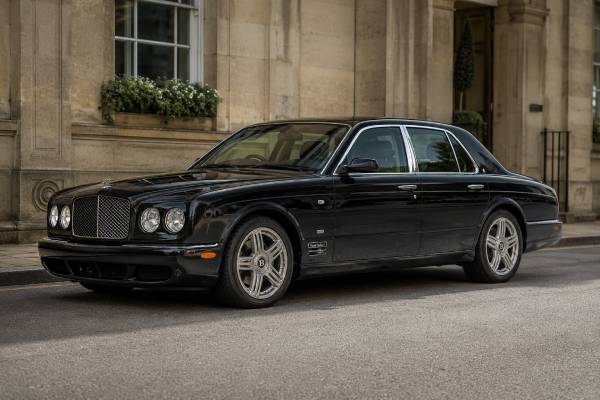
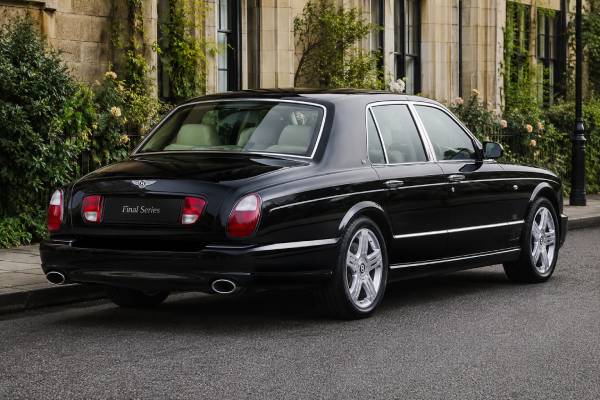
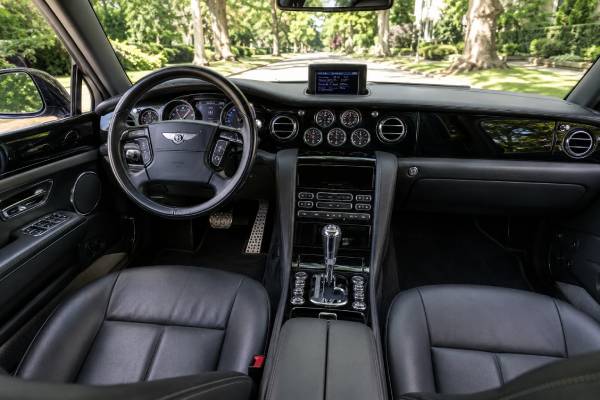
The 2009 Bentley Arnage Final Series is the 150-car farewell to the Arnage and one of the clearest expressions of Bentley’s transition between eras. It combines the 500 hp, 1,000 Nm drivetrain of the Arnage T with the more refined character associated with the Arnage R, then adds edition-specific exterior and cabin details influenced by the Brooklands coupe. Bentley created it to mark 10 years of Arnage production, 50 years of the company’s 6.75-liter V8, and 90 years of the marque. Its value therefore depends on more than condition alone. A genuine car should retain its identifying trim, correct 20-inch wheels, dark grilles, Final Series badges, special treadplates, inset waist-rail details, cocktail cabinet, picnic tables, and documented build history. Mechanical standards must be equally high: the Final Series is still a 179 mph, 2.6-tonne flagship with complex hydraulics, electronics, cooling, and bespoke trim. This guide explains how to identify, understand, maintain, inspect, and value the final factory Arnage sedan.
Table of Contents
- Why Bentley Built the Final Series
- Final Series Technical Data
- Authenticating the Edition-Specific Details
- How T Performance and R Refinement Were Combined
- Preservation and Mechanical Service
- Collector-Grade Inspection and Documentation
- Buying, Using, and Storing a Final Series
Why Bentley Built the Final Series
Bentley built the Final Series to close the Arnage line with one definitive specification rather than allow the model to fade out as an ordinary final-year car. Limited to 150 examples, it celebrated the sedan’s decade in production and the 50th anniversary of the V8 design lineage that began with the Bentley S2 in 1959.
Bentley described the Final Series as combining the performance of the Arnage T with the refinement of the Arnage R. That distinction separates it from a simple badge-and-trim package. The car uses the 500 bhp, 1,000 Nm version of the twin-turbo V8 and the six-speed ZF automatic, giving it the same 179 mph maximum speed as the late T. Its presentation, cabin equipment, and ride intent were chosen to make it an ultimate grand touring sedan rather than only the hardest-edged Arnage.
Brooklands coupe influences supplied several visual cues. The Final Series received 20-inch five-spoke two-piece wheels and lower front-wing vents, accompanied by dark-tinted upper and lower grilles, a retractable Flying B, body-color lamp bezels, a billet-aluminum “jewel” fuel filler cap, and Final Series badging. Inside, Bentley used specific treadplates, drilled alloy pedals carrying the Bentley B, waist rails with inset chrome strips and recessed badges, a rear cocktail cabinet, veneered picnic tables, and four umbrellas mounted beneath the boot lid.
Final Series Technical Data
The Final Series is a gasoline-powered, rear-wheel-drive four-door sedan using Bentley’s 6,761 cc L410TT twin-turbo V8. Its mechanical specification is closely related to the 500 hp Arnage T, while its standard equipment and edition details create the distinctive final-year package.
| Engine | 6,761 cc aluminum V8, central camshaft, pushrod valvegear |
|---|---|
| Engine family | Bentley L410TT |
| Induction | Two Mitsubishi TD04 low-inertia turbochargers with intercooling |
| Engine management | Bosch Motronic ME7.1 |
| Maximum power | 500 bhp (373 kW) at approximately 4,200 rpm |
| Maximum torque | 1,000 Nm (738 lb-ft) at 3,200 rpm |
| Transmission | ZF 6HP-26 six-speed automatic with sport and manual functions |
| Drive layout | Front-engine, rear-wheel drive |
| 0–60 mph | 5.2 seconds |
|---|---|
| 0–100 km/h | 5.5 seconds |
| 0–100 mph | 12.1 seconds |
| Maximum speed | 179 mph (288 km/h) |
| Fuel | Premium unleaded gasoline |
| Fuel tank | 96 liters (25.3 US gallons) |
| Combined consumption | 14.5 mpg imperial (19.5 L/100 km) on the period EU cycle |
| Combined CO2 | 465 g/km on the period EU cycle |
| Body | Four-door, five-seat luxury sedan |
|---|---|
| Overall length | 5,400 mm (212.6 in) |
| Wheelbase | 3,116 mm (122.7 in) |
| Width across mirrors | 2,125 mm (83.7 in) |
| Height | 1,515 mm (59.6 in) |
| Track | Approximately 1,602 mm front and rear |
| Kerb weight | 2,585 kg (5,699 lb) |
| Gross vehicle weight | 3,065 kg (6,757 lb) |
| Boot capacity | 374 liters (13.2 cu ft) |
| Structure | Steel monocoque with front and rear subframes |
|---|---|
| Suspension | Independent double wishbones, coil springs, anti-roll bars |
| Damping | Adaptive electro-hydraulic dampers |
| Level control | Automatic self-leveling with load compensation |
| Steering | Speed-sensitive power-assisted rack and pinion |
| Standard brakes | Ventilated iron discs with ABS and electronic brake assistance |
| Optional brakes | Carbon-silicon-carbide cross-drilled discs were factory available |
| Driver aids | Electronic Stability Program, traction control, tire-pressure monitoring |
| Wheels | 20-inch five-spoke two-piece alloy wheels derived from the Brooklands |
|---|---|
| Front treatment | Dark upper and lower matrix grilles, retractable Flying B, lower wing vents |
| Exterior details | Body-color lamp bezels, jewel fuel cap, Final Series badges |
| Interior details | Final Series treadplates, drilled alloy pedals, inset waist-rail chrome |
| Rear compartment | Veneered picnic tables and central cocktail cabinet |
| Boot equipment | Four Bentley umbrellas housed under the boot lid |
| Production | 150 cars worldwide |
These are factory model values. Individual build options, market equipment, and later replacements can change weight, tire specification, brakes, and trim. The car’s build sheet and service documentation take priority for component-level decisions.
Authenticating the Edition-Specific Details
A Final Series should be authenticated through documents and parts together. No single badge, wheel, or grille proves identity because visible components can be added to another Arnage, removed during repair, or replaced incorrectly.
Start with the full VIN and obtain a factory or recognized heritage build record. It should identify the model, production date, original colors, veneer, trim, market, standard equipment, and Mulliner options. Match that information against the car. Confirm that the VIN appears consistently on legal documents, body locations, labels, service invoices, and diagnostic records. Investigate discrepancies before discussing price.
Exterior identifiers
The front view should include dark-tinted matrix grilles above and below the bumper and the retractable Flying B mascot. The lower front wings carry the Le Mans-style vents associated with the Brooklands. Lamp bezels are body colored rather than bright chrome, and the fuel filler is the machined jewel design. Final Series badges should be correctly positioned and finished.
The 20-inch five-spoke wheels are especially important. Inspect casting and part markings, two-piece construction, finish, hardware, center caps, and matching dimensions. Confirm that all four wheels are correct rather than a visually similar aftermarket set. Look for cracks, bends, corrosion beneath the finish, damaged bolt seats, and poor refinishing. The spare or inflation equipment should match the build specification.
Body repairs can erase edition details. A collision may lead to a standard bumper, grille, lamp surround, or wing being fitted because the correct component was unavailable. Compare both sides, check panel gaps, examine fasteners and paint depth, and review repair invoices. A professionally repaired car may remain desirable, but accuracy and disclosure affect value.
Interior identifiers
Open the front doors and inspect the Final Series treadplates. The drilled alloy brake and accelerator pedals should carry the Bentley B motif. Waist-rail veneer includes an inset chrome strip with recessed Bentley badges, a feature that should appear integrated rather than glued on later. Check the rear picnic tables and cocktail cabinet for correct veneer, hinges, latches, lining, and fit.
The four boot-lid umbrellas are frequently overlooked. Verify the holders, straps or clips, umbrellas, handles, and condition of the boot-lid trim. Missing pieces may seem minor but can be hard to replace with authentic items. The same principle applies to keys, books, tool kit, battery cover, warning triangle or market equipment, navigation media, and remote controls.
How T Performance and R Refinement Were Combined
The Final Series uses the late Arnage T’s 500 hp drivetrain but is intended to deliver that performance with a more rounded grand-touring character. The combination gives the car enormous pace without making every journey feel like a demonstration of its power.
The 6.75-liter V8 produces its torque at modest engine speed. Two low-inertia turbochargers reduce response delay, while roller tappets and revised valve timing improve efficiency and refinement. More than outright acceleration, the defining sensation is reserve: the car can increase speed strongly without an obvious rise in engine effort.
The six-speed ZF automatic supports that character. In Drive, it uses the torque and shifts early enough to keep the cabin calm. Sport mode holds gears and responds more quickly. Manual selection can help on descents or a flowing road, but the transmission remains protective and electronically coordinated with the engine and stability system. Healthy operation should be smooth at light throttle and decisive under load, with no flare, shudder, delay, or warning message.
At 2,585 kg, the Final Series controls movement rather than disguising mass. Adaptive electro-hydraulic dampers and self-leveling suspension manage pitch and load, while double-wishbone geometry helps maintain tire contact. The car should absorb small irregularities, settle after long undulations, and stay composed during a quick lane change. A brittle ride, repeated bounce, uneven stance, or steering correction points to tires, alignment, suspension wear, hydraulic condition, or incorrect components.
The 20-inch wheels sharpen appearance and response but reduce sidewall depth compared with smaller Arnage wheels. That makes tire quality and wheel condition especially important. Use four matching premium tires with the exact load and speed ratings specified for the car. Check date codes and inner shoulders. Old tires can look unworn yet provide poor wet grip and a harsh ride.
Standard iron brakes are powerful when maintained. Factory carbon-silicon-carbide discs were optional and require separate evaluation. Carbon-ceramic hardware can reduce unsprung mass and resist fade, but replacement cost, surface damage, correct pads, and specialist measurement matter. Determine which system the car has from the build record and physical inspection; do not rely on caliper color or seller description.
The published 179 mph maximum demonstrates the drivetrain’s capability, not a recommended test for an unknown used car. At any speed, the driver must account for tire age, brake condition, fluid temperatures, road surface, and the car’s size. Smooth steering, throttle, and braking inputs produce the best behavior. Stability control is a valuable safeguard but cannot create grip where tires do not have it.
Rear passengers still receive the qualities expected of an Arnage: deep seating, substantial sound isolation, generous materials, picnic tables, and a central cabinet. This dual role is the essence of the Final Series. It can cross a country rapidly with the driver engaged, then arrive with the formality and cabin comfort of a traditional Bentley flagship.
Preservation and Mechanical Service
Preserve a Final Series by servicing it as a high-performance machine and caring for it as a limited-production object. Mechanical neglect can destroy usability; careless cosmetic repair can erase the details that make the car collectible.
Engine cooling and heat control
The engine bay packages a large twin-turbo V8, catalytic converters, cooling circuits, hydraulic equipment, and extensive wiring. Heat ages hoses, connectors, seals, insulation, and plastic tanks even when mileage is low. Inspect the system cold, then verify it fully hot in traffic with the air conditioning running.
Look for coolant residue at the expansion tank, radiator seams, hose joints, turbo lines, and charge-cooling components. Confirm fan operation and stable temperature. Repeated coolant top-ups, a sweet smell, damp undertrays, or dried staining requires pressure testing. Avoid sealant products that can mask leaks and contaminate small passages.
Engine oil should be changed by time and use with the correct approved specification. Examine turbo oil feeds and drains, rocker areas, front covers, filter housing, sump, and crankcase ventilation. Blue smoke after idle, smoke under boost, or unusual turbo noise needs diagnosis. After demanding driving, finish with a period of low load rather than shutting down immediately at peak temperature.
Transmission and driveline
The ZF six-speed works under extreme torque. Review invoices for fluid and filter service, software or adaptation work, leaks, and previous repairs. During a test, check engagement from cold and hot, gentle shifts, kickdown, steady-speed converter lockup, and manual selection. Shudder or harshness may involve fluid, solenoids, valve body, converter, mounts, wiring, or internal wear.
Suspension, hydraulics, and brakes
Record ride height and inspect both sides under comparable load. Check dampers, accumulators, hydraulic lines, springs, bushes, joints, steering components, and subframe mounts. A self-leveling pump that runs excessively may be compensating for pressure loss or leakage. Uneven tire wear can expose geometry problems before a warning appears.
Measure brake discs and pads. On iron systems, inspect for corrosion, cracking, scoring, deposits, and thickness variation. On carbon-silicon-carbide systems, use the factory inspection method and a specialist familiar with condition limits. Check fluid age, hoses, calipers, sensors, and parking-brake operation. The entire system must be judged together.
Electrical systems and storage
A Final Series can develop numerous misleading faults when battery voltage is low. Confirm the correct battery type, age, charge state, alternator output, grounds, and parasitic draw. A compatible maintainer is sensible during storage, but the car should also be driven regularly enough to exercise modules, relays, pumps, climate equipment, and moving mechanisms.
Scan all available control units before clearing codes. Record undervoltage, communication, engine, transmission, suspension, stability, climate, seat, parking, and security faults. Water intrusion in the boot, footwells, doors, sunroof drains, or around glass can damage hidden modules and connectors.
Operate every item: retractable mascot, seats and memories, heaters, windows, locks, mirrors, climate control, navigation, audio, telephone hardware, parking sensors, camera, picnic tables, cocktail cabinet fittings, boot-lid umbrellas, and any Mulliner feature. An edition detail that exists but does not work still requires a plan.
Paint, leather, veneer, and plated details
Use preservation-minded cleaning. Aggressive paint correction can thin edges, polish through hand-applied finishes, or alter satin and dark-tinted trim. Confirm the correct treatment before refinishing grilles, wheels, badges, treadplates, or the jewel fuel cap. Store removed original parts even when a reversible replacement is fitted.
Leather should be cleaned gently and kept supple without heavy silicone coatings. Check piping, bolsters, diamond quilting, steering wheel, rear armrest, and table edges. Veneer lacquer can crack or cloud from heat and moisture. Repair should preserve the original veneer whenever possible and match color, grain, and gloss across adjacent pieces.
Corrosion remains possible despite treated steel. Inspect wheel arches, sill seams, jacking points, door bottoms, boot edges, subframes, and suspension mounts. Keep drains clear and avoid trapping moisture beneath covers. A breathable indoor environment is better than sealing a damp car under an impermeable sheet.
Collector-Grade Inspection and Documentation
A collector-grade inspection must answer three separate questions: Is the car genuinely a Final Series, is it mechanically safe and healthy, and are its rare parts complete enough to preserve its value? A standard pre-purchase report may cover only the second question.
Before the visit, request the VIN, build sheet, service invoices, ownership history, recall and campaign record, photographs of identifying details, wheel markings, tool kit, books, keys, umbrellas, and any removed original parts. Compare dates and mileage across records. Long gaps are not automatic rejection, but they require evidence of storage conditions and recommissioning.
Inspect the car cold and in good light. Check paint consistency, panel gaps, glass dates, wheel finish, grille color, badges, lamp bezels, wing vents, mascot operation, fuel cap, and underbody. Look for accident repairs that substituted standard Arnage components. Photograph part numbers and unusual fittings.
Inside, compare hide, veneer, stitching, treadplates, pedals, waist rails, tables, cabinet, controls, and boot equipment with the build record. Test each function fully. Modernized infotainment should be evaluated for workmanship, reversibility, electrical integration, and retention of original hardware.
The mechanical test should be deliberate:
- Observe warning lamps and the cold start without prior engine warming.
- Confirm clean idle, stable voltage, correct fluid pressure behavior, and no persistent smoke.
- Load the climate and electrical systems while stationary.
- Drive gently until the engine and gearbox reach operating temperature.
- Assess ride and noise over rough roads, then steering and vibration at steady speed.
- Use moderate boost and firm braking only after tires and brakes are judged safe.
- Check low-speed maneuvering, full steering lock, parking aids, and reverse camera.
- Let the hot car idle, inspect underneath, and perform a hot restart.
A diagnostic report should be saved rather than summarized verbally. On a lift, remove undertrays where appropriate and inspect coolant and oil lines, turbo plumbing, hydraulic pipes, suspension, steering, brake hardware, exhaust, differential, floor, jacking points, and structural repair. Determine whether the brakes are iron or carbon-silicon-carbide and apply the correct evaluation method.
Ask the specialist to divide findings into safety-critical work, reliability work due now, maintenance due by time, edition-detail restoration, and optional cosmetic improvements. Obtain parts availability and labor estimates. A missing badge and a minor coolant seep may sound small, but the badge could be unavailable and the seep could require extensive dismantling.
Documentation should remain with the car. Keep digital scans of the build record, invoices, diagnostic reports, paintwork photos, wheel repairs, trim restoration, tire purchases, and any modifications. When original components are removed, label and store them. That file allows a future buyer to distinguish careful stewardship from cosmetic presentation.
Buying, Using, and Storing a Final Series
The best Final Series is not necessarily the lowest-mileage example; it is the most complete, authentic, mechanically proven car at a price that leaves room for proper stewardship. A highly original car that has been exercised and maintained can be safer and more valuable than a static display piece needing full recommissioning.
Decide first how the car will be used. A collector seeking concours originality should prioritize factory paint, trim, edition components, documentation, and sympathetic restoration. An owner planning European tours or regular events should place equal weight on cooling, tires, brakes, climate control, charging, and parts support. Neither goal justifies ignoring the other: an authentic car that cannot complete a journey and a reliable car stripped of its defining parts are both compromised.
Compare candidates by total requirement, not asking price. Build a worksheet covering immediate service, tires, brakes, cooling, hydraulics, suspension, batteries, air conditioning, wheel restoration, paint correction, leather and veneer, missing Final Series parts, transport, taxes, storage, and insurance. Confirm which tasks can be completed with available parts before purchase.
The Final Series differs from the late Arnage T mainly in edition specification and its intended blend of refinement. Buyers interested only in performance may find a well-kept 2007–2009 T at a lower price. An Arnage R offers 450 hp and a softer character without limited-edition exposure. The Final Series earns its premium when the buyer values the 150-car production story, farewell equipment, Brooklands cues, and completeness.
Storage should be clean, dry, secure, ventilated, and large enough to open the long doors without risk. Maintain stable tire pressure and use protective pads for extended parking where appropriate. Connect a compatible battery maintainer according to safe procedures. Keep fuel fresh, manage humidity, protect against rodents, and avoid placing plastic directly against damp bodywork.
Exercise the car on meaningful journeys. Bring engine oil, coolant, transmission, brakes, and tires to operating temperature. Use the climate system, windows, seats, mascot, locks, and other mechanisms. Avoid repeated short starts, which add moisture without fully charging the battery or warming fluids. Record observations after each drive so small changes in temperature, noise, ride height, shift quality, or electrical behavior are addressed early.
The Final Series closes the Arnage story convincingly because it contains both sides of Bentley’s identity. It has the speed and torque of the late T, the cabin calm expected of the R, the hand craftsmanship of Crewe’s traditional flagship line, and details created specifically for the farewell. A correct example is historically important, but it remains a machine built to travel. Authentication, preventive maintenance, complete records, and thoughtful use are the four disciplines that allow its engineering and its limited-edition significance to survive together.
References
- BENTLEY NEWSROOM : 2009 Arnage Final Series 2009 (Bentley Heritage Collection)
- Vehicle Specifications 2009 Arnage Final Series 2009 (Technical Specification)
- Bentley Arnage Final Series 2008 (Bentley Press Information)
- Bentley Arnage Final Series Parts Catalogue & Chassis Info | IntroCar 2009
- Bentley Arnage (Official Heritage Parts Catalogue)
- Bentley Arnage Recalls (Recall Database)
Disclaimer
This article is for informational purposes and does not replace professional diagnosis, authentication, inspection, or repair. Specifications, torque values, service intervals, parts, and procedures may differ by VIN, market, build date, brake option, and Mulliner equipment; verify all decisions against official Bentley documentation for the individual car.
Please share this guide on Facebook, X/Twitter, or a trusted Bentley community if it helped your research and you would like to support our work.