
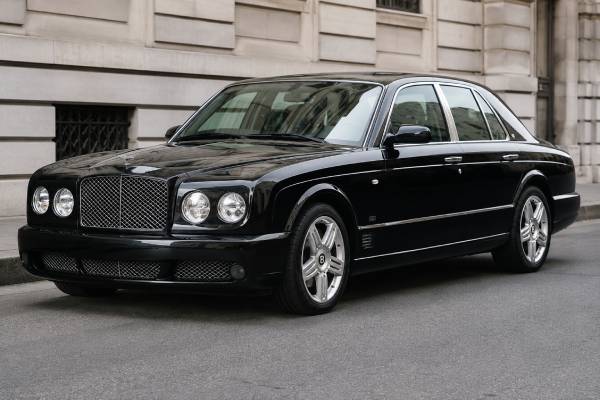
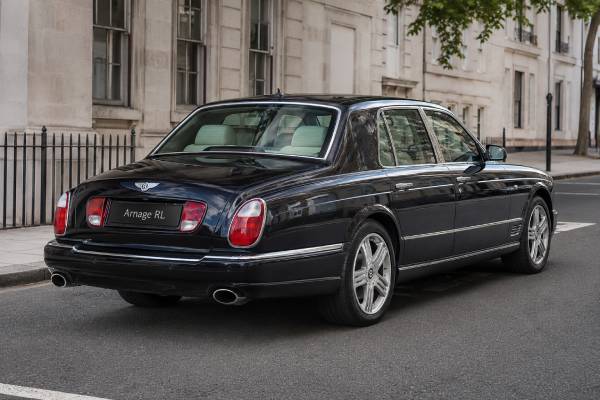
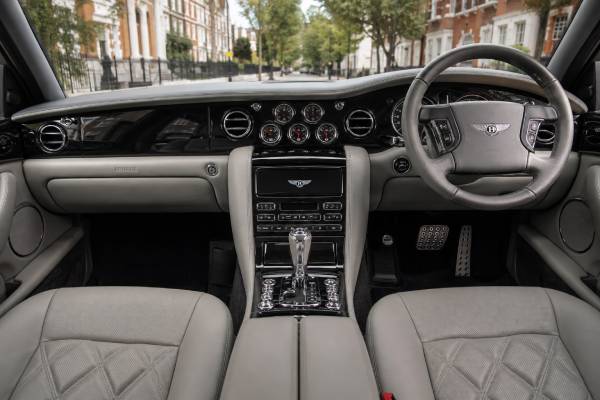
The 2007–2009 Bentley Arnage RL is the most fully developed factory long-wheelbase Arnage: a hand-built luxury sedan with 250 mm of additional wheelbase, a 450 hp twin-turbo 6.75-liter V8, and a six-speed automatic transmission. Its defining feature is not simply extra rear legroom. Bentley divided the extension between the front and rear door areas, preserving the car’s formal proportions while creating easier access and a genuinely spacious passenger compartment. The 2007 update also brought stronger torque, faster turbo response, revised electronic systems, and more standard rear-cabin equipment. These cars were often highly personalized through Mulliner, so two RLs can differ greatly in seating, communications, entertainment, privacy features, veneer, and storage. That individuality is attractive, but it makes verification essential. A good RL should ride level, cool both cabins effectively, shift smoothly, and operate every bespoke feature without drama. This guide covers its exact dimensions and performance, rear-compartment design, road manners, maintenance demands, and the checks needed before purchase.
Table of Contents
- What the 2007 Redesign Added
- Long-Wheelbase Specifications and Technical Data
- Rear-Compartment Engineering and Equipment
- How the RL Drives and Rides
- Systems That Need Planned Maintenance
- An RL-Specific Pre-Purchase Inspection
- Who the Arnage RL Suits Best
What the 2007 Redesign Added
The 2007 model-year update made the Arnage RL faster, quieter, and easier to use without changing its core purpose as Bentley’s formal long-wheelbase sedan. Power increased to 450 hp, torque reached 875 Nm, and the six-speed ZF automatic replaced the previous four-speed unit.
That transmission change transformed low-speed and highway behavior. The RL weighs more than the standard-wheelbase Arnage, yet first gear gives it clean launch response and the additional ratios keep the engine within its broad torque band. At cruising speed, a taller top ratio lowers engine revs and reduces the sense of effort. The car can still accelerate to 60 mph in roughly six seconds and reach about 168 mph, figures that are remarkable for a limousine-sized sedan, but the more relevant gain is smooth, decisive progress with several passengers aboard.
Bentley also revised the engine. The L410TT retained the company’s traditional aluminum V8 block, central camshaft, pushrods, and two valves per cylinder, but gained low-inertia turbochargers, roller tappets, updated management, and emissions improvements. Maximum torque arrives at very low engine speed, so the RL rarely needs to sound busy. A healthy car moves away with a muted surge rather than a delayed rush.
The passenger compartment received particular attention. Period Bentley material listed a rear center-armrest bottle cooler, a veneered rear center cushion box, rear rSAP telephone equipment, and a reversing camera among the added standard features in relevant markets. The exact equipment varies by destination and commission, so the build record must be checked rather than assuming that every car has the same hardware.
The body extension is also more sophisticated than a simple spacer inserted behind the rear doors. Compared with the standard Arnage, the RL’s wheelbase is 250 mm longer. Bentley allocated 50 mm around the front-door area and 200 mm to the rear compartment. This helps rear passengers enter without an awkwardly narrow opening and maintains a coherent side profile. The result is a length of approximately 5,640 mm and a wheelbase of 3,366 mm.
Mulliner personalization made the RL unusually diverse. A car could be commissioned as an understated four- or five-seat express, a mobile office, or a formal privacy-focused vehicle. Options could include picnic tables, rear entertainment screens, additional telephones, specialized storage, silk curtains, privacy glass, a rear sunroof, document compartments, bespoke audio, and custom color matching. Some cars therefore carry systems that exist on very few other examples. Before buying, identify which equipment is original, which has been altered, and whether support is still practical.
Long-Wheelbase Specifications and Technical Data
The late Arnage RL is an internal-combustion, rear-wheel-drive sedan with a 6,761 cc twin-turbo gasoline V8 and a six-speed automatic. Its long wheelbase increases passenger space and overall mass, while the 450 hp tune retains the softer, refinement-led character shared with the Arnage R.
| Engine | 6,761 cc Bentley V8, aluminum block and heads, pushrod valvegear |
|---|---|
| Induction | Twin low-inertia turbochargers with intercooling |
| Engine designation | L410TT family |
| Maximum power | 450 bhp (336 kW) at about 4,100 rpm |
| Maximum torque | 875 Nm (645 lb-ft) at about 1,800 rpm |
| Transmission | ZF six-speed automatic with sport and manual-selection modes |
| Driven wheels | Rear |
| 0–60 mph | Approximately 5.9 seconds |
|---|---|
| Maximum speed | 168 mph (270 km/h) |
| Fuel requirement | Premium unleaded gasoline |
| Fuel tank | 96 liters (about 25.3 US gallons) |
| Combined consumption | Approximately 14 mpg imperial on the period combined cycle |
| Body | Four-door long-wheelbase luxury sedan |
|---|---|
| Overall length | Approximately 5,640 mm (222.0 in) |
| Wheelbase | 3,366 mm (132.5 in) |
| Wheelbase increase | 250 mm (9.8 in) over the standard Arnage |
| Width across mirrors | Approximately 2,125 mm (83.7 in) |
| Height | Approximately 1,515 mm (59.6 in) |
| Kerb weight | Approximately 2,655 kg (5,853 lb), dependent on commission |
| Structure | Steel monocoque with subframes and extended body structure |
|---|---|
| Suspension | Independent double wishbones with coil springs and anti-roll bars |
| Damping | Adaptive electro-hydraulic dampers |
| Rear leveling | Automatic self-leveling to manage passenger and luggage load |
| Steering | Speed-sensitive power-assisted rack and pinion |
| Brakes | Large ventilated discs with ABS and electronic assistance |
| Driver aids | Electronic stability control, traction control, tire-pressure monitoring |
| Rear seating | Electrically adjustable and heated outboard seats; exact layout depends on build |
|---|---|
| Rear climate provision | Dedicated vents and controls, with commission-specific enhancements possible |
| Standard 2007-market additions | Rear bottle cooler, veneered center storage, rear telephone system, reversing camera in specified markets |
| Mulliner possibilities | Picnic tables, screens, office equipment, privacy features, custom storage, special hides and veneers |
| Wheel choices | 18- and 19-inch factory designs, depending on market and specification |
Because RLs were commissioned individually, published model specifications cannot describe every example. Verify seating capacity, curb weight, tire size, electrical equipment, communications systems, and privacy features from the VIN-linked build sheet and the car itself.
Rear-Compartment Engineering and Equipment
The RL’s extra space is useful because Bentley integrated it into access, seating position, and cabin equipment rather than merely increasing the distance between seat cushions. The rear doors are longer, the aperture is more generous, and passengers can enter with less twisting than in the standard Arnage.
Once seated, the benefit appears in knee room and the ability to recline or adjust the rear seats without crowding the front occupants. The flat, formal roofline preserves headroom. Thick carpeting, substantial door seals, deep seat cushions, and the long distance from the rear passengers to the engine contribute to quietness. A partition was not standard, so the normal RL remains an open, sociable cabin rather than a traditional divided limousine.
The long wheelbase also gave Mulliner room to integrate equipment. Common features include veneered picnic tables, rear vanity mirrors, a chilled bottle compartment, separate storage, entertainment displays, telephones, and extra controls. Some commissions added a power-folding roof screen, office computer hardware, privacy glass, curtains, or a rear sunroof. These systems should be evaluated as engineered assemblies, not as decorative extras.
Originality and obsolescence
Period communications and entertainment hardware may no longer work on current networks or media formats. That does not necessarily make the car defective, but it changes the restoration decision. Preserving original equipment may suit a collector; discreetly updating a screen, amplifier, or connectivity module may suit an owner who uses the car regularly. Any update should avoid cutting veneer, leather, structural panels, or original harnesses. Reversible work with documentation protects value.
An inoperative rear screen can have several causes: a failed display, damaged hinge wiring, obsolete source unit, weak power supply, or control-module fault. Similarly, a bottle cooler that does not chill may have an electrical issue, a failed thermoelectric unit, blocked ventilation, or damaged wiring. Diagnose first. Removing rare hardware or replacing it with generic parts may reduce both authenticity and usability.
Climate performance
Rear comfort depends heavily on the climate-control system. The larger cabin and extensive glass create a significant cooling load, especially in dark-colored cars or hot climates. Test the system after the car has heat-soaked, not only in a cool workshop. Airflow should be strong, vent temperatures should fall promptly, and front and rear commands should behave consistently. Weak cooling can result from refrigerant loss, compressor problems, blend-door faults, fan issues, sensor errors, or blocked condensers.
Check for water entry around any sunroof, rear glass, door seals, antenna points, and boot openings. Moisture can damage carpets, leather, veneer, telephone modules, amplifiers, and wiring hidden beneath trim. Smell the cabin, lift removable mats, inspect the spare-wheel area, and look for tide marks or corrosion on connectors.
Seating and trim
Run each seat through its complete range while someone watches for interference with carpets, consoles, picnic tables, and belts. Motors should move evenly and stop at their limits. Test heaters, lumbar functions, easy-exit features, memory settings, head restraints, and any massage function. A slow seat may reflect dry mechanisms or low voltage; a dead seat can involve switches, motors, modules, or damaged wiring.
Leather should be supple rather than heavily shiny, brittle, or thickly recolored. Pay attention to piping, outer bolsters, rear armrests, table edges, and areas around telephone cradles. Veneer should show a consistent finish without lifting, cracks, cloudy lacquer, or mismatched repairs. Because the cabin contains large pieces made for a specific car, high-quality restoration requires a craft specialist rather than an ordinary trim shop.
How the RL Drives and Rides
The Arnage RL should feel stable and dignified, not cumbersome or disconnected. Its extra wheelbase smooths long road undulations and gives rear passengers a calm ride, while 875 Nm of torque prevents the added length and weight from making it feel underpowered.
In city use, physical size is the main challenge. The turning circle, long rear doors, extended wheelbase, and substantial width require planning in parking structures and narrow streets. The reversing camera is helpful when functioning, but its image quality is period technology. Parking sensors should respond consistently across all corners. A failed sensor or camera is more than an inconvenience because the bodywork and brightwork are costly to repair correctly.
At highway speed, the RL comes into its own. The engine turns quietly, the six-speed transmission avoids unnecessary shifts, and the long body resists pitch. Crosswinds and road crowns should not cause constant correction. If the car wanders, investigate tire age and matching, wheel alignment, suspension joints, steering play, ride height, and previous structural repair.
Rear-seat evaluation is essential. Have another person drive while you sit in both rear positions over broken pavement, expansion joints, and a smooth highway. Listen for trim movement, suspension knocks, wind leaks, and noises from tables or screens. A chauffeur may accept steering or brake behavior that a rear passenger immediately recognizes as head toss, harshness, or vibration.
The self-leveling system must compensate when passengers and luggage are added. An RL that sits low at one corner, changes height slowly, or runs its hydraulic pump excessively needs diagnosis. The cause may be a leak, weak accumulator, sensor problem, tired spring, or component wear. Do not assume a level-looking parked car proves that the system works under load.
Braking should be smooth enough that rear passengers are not thrown forward. The pedal must remain consistent through repeated stops. Steering-wheel shake, pedal pulsation, pulling, or a hot-wheel smell can indicate disc, pad, caliper, hose, bearing, or tire problems. The car’s weight makes small brake defects noticeable and increases the consequences of neglect.
The RL is capable of very high speed, but its best dynamic quality is reserve. A small throttle opening produces a strong, quiet increase in pace. Full acceleration is impressive, yet smooth driving better suits the chassis and passengers. Correct tire load rating and pressure are critical, especially when the car regularly carries several occupants.
Systems That Need Planned Maintenance
An RL should be maintained as a collection of interdependent systems rather than serviced only when an annual mileage target is reached. Low use does not stop coolant hoses, hydraulic seals, batteries, tires, adhesives, and electrical contacts from aging.
Engine heat management
The twin-turbo V8 produces considerable heat in a crowded engine bay. Inspect radiators, cooling fans, hose junctions, the expansion tank, turbo coolant lines, charge-cooling components, belts, and heat shields. The temperature gauge must remain stable in traffic with the air conditioning operating. Coolant odor, residue, repeated top-ups, or evidence of sealant products requires a pressure test and careful inspection.
Fresh engine oil of the correct specification and sensible time-based changes help protect turbochargers and valvetrain components. Look for leaks after a full drive, not only when the car is cold. Blue smoke, persistent exhaust haze, irregular boost, or turbo whine should be investigated before purchase.
Six-speed transmission and driveline
The gearbox should select Drive and Reverse promptly and shift cleanly at light and heavy throttle. Service records should identify fluid and filter work where performed. Shudder, flaring, delayed engagement, harsh downshifts, or fault messages can involve fluid condition, adaptation, solenoids, valve body, torque converter, wiring, or mechanical wear. The differential, propeller shaft, mounts, and couplings also need inspection for leaks and vibration.
Hydraulics, suspension, and tires
The adaptive damping and self-leveling equipment are central to the RL’s passenger comfort. Check hydraulic pipes, accumulators, dampers, springs, bushes, ball joints, links, and height sensors. Uneven stance or inner-edge tire wear may reveal problems that are not obvious during a slow walk-around. Replace tires by condition and age, not tread depth alone, and use four matching premium tires with correct load and speed ratings.
Electrical supply and low-voltage faults
The RL has a high electrical load even when parked. A weak or incorrect battery can trigger telephone, seat, transmission, stability, alarm, climate, and convenience faults. Confirm charging voltage, battery age, battery specification, and parasitic draw. Use an appropriate maintainer during storage, but do not use a maintainer to disguise a failing battery or excessive drain.
Diagnostic scans should be performed before fault codes are erased. Multiple communication or undervoltage codes may share one cause, while a single recurring code can identify a genuine component failure. Repairs are more efficient when a technician understands Bentley network behavior and has access to model-appropriate diagnostic equipment.
Body preservation
Inspect door bottoms, sills, wheel arches, jacking points, subframes, boot seams, window surrounds, and areas hidden by trim. Long rear doors place demands on hinges and latches; they should open without dropping and close without being lifted. Check drains and weather seals. Poorly repaired collision damage can affect door alignment, wind noise, water sealing, and resale value.
A maintenance file should record condition as well as replaced parts. Brake thickness, tire dates, suspension play, fluid leaks, battery test results, climate performance, and diagnostic codes provide a useful baseline. That record is especially valuable for a bespoke car whose equipment may not be familiar to the next workshop.
An RL-Specific Pre-Purchase Inspection
A standard luxury-car inspection is not enough for an Arnage RL. The examiner must verify the extended body, rear-cabin systems, self-leveling operation under load, and the exact Mulliner commission as well as the engine and transmission.
Begin with documentation. Match VINs, registration records, service invoices, recall history, build sheet, option list, keys, books, and any Mulliner correspondence. Confirm that the car is a factory RL rather than a later conversion. The 3,366 mm wheelbase and integrated door proportions distinguish it from the separate, still longer factory Limousine and from aftermarket stretch work.
Inspect panel gaps along the extended doors and sills. Both rear doors should remain aligned, latch easily, and seal without wind noise. Look beneath the car for distortion, crushed lifting points, corrosion, non-factory welding, or repairs near structural reinforcements. Measure paint depth where appropriate and examine glass date markings.
The test should start cold and continue until fully hot:
- Watch the warning-lamp self-check and listen for abnormal engine noise.
- Confirm stable idle, clean exhaust, and prompt transmission engagement.
- Run every front and rear electrical feature through its full operating range.
- Test climate control after the cabin has warmed, including rear vents and controls.
- Drive over different road surfaces with one person in the rear seat.
- Add passenger load and observe self-leveling response and ride height.
- Perform moderate acceleration and repeated braking while checking for vibration or warnings.
- Let the car idle after the drive, inspect for leaks, and perform a hot restart.
A lift inspection should cover brakes, tires, suspension, steering, hydraulic pipes, exhaust, driveline, floor, sills, and signs of previous underbody damage. A diagnostic scan should include all accessible modules, not only the engine controller. Ask for a written estimate divided into immediate safety work, near-term reliability work, routine servicing, and cosmetic restoration.
Pay special attention to equipment that the seller describes as “never used.” That phrase can mean preserved condition, but it can also mean the function has not been tested for years. Screens, coolers, rear phones, sunroofs, curtains, tables, seat mechanisms, and privacy systems should all be demonstrated. Where old telecommunications cannot operate on modern networks, confirm that the hardware powers up and that any modification has been documented.
Who the Arnage RL Suits Best
The Arnage RL suits an owner who will use its rear compartment and values traditional coachbuilt luxury more than easy parking or modern infotainment. It makes the most sense when passenger comfort, formal presence, and individualized specification are part of the experience.
It can serve several roles. A collector may preserve an unusual Mulliner commission and use it for events. A business owner may employ a professional driver for longer journeys. A private owner may drive it personally while appreciating the ability to carry family or guests in exceptional comfort. The car is less convincing for someone seeking a low-maintenance display piece, a compact urban sedan, or a vehicle that any general repair shop can support.
Choose an RL over the standard Arnage R when the rear-space benefit will be used regularly. The standard car is easier to garage and may feel slightly more agile. Choose the RL over the separate factory Limousine when you want substantial extra room without the Limousine’s even greater length and rarity. Choose an Arnage T when the driver’s sporting experience matters more than rear-seat calm.
The purchase budget should include a substantial reserve. Tires, brakes, cooling work, hydraulic repairs, air-conditioning restoration, batteries, bespoke electronics, and trim can overlap. A car priced below the market because several systems are inactive may not be a bargain. Obtain parts-availability and labor estimates before agreeing to buy, especially for unique Mulliner equipment.
Storage must be dry, secure, and large enough for the 5.64-meter body and long rear doors. A narrow garage can make passenger entry difficult and encourage paint damage. Maintain battery support, tire pressures, fuel quality, ventilation, and pest control. Exercise the car on proper journeys that bring the engine, transmission, brakes, and fluids to operating temperature; repeated short starts are harmful rather than helpful.
The best RLs have a coherent story. Their colors and materials suit the body, their bespoke equipment remains intact, and their service history shows that owners understood the car as machinery as well as furniture. Cosmetic perfection cannot compensate for unstable temperature, weak hydraulics, old tires, or electrical faults. Conversely, a mechanically excellent car with honest minor wear may be a better long-term purchase than a freshly detailed example with little documentation.
In correct condition, the 2007–2009 Arnage RL delivers something increasingly rare: genuine long-wheelbase comfort powered by a low-revving, hand-assembled V8 and surrounded by materials shaped for one specific car. Its value is not measured only by speed or rear legroom. It lies in the integration of power, silence, access, craftsmanship, and personal commission. Buy with specialist evidence, maintain every system proactively, and the RL can remain both a usable grand limousine and a significant example of late Crewe coachbuilding.
References
- Bentley Range 2007 2007 (Model Range Brochure)
- Bentley Arnage RL 2003
- Used 2007 Bentley Arnage RL Specs & Features 2007
- Bentley Arnage RL specs (2006-2009), performance, dimensions & technical specifications – encyCARpedia 2006
- 2007 Model Year Bentley Arnage – Sgcarmart 2006
- Bentley Arnage Recalls (Recall Database)
Disclaimer
This article is for informational purposes and does not replace professional diagnosis, inspection, or repair. Specifications, torque values, service intervals, components, and procedures may differ by VIN, market, build date, seating layout, and Mulliner equipment; always verify them against official Bentley documentation for the individual car.
Please share this article on Facebook, X/Twitter, or a relevant Bentley community if it improved your research and you would like to support our work.