
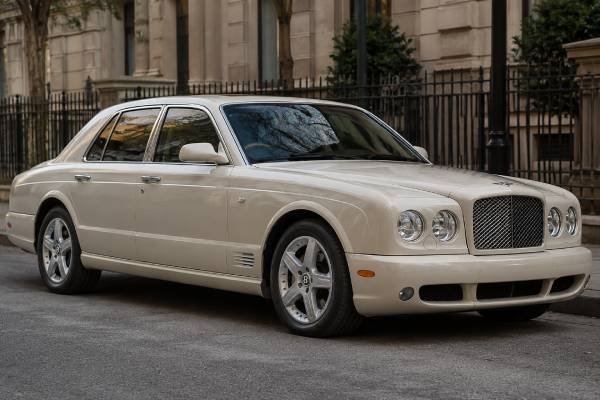
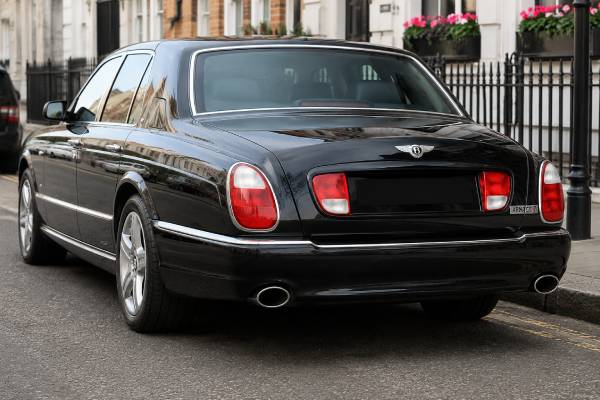
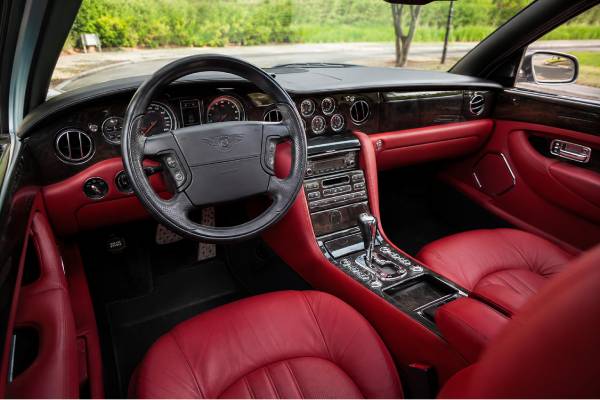
The 2007–2009 Bentley Arnage T is the fastest regular-production Arnage sedan and the point at which Crewe’s traditional 6.75-liter V8 reached 500 hp and 1,000 Nm of torque. Bentley paired that immense low-speed output with quick-spooling turbochargers, revised valvegear, a six-speed ZF automatic, updated stability control, and a sport-oriented chassis. The result can reach 60 mph in 5.2 seconds and 179 mph, yet it still surrounds its occupants with hand-stitched hide, polished veneer, deep carpeting, and the upright formality of an old-school flagship. Those abilities also create serious ownership responsibilities. A 2.6-tonne car capable of supercar-era speed depends on correct tires, powerful brakes, stable cooling, healthy adaptive suspension, and fault-free electronic control. Low mileage does not cancel age, heat, or inactivity. This guide explains the late T’s engineering, specifications, performance character, maintenance needs, and a disciplined buying process for finding a car that remains as convincing mechanically as it appears cosmetically.
Table of Contents
- Why the 500 hp Arnage T Matters
- 500 hp Arnage T Specifications
- Engine, Turbocharger, and Transmission Engineering
- Chassis Control at Arnage T Speeds
- Heat, Wear, and Service Planning
- A Performance-Focused Inspection
- Ownership, Alternatives, and Long-Term Value
Why the 500 hp Arnage T Matters
The late Arnage T matters because it combines the highest regular Arnage sedan output with the last major engineering update before production ended. It is not merely an R with more boost: Bentley calibrated the T’s suspension, wheels, styling, throttle response, and driver environment around a more assertive role.
When introduced for the 2007 model year, the revised T gained 11 percent more power and roughly 14 percent more torque than the previous 450 hp version. Maximum output rose to 500 bhp, and torque reached 1,000 Nm. Top speed increased from 168 to 179 mph. More important in normal use, the new low-inertia turbochargers reached operating speed faster and reduced the pause between throttle input and acceleration.
A six-speed ZF automatic replaced the four-speed GM transmission. The wider ratio spread helped at both ends: shorter lower gearing improved response from rest, closer intermediate gears kept the V8 in its strongest range, and a taller cruising ratio reduced engine speed. Drivers could leave the gearbox in Drive, select a sport program, or move the lever into a manual gate. The gearbox did not turn the Arnage into a lightweight sports sedan, but it made the power easier to meter and the car less dependent on one vast surge through a small number of ratios.
The T’s visual signals were deliberate rather than excessive. Depending on market and specification, it used a dark-tinted matrix grille, sportier bumpers, lower front-wing vents, larger exhaust outlets, red Bentley badges, and 19-inch wheels. Inside, many examples feature diamond-quilted hide, engine-turned aluminum or dark veneer, drilled alloy pedals, and other Mulliner details. Because customers could personalize extensively, originality should be judged against the individual build sheet rather than a single assumed standard.
The car’s appeal rests on contrast. Its body is tall and formal, the seating position is upright, and its controls have the physical weight of a traditional luxury car. Yet a moderate throttle opening releases more torque than many contemporary supercars produced. The cabin remains composed while road speed builds, so the driver must monitor pace consciously. The T’s performance is least convincing when treated as a drag-race novelty and most convincing when it compresses long distances with very little visible effort.
500 hp Arnage T Specifications
The 2007–2009 Arnage T is a gasoline-only, front-engine, rear-wheel-drive sedan powered by a 6,761 cc twin-turbo V8. Its 500 hp rating and 1,000 Nm torque output are supported by a six-speed automatic, adaptive suspension, large ventilated brakes, and electronic stability control.
| Engine | 6,761 cc aluminum V8 with central camshaft and pushrod valvegear |
|---|---|
| Engine family | Bentley L410TT |
| Induction | Twin Mitsubishi TD04 low-inertia turbochargers with intercooling |
| Fuel and management | Premium unleaded; Bosch Motronic engine management |
| Maximum power | 500 bhp (373 kW) at 4,200 rpm |
| Maximum torque | 1,000 Nm (738 lb-ft) at 3,200 rpm |
| Compression ratio | 7.8:1 |
| Transmission | ZF six-speed automatic with Drive, Sport, and manual selection |
|---|---|
| Drive | Rear-wheel drive |
| 0–60 mph | 5.2 seconds |
| 0–100 km/h | 5.5 seconds |
| Maximum speed | 179 mph (288 km/h) |
| Fuel tank | 96 liters (25.3 US gallons) |
| Combined consumption | 14.5 mpg imperial (19.5 L/100 km) on the period EU cycle |
| Body | Four-door, five-seat luxury performance sedan |
|---|---|
| Overall length | 5,400 mm (212.6 in) |
| Wheelbase | 3,116 mm (122.7 in) |
| Width across mirrors | 2,125 mm (83.7 in) |
| Height | 1,515 mm (59.6 in) |
| Kerb weight | Approximately 2,585 kg (5,699 lb) |
| Gross vehicle weight | Approximately 3,065 kg (6,757 lb) |
| Luggage capacity | 374 liters (13.2 cu ft) |
| Structure | Steel monocoque with front and rear subframes |
|---|---|
| Suspension | Independent double wishbones, coil springs, and anti-roll bars |
| T calibration | Stiffer springs, anti-roll bars, and dedicated damper tuning |
| Damping | Computer-controlled adaptive electro-hydraulic dampers |
| Ride-height control | Automatic rear self-leveling with load compensation |
| Steering | Speed-sensitive power-assisted rack and pinion |
| Driver aids | ABS, traction control, Electronic Stability Program, tire-pressure monitoring |
| Standard brakes | Large ventilated iron discs with electronic assistance |
|---|---|
| Factory wheel size | 19 x 8-inch alloy wheels in T-specific designs |
| Typical tire size | 255/45 R19 with appropriate load and speed ratings |
| Spare arrangement | Market- and build-dependent; verify tools and inflation equipment |
| Brake inspection priority | Measure disc condition and thickness; inspect pads, hoses, calipers, and fluid |
Individual Mulliner options and market equipment can alter weight, wheel design, trim, and convenience features. Verify the exact car through its VIN, build specification, tire placard, and official service information.
Engine, Turbocharger, and Transmission Engineering
The late T’s greatest engineering achievement is not the peak horsepower figure but the controlled delivery of 1,000 Nm through a refined automatic driveline. Bentley modernized the V8 where necessary while preserving its low-revving character.
The engine’s architecture is unusual by 2007 standards. It uses an aluminum block and heads, a gear-driven central camshaft, two overhead valves per cylinder operated through pushrods, and a very low 4,600-rpm operating ceiling. Large displacement and modest engine speed create strong base torque; two turbochargers then expand the plateau rather than producing a narrow high-rpm peak.
Bentley replaced the earlier Garrett units with smaller, lower-inertia Mitsubishi turbochargers. Period engineering material stated that the new turbines could reach maximum speed in about half the time of the previous units. That reduced lag and made the first portion of throttle travel more predictable. A reprofiled camshaft and roller tappets revised valve timing while reducing friction and mechanical harshness.
The 6,761 cc capacity is sometimes described casually as 6.75 liters or 6.8 liters. Both are common model descriptions, but the exact late-engine capacity is 6,761 cc. Power ratings were based on high-octane fuel, and the engine’s boost, ignition, and knock-control strategy assume fuel of suitable quality. Filling with the minimum available grade, especially in heat or under sustained load, is false economy.
The ZF 6HP automatic is central to the update. Its control unit coordinates with the engine and stability system, requesting torque reductions during shifts and responding to throttle position, road speed, and selected mode. In normal operation, shifts should be fast enough to maintain momentum but smooth enough not to disturb occupants. The sport program holds lower gears longer and responds more readily to throttle. Manual selection gives useful control on gradients, though the car will still protect the driveline from inappropriate commands.
A transmission can feel acceptable during a gentle five-minute drive and reveal problems only when hot or under torque. Test for delayed engagement, flare between ratios, shudder at steady speed, a heavy thump during downshifts, or warning messages. Causes can range from voltage or adaptation issues to valve-body wear, solenoids, fluid deterioration, torque-converter problems, or internal damage. Proper diagnosis comes before parts replacement.
The driveline also includes mounts, a propeller shaft, couplings, differential, half-shafts, wheel bearings, and rear suspension components that must handle immense torque. A vibration under load may not be “just an old tire.” It can arise from wheels, driveline angles, worn mounts, joint play, or damage. The inspection must reproduce the speed and load at which the symptom appears.
Chassis Control at Arnage T Speeds
The Arnage T handles its power through disciplined control of mass, not by pretending to be light. Healthy examples turn accurately, resist repeated body movement, and remain stable under acceleration and braking while still providing luxury-car compliance.
Bentley’s T calibration uses firmer springs, anti-roll bars, and damper settings than the Arnage R. The adaptive electro-hydraulic dampers vary response according to movement and driving conditions. Automatic rear leveling helps maintain geometry as load changes. On a smooth fast road, the car should feel planted and remarkably untroubled. On broken surfaces, it should be firm but not brittle, with one controlled body movement rather than continued bouncing.
A harsh or unsettled car may have old tires, incorrect pressures, failed damping control, weak accumulators, worn bushes, broken springs, incorrect ride height, or aftermarket wheel changes. Conversely, excessive float, delayed settling, or nose movement under braking can indicate tired dampers or suspension wear. Because several faults produce similar sensations, assessment on a lift and with diagnostic equipment is more reliable than replacing parts by guesswork.
The steering is power assisted but should gain weight with speed. It will not deliver the immediate response of a small modern sports sedan, yet it should center naturally and follow a chosen line without constant correction. Wandering can result from alignment, worn joints, tire construction, inner-shoulder wear, incorrect ride height, or previous collision repair. Check the steering box or rack area, hoses, pump, tie rods, ball joints, and front subframe mounts.
Brakes are a critical part of any T purchase. Standard iron discs are large and effective when healthy, but the mass and speed potential create heat quickly. The pedal should remain consistent through repeated stops and the car should track straight. Vibration may come from disc variation, deposits, wheel or hub condition; pulling may involve calipers, hoses, tires, or alignment. Fluid age matters because absorbed moisture lowers boiling resistance and promotes internal corrosion.
Tires need the correct size, load rating, speed rating, and construction. A matching set matters because the stability system expects predictable grip from all four corners. Inspect date codes, repairs, cracks, sidewalls, bead areas, and inner shoulders. A low-mileage car may have visually deep tread on tires too old for high-speed use. Replace them before exploring performance.
The Electronic Stability Program adds a safety layer, not immunity from physics. A 2,585 kg rear-drive sedan with 1,000 Nm can overwhelm cold, wet, or aged tires. Smooth throttle application is essential, particularly while cornering or crossing painted road markings. Drivers new to the car should learn its responses gradually on dry roads with all systems enabled.
At speed, aerodynamic lift, tire temperature, road surface, brake condition, and crosswinds become significant. The published 179 mph figure demonstrates engineering capability; it is not a casual target for public roads or an unknown used car. Mechanical condition must be proven before any track or closed-course high-speed use.
Heat, Wear, and Service Planning
The T’s maintenance burden is driven by heat, weight, age, and low production volume. A reliable car is usually one whose owner repaired developing issues early rather than waiting for a warning light or breakdown.
Cooling and charge-air systems
Start with the car fully cold. Inspect coolant level and color, the expansion tank, radiator seams, fan operation, hoses, clamps, turbo coolant lines, intercooler plumbing, and evidence of dried residue. After a long drive, let the engine idle with the climate control running and verify stable temperature. A sweet smell, repeated coolant loss, uneven fan behavior, or staining deserves pressure testing.
Air leaks between turbochargers, intercoolers, throttle body, and engine can reduce performance or create mixture faults. Check hoses for oil saturation, splits, loose clamps, and rubbing. A light oil film may be expected in some intake plumbing, but pooled oil, heavy smoke, or falling oil level needs investigation.
Lubrication and turbocharger care
Use the correct oil and a time-based service schedule. The engine’s oil supplies bearings, valvetrain, and turbochargers while operating in a very hot environment. Inspect for leaks around rocker covers, front covers, oil lines, filter housing, sump, and turbo feeds and drains. Oil reaching exhaust parts can create odor or smoke and should not be dismissed.
After hard use, allow a brief period of low-load driving before shutdown so temperatures stabilize. Prolonged stationary idling is not a substitute for cooling airflow. Cars that make only short journeys accumulate moisture and fuel dilution, so regular full-temperature drives are preferable.
Transmission, differential, and mounts
Ask for evidence of gearbox servicing and note whether the correct fluid, filter, pan, and procedure were used. “Sealed for life” should not be interpreted as immune to age or heat. Differential oil, leaking seals, propeller-shaft components, and mounts also need review. A thump when taking up drive can come from several points, and replacing the cheapest visible part may not cure it.
Suspension, brakes, and hydraulics
Measure rather than guess. Record brake-disc thickness and condition, pad remaining life, tire tread and age, suspension play, ride height, hydraulic pressure behavior, and damper leakage. Inspect accumulators, pipes, springs, bushes, joints, wheel bearings, and alignment. Replacing a single worn component may leave the chassis inconsistent if paired parts are similarly aged.
Electrical health
A stable battery and charging system are essential. Low voltage can produce engine, transmission, stability, alarm, seat, climate, and infotainment faults that appear unrelated. Confirm battery type, age, installation, charging output, and parasitic draw. Scan every available module before clearing codes and retain the report.
Operate all cabin equipment, including seat memories, heating, lumbar support, windows, locks, mirrors, climate zones, navigation, audio, telephone hardware, parking sensors, reversing camera, sunroof, rear controls, and any Mulliner options. Water ingress near the boot, windscreen, sunroof, door membranes, or rear glass can damage expensive modules hidden below trim.
Body and interior preservation
Look for corrosion at wheel arches, sills, door bottoms, jacking points, boot seams, subframes, and underbody mounting areas. Examine paint texture, panel gaps, overspray, glass markings, and fasteners for evidence of repair. A high-quality repair is not automatically disqualifying, but it must be structurally sound and documented.
Leather and veneer require gentle care. Thick recoloring can hide cracks, while aggressive cleaners remove surface protection. Check diamond quilting, piping, seat bolsters, steering wheel, headlining, table mechanisms, and lacquer edges. Original trim pieces can be difficult to source, so preserving them is usually preferable to replacing them with generic material.
A Performance-Focused Inspection
Inspect an Arnage T as both a hand-built luxury car and a 179 mph performance machine. The process should test cold behavior, full operating temperature, high electrical load, moderate boost, braking heat, and chassis response.
First, establish identity. Match the VIN across the body, documents, service history, and diagnostic record. Obtain the original build specification when possible. Confirm factory wheels, trim, exterior badges, grille finish, exhaust, and Mulliner options. A car modified to resemble a later edition may still be enjoyable, but it should not be represented as something it is not.
Before starting, check fluid levels, hoses, tire date codes, brake surfaces, ride height, battery installation, panel alignment, and damp areas. Ask the seller not to pre-warm the car. On startup, observe all warning lamps, listen for abnormal valvetrain or accessory noise, and watch the exhaust. The idle should settle cleanly without persistent smoke or misfire.
During a static test, load the electrical system. Run lights, heated windows, climate control, seat motors, audio, and other equipment while observing voltage and warning behavior. Test every switch. Confirm the tire-pressure system, parking aids, and stability-control messages complete their checks correctly.
The road test should progress in stages:
- Use light throttle until fluids are warm, noting shift timing and steering response.
- Drive over rough and smooth surfaces to assess dampers, bushes, rattles, and ride height.
- Hold steady speeds to detect wheel, tire, propeller-shaft, or torque-converter vibration.
- Apply moderate and then stronger acceleration where safe, watching for clean boost and stable shifts.
- Brake repeatedly from ordinary road speed, checking pedal consistency, tracking, smell, and vibration.
- Maneuver at full steering lock and in reverse to expose joint, pump, parking-sensor, or camera faults.
- After the drive, idle the fully hot car, inspect for leaks, and perform a hot restart.
Do not conduct maximum-performance tests on old tires, an unknown brake system, or a car with warning lights. A specialist can evaluate boost, fuel trims, misfire counts, temperatures, transmission adaptation, and stored faults without abusing the vehicle.
Place the car on a lift. Inspect undertrays before and after removal, because a clean cover can conceal fluid accumulation. Examine cooling and oil lines, exhaust heat shields, suspension, steering, hydraulic pipes, brake hoses, subframes, floor, differential, and signs of poor jacking or collision damage. Obtain written estimates, not verbal reassurance.
Service history should show a pattern of diagnosis and prevention. Invoices for recent tires, cooling work, suspension renewal, brakes, batteries, air conditioning, and transmission attention can add more value than a polished exterior. Confirm relevant recalls and campaigns by VIN through an authorized Bentley source.
Ownership, Alternatives, and Long-Term Value
The late Arnage T suits an owner who wants the most forceful standard Arnage and accepts that maintaining its performance is inseparable from maintaining its luxury. It rewards regular, properly warmed use and specialist care; it punishes neglect hidden beneath low mileage and immaculate detailing.
Buy on condition and provenance first. A strong car has complete invoices, matching premium tires, a dry and stable cooling system, clean diagnostic results, consistent ride height, smooth transmission behavior, powerful straight-line braking, and functioning cabin equipment. Original tools, books, keys, umbrellas, and build documentation strengthen the package.
Choose the Arnage R instead when ride softness and understated presentation matter more than the final 50 hp. Choose the RL when rear passenger space is the priority. The 2009 Final Series uses the T drivetrain but blends it with R-oriented refinement and limited-edition detailing; it may command a collector premium. Earlier 450 hp Ts retain a dramatic character but lack the six-speed gearbox and 500 hp update.
Color and specification influence desirability, but there is no single correct combination. Traditional dark paint with light hide emphasizes formality. More unusual colors can suit the T’s personality and may be rare, provided they are original and well documented. Mulliner features add interest when intact; incomplete or nonfunctional bespoke equipment can become an expensive restoration project.
Set aside an acquisition reserve even after a clean inspection. Tires, brake work, cooling hoses, batteries, hydraulic components, suspension joints, air-conditioning repairs, and fluid services may come due close together. Secure storage, specialized insurance, fuel, and occasional transport also belong in the annual cost.
Use the car. A long drive circulates fluids, exercises seals and valves, cleans brake surfaces, charges the battery, and reveals developing faults before an important trip. Keep it on a compatible battery maintainer when parked for extended periods, maintain tire pressures, and avoid repeated short starts. Record every service and diagnostic scan so future decisions are based on evidence.
The 500 hp Arnage T occupies a special place in Bentley history. It represents the extreme development of a sedan architecture and V8 lineage that began in another era, updated with enough transmission and control technology to remain formidable at the end of the 2000s. Its mass, fuel use, and maintenance needs are impossible to ignore, but so is its character. A correct late T delivers vast torque, disciplined high-speed stability, and craftsmanship that feels personal rather than industrial. The right example is not the cheapest car to buy; it is the one whose condition allows all of those qualities to exist at the same time.
References
- Bentley Range 2007 2007 (Model Range Brochure)
- 2007 Bentley Arnage T – Images, Specifications and Information 2006 (Bentley Press Information)
- 2007 Bentley Arnage T Specifications – Ultimatecarpage.com 2007
- Used 2007 Bentley Arnage T Specs & Features 2007
- 2007 Bentley Arnage: What’s New 2006
- Bentley Arnage Recalls (Recall Database)
Disclaimer
This article is for informational purposes and is not a substitute for professional diagnosis, inspection, or repair. Specifications, torque values, service intervals, parts, and procedures may vary by VIN, market, production date, and equipment; confirm all work with official Bentley service documentation for the specific vehicle.
Please share this guide on Facebook, X/Twitter, or your preferred enthusiast forum if it supported your Arnage T research and you would like to help our work reach more readers.