
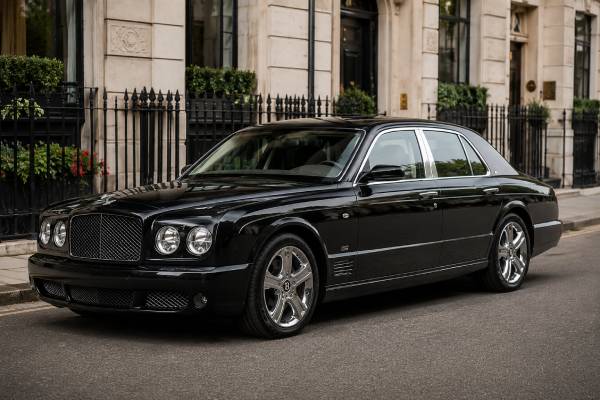
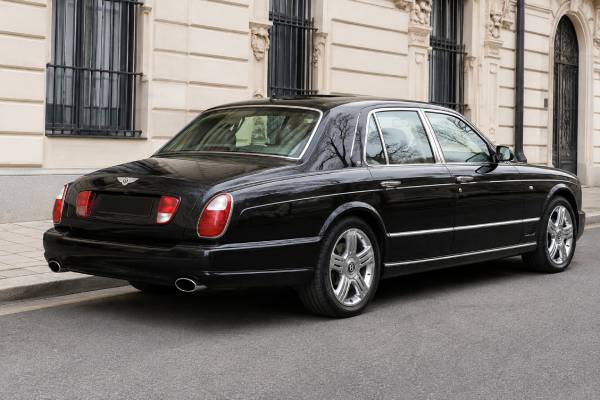
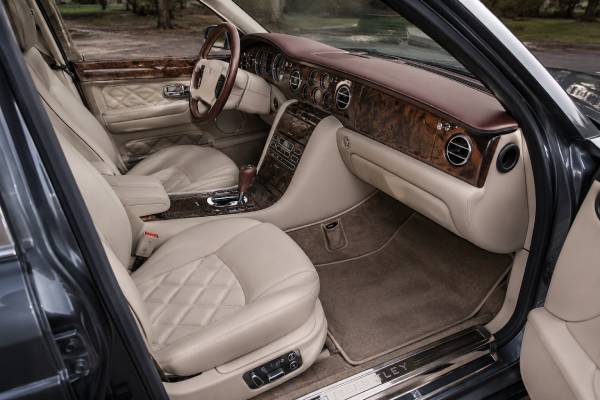
The 2007–2009 Bentley Arnage Armoured is a factory-recognized 450 hp derivative of the late Arnage, built around the revised 6.75-liter L410TT twin-turbo V8 and six-speed ZF automatic. It should not be treated as an ordinary Arnage with generic armor added later. Factory-integrated protection begins with the body structure, suspension, braking, glazing, closures, electrical equipment, and certification package, and the finished specification can be unique to the commission.
That individuality changes the buying process. Published figures for a standard Arnage R or RL cannot safely be copied onto an armoured example, particularly for weight, dimensions, tire requirements, payload, performance, protection level, and service procedures. The correct values must come from the car’s build record and protection documentation. Buyers should first establish identity and legal status, then inspect structural integrity, glazing, door support, suspension, brakes, wheels, tires, cooling, transmission, and bespoke systems. An inexpensive example without complete records can be impossible to value, register, insure, repair, or certify correctly, even when the engine runs well and the cabin appears luxurious.
Table of Contents
- What “Armoured” Means on an Arnage
- Confirmed Mechanical Specification
- How Protection Changes the Vehicle
- Identity, Certification, and Records
- Specialist Inspection Priorities
- Maintenance and Operational Planning
- Making a Sound Purchase Decision
What “Armoured” Means on an Arnage
An Arnage Armoured is a security-engineered vehicle whose protective elements form part of the whole-car design. The important distinction is integration: armor, glazing, door structures, suspension, brakes, tires, wiring, and cabin equipment must work together while preserving acceptable handling, cooling, visibility, reliability, and occupant access.
Bentley’s own description of factory armouring on the Arnage Limousine explained that protection was considered at the bare-bodyshell stage rather than installed as a final accessory. That approach allowed the protected shell to receive corrosion treatment and paint, enabled weight to be distributed deliberately, and preserved access to Mulliner interior choices. The same principle is the correct lens for evaluating a late Arnage Armoured: the protection package is structural and system-wide, not decorative.
The model also appears as a distinct manufacturer and chassis category in official and specialist identification resources. Late-production references associate the Armoured Arnage with a 450 hp, EU4 non-OBD engine designation separate from ordinary R, RL, and T listings. That does not reveal the full build specification, but it supports the need to identify the car through its VIN and factory records rather than through external appearance.
Protection details should be handled responsibly and precisely. Do not assume a ballistic or blast rating from body thickness, glass appearance, vehicle origin, or a sales claim. Ratings depend on a defined standard, test level, coverage area, materials, joints, and certification date. A car described only as “armoured” may have a factory package, a later conversion, partial protection, altered glazing, or documentation that no longer corresponds to its present condition.
The same caution applies to weight and performance. An armoured car is heavier than its donor, but the amount depends on body length, protection coverage, glazing, floor and roof treatment, equipment, wheel-and-tire package, and later changes. Quoting a single generic kerb weight can create errors in transport, lifting, tire selection, licensing, and payload calculations. Use the plated and certified values for the exact vehicle.
Confirmed Mechanical Specification and Technical Data
The late Arnage Armoured assignment identifies the 450 hp L410TT powertrain used from 2007 through 2009. This generation received low-inertia turbochargers, roller tappets, revised engine management, and the six-speed ZF automatic introduced across the updated Arnage range.
| Parameter | Confirmed late Arnage Armoured specification |
|---|---|
| Engine family | Bentley L410TT-series |
| Configuration | 90-degree aluminum V8, central camshaft, overhead valves, 2 valves per cylinder |
| Displacement | Approximately 6,761 cc, conventionally described as 6.75 liters |
| Induction | Twin low-inertia turbochargers with intercooling |
| Maximum power | 450 bhp (336 kW) at approximately 4,100 rpm |
| Maximum torque | 875 Nm (645 lb-ft) at approximately 3,250 rpm |
| Emissions generation | Late EU4-era Arnage engine specification; market certification is VIN-specific |
| System | Configuration |
|---|---|
| Transmission | ZF 6HP26 6-speed automatic with electronic engine-and-gearbox coordination |
| Drive layout | Front engine, rear-wheel drive |
| Driving modes | Normal and sport transmission behavior; chassis mode equipment depends on build |
| Stability systems | ABS, traction control, and revised electronic stability control |
| Fuel | Premium unleaded gasoline to the vehicle’s market specification |
| Area | Late Arnage configuration |
|---|---|
| Core structure | Steel monocoque with subframes, modified as required for the protected build |
| Suspension | Independent double-wishbone layout with coil springs, adaptive damping, and self-leveling functions |
| Steering | Power-assisted rack and pinion |
| Braking | Ventilated disc system with protection-specific hardware or calibration documented by the build record |
| Electrical system | Arnage vehicle network plus commission-specific security and cabin equipment |
| Field | Correct source |
|---|---|
| Kerb and gross vehicle weight | Vehicle plates, homologation record, and final build certificate |
| Axle loads and payload | Certified weight documentation for the completed protected car |
| Protection rating and coverage | Original protection certificate and test-standard documentation |
| Wheel, tire, and pressure specification | Factory build sheet and current approved tire documentation |
| Overall dimensions | Commission drawings or homologation data for the body configuration |
| Performance | Manufacturer data for the completed build, not ordinary Arnage R or RL figures |
| Document | Purpose |
|---|---|
| Bentley build specification | Confirms model, powertrain, market, and Mulliner equipment |
| Protection certificate | Defines the standard, level, tested areas, and original configuration |
| Weight and axle data | Supports legal operation, tires, lifting, transport, and payload control |
| Glazing identification record | Matches protected glass to the certified build and replacement requirements |
| Service and modification history | Shows whether structural, security, and mechanical systems remain consistent |
| Import and registration approvals | Confirms legal status in the vehicle’s current jurisdiction |
Do not use ordinary Arnage dimensions or weight to fill missing data. The omission of a generic number is safer and more accurate than publishing a value that may be wrong for a protected, extended, or specially equipped commission.
How Protection Changes the Vehicle
Protection changes loads, wear patterns, service access, and operating behavior throughout the car. The effect is not confined to slower acceleration or higher fuel consumption.
Doors are a clear example. Protected glazing and internal materials increase mass, so hinges, latches, checks, seals, frames, window mechanisms, and power-closing functions carry greater loads. A door that drops, rebounds, requires lifting to latch, or contacts the aperture can signal worn hardware or structural movement. Adjustment alone may not be enough if the hinge reinforcement, glass support, or closure has been altered.
Glazing is another complete system. Inspect identification marks, clarity, edge condition, delamination, bubbles, discoloration, cracks, seal integrity, and correct operation of any movable sections. Replacement must preserve the certified specification and fit; ordinary laminated glass is not an equivalent. Excessive distortion can create driver fatigue and visibility problems even when the pane is technically intact.
Suspension and brakes work harder because the completed vehicle carries more mass. Springs, dampers, bushes, ball joints, wheel bearings, steering components, hubs, rotors, pads, calipers, hoses, and brake fluid all require inspection against the protected build’s requirements. Standard Arnage parts may look similar but may not be correct for load rating, calibration, or durability.
Wheels and tires are especially important. The correct tire may include a specific load index, speed capability, reinforced construction, or mobility system. Its pressure may be tied to certified axle loads. Fitment based only on wheel diameter is unsafe. Record the manufacturer, model, dimensions, service description, date code, condition, and any internal support system during inspection.
Cooling demands can increase during low-speed operation because added mass, security equipment, electrical load, and prolonged idling place pressure on the engine, transmission, air-conditioning, alternator, fans, and heat exchangers. Verify temperature stability in real traffic, not only during a short road test. Check that auxiliary electrical equipment has been installed with correct protection and does not create uncontrolled parasitic drain.
Body corrosion and water sealing deserve unusual attention. Protective layers can make inspection difficult, and later drilling or accessory installation can compromise corrosion protection. Look for moisture in carpets and cavities, staining around glazing, blocked drains, seam disturbance, repair welds, and corrosion near door and aperture reinforcements. Use a specialist who understands what can be inspected without damaging certified materials.
Identity, Certification, and Records
The first buying question is not “How much armor does it have?” but “What exactly is this vehicle, and can that identity be proven?” Without reliable records, every later judgment becomes uncertain.
Match the VIN on the body, plates, diagnostic systems, title, registration, Bentley build record, and protection certificate. Check whether the manufacturer designation includes Armoured Arnage or whether the car began as another Arnage derivative and was converted later. Both can be legitimate, but they are not equivalent in provenance, certification, maintenance, or value.
Read the protection certificate closely. It should identify the standard used, the level achieved, the tested or covered areas, the organization responsible, the date, and the vehicle to which it applies. Be wary of a photocopied certificate without a VIN, a certificate for materials rather than the completed vehicle, or a rating described only in marketing language.
Confirm that the car remains in the certified configuration. Changes to glass, doors, body panels, roof equipment, floor, bulkheads, wheels, tires, seating, emergency systems, or security electronics may affect the original claim. A high-quality repair can be appropriate, but it should be documented by an organization competent to assess the protected structure.
Legal requirements differ by country and can include import approval, registration category, weight limits, driver licensing, inspection, controlled-equipment rules, export permissions, or disclosure to insurers. Resolve these matters before purchase. A vehicle that can be registered in one jurisdiction may be difficult to import or operate in another.
Service history should name both the Bentley specialist and any protection specialist involved. Ordinary mechanical work may require awareness of additional weight, concealed structure, wiring, and lifting points. Protection-system work may require coordination with Bentley diagnostic and electrical systems. Records should show who performed the work and what documentation was updated.
Security-sensitive documents should be stored appropriately, but their existence and chain of custody should still be verifiable. A buyer does not need public disclosure of every construction detail; the buyer does need enough authenticated information to maintain, insure, certify, and use the vehicle lawfully.
Specialist Inspection Priorities
An Armoured Arnage needs a combined inspection by people who understand both the late Arnage and the vehicle’s protection system. A conventional pre-purchase inspection is insufficient.
Begin with a cold vehicle and review the documents before starting it. The inspector should know the certified weight, lifting method, wheel-and-tire specification, and any restrictions on removing trim or accessing protected cavities. Using an unsuitable lift or jack can damage the vehicle or create a safety risk.
The mechanical inspection should include the L410TT engine, cooling system, turbochargers, fuel and ignition systems, ZF six-speed transmission, propeller shaft, differential, steering, adaptive suspension, self-leveling, brakes, wheel bearings, wheels, tires, batteries, alternator, and all diagnostic modules. Test after full operating temperature because heavy vehicles can expose cooling, transmission, and braking issues only when hot.
The protected-body inspection should include:
- Alignment and support of every door, hinge, latch, and check mechanism
- Condition and identification of all protected glazing
- Seals, drains, water entry, and corrosion evidence
- Structural repairs, disturbed seams, nonfactory drilling, and changed fasteners
- Condition of the roof, floor, bulkheads, pillars, and closures where inspection is permitted
- Operation of emergency exits or release systems according to official instructions
- Security equipment function without publishing or altering sensitive configuration details
Road testing must be planned around the vehicle’s legal status and tire condition. Evaluate straight-line stability, steering effort, brake response, ride-height control, transmission behavior, temperature stability, vibration, and warning messages. Do not perform aggressive maneuvers to “test the armor.” Protection is established by certification, not by improvised demonstrations.
Measure, do not guess. Record brake thickness, tire age, axle weights where appropriate, ride height, battery performance, charging voltage, fault codes, fluid condition, and temperature behavior. Photograph accessible identification marks and pre-existing damage. A detailed baseline is valuable because future service intervals and wear can be compared against it.
Obtain written quotations for defects before negotiating. Door support, protected glazing, certified tires, suspension components, brake work, corrosion correction, and obsolete security electronics can each be expensive. Availability may matter more than price if a component must be specially manufactured or certified.
Maintenance and Operational Planning
Ownership requires a planned support network. The car should have a Bentley-capable workshop, a protection specialist, suitable recovery and transport providers, secure storage, correct lifting equipment, and an insurer familiar with protected vehicles.
Establish a mechanical baseline immediately. Service fluids and filters according to VIN-specific documentation, pressure-test the cooling system where appropriate, assess turbo and ignition health, test the six-speed transmission, measure brakes, inspect the entire suspension, and replace age-expired tires. Avoid creating intervals from ordinary Arnage assumptions when the completed vehicle’s duty cycle is different.
Weight accelerates wear. Track brake measurements, tire wear, bush condition, ride height, wheel-bearing noise, door alignment, and hinge movement over time. A small change can reveal developing load-related problems before a closure, suspension, or tire failure becomes severe.
Electrical maintenance begins with batteries and charging. Security systems, communications equipment, reinforced window mechanisms, climate control, and prolonged standby can create substantial demand. Measure sleep current and identify circuits rather than compensating with ever-larger batteries. Use a compatible maintainer during storage and follow any instructions for backup power supplies.
Keep the cooling system clean and fully functional. Heavy low-speed use and idling can be more demanding than occasional motorway driving. Confirm fan operation, radiator and condenser airflow, coolant condition, transmission cooling, and air-conditioning performance. Do not block heat exchangers with accessories or cosmetic mesh not approved for the build.
Recovery planning should be written down. Confirm the actual weight and dimensions, approved towing or loading points, ground-clearance limitations, key and alarm procedures, and who can authorize transport. A standard roadside truck may be unsuitable. The operator should not attach equipment to reinforced panels, suspension links, or body structures based on assumptions.
Document every change. If glazing, tires, communications equipment, locks, body panels, suspension, brakes, or electrical systems are replaced, retain part identification, installer details, photographs, certificates, and updated weight information where relevant. Unrecorded changes can weaken future certification and resale confidence.
Making a Sound Purchase Decision
A sound purchase is a complete, legally usable, correctly documented vehicle with current specialist support. Mechanical condition alone cannot compensate for uncertain protection claims or missing certification.
Rank candidates by evidence. First comes a matching VIN, Bentley build record, protection certificate, current registration status, and coherent service history. Second comes structural and glazing condition. Third comes safety-critical mechanical health. Cosmetic finish and rear-cabin options matter only after those foundations are secure.
Avoid price comparisons with ordinary Arnage R or RL cars. The cost of protected glazing, certified tires, door hardware, suspension and brake work, documentation recovery, specialist transport, and legal approval changes the ownership equation. A cheap car can be valueless for the intended purpose if its protection status cannot be established.
Define the intended use before buying. A collector may prioritize originality and documentation. A ceremonial or security operator may require current certification, reliability, parts support, and compliance with internal policies. An enthusiast who simply likes the appearance may be better served by an ordinary Arnage because the protected car’s mass and maintenance burden remain even when protection is not operationally needed.
Arrange insurance and storage before delivery. Confirm agreed value, permitted drivers, geographic limits, repair authorization, recovery procedures, and how security equipment is described. Some details should remain confidential, but the policy must accurately reflect the vehicle category and replacement cost.
Do not assume an old certificate guarantees present performance. Materials, seals, glazing, fasteners, corrosion protection, and repairs age. Only a qualified organization can assess whether a decades-old vehicle still corresponds to its original standard. The buyer’s decision should be based on documented current condition, not an unsupported promise that “armor never expires.”
Transport and workshop access can decide whether ownership is practical. Confirm that local lifts, alignment equipment, tire machines, brake-testing equipment, and recovery trucks are rated for the certified mass and dimensions. Ask how the vehicle can be moved if a powered window, heavy door, air suspension function, transmission selector, or security system fails. A workshop may be capable of servicing an ordinary Arnage yet unable to raise or store the protected version safely.
Parts planning also deserves attention. Some mechanical components may be standard late-Arnage items, others may be uprated, and still others may have been fabricated for the commission. Build a parts list from the car rather than an online catalog, and retain removed items until replacements are proven correct. When a security-related component is obsolete, the solution should preserve legal compliance, structural integrity, and documentation rather than merely restore visible operation without evidence that the protected system remains suitable, documented, serviceable, and legally compliant in its current market.
The late Arnage Armoured is a remarkable combination of hand-built luxury, traditional Bentley torque, and integrated protective engineering. It can also be one of the most demanding Arnage derivatives to own. A disciplined buyer who verifies identity, certification, structure, legal status, and support can acquire a rare, purposeful vehicle. Anyone unwilling to fund that process should choose a conventional Arnage whose specifications and maintenance path are far easier to establish.
References
- BENTLEY MOTORS LIMITED – MID 2025 (Official Manufacturer Database)
- Chassis Number References – RR Silver Seraph & Bentley Arnage | Flying Spares 2026
- 2007 Bentley Arnage T – Images, Specifications and Information 2006
- Bentley Motors to produce the Arnage Limousine 2004
- Used 2007 Bentley Arnage Specs & Features 2007
- Bentley Arnage Recalls 2026 (Recall Database)
Disclaimer
This article is for informational purposes and is not a substitute for professional diagnosis, repair, protection assessment, or legal advice. Specifications, torque values, intervals, certification, equipment, and procedures differ by VIN, market, body configuration, and protection package; verify them against official Bentley and protection-system documentation for the exact vehicle. Please share this guide on Facebook, X/Twitter, or another platform if it was useful.