
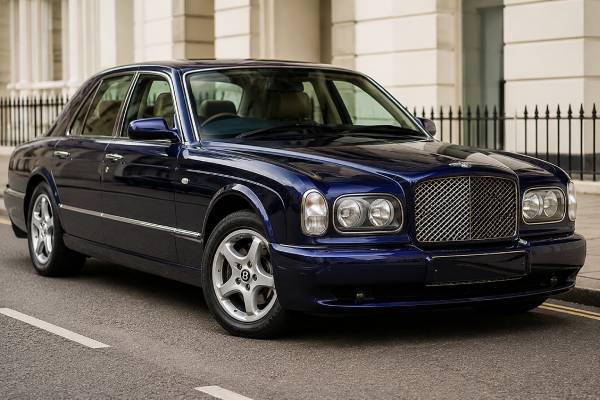
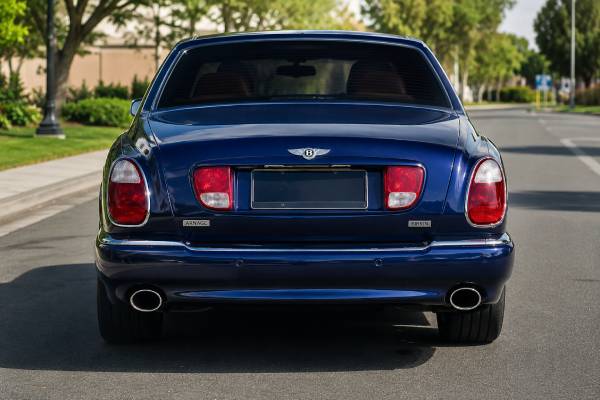
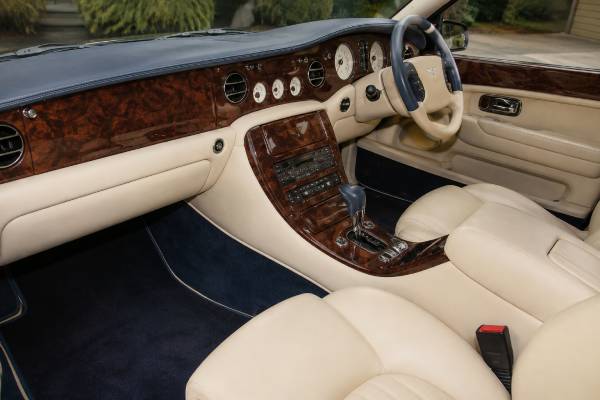
The Bentley Arnage Birkin is the rare closing chapter of the BMW-powered Arnage. Built across 2000 and 2001, it combines the 350 bhp twin-turbo 4.4-liter V8 and five-speed automatic of the Green Label with late first-series chassis improvements and a limited-edition identity honoring Bentley Boy Sir Henry “Tim” Birkin. Fifty-four cars were reportedly planned to echo the number of original Blower Bentleys, but 52 were completed. That small production makes authentication, originality, and documentation more important than ordinary used-car considerations. A genuine Birkin should not be valued simply as a Green Label with a special name, yet the name does not protect it from the same cooling, timing-chain, turbo, suspension, electrical, and trim risks faced by every early Arnage. The best purchase is a correctly identified chassis with its build record, proper instruments and equipment, careful preservation, and invoices that show regular specialist attention. Rarity magnifies both quality and mistakes.
Table of Contents
- Birkin Provenance and Production Story
- Authentication Clues That Matter
- Birkin Specifications and Technical Data
- Late Green Label Engineering Improvements
- How the Birkin Feels on the Road
- Preservation-Led Maintenance
- Buying a Birkin as a Car and Collectible
Birkin Provenance and Production Story
The Birkin was conceived as the final limited run of the 4.4-liter Arnage, linking the outgoing BMW-powered car to one of Bentley’s most famous racing personalities. Sir Henry “Tim” Birkin was a leading Bentley Boy and the force behind the supercharged 4½ Litre “Blower” Bentleys, so his name brings genuine historical weight.
The reported plan was to build 54 Birkin Arnages, matching the number of original Blower Bentleys. Production records commonly list 52 completed cars instead. Fifty were model-year 2000 examples and two were model-year 2001, with the great majority in right-hand drive. That distribution matters because a left-hand-drive Birkin is exceptionally uncommon and should receive especially careful documentary verification.
Mechanically, the Birkin remained a Green Label. It used the BMW-derived, Bentley-developed 4.4-liter twin-turbo V8 rather than the revived 6.75-liter engine of the Red Label. This makes the edition historically layered: it commemorates a very British racing figure while using the most internationally sourced powertrain fitted to a modern Crewe-built Bentley of its era.
The limited-edition idea was not based on a major increase in power. The attraction was the end-of-line specification, revised body and chassis features, distinctive instrumentation, improved accommodation, and scarcity. Buyers should therefore resist advertisements that imply a unique high-output engine unless the seller can produce factory evidence of a specific commissioning change.
The Birkin also sits at a transition point in Arnage development. Bentley had strengthened the body, stiffened the front suspension, enlarged the brakes, added parking assistance, redesigned the seats, and improved rear legroom. These changes moved the 4.4-liter car closer to the dynamic and comfort standard established by the Red Label while retaining the lighter engine and five-speed gearbox.
Because only 52 were made, the survival rate and present condition of each car can influence how the market perceives the edition. A complete, original car with a known chain of ownership is more valuable to the historical record than one heavily modified or assembled from mixed components. That does not mean every worn factory part must be preserved, but replacements and upgrades should be documented and reversible where practical.
Authentication Clues That Matter
A Birkin should be authenticated from the chassis record, build specification, and factory features together. A badge, seller description, or registration entry is not enough because Green Label parts can be exchanged and the limited-edition name is tempting to misuse.
The documented Birkin chassis sequence uses the Arnage B-series model identity and falls within a known range. The first and last recorded chassis numbers provide useful boundaries, but numbers were not necessarily produced in a simple uninterrupted block. The safest method is to obtain the individual build information and compare it with recognized production records.
Check the car’s original market and steering position. With 49 of the 52 cars recorded as right-hand drive, a left-hand-drive example should have unusually strong evidence. Its VIN, registration history, import documents, original sales paperwork, service books, and commissioned specification should tell one consistent story.
The instrument cluster is an important clue. Birkin references identify a distinctive three-dial arrangement rather than the standard five-dial presentation associated with other Arnages. Verify the exact appearance against period documentation and the build record. A replacement cluster may be legitimate after failure, but the reason, mileage handling, and original unit should be documented.
Equipment changes associated with the Birkin and late Green Label include front and rear park-distance control, revised seats, additional rear legroom, a lighter-effort steering calibration, a strengthened body shell, stiffer front suspension, and larger brakes. Some sources also cite an Alpine pop-up navigation system and power-folding mirrors. Because Bentley specifications varied by market and commission, absence of one optional convenience item is not proof against authenticity; the build sheet remains decisive.
Exterior badges, wheels, paint, and trim are supporting evidence. Inspect emblem mounting, paint around badge holes, wheel casting marks, spare wheel, tire size, lamp covers, and any signs that a car has been cosmetically updated. A later grille or wheels may have been installed after damage, but undocumented changes reduce confidence.
Inside, compare hide colors, piping, veneer, carpets, headlining, and stitching with the factory order. Bentley could build highly individual cabins, so a surprising combination may be genuine. Quality of execution is the key: factory leatherwork has consistent grain and stitching, veneer panels match across the cabin, and switches fit cleanly.
Mileage should be corroborated across instrument records, inspection certificates, service invoices, tire dates, seat wear, pedal condition, steering-wheel finish, and electronic diagnosis. On a rare car, a replacement odometer or cluster is not necessarily disqualifying, but the history must explain it transparently.
| Specification | Value |
|---|---|
| Model years | 2000 and 2001 |
| Production | 52 cars recorded; 54 were originally planned |
| Namesake | Sir Henry “Tim” Birkin, Bentley Boy and Blower Bentley advocate |
| Mechanical basis | Arnage Green Label with 4.4-liter twin-turbo V8 |
| Chassis identification | Arnage B-series identity; documented Birkin chassis range is essential for authentication |
| Steering distribution | Predominantly right-hand drive, with only a few left-hand-drive examples recorded |
Birkin Specifications and Technical Data
The Arnage Birkin is a petrol-powered, front-engine, rear-wheel-drive saloon based on the late 4.4-liter Green Label. Its performance is essentially that of the standard BMW-powered Arnage, while its body, seating, brakes, steering, parking assistance, and suspension incorporate late first-series improvements.
| Specification | Value |
|---|---|
| Engine family/code | BMW M62B44-based Bentley twin-turbo V8 |
| Displacement | 4,398 cc (4.4 L) |
| Layout | Longitudinal aluminum V8, DOHC, 32 valves |
| Induction | Two turbochargers with intercooling |
| Power | 350 bhp (261 kW) at 5,500 rpm |
| Torque | 570 Nm (420 lb-ft) in the midrange |
| Transmission | Five-speed adaptive automatic |
| Drive | Rear-wheel drive |
| Specification | Value |
|---|---|
| 0–100 km/h | Approximately 6.5 seconds |
| Top speed | 240 km/h (150 mph) |
| Fuel-tank capacity | 100 L (26.4 US gal) |
| Listed combined consumption | 14.8 L/100 km in period Australian-market data |
| Luggage capacity | About 374 L (13.2 cu ft) |
| Specification | Value |
|---|---|
| Length | 5,390 mm (212.2 in) |
| Width without mirrors | About 1,930 mm (76.0 in) |
| Height | 1,515 mm (59.6 in) |
| Wheelbase | 3,116 mm (122.7 in) |
| Front suspension | Stiffened independent control-arm arrangement with adaptive damping |
| Rear suspension | Independent self-leveling arrangement with adaptive damping |
| Brakes | Larger ventilated discs than the earliest 4.4-liter Arnage specification |
| Wheels and tires | 17-inch alloy wheels; typically 255/55 R17 tires |
| Specification | Value |
|---|---|
| Parking assistance | Front and rear park-distance control |
| Body structure | Further strengthened shell |
| Rear accommodation | Rear bench repositioned lower and farther back for roughly 50 mm more legroom |
| Seats | Redesigned seat construction |
| Steering | Revised assistance for lower effort at parking speeds |
| Headlamp covers | Plastic rather than the earlier glass covers |
| Instrument detail | Three-dial cluster is cited as a Birkin-specific identifying feature |
The specification tables should not be read as a promise that every Birkin left Crewe identically equipped. Bentley’s commissioning model allowed extensive choice, and market requirements differed. Engine, gearbox, principal dimensions, and edition identity should remain consistent; colors, trim, navigation, telephones, audio, and some convenience equipment may vary.
Late Green Label Engineering Improvements
The Birkin is more than an early Arnage with a plaque because it benefits from structural and chassis revisions introduced as Bentley developed the platform. The changes improve braking, rear accommodation, parking usability, and body control without replacing the essential 4.4-liter powertrain.
Additional shell stiffness gives the suspension a more stable foundation. A rigid body lets dampers and bushes control wheel movement rather than wasting energy flexing the structure. In practice, a sound Birkin should feel solid over diagonal bumps and should not produce creaks from door openings or the dashboard. Noise in those areas can indicate worn mounts, loose trim, corrosion, or previous structural repair.
The stiffer front suspension sharpens control of the lighter BMW-based engine package. It should not make the car harsh on its original 17-inch tires. If a Birkin crashes over small ridges, first examine tire age and pressure, wheel size, damper condition, bushes, and ride height rather than assuming that firmness is factory character.
Larger brakes address the demands of a car that weighs more than 2.3 tonnes and can reach 150 mph. Correct components are important because a mixture of early and later brake parts may complicate servicing. Measure disc thickness, inspect both faces, confirm caliper operation, and verify that replacement pads and discs match the actual system fitted.
The rear-seat changes are subtle but useful. Moving the rear bench lower and farther back creates approximately 50 mm of extra legroom, helping the standard-wheelbase Arnage serve rear passengers without the size of a long-wheelbase car. Inspect seat movement, memory functions, heating, belts, and clearance around the revised seat structure.
Parking sensors were a practical addition for a 5.39-meter saloon with limited visibility at its corners. They should detect obstacles consistently without false continuous tones. Failed sensors, damaged bumper wiring, or an improvised aftermarket replacement can be expensive to correct neatly.
The revised steering assistance aims to reduce effort at low speeds while retaining stability on the road. Heavy steering may indicate low pressure, pump or rack trouble, incorrect tire pressure, seized joints, or alignment problems. Excessively vague assistance can point to wear. The system should be judged after the tires and chassis have been confirmed correct.
Plastic headlamp covers replaced earlier glass covers. Inspect them for clouding, cracks, moisture, and poor previous polishing. Replacement availability and originality matter on a limited-edition car, so restoration should preserve lens shape and optical performance rather than relying on generic coatings.
How the Birkin Feels on the Road
A healthy Birkin feels smoother and more progressive than its 6.75-liter Red Label contemporary. The engine builds power with revs, the five-speed automatic provides more ratios, and the front end carries less mass. Its pace is discreet rather than theatrical.
From rest, throttle response should be clean and controlled. The car does not need a dramatic surge to feel quick; the key is uninterrupted acceleration as the turbochargers supply boost and the transmission moves through its ratios. Roughness, hesitation, smoke, or inconsistent boost is abnormal.
At motorway speed, the Birkin settles into its intended role. The long wheelbase, thick glazing, heavy structure, and adaptive damping isolate occupants, while the engine maintains speed without strain. Wind noise should remain low and the steering should require only small corrections. A car that wanders may have old tires, incorrect alignment, worn bushes, or steering play.
On a winding road, the Birkin rewards smooth inputs. Brake before the corner, allow the body to settle, then use the midrange torque on exit. Abrupt steering and throttle only emphasize mass. Driven with rhythm, the lighter powertrain and late chassis tuning make it unexpectedly composed.
The transmission should be almost invisible in gentle driving and decisive when asked for acceleration. Test manual or sport functions where fitted, but prioritize basic behavior: immediate engagement, no flare, no shunt, and no warning. A gearbox that behaves well cold but deteriorates hot may have fluid, valve-body, pressure, or internal wear issues.
Ride quality depends heavily on original-style wheels and fresh, correctly rated tires. Large aftermarket wheels can make the car look more modern while undermining the engineering that distinguishes it. A limited-edition buyer should regard the correct wheel set, including the spare and original fasteners, as part of the car’s identity.
Braking should be strong and linear. Because the cabin isolates noise, a driver can overlook gradual brake drag or wheel-bearing roughness. After a test drive, compare wheel temperatures cautiously and investigate a wheel that is noticeably hotter than the others.
The Birkin is not most enjoyable at maximum speed. Its appeal is the contrast between a formal, hand-crafted cabin and the fluent way the BMW-derived engine moves the car. That contrast is what a road test should reveal.
Preservation-Led Maintenance
Maintenance on a Birkin should protect both mechanical function and limited-edition integrity. The correct repair is one that restores reliability without erasing evidence of what the car was when built.
Cooling-system prevention remains the first mechanical priority. Inspect the radiator, fans, thermostat operation, pump, expansion tank, cap, turbo cooling plumbing, hoses, clamps, and signs of dried residue. Establish a baseline if records are incomplete. Do not accept repeated coolant top-ups as normal.
Use engine oil and filters appropriate to the exact Bentley application and service by elapsed time as well as mileage. Ask the specialist to inspect the old filter for debris and to note startup noise, oil pressure behavior, leaks, and crankcase ventilation. The chain drive has no simple belt interval, but guides and tensioning components age.
Turbo and intake systems should be pressure- or smoke-tested when performance is weak or mixture faults appear. Old hoses can split on the underside where they are difficult to see. Vacuum leaks, mass-airflow faults, oxygen-sensor aging, ignition issues, and boost leaks can overlap, so diagnosis should use live data rather than parts swapping.
The five-speed transmission, differential, steering, brakes, and self-leveling suspension need correct fluids and leak inspection. Service decisions should follow the car’s records and official procedures. An indiscriminate transmission flush on a unit without documented service history is not a substitute for diagnosis.
Electrical health begins with a correct battery, clean grounds, and stable charging. Rarely used cars are vulnerable to deep discharge. Use an appropriate maintainer when stored, but investigate abnormal drain instead of masking it. Alarm modules, aftermarket trackers, phones, and audio additions can create parasitic loads.
Preserve removed factory parts. If an obsolete navigation or telephone component is replaced for usability, label and store it with the car. Avoid cutting veneer, leather, or structural brackets. Photograph wiring before and after work and keep invoices that list part numbers.
The cabin needs controlled humidity and gentle materials. Keep water drains open, inspect door and trunk seals, lift carpets if dampness is suspected, condition hide without over-softening it, and protect veneer from heat. Matching a damaged Birkin-specific trim piece may be harder than repairing it early.
A sensible preservation schedule includes a comprehensive annual inspection, brake-fluid service at the official interval, regular air-conditioning operation, tire replacement by age, alignment checks after suspension work, and road use long enough to bring all fluids to temperature. Storage should be dry, ventilated, secure, and free from rodents.
Buying a Birkin as a Car and Collectible
The best Birkin is simultaneously authentic, mechanically sound, and usable. A car that satisfies only one of those categories creates an expensive dilemma: perfect provenance can be overwhelmed by neglect, while a beautifully restored driver may lose value if its identity is uncertain.
Request the factory build record before negotiating. Match it to the VIN, engine type, transmission, steering position, color, trim, instruments, wheels, and options. Review ownership history and check whether the car appears in recognized Birkin records. Any discrepancy should be resolved with evidence, not explanation alone.
Commission a specialist inspection that begins cold and ends after a heat-soak restart. Test cooling stability, boost, transmission behavior, adaptive damping, self-leveling, brakes, steering, parking sensors, air conditioning, seats, windows, locks, mirrors, instruments, audio, and alarm. Scan all accessible modules and retain a copy of the report.
Look closely at accident repairs. A rare car is not necessarily disqualified by a professional repair, but structural alignment, corrosion protection, paint match, correct lamps, bumper sensors, and original trim must be right. Poor work is costly to reverse and may affect how the car drives.
Evaluate completeness. Original books, keys, tools, spare wheel, navigation media, telephone equipment, plaques, removed parts, invoices, and sales literature add confidence. A missing small item can be disproportionately difficult to replace when only 52 cars were produced.
Budget for immediate recommissioning even when the car appears excellent. Fluids, tires, battery, hoses, air conditioning, brakes, suspension alignment, and cosmetic preservation may be due because of age rather than mileage. Keep a separate contingency for one unexpected electronic or cooling fault.
Do not pay a limited-edition premium for a badge-only story. Conversely, do not dismiss a properly documented Birkin because a standard Green Label appears cheaper. The edition’s appeal lies in its final-production context, Tim Birkin connection, scarce build count, and late improvements.
A Birkin is best owned by someone willing to retain records, preserve original parts, and drive the car enough to keep it healthy. It should not become a static display object unless it is maintained as rigorously as a road car. Mechanical exercise and historical preservation are compatible when every outing begins with proper checks and ends with attention to new symptoms.
The final decision should rest on evidence. A genuine 52-car edition with an honest history and a sorted chassis is a compelling modern Bentley collectible. An uncertain car with polished paint and no documents is simply a complex early Arnage wearing a persuasive story.
References
- Bentley Arnage 4.4L Birkin 2026 (Production and Chassis Data)
- Bentley Arnage 4.4L Birkin Parts Catalogue & Chassis Info | IntroCar 2026 (Parts and Identification)
- Bentley Arnage 2000 Birkin Edition Pricing & Specifications – carsales 2026 (Market Specifications)
- 1998-2009 2022 (Bentley Heritage Technical Library)
- 2000 Bentley Arnage – Motor Trend 1999 (Instrumented Road Test)
- Used car buying guide: Bentley Arnage | Autocar 2018 (Buying Guide)
Disclaimer
This article provides general information and does not replace professional diagnosis, repair, authentication, valuation, or inspection. Specifications, procedures, fluids, intervals, and torque values may differ by VIN, market, production date, and commissioned equipment; verify all technical work with the official service documents for the exact car.
Please share this Birkin guide on Facebook, X/Twitter, or a relevant Bentley community if it helps preserve accurate information about the edition.