
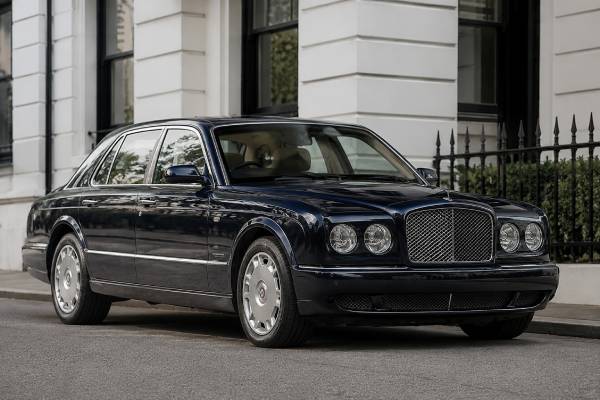
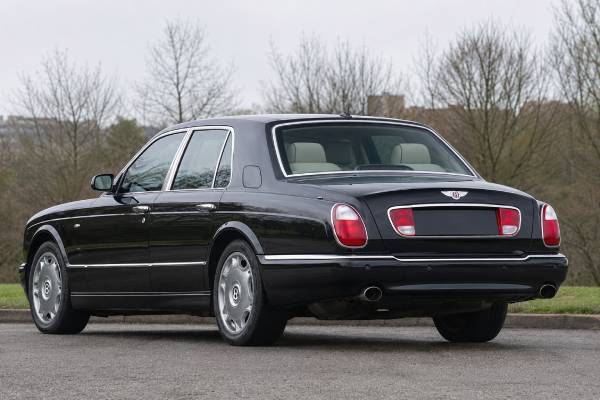
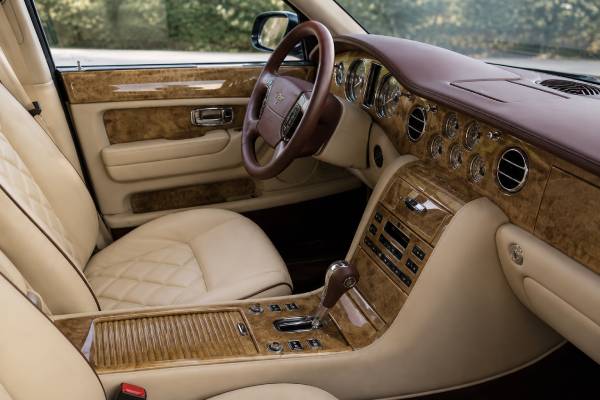
The 2006 Bentley Arnage Diamond Series with 400 hp is a commemorative Mulliner edition built to mark 60 years of Bentley production at Crewe. Only 60 Diamond Series cars were planned, and the model’s appeal comes from the way it layers identifiable anniversary details—diamond-pattern upholstery, special veneer work, stainless exterior accents, Union Jack badges, unique wheels, and the returning Flying B mascot—onto the refined Arnage R mechanical package.
That combination makes authenticity more important than simple mileage. Ordinary Arnages can be fitted with similar wheels, grilles, badges, or quilted leather, while genuine Diamond Series cars may have lost original details through repainting, accident repair, retrimming, or modernization. A strong purchase therefore begins with factory build information and a careful feature-by-feature inspection. Mechanically, the 400 hp version uses the 6.75-liter L410MT-family twin-turbo V8, 835 Nm of torque, rear-wheel drive, and a four-speed automatic. It is less forceful than the optional 450 hp Diamond, but its softer, torque-led character suits the edition’s grand-touring identity.
Table of Contents
- The Crewe Anniversary Edition
- 400 hp Specifications and Technical Data
- How to Authenticate a Diamond Series
- Driving the 400 hp Version
- Preserving Its Special Materials
- Mechanical Inspection and Care
- Collector Buying Strategy
Why the Diamond Series Matters
The Diamond Series is significant because it celebrates the factory and craftspeople behind the Arnage rather than a racing victory or a performance record. Bentley began producing cars at Crewe during the 1940s, and the 2006 edition marked six decades of work at the site with a run of 60 individually special saloons.
Its foundation was the Arnage R, the comfort-oriented model in the range. That choice shaped the car’s personality. Instead of turning the anniversary edition into a heavily stiffened sports saloon, Bentley emphasized hand-finished cabin details, formal exterior brightwork, and a broad choice of commissions. The standard 400 hp engine provided more than enough performance for the intended use, while buyers could specify the higher-output 450 hp version at extra cost.
This two-output arrangement is one reason the assignment must be treated precisely. A Diamond Series badge does not prove that the car has 450 hp, and a 450 hp engine does not automatically make a car a Diamond Series. The 400 hp car should be identified through its VIN, build sheet, engine specification, and original sales documents. Engine-bay appearance alone is not sufficient after years of repairs and parts substitution.
Production claims also require care. The edition is commonly described as a 60-car run, with most examples intended for the United States and a smaller number in right-hand drive. Because Mulliner cars were highly configurable and registration dates can differ from build dates, collectors should avoid assuming that every genuine example looks identical or was first registered in the same calendar year.
The best way to understand the model is as an anniversary specification rather than a separate engineering platform. Its core body, suspension, brakes, and drivetrain remain Series Two Arnage, while the unique value lies in the curated combination of visible details and documented provenance. That makes replacement with “close enough” parts more damaging to collector appeal than it might be on a regular Arnage R.
Bentley Arnage Diamond Series 400 hp Specifications and Technical Data
The 400 hp Diamond Series is a gasoline-powered, rear-wheel-drive luxury saloon using Bentley’s traditional 6.75-liter twin-turbo V8 and four-speed automatic. It delivers 835 Nm of torque, so its performance feels stronger than the horsepower figure suggests, especially from low and medium engine speeds.
| Item | Diamond Series 400 hp |
|---|---|
| Engine family | L410MT-series Bentley V8 |
| Configuration | 90-degree aluminum V8, overhead valves, 16 valves |
| Displacement | 6,750 cc |
| Induction | Twin turbochargers with intercooling |
| Maximum power | 400 bhp (298 kW) at 4,000 rpm |
| Maximum torque | 835 Nm (616 lb-ft) |
| Fuel requirement | Premium unleaded gasoline to the market-specific Bentley specification |
| Item | Specification |
|---|---|
| Gearbox | GM 4L80-E electronically controlled 4-speed automatic |
| Driven wheels | Rear |
| Engine management | Bosch electronic fuel-injection and ignition management |
| Driver aids | ABS, traction control, and electronic stability control |
| Character | High torque at low rpm with smooth automatic operation |
| Measurement | Approximate published value |
|---|---|
| Body | Four-door, five-seat luxury saloon |
| Wheelbase | 3,116 mm |
| Length | Approximately 5,390 mm |
| Width | Approximately 1,932 mm excluding mirrors |
| Height | Approximately 1,515 mm |
| Fuel tank | Approximately 96 liters |
| Boot volume | Approximately 374 liters |
| Item | Details |
|---|---|
| Suspension | Independent double wishbones, coil springs, self-leveling, and adaptive electro-hydraulic damping |
| Brakes | Ventilated disc brakes with ABS |
| Steering | Power-assisted rack and pinion |
| Top speed | Approximately 155 mph (250 km/h) for the 400 hp specification |
| 0–60 mph | Approximately six seconds, depending on test method and vehicle condition |
| Wheel package | Special 19-inch Diamond Series alloy wheels |
| Area | Typical Diamond Series feature |
|---|---|
| Front exterior | Stainless lower bumper treatment and retractable Flying B mascot |
| Body identification | Union Jack badges on the front wings |
| Cabin upholstery | Diamond-quilted hide treatment |
| Veneer | Special diamond-themed inlay or detailing |
| Wheels | Distinctive 19-inch design associated with the edition |
| Production intent | Limited anniversary run of 60 cars |
Exact colors, rear-seat arrangements, audio equipment, and Mulliner options differ from car to car. Treat the build record as the authority for the individual vehicle, especially where a feature could have been optional, deleted, or added later.
How to Authenticate a Diamond Series
Authentication should begin with documents and end with physical evidence. A collection of visible Diamond-style parts is not enough, because several features can be retrofitted and many ordinary Arnages were also commissioned through Mulliner.
Ask for the original order, build specification, sales invoice, service book, handbooks, and correspondence from Bentley or the supplying dealer. The VIN should match every document and every identification point on the vehicle. When records are incomplete, a Bentley dealer, heritage service, or recognized marque specialist may be able to confirm the factory build specification.
Next, inspect the exterior as a complete design rather than checking isolated badges. The special wheel design should be present in the correct size and finish. The stainless front-bumper details should fit with factory-level precision, not appear as loosely attached trim. Union Jack wing badges should be correctly positioned and consistent on both sides. The Flying B mechanism should retract and rise smoothly, sit square, and show no evidence of improvised wiring or corrosion.
Paintwork deserves particular attention because anniversary details can disappear during body repair. Check paint depth across adjacent panels, inspect the edges of badges and brightwork, and look for overspray on seals or fasteners. A repainted bumper is not automatically a problem, but the repair should preserve the proper stainless elements and mounting details. Uneven panel gaps or a bonnet mascot that no longer aligns with the radiator shell may indicate more than cosmetic work.
Inside, examine the quilting pattern, stitching, leather type, veneer inlays, plaques, treadplates, and any embroidered or personalized features. Factory work usually has consistent spacing, materials, and finish across the cabin. Later retrimming can be excellent, but it should be disclosed, photographed, and ideally retain the original design. A generic diamond-quilt pattern installed during resale preparation does not carry the same historical value as documented Mulliner upholstery.
The engine output must be verified separately. The 400 hp version uses the lower-output calibration associated with the Arnage R. Review the build sheet and engine-control information, and ask whether the engine or control modules have ever been changed. An aftermarket tune, replacement engine, or conversion to later components may improve performance but changes the car’s originality and can complicate emissions, diagnostics, and future parts matching.
Finally, assess whether all edition features have remained together. A genuine car missing its unique wheels, mascot, veneer, or badges can still be restored, but the cost and difficulty of finding correct parts should be reflected in the price. Documentation for removed original parts is valuable; a box of unidentified trim is not the same as a complete, labeled set.
What the 400 hp Diamond Series Is Like to Drive
The 400 hp Diamond Series delivers traditional Bentley pace with a calmer edge than the 450 hp alternative. Its defining sensation is the immediate availability of torque, not a rush toward the redline.
In normal driving, the four-speed automatic keeps the engine in a broad, quiet operating range. A light throttle input produces decisive movement without obvious turbo drama. When more acceleration is requested, the gearbox should select a lower ratio cleanly and the car should build speed in one sustained surge. Rough shifts, delayed engagement, a sudden flare in engine speed, or inconsistent boost are warning signs rather than normal behavior.
The Arnage R chassis tune is well matched to the anniversary model. It allows some body movement but should never feel uncontrolled. On a flowing road, the car settles into long arcs with accurate steering and strong stability. On poor surfaces, the adaptive dampers and tall sidewalls of the original tire specification preserve the dense, composed ride expected of a Crewe saloon.
The 400 hp car also has a useful ownership advantage: it discourages buyers from judging the vehicle solely by maximum output. A correctly maintained 400 hp Diamond can feel more satisfying than a neglected 450 hp example because throttle response, transmission quality, suspension control, tire condition, and brake confidence determine the real experience. The difference between the outputs is noticeable, but it does not override condition.
At motorway speed, wind noise should be low, the steering should remain stable, and the temperature gauge should hold steady. The climate system must cool the large cabin without the engine temperature rising abnormally in traffic. Listen for wheel-bearing hum, propeller-shaft vibration, trim rattles, and differential noise with the audio system off.
Because many Diamond Series cars have low recorded mileage, include repeated hot restarts and a long enough drive to bring every system to operating temperature. Cars that spend long periods stationary can develop tire flat spots, sticking brakes, weak batteries, dried seals, stale fuel, and air-conditioning faults despite appearing immaculate in a showroom.
Preserving the Diamond Series Interior and Exterior
The rare trim is part of the car’s identity, so preservation should be planned with the same care as mechanical servicing. Aggressive cleaning, casual retrimming, and modern accessories can do lasting harm even when the intention is improvement.
For the leather, use products suitable for the original hide finish and avoid saturating perforations, seams, or quilted panels. Diamond quilting creates many stitch lines where dirt and moisture can collect. Clean gently with controlled amounts of product, support the leather while working, and address early shrinkage before seams become heavily stressed. Photograph the original stitching and panel layout before any repair.
Veneer should be inspected in changing light. Fine cracks in the clear finish, cloudy areas, lifting edges, or movement around inlays may not be obvious under showroom lighting. Repair is specialist work because the goal is to preserve the substrate and pattern, not simply sand away historical material. Matching a unique inlay can be much harder than refinishing ordinary burr walnut.
Stainless exterior trim needs cleaning without heavy abrasion. Polishing too aggressively can alter the factory finish and round sharp edges. Confirm that fasteners and backing pieces remain secure, especially after bumper removal. The wing badges and mascot should not be treated as handles when washing or covering the car.
The special wheels are vulnerable to corrosion, curb damage, and incorrect refinishing. Before refurbishment, record the original surface, spoke details, center caps, and markings. Use a repairer capable of checking runout and structural condition, not only applying new paint. Fit tires with the correct dimensions, load rating, speed rating, and date freshness; a collector car still needs safe road tires.
Storage should be dry, ventilated, and electrically managed. Use a compatible battery maintainer, avoid plastic covers that trap moisture, keep rodents away from wiring and insulation, and move or correctly support the car to protect tires. Exercise the air conditioning, seats, windows, locks, and mascot periodically rather than allowing every motor and seal to remain dormant for months.
Modifications should be reversible. A discreet modern audio source, phone interface, or navigation solution can improve use, but cutting unique veneer or replacing original controls damages the edition’s integrity. Keep removed components, label them, and document the wiring so a future owner can return the car to factory presentation.
Mechanical Inspection and Care
A Diamond Series requires the same rigorous mechanical baseline as any Arnage, with added concern for low-use deterioration. The anniversary specification does not reduce the demands of a large twin-turbo V8, adaptive suspension, powerful brakes, and extensive electrical equipment.
Engine and cooling system
Inspect from cold. Confirm coolant level and condition, check the radiator and expansion system, inspect hoses and fan operation, and look for residue around joints. During the road test, include traffic, steady cruising, and a hot shutdown. A stable temperature reading is essential. Any sign of overheating, coolant pressurization, repeated top-ups, or sweet odor in the cabin requires diagnosis before purchase.
Check for oil leakage with the undertrays removed where possible. Listen for abnormal tapping or knocking, assess idle quality, and observe exhaust smoke at startup and after a period of idling. Review service invoices for oil changes by time, not merely mileage. A car that traveled only a few hundred miles per year still needed regular fluid and filter service.
Fuel, ignition, and turbo systems
The engine should pull evenly without misfire or hesitation. Inspect turbo plumbing, boost-control hoses, ignition components, and heat-affected wiring. Fuel odor must be treated seriously, and recall completion should be checked by VIN. Ask whether fuel lines, pumps, injectors, ignition coils, or turbochargers have been replaced and whether the work was carried out as a matched diagnosis rather than a sequence of guesses.
Gearbox and driveline
The four-speed automatic should engage Drive and Reverse promptly, shift smoothly at light throttle, and respond decisively to kickdown. Test it only after the fluid is warm. Check for leaks, cooler condition, mount deterioration, propeller-shaft vibration, and differential noise. Service claims should be supported by invoices stating the fluid, filter, and work performed.
Suspension, steering, and brakes
Look for leaking dampers, uneven ride height, worn bushes, cracked ball-joint boots, corroded springs, and tire wear on the inner shoulders. The car should not continue bouncing after a bump or wander on a flat road. Steering effort should be consistent, and braking should remain straight and free of vibration.
Measure the brakes and inspect both faces of each rotor. Low annual mileage can promote corrosion and sticking calipers. Verify the age and specification of the tires and check the wheels for buckles or poor prior repairs. A cosmetic wheel refurbishment can mask impact damage without correcting it.
Electrical and cabin systems
Begin with battery condition and charging voltage. Low voltage can trigger misleading warnings and intermittent failures. Test every seat movement, heater, window, mirror, lock, lamp, climate setting, parking aid, audio source, navigation component, and mascot cycle. Scan all available control modules before and after the drive, then investigate faults rather than clearing them for presentation.
How to Buy the Right 400 hp Diamond Series
The best 400 hp Diamond Series is the most complete, documented, and mechanically healthy example—not automatically the lowest-mileage or most highly polished car. Rarity increases the importance of provenance, but it does not excuse deferred maintenance.
Prioritize the purchase in this order:
- Confirm the factory identity, 400 hp specification, and original Mulliner build.
- Verify structural integrity, accident history, and completeness of special parts.
- Obtain an Arnage-specialist mechanical and diagnostic inspection.
- Price immediate safety and reliability work using real quotations.
- Evaluate cosmetics and collector desirability only after the first four steps.
A car with a continuous history and carefully preserved original materials may justify a premium even if its paint shows light use. Conversely, a freshly detailed example with missing records, nonfunctioning special equipment, old tires, and unexplained warning lights is a restoration project regardless of mileage.
Consider how you will use the car. For frequent touring, favor a mechanically sorted example with functional air conditioning, current tires, and sympathetic upgrades that preserve originality. For a collection, complete books, tools, keys, remotes, original wheels, build documents, and period accessories carry extra weight. In either case, the car should be exercised regularly and serviced by people who understand the Arnage rather than stored indefinitely.
The 400 hp version is often overshadowed by the optional 450 hp car, but that can be an advantage. It offers the same anniversary story and most of the visible special features with the smoother Arnage R powertrain tune. Buyers who value craftsmanship over output may find it the more coherent specification.
Plan a reserve after purchase. Even an excellent car can need batteries, tires, fluid service, air-conditioning work, suspension bushes, or correction of old electrical additions. Establishing a documented baseline protects both the driving experience and the car’s future value. Once correctly sorted, the Diamond Series is more than a decorated Arnage: it is a concentrated record of Crewe’s traditional skills at a pivotal point in Bentley history.
Insurance and storage arrangements should also reflect the car’s limited-edition status. Agree how the insurer will value unique trim, confirm that specialist repair and recovery are permitted, and keep current photographs of the exterior, cabin, engine bay, documents, and numbered details. Store copies of the build sheet and major invoices away from the vehicle. These steps will not prevent a loss, but they make it easier to establish what the car was and what correct reinstatement would require.
References
- Bentley Arnage Diamond Series 2006
- 2006 Bentley Arnage 2025
- Iconic Auctioneers | 2006 Bentley Arnage ‘R’ Diamond Series-Sold 2026
- 2006 Bentley Arnage Trims Comparison [+ Chart] 2006
- 2006 Bentley Arnage: What’s New 2006
- Bentley Arnage Recalls 2026 (Recall Database)
Disclaimer
This article is for informational purposes and is not a substitute for professional diagnosis or repair. Specifications, torque values, intervals, equipment, and procedures can differ by VIN, market, and Mulliner commission; verify them against official Bentley service documentation for the exact vehicle. Please share this article on Facebook, X/Twitter, or another platform if it supported your research.