
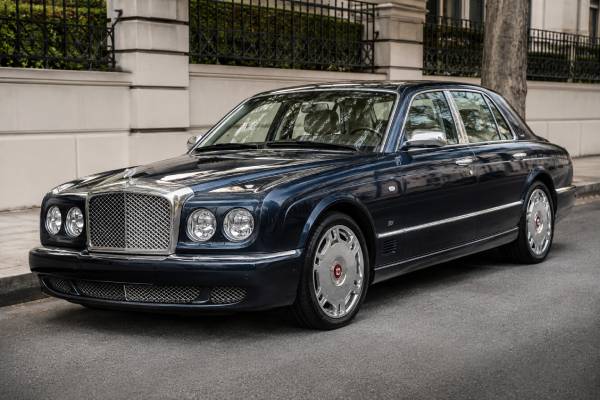
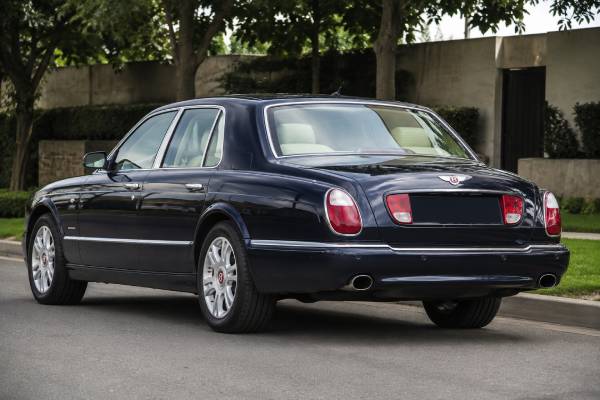
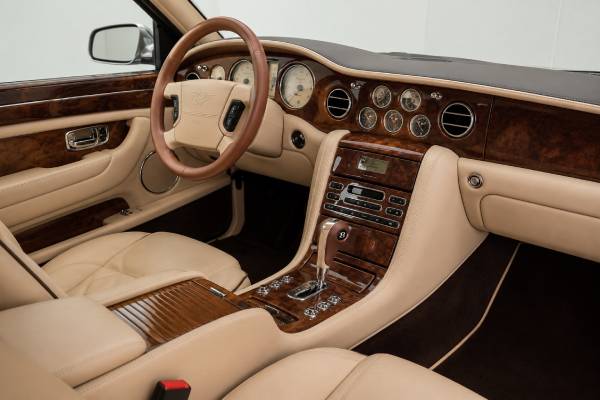
The 450 hp Bentley Arnage Diamond Series is the rare high-output form of Bentley’s 2006 Crewe anniversary edition. It combines the Diamond Series’ limited-run Mulliner details with the stronger 6.75-liter twin-turbo V8 tune normally associated with the contemporary Arnage T: 450 bhp and 875 Nm, sent to the rear wheels through a four-speed automatic. The result is unusual because its appearance and cabin celebrate craftsmanship, while its acceleration approaches the performance flagship.
For a buyer, the essential task is proving both halves of that identity. A genuine Diamond Series car can have the standard 400 hp engine, and an ordinary Arnage can carry 450 hp. The correct car needs documentary evidence of the anniversary build and the optional high-output specification. It should also retain the edition’s unique exterior and interior pieces. Once identity is established, condition dominates: heat management, turbo plumbing, transmission behavior, adaptive suspension, brakes, tires, electrical health, and the preservation of bespoke trim determine whether the car is a usable grand tourer or an expensive recommissioning project.
Table of Contents
- A High-Output Anniversary Model
- Technical Specifications
- Arnage R Chassis with Arnage T Power
- Verifying the 450 hp Specification
- Performance, Braking, and Tires
- Maintenance: Heat, Age, and Complexity
- Buying and Valuing the 450 hp Diamond
Why the 450 hp Diamond Series Is Unusual
The 450 hp Diamond Series occupies a narrow space between a commemorative Arnage R and the overtly sporting Arnage T. Bentley based the edition on the refined R, then allowed buyers to order the higher-output engine, creating a car with the softer visual and chassis emphasis but the T’s substantial power and torque.
That distinction is more meaningful than a 50 hp difference on paper. The 450 hp calibration raises torque from 835 Nm to 875 Nm and gives the car stronger acceleration at road speeds. It also adds thermal and drivetrain demands that make maintenance quality especially important. A car can look perfect in its diamond-quilted cabin while hiding aged turbo hoses, marginal cooling, old tires, or a transmission that has not been serviced correctly.
The anniversary context remains central. Bentley planned 60 Diamond Series cars to celebrate 60 years of production at Crewe. Special features typically included diamond-pattern hide, distinctive veneer work, Union Jack wing badges, stainless front-bumper detailing, unique 19-inch wheels, and a retractable Flying B mascot. The exact color, seating, audio, and Mulliner options varied, but the car should present as a coherent factory commission rather than a collection of later accessories.
Collectors sometimes assume that the highest-output version must automatically be the most desirable. It is rarer in specification, but desirability still depends on evidence. A documented 400 hp car with complete original trim and excellent mechanical history can be a better purchase than a claimed 450 hp example with no build sheet, changed control modules, missing anniversary parts, or unexplained engine work.
The model also marks the end of an era in the Arnage powertrain. The 2006 high-output engine still uses the L410MT-era hardware and four-speed automatic. The 2007 range moved to the extensively revised L410TT specification, low-inertia turbochargers, roller tappets, updated management, and a six-speed ZF transmission. The Diamond 450 therefore delivers near-late-model performance through the earlier mechanical package, which gives it a distinct character and parts profile.
Bentley Arnage Diamond Series 450 hp Technical Specifications
The 450 hp Diamond Series is a front-engine, rear-wheel-drive internal-combustion saloon. Its 6.75-liter pushrod V8 uses twin turbochargers and intercooling, producing 875 Nm of torque through a heavy-duty four-speed automatic.
| Parameter | Value |
|---|---|
| Engine family | Bentley L410MT-series high-output specification |
| Architecture | 90-degree aluminum V8, central camshaft, overhead valves, 2 valves per cylinder |
| Displacement | 6,750 cc |
| Bore and stroke | Approximately 104.1 mm × 99.1 mm |
| Induction | Twin turbochargers with intercooling |
| Maximum power | 450 bhp (approximately 336 kW) at about 4,100 rpm |
| Maximum torque | 875 Nm (645 lb-ft) at about 3,250 rpm |
| Parameter | Specification |
|---|---|
| Transmission | GM 4L80-E 4-speed automatic |
| Drive | Rear-wheel drive |
| Stability control | Electronic stability and traction-control systems |
| Suspension control | Adaptive electro-hydraulic damping with self-leveling |
| Steering | Power-assisted rack and pinion |
| Item | Published figure |
|---|---|
| Body style | Four-door luxury saloon |
| Wheelbase | 3,116 mm |
| Overall length | Approximately 5,390 mm |
| Body width | Approximately 1,932 mm excluding mirrors |
| Height | Approximately 1,515 mm |
| Fuel capacity | Approximately 96 liters |
| Luggage capacity | Approximately 374 liters |
| Measure | Representative published figure |
|---|---|
| Top speed | 168 mph (270 km/h) |
| 0–60 mph | Approximately 5.5 seconds |
| Power delivery | Peak output near 4,100 rpm with strong low- and mid-range torque |
| Fuel economy context | Very high consumption by modern standards; condition and use strongly affect results |
| Emissions context | Market-specific certification; verify the exact vehicle and registration jurisdiction |
| Area | Configuration |
|---|---|
| Suspension layout | Independent double wishbones front and rear with coil springs |
| Brakes | Ventilated discs with ABS |
| Wheels | Edition-specific 19-inch alloys |
| Front detailing | Stainless lower-bumper elements and retractable Flying B |
| Edition badges | Union Jack front-wing badges and model-specific cabin details |
| Interior | Diamond-quilted hide and special veneer treatment, with individual Mulliner options |
Values can vary slightly by market and measurement convention. Do not transfer tire pressures, fluid specifications, torque settings, or emissions data from a 400 hp Diamond, a 2007 Arnage, or a visually similar T without confirming the VIN and official service information.
How the Arnage R Chassis Works with Arnage T Power
The 450 hp Diamond’s appeal comes from pairing forceful acceleration with a comfort-led chassis. It is not as visually aggressive as an Arnage T, and its anniversary mission favors polished long-distance travel over an overt sports-saloon identity.
The independent double-wishbone suspension, adaptive dampers, and self-leveling system have to manage a heavy steel-bodied saloon while isolating occupants from sharp road inputs. In good condition, the result is controlled softness: the body moves over long undulations but settles promptly, and the steering remains accurate enough to place the large car confidently.
A worn car behaves very differently. Weak dampers, tired bushes, incorrect ride height, old tires, or poor alignment can turn the same compliant setup into float, tramlining, steering delay, and uneven braking. Because the 450 hp engine can build speed so quickly, chassis deterioration is more than a comfort issue. The car must be able to maintain geometry and tire contact under acceleration, cornering, and braking.
The four-speed automatic is part of the model’s character. It has fewer ratios than the later six-speed unit, so each gear covers a broad speed range and the engine’s torque does much of the work. Smoothness matters more than shift frequency. At light throttle, changes should be nearly unobtrusive; under load, the gearbox should respond without flare or a heavy impact.
Compared with a standard 400 hp Diamond, the 450 hp car feels more urgent when overtaking and less dependent on a downshift. Compared with a 2007–2009 Arnage T, it has older turbo and valvetrain technology, the four-speed transmission, and a less extensively revised electronic relationship between engine and gearbox. Some drivers prefer this muscular simplicity, while others will find the later car more polished and responsive.
The brakes and tires determine how usable the additional output feels. Correct high-quality tires give the steering weight and wet-road security the chassis expects. Cheap or aged tires can make the car spin its rear wheels, follow road grooves, and trigger stability-control intervention even when the suspension itself is healthy.
How to Verify a Genuine 450 hp Diamond Series
Verification requires two separate proofs: that the car left Bentley as a Diamond Series and that it was built with the 450 hp option. Neither should be inferred from badges, exhaust tips, an advertisement, or a seller’s recollection.
Begin with the factory specification. The VIN, original invoice, build sheet, supplying-dealer records, service book, and any Bentley heritage correspondence should agree. Ask specifically where the high-output engine appears in the documentation. A reference to “Diamond Series” alone may identify only the commemorative package.
Inspect the engine and control system with a specialist. The engine identification, turbo specification, management hardware, software information, and supporting components should be consistent with the 450 hp L410MT-era installation. Replacement control modules or a remap can make electronic identification less straightforward, so historical invoices matter. A dyno sheet is not a substitute for factory provenance and can introduce questions about how the car was tested.
Confirm the anniversary equipment independently. Check the retractable mascot, stainless bumper treatment, correct 19-inch wheels, wing badges, diamond quilting, veneer details, treadplates, and any numbered or commission-specific identifiers. Compare the car with period photographs and its own build record rather than assuming every one of the 60 cars had the same options.
Look for evidence of cloning or incomplete restoration:
- Badges positioned inconsistently or attached over later paint
- Generic quilted leather with incorrect stitch scale or panel design
- Wheels in the right general style but wrong dimensions or markings
- Missing stainless components after bumper repair
- A mascot installed without the correct factory mechanism
- Build documents that identify a standard Arnage R or T rather than the special edition
- Engine-output claims unsupported by the original order or diagnostic evidence
A genuine car that has lost parts is not necessarily a bad purchase, but restoration should be costed realistically. Unique trim may require specialist fabrication, and an inaccurate reproduction can reduce value even when it looks attractive. Original removed items, photographs before repair, and detailed invoices are all useful.
Check the chronology. The car should fit the 2006 anniversary program, but build, model-year, sale, and registration dates need not be identical. Imported vehicles may have titles that simplify the model name or horsepower. Resolve discrepancies before money changes hands, especially when a price premium is based on rarity.
Performance, Braking, and Tire Requirements
The 450 hp Diamond is genuinely fast for a large hand-built saloon, reaching 60 mph in roughly 5.5 seconds and a published 168 mph under suitable conditions. Those numbers make the condition of every speed-related system critical.
Acceleration should be seamless. From low rpm, the car should respond strongly without a pronounced pause, misfire, or sudden uneven surge. A small amount of turbo delay is normal for the period, but an extended dead zone followed by abrupt boost may indicate leaks, control faults, ignition weakness, or turbo wear. Test full-load behavior only after the engine is warm and basic safety has been confirmed.
The transmission must be evaluated through several patterns: gentle takeoff, moderate throttle, kickdown, manual range selection, stop-and-go traffic, and a hot restart. A cold gearbox can mask symptoms that appear after fluid temperature rises. Delayed reverse, slipping between ratios, repeated hunting, or a shunt when selecting Drive should be diagnosed before purchase.
Brake testing should be progressive, not abusive. Begin with light applications and observe pedal consistency, steering pull, vibration, noise, and the car’s ability to stop straight. After several moderate stops, confirm that the pedal and response remain stable. Corroded inner rotor faces, sticking calipers, old fluid, aged hoses, and worn suspension joints can all undermine braking even when the outer rotor surface looks presentable.
Tires are a safety component, not a cosmetic detail. Check the precise size, load index, speed rating, date codes, manufacturer consistency, tread depth across the full width, and inner sidewalls. The original 19-inch package needs tires capable of carrying the Arnage’s mass at high speed. A low-mileage tire can still be unsafe because rubber hardens with age.
Wheel condition affects more than appearance. Inspect for cracks, welds, bends, corrosion around the bead, damaged mounting faces, and missing center-cap parts. Measure runout if vibration is present. Refinished wheels should retain the correct design and should not conceal excessive material removal or poor structural repair.
On the road, a healthy car should track with little correction, absorb a bump without repeated oscillation, and remain stable under power. Stability-control activity on a dry, straight road may point to tire mismatch, wheel-speed sensor faults, alignment problems, or uneven torque delivery rather than excessive power alone.
Maintenance Risks: Heat, Age, and Complexity
The greatest risk is accumulated neglect across many interdependent systems. The 450 hp tune raises heat and load, while low collector mileage can allow seals, fluids, contacts, batteries, brakes, and air-conditioning components to age without regular exercise.
Cooling first
Treat cooling-system integrity as the first mechanical priority. Inspect the radiator, expansion system, hoses, clamps, fans, thermostat operation, and signs of dried coolant. Verify temperature stability in traffic and after a sustained climb. Repeated coolant loss, pressure remaining unusually high after cooling, or a history of overheating requires deeper investigation.
The engine bay should also be checked for heat-damaged wiring, brittle hoses, and deteriorated insulation. Turbochargers and exhaust components create high local temperatures, so a repair that addresses only the failed hose may not correct nearby aging.
Lubrication, turbochargers, and ignition
Review oil-change history by date. Check for active leaks, smoke, unusual noises, and oil contamination in induction plumbing. Inspect turbo oil and coolant connections and confirm that both sides deliver consistent boost. A misfire under load can arise from ignition, fueling, compression, wiring, or boost problems; replacing parts without diagnosis becomes expensive quickly.
After a hard drive, allow appropriate cool-down rather than switching off immediately after maximum load. Regular owners should also avoid repeated cold starts followed by very short movement, which adds moisture and fuel dilution without fully warming the engine and exhaust.
Transmission and driveline
Fluid and filter service must use the correct specification and procedure for the Bentley installation. Inspect the cooler, lines, mounts, propeller shaft, differential, and driveshaft joints. If the car has been tuned beyond factory output, ask how the transmission and cooling were considered; undocumented modifications increase uncertainty.
Suspension and brakes
Check adaptive-damper operation, self-leveling behavior, ride height, bushes, ball joints, steering rack, wheel bearings, brake pipes, hoses, rotors, pads, and parking-brake operation. Any corrosion or previous repair around suspension pickups and subframes deserves careful assessment. Use a lift and remove covers where necessary.
Electrical and bespoke systems
Start with batteries and charging. Scan every available module, test all warning lamps, and operate the mascot repeatedly. Then test seats, heaters, windows, mirrors, locks, climate control, parking assistance, audio, navigation, telephone hardware, and any Mulliner equipment. Keep remotes, codes, diagrams, and removed components with the car.
Recall completion should be verified by VIN in the relevant market. Arnage campaigns included fuel-line, wheel-bolt, and retractable-mascot issues affecting particular years or vehicles. Registration changes and imports can make records incomplete, so use a Bentley dealer or official database rather than relying only on a seller’s file.
Buying and Valuing the 450 hp Diamond
Value rests on the intersection of rarity, authenticity, condition, and usability. A high-output claim raises interest, but only documented factory specification justifies a collector premium.
Commission a pre-purchase inspection from an Arnage specialist who can confirm identity, perform diagnostic scans, inspect the underside, evaluate the transmission hot, and understand Mulliner trim. General exotic-car experience is helpful, but knowledge of the Crewe V8, adaptive suspension, and model-specific electronics is more important.
Build a written cost plan in three groups. The first is safety: tires, brakes, steering, suspension joints, fuel leaks, recalls, and structural issues. The second is reliability: cooling, batteries, charging, fluids, turbo plumbing, ignition, air conditioning, and transmission condition. The third is preservation: veneer, leather, wheels, stainless trim, badges, mascot, and obsolete cabin electronics. Do not spend the cosmetic budget before the safety and reliability groups are understood.
Mileage should be interpreted alongside time and use. A 10,000-mile car may need extensive recommissioning after years of static storage. A 50,000-mile car with regular long journeys, annual servicing, and recent suspension and cooling work may be the healthier machine. Look for invoices that describe faults, test results, parts, and labor rather than vague entries such as “full service.”
The color and commission can materially affect desirability. Original, well-preserved combinations with complete documentation generally have stronger collector appeal than fashionable retrims. Personalization does not need to be universally popular, but it should be authentic and coherent. Keep in mind that highly individual colors or monograms may narrow the resale audience.
Compare the car with three alternatives: the 400 hp Diamond Series, a standard 2006 Arnage T, and the revised 2007–2009 Arnage range. The 400 hp Diamond offers the anniversary package with a calmer engine tune. The standard T provides similar output without the Diamond premium. The later T adds 500 hp, 1,000 Nm, low-inertia turbochargers, and a six-speed automatic. The 450 hp Diamond is the right choice when the combination of anniversary provenance and earlier high-output character matters more than obtaining the newest engineering.
Once purchased, document a baseline with photographs, diagnostic reports, fluid dates, tire codes, battery tests, and the condition of every unique feature. Agree an insurance value that recognizes rare trim and specialist repair. Keep a separate inventory of original tools, keys, remotes, books, covers, and removed parts, because these small items become disproportionately difficult to replace on a 60-car edition. Arrange recovery through a provider comfortable with low-clearance, heavy luxury cars, and identify a specialist before a breakdown occurs. A transport operator should know the approved towing points and avoid loading methods that can damage the long nose, undertrays, suspension, or special bumper trim. Used regularly and maintained preventively, the 450 hp Diamond Series can deliver exactly what its specification promises: discreet commemorative craftsmanship backed by serious, effortless performance.
References
- Bentley Arnage Diamond Series 2006
- 2006 Bentley Arnage 2025
- Iconic Auctioneers | 2006 Bentley Arnage ‘R’ Diamond Series-Sold 2025
- 2006 Bentley Arnage Trims Comparison [+ Chart] 2006
- 2006 Bentley Arnage – Specs, Prices, MPG, Reviews & Photos 2006
- Bentley Arnage Recalls 2026 (Recall Database)
Disclaimer
This article is for informational purposes and does not replace professional diagnosis or repair. Specifications, torque values, service intervals, software, and equipment vary by VIN, market, and Mulliner commission; confirm all procedures and values with official Bentley documentation for the exact car. Please share this guide on Facebook, X/Twitter, or another platform if it was useful.