
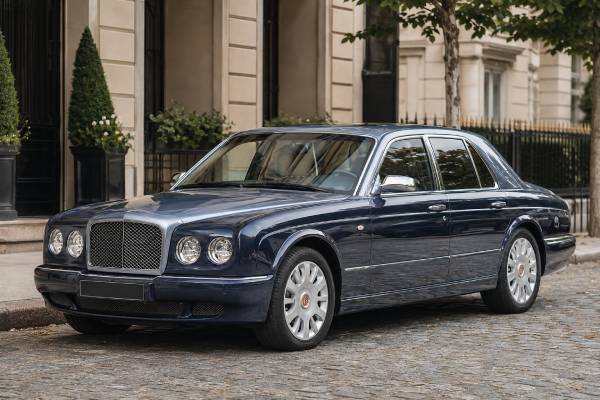
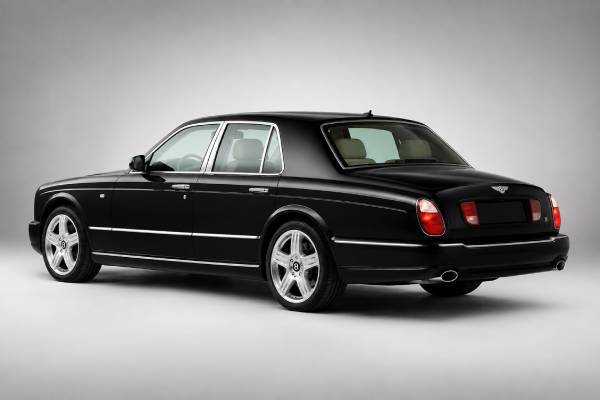
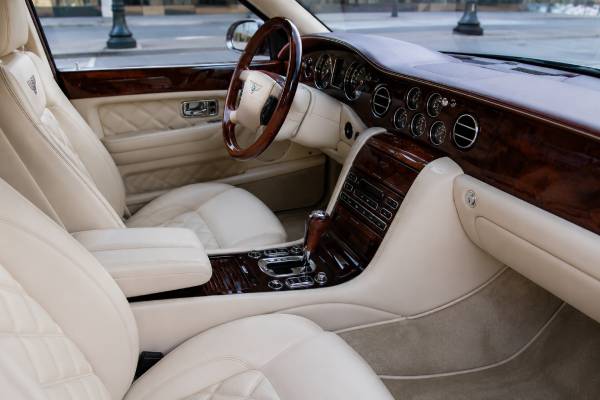
The 2007–2009 Bentley Arnage R is the late Arnage for buyers who want effortless speed without the firmer, more overtly sporting character of the Arnage T. Its hand-built 6.75-liter twin-turbo V8 produces 450 hp and 875 Nm of torque, while a six-speed ZF automatic gives the huge sedan calmer cruising and more responsive intermediate gears than the earlier four-speed model. The result is not a slow alternative to the T; it is a different interpretation of performance, built around quiet authority, supple ride quality, and long-distance composure. Because every Arnage is now an aging, low-volume luxury car, condition matters far more than mileage alone. Cooling, hydraulics, suspension, electronics, tires, brakes, corrosion, and service documentation all deserve close attention. This guide explains what changed for 2007, how the R feels on the road, which specifications matter, what ownership requires, and how to separate a well-kept example from a deferred-maintenance liability.
Table of Contents
- Where the Late Arnage R Fits
- Arnage R Technical Data and Specifications
- How the 450 hp V8 and Six-Speed Changed the Car
- Ride, Steering, Braking, and Real-World Performance
- Maintenance Priorities and Age-Related Risks
- Inspection and Test-Drive Method
- Choosing the Right Arnage R
Where the Late Arnage R Fits
The late Arnage R is the comfort-led standard-wheelbase model, not a detuned Arnage T and not a short version of the chauffeur-focused RL. Its purpose is to combine a traditional Bentley cabin and soft-edged ride with enough torque to move more than 2.5 tonnes without strain.
For the 2007 model year, Bentley revised the entire Arnage range. The R and long-wheelbase RL rose from 400 hp to 450 hp, torque increased from 835 Nm to 875 Nm, and the old four-speed automatic gave way to a computer-controlled six-speed transmission. The T received 500 hp and a more aggressive chassis personality, but the R retained the more relaxed suspension calibration, less theatrical exterior detailing, and a cabin atmosphere suited equally to driving or being driven.
That distinction matters in the used market. An Arnage R buyer is usually better served by a car that rides correctly on standard-size wheels, has complete maintenance records, and retains its original comfort-oriented specification than by one modified to imitate a T. The R’s appeal lies in the way it absorbs distance. At modest throttle openings, the engine rarely needs to rev hard. The transmission keeps the V8 near its torque plateau, wind noise remains low, and the cabin’s thick hides, deep carpets, polished veneer, and substantial switchgear create a sense of occasion that modern mass-produced luxury cars reproduce differently.
There are three practical reasons to seek an R rather than another late Arnage:
- It offers the standard 3,116 mm wheelbase, which is easier to place and garage than an RL.
- Its 450 hp output is already sufficient for rapid highway travel, yet its chassis tune favors comfort over sharpness.
- It often attracts less collector attention than a Final Series or exceptional T, allowing condition-focused buyers to prioritize history and specification.
None of those advantages makes it inexpensive to run. The Arnage R was a hand-built flagship with complex self-leveling suspension, large brakes, specialized tires, extensive leather and veneer, and many parts produced in modest quantities. Purchase price is only the entrance cost. A realistic plan includes specialist inspection, immediate fluid and rubber-item review, a contingency reserve, and regular use rather than prolonged storage.
Arnage R Technical Data and Specifications
The 2007–2009 Arnage R is a rear-wheel-drive, gasoline-powered luxury sedan using Bentley’s 6,761 cc L410-family twin-turbo V8 and a ZF six-speed automatic. Its defining numbers are 450 hp, 875 Nm, a 168 mph top speed, and a 5.5-second 0–60 mph time, but the low-rev torque and considerable mass explain its character better than peak output alone.
| Engine | 6,761 cc aluminum V8, pushrod valvegear, twin turbochargers |
|---|---|
| Engine family | Bentley L410TT |
| Fuel | Premium unleaded gasoline |
| Maximum power | 450 bhp (336 kW) at 4,100 rpm |
| Maximum torque | 875 Nm (645 lb-ft) at 1,800 rpm |
| Transmission | ZF six-speed automatic with sport and manual-selection functions |
| Drive layout | Front-engine, rear-wheel drive |
| 0–60 mph | 5.5 seconds |
|---|---|
| 0–100 km/h | 5.8 seconds |
| Maximum speed | 168 mph (270 km/h) |
| Combined fuel consumption | Approximately 14.5 mpg imperial (19.5 L/100 km) on the period EU cycle |
| Fuel tank | 96 liters (about 25.3 US gallons) |
| Body | Four-door, five-seat luxury sedan |
|---|---|
| Overall length | 5,400 mm (212.6 in) |
| Wheelbase | 3,116 mm (122.7 in) |
| Width across mirrors | 2,125 mm (83.7 in) |
| Height | 1,515 mm (59.6 in) |
| Kerb weight | Approximately 2,585 kg (5,699 lb), depending on specification |
| Luggage capacity | 374 liters (13.2 cu ft) |
| Body structure | Steel monocoque with front and rear subframes |
|---|---|
| Front suspension | Independent double wishbones, coil springs, anti-roll bar |
| Rear suspension | Independent double wishbones, coil springs, anti-roll bar, self-leveling |
| Damping | Adaptive electro-hydraulic control |
| Steering | Power-assisted rack and pinion |
| Brakes | Ventilated discs with ABS and electronic brake assistance |
| Stability system | Electronic Stability Program and traction control |
| Typical wheel size | 18- or 19-inch Bentley alloy wheels, depending on market and options |
|---|---|
| Typical tire size | 255/50 R18 or 255/45 R19, matched as a full set |
| Cooling system | Pressurized liquid cooling with multiple hoses, radiator, fans, and charge-cooling circuits |
| Hydraulic systems | Power steering and suspension-related hydraulic circuits require correct fluid and leak-free operation |
| Battery demand | High standby load from security, convenience, and control modules; correct battery support is important |
These figures should be treated as model-level guidance. Mulliner options, market equipment, wheel packages, and individual build specifications can change weight and details. The VIN, build sheet, tire placard, and official workshop information remain the correct references for a particular car.
How the 450 hp V8 and Six-Speed Changed the Car
The 2007 update made the Arnage R feel younger mainly because it improved the way power reached the road. Fifty additional horsepower mattered, but the closer ratios, quicker transmission logic, and broader useful torque made a greater difference in normal driving.
The six-speed ZF has two more ratios than the earlier GM automatic. First gear helps the heavy sedan move away with less apparent effort, the middle ratios keep acceleration continuous, and the taller upper gears reduce engine speed during steady cruising. A driver can select a sport program or command shifts manually, but the R is at its best when the gearbox is allowed to use the engine’s torque rather than chase high rpm. Healthy examples shift with a firm but polished action. Repeated flares, bangs, hesitation when selecting Drive or Reverse, or a warning message require diagnosis rather than an assumption that all old luxury cars behave that way.
Bentley’s engine revisions were substantial. Low-inertia Mitsubishi turbochargers responded more quickly, revised air and fuel control supported higher output, and roller tappets reduced friction in the valvetrain. The engine still uses a central camshaft and pushrods, so it delivers power differently from a modern multivalve V8. Peak torque arrives at only 1,800 rpm. That allows the car to surge forward from low speed without a dramatic downshift, which is central to the Arnage character.
The engineering also had to manage emissions and heat. A twin-turbo 6.75-liter engine in a tightly packed bay creates a severe thermal environment. Cooling fans, hoses, plastic connectors, radiator condition, turbo oil and coolant lines, heat shields, and under-bonnet wiring all matter. A car may produce correct boost on a brief test yet still have marginal cooling capacity in traffic. For that reason, the best inspection includes a fully cold start, an extended warm-up, slow-speed operation, and a hot restart.
Electronic integration became more important with the six-speed car. Transmission control, throttle management, stability control, engine torque requests, and instrument warnings communicate across the car. Low voltage can create misleading faults, while a weak alternator or incorrect battery can make intermittent problems difficult to trace. A specialist scan should therefore be performed with a stable electrical supply and should record faults before they are cleared.
The 450 hp R is not simply a lower-output T. Its engine software, exhaust presentation, wheel choices, damping tune, and interior treatment support a quieter mission. Owners who fit oversized wheels, very low-profile tires, or aggressive suspension parts can remove the quality that makes the R valuable. Returning such a car to a correct, matched specification may cost more than buying the right example initially.
Ride, Steering, Braking, and Real-World Performance
A sound Arnage R should feel composed, heavy, and exceptionally stable rather than loose or floaty. It isolates rough surfaces well, but the steering should still track accurately and the body should settle after a major bump without repeated oscillation.
At parking speed, the car’s width and long nose demand care. The steering is lighter than the visual mass suggests, and the 2007 car’s reversing camera and parking sensors help, but neither system replaces a clear check of corners and mirrors. On the move, assistance reduces and the rack communicates enough load to place the car confidently. Excessive wander may come from tire condition, alignment, worn suspension joints, incorrect ride height, or a mix of tire brands and ages.
The adaptive dampers vary their response according to speed and movement. In the R, the baseline setting is chosen for compliance. Small sharp impacts should be rounded off, while larger undulations should be controlled in one movement. A persistent hard ride is not automatically “normal Bentley firmness.” It can point to old tires, incorrect pressures, failed damping control, seized components, inappropriate wheel fitment, or a suspension system operating outside its intended height.
Performance is deceptive. The cabin remains calm while the speedometer advances rapidly, and 875 Nm can make overtaking require little more than a measured throttle input. The R reaches 60 mph in about 5.5 seconds, impressive for its size, but its strongest quality is acceleration from ordinary road speeds. The six-speed transmission can drop one or two ratios, yet the engine often has enough torque to avoid a dramatic shift.
Braking deserves respect because the car carries significant kinetic energy. The pedal should be progressive and the car should stop in a straight line without steering vibration. Pulsation can indicate disc thickness variation or pad deposits; a soft pedal, warning lamp, fluid leak, or pulling sensation needs immediate investigation. Replacement costs rise quickly if calipers, discs, hoses, sensors, and tires require work together.
Tires are part of the chassis, not a cosmetic purchase. Four matching premium tires with the correct load and speed ratings allow the suspension and stability systems to work as intended. A car that has covered little annual mileage may still be running on hardened, cracked tires. Check date codes, inner shoulders, sidewalls, repair history, and whether the same model is fitted on all four corners. The least expensive tire that fits the wheel is rarely appropriate for a 168 mph, 2.5-tonne sedan.
The R can be enjoyable on a flowing road, but it communicates its limits through mass rather than sharp responses. Smooth inputs preserve balance. Abrupt braking, steering, or throttle asks the front tires and stability control to manage a great deal of weight. The T is the better choice for a buyer seeking the most aggressive factory response; the R rewards a driver who values momentum, precision, and refinement.
Maintenance Priorities and Age-Related Risks
The most important maintenance rule is to treat time, heat, and inactivity as seriously as mileage. A 20,000-mile Arnage can require more recommissioning than a regularly serviced 60,000-mile car if fluids, hoses, seals, batteries, tires, and suspension components were ignored.
Cooling and engine-bay condition
Inspect the system when cold. Look for staining around hose joints, expansion-tank fittings, radiator edges, turbo plumbing, and the valley of the engine. Confirm that both cooling fans operate correctly and that temperature remains stable after idling with the climate control running. Sweet odors, dried coolant residue, repeated topping-up, or evidence of stop-leak products justify pressure testing.
Oil leaks should be assessed by source and severity. A light film on an old engine differs from fresh oil reaching hot exhaust components or dripping onto the ground. Turbocharger oil lines, rocker-area seals, front covers, and crankcase ventilation all deserve inspection. Blue smoke after a long idle, persistent smoke under boost, or unusual turbo noise requires specialist diagnosis.
Transmission, driveline, and mounts
Service history should show appropriate fluid attention even where period marketing implied long intervals. Fluid condition alone cannot prove internal health, but neglected oil, harsh engagement, torque-converter shudder, or delayed shifts are warning signs. Inspect the differential and propeller-shaft area for leaks, worn couplings, or vibration. Engine and transmission mounts can soften with age, allowing thumps or excess movement.
Suspension and hydraulics
The self-leveling and adaptive suspension should maintain an even stance and respond consistently. Check for dampness around hydraulic lines and components, damaged accumulators, tired bushings, ball-joint play, broken springs, and leaking dampers. Uneven tire wear can be the first visible evidence of geometry or joint problems. A specialist familiar with the system can distinguish normal pump operation from excessive running caused by leakage or pressure loss.
Electrical and cabin systems
Operate every function, not just the major ones. Test seat movement and memories, heaters, lumbar support, mirrors, windows, central locking, alarm, navigation display, audio, telephone-related equipment, parking sensors, reversing camera, climate control, rear controls, sunroof if fitted, and every warning lamp during the startup check. A single failure may be minor; several unrelated failures may indicate low voltage, water intrusion, network faults, or previous disassembly.
The cabin’s craftsmanship also needs maintenance. Dry or heavily recolored leather can split at bolsters and piping. Cloudy or lifted veneer may require specialist refinishing rather than ordinary polishing. Sagging headlining, damaged lambswool rugs, missing umbrellas, broken picnic-table hardware, and non-original audio alterations affect both cost and desirability.
Corrosion and underbody protection
The Arnage uses galvanized and treated steel, but age, road salt, blocked drains, poor repairs, and trapped moisture can still cause corrosion. Examine wheel arches, sill areas, jacking points, door bottoms, boot seams, suspension mounting regions, subframes, and the underside of the rear body. Inspect beneath trim where practical. Fresh underseal applied over dirt or rust should prompt questions, not reassurance.
A sensible annual program combines scheduled servicing with a condition review. Fluids, filters, belts, hoses, battery health, tire age, brake measurements, suspension play, leak checks, and diagnostic scans should be recorded. Preventive work is usually cheaper than waiting for a heat-related or hydraulic failure to strand the car.
Inspection and Test-Drive Method
The correct way to inspect an Arnage R is to begin before the engine has been started and continue until the car is fully hot. A short, pre-warmed demonstration can conceal cold-start noise, battery weakness, smoke, fluid leaks, and temperature-control problems.
- Confirm identity and history. Match the VIN on the car, title, service invoices, and build information. Review dates as well as mileage. Look for repeated specialist care, not merely stamps with no supporting work.
- Inspect the cold car. Check fluid levels, hose condition, belt condition, battery installation, tire dates, brake-disc surfaces, ride height, panel gaps, paint consistency, glass markings, and signs of dampness in the cabin and boot.
- Observe the startup sequence. Warning lamps should illuminate for their self-check and then extinguish. The engine should start promptly without prolonged cranking, heavy smoke, severe tapping, or hunting idle.
- Test all static functions. Run the climate control at different temperatures and fan speeds. Move every seat through its full travel. Check windows, locks, mirrors, lighting, audio, screens, parking aids, and rear-cabin equipment.
- Drive through varied conditions. Include rough urban surfaces, tight turns, steady highway speed, moderate acceleration, a safe full-throttle request, repeated gentle braking, and one firmer stop where conditions permit. Note shift quality, steering centering, vibration, temperature, and warning messages.
- Perform a hot inspection. Let the car idle after the drive. Look and smell for coolant, oil, or fuel leaks. Listen for fans, pumps, and abnormal noises. Shut down, wait briefly, then confirm a clean hot restart.
- Scan and inspect underneath. A Bentley-capable diagnostic scan and lift inspection are essential. Record stored and pending faults, then examine the structure, pipes, suspension, brakes, exhaust, driveline, and evidence of collision repair.
Service invoices are especially valuable when they name parts and diagnostic work. A vague claim that “everything was done” is less useful than dated evidence of cooling-system renewal, suspension work, transmission service, brake measurements, batteries, tires, and electrical repairs. Confirm that recall and campaign work applicable to the VIN has been completed through an authorized source.
A pre-purchase inspection should produce a prioritized estimate: safety items, immediate reliability work, near-term maintenance, cosmetic needs, and optional improvements. The total matters more than any single defect. Several modest issues across brakes, tires, hydraulics, climate control, and trim can exceed the price difference between an average car and an excellent one.
Choosing the Right Arnage R
Buy the best-documented, most original Arnage R you can verify, even when another example has lower mileage or a more dramatic color. History, correct operation, and evidence of regular use are stronger predictors of ownership quality than odometer reading alone.
A strong candidate typically has:
- Continuous invoices from Bentley or recognized Rolls-Royce/Bentley specialists.
- Four recent, matching premium tires of the correct specification.
- Stable coolant temperature, dry fluid systems, and no unexplained warning messages.
- Smooth six-speed operation from cold through fully hot conditions.
- Even ride height, controlled damping, accurate steering, and vibration-free braking.
- Original books, keys, tools, umbrellas, build records, and functioning bespoke equipment.
- Paint and trim condition consistent with age, without poorly documented accident repair.
Specification should support intended use. Eighteen-inch wheels generally favor ride comfort and tire compliance. Nineteen-inch wheels can look more purposeful but should still be matched with correct tires and healthy suspension. A sunroof, rear entertainment equipment, special veneer, or complex Mulliner commission can add appeal, yet each extra system must work. Rare does not automatically mean desirable if restoration is impractical.
Compare the R with its siblings honestly. Choose the T when 500 hp, firmer responses, and sportier presentation are central to the purchase. Choose the RL when rear legroom and chauffeur use outweigh parking convenience. Choose the Final Series when limited-edition status, farewell detailing, and the T’s 500 hp drivetrain justify a collector premium. Choose the R when the priority is the most balanced late Arnage experience: standard wheelbase, substantial torque, understated styling, and a chassis calibrated for long journeys.
Budgeting should include more than routine oil service. Create an acquisition reserve for tires, brakes, cooling components, batteries, hydraulic repairs, suspension joints, air-conditioning work, and electronic diagnosis. Insurance, secure storage, fuel, specialist transport, and parts lead times also belong in the plan. An inexpensive car with several overdue systems can consume that reserve immediately.
Regular use helps. Long periods of inactivity encourage battery discharge, flat-spotted tires, sticking brakes, dried seals, fuel deterioration, and faults that appear only after recommissioning. A properly warmed drive every few weeks, supported by an appropriate battery maintainer when parked, is better than repeated short starts. Avoid running the engine briefly without reaching full operating temperature.
The late Arnage R succeeds because it does not chase modern definitions of sportiness. Its steering has weight, its body moves, and its engine delivers a broad shove instead of a high-rev rush. Yet the six-speed transmission and 450 hp update give it enough responsiveness to feel convincing in current traffic. A carefully chosen example can provide a deeply distinctive grand-touring experience, but only when the buyer treats maintenance evidence as part of the car’s value rather than an optional extra.
References
- Bentley Range 2007 2007 (Model Range Brochure)
- 2007 Bentley Arnage T – Images, Specifications and Information 2006 (Bentley Press Information)
- Bentley Arnage R Specs, Performance, Comparisons 2007
- Used 2007 Bentley Arnage R Specs & Features 2007
- 2007 Bentley Arnage: What’s New 2006
- Bentley Arnage Recalls (Recall Database)
Disclaimer
This article is for informational purposes and is not a substitute for professional diagnosis, inspection, or repair. Specifications, torque values, maintenance intervals, parts, and procedures can vary by VIN, market, production date, and equipment; verify all work against official Bentley service documentation for the individual vehicle.
Please share this guide on Facebook, X/Twitter, or your preferred automotive community if it helped you research the Arnage R and you would like to support our work.