
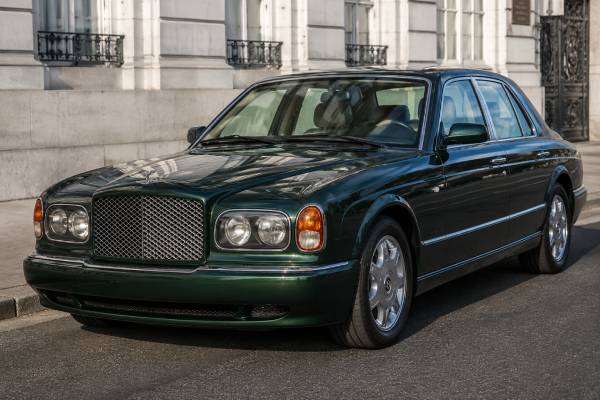
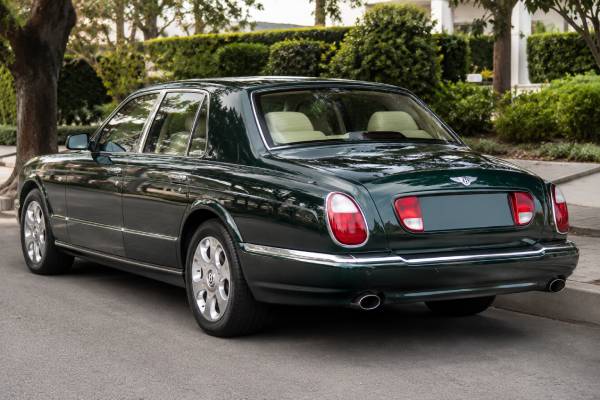
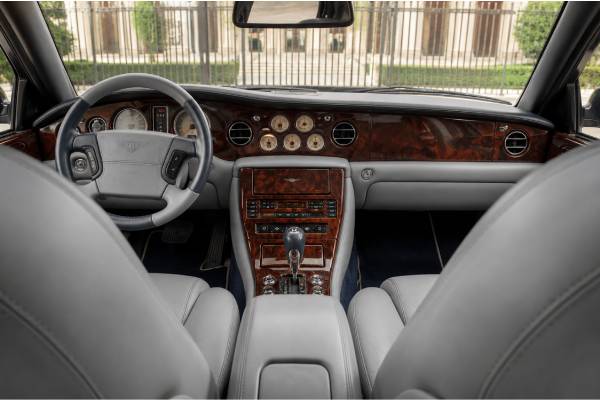
The 2000 Bentley Arnage Green Label is the last clearly identified form of the BMW-powered Arnage and the direct alternative to the newly introduced 6.75-liter Red Label. It keeps the 350 bhp, twin-turbo 4.4-liter V8 and five-speed automatic of the original 1998–1999 car, but its green badging gave buyers an easy way to distinguish it in a showroom where two very different Arnages were offered at once. The Green Label is smoother, lighter over the nose, and more willing to use engine speed than the Red Label. It is also rarer, less conventionally “Bentley” in its engine lineage, and often misunderstood in the used market. Its best qualities appear only when the cooling, boost, transmission, suspension, and electrical systems are healthy. For a buyer, the correct priority is not whether the BMW-based engine is theoretically cheaper or more reliable than the 6.75-liter unit. The priority is finding a complete, original car with continuous specialist records and no unresolved warning signs.
Table of Contents
- What the Green Label Actually Means
- Technical Snapshot of the 2000 Model
- Power Delivery and Driving Character
- Year-Specific Identity and Originality
- Maintenance Logic for the M62-Based Arnage
- Buyer Tests That Reveal an Honest Car
- Deciding Between Green and Red
What the Green Label Actually Means
“Green Label” identifies the 4.4-liter BMW-based Arnage sold for model year 2000 beside the 6.75-liter Red Label. It does not describe a hybrid, an economy model, or a low-emissions special edition; the color refers to Bentley’s badge treatment and the need to separate two engine choices.
The distinction exists because the Arnage arrived during an extraordinary change in ownership. The new saloon had been developed with BMW-supplied engines before Volkswagen acquired the Crewe operation. Volkswagen wanted Bentley to regain a powertrain independent of BMW, so the traditional L-series 6.75-liter V8 was re-engineered and installed in the Arnage. For a brief overlap, customers could choose the newer 4.4-liter, multivalve, twin-turbo V8 or the older-in-concept but newly updated 6.75-liter pushrod V8.
The Green Label was therefore not merely the “old engine” left in production. It represented a coherent engineering package: relatively compact aluminum V8, two turbochargers, a five-speed automatic, 17-inch wheels, and the original chassis balance. The Red Label added more torque and traditional Bentley identity, but also more mass at the front, a four-speed transmission, 18-inch wheels, larger brakes, and chassis revisions.
A Green Label should be bought as that specific package. Cars wearing red badges, later wheels, aftermarket grilles, or mixed trim need careful documentation. Badge color can be changed easily and is not proof of identity. Verify the chassis number, engine type, transmission, build record, and original equipment. The Green Label’s historical value rests in being the final named version of the first Arnage engineering concept.
The model’s scarcity is a double-edged advantage. It can make a correct car interesting to collectors, yet it also means fewer technicians have recent experience with it and some Bentley-specific components are difficult or costly to source. BMW engine ancestry does not turn the whole car into a BMW. Many surrounding systems, calibration decisions, brackets, hoses, cooling parts, body electronics, and interior pieces remain low-volume Bentley items.
Technical Snapshot of the 2000 Model
The Green Label is an internal-combustion, rear-wheel-drive luxury saloon using a Bentley-specific twin-turbo interpretation of BMW’s M62B44 V8. Its essential numbers are 4,398 cc, 350 bhp, 570 Nm, five forward gears, a 3,116 mm wheelbase, and a 100-liter fuel tank. Values below apply to the 4.4-liter 2000 Green Label rather than the 6.75-liter Red Label sold in the same year.
| Specification | Value |
|---|---|
| Engine code/family | M62B44-based Bentley twin-turbo V8 |
| Displacement | 4,398 cc (4.4 L) |
| Configuration | 90-degree V8, aluminum block and heads |
| Valvetrain | DOHC, 32 valves |
| Induction | Twin turbochargers and intercooling |
| Fuel delivery | Electronic multi-point injection |
| Output | 350 bhp (261 kW) at 5,500 rpm |
| Torque | 570 Nm (420 lb-ft) in the midrange |
| Camshaft drive | Timing chains |
| Specification | Value |
|---|---|
| Gearbox | Five-speed adaptive automatic |
| Driven wheels | Rear |
| 0–100 km/h | Approximately 6.5 seconds |
| Top speed | 240 km/h (149–150 mph) |
| Performance character | Progressive boost and higher-revving delivery than the 6.75-liter Red Label |
| Specification | Value |
|---|---|
| Fuel | Premium unleaded petrol |
| Fuel-tank capacity | 100 L (26.4 US gal) |
| Listed combined consumption | 14.8 L/100 km in period Australian-market data |
| Equivalent of listed combined figure | About 15.9 mpg US (19.1 mpg UK) |
| Practical note | Traffic, short trips, boost use, and mechanical condition can raise consumption substantially |
| Specification | Value |
|---|---|
| Body style | Four-door, five-seat saloon |
| Length | 5,390 mm (212.2 in) |
| Width without mirrors | About 1,930 mm (76.0 in) |
| Height | 1,515 mm (59.6 in) |
| Wheelbase | 3,116 mm (122.7 in) |
| Boot volume | About 374 L (13.2 cu ft) |
| Ground clearance | About 150 mm (5.9 in) |
| Turning circle | Roughly 12.6 m (41.4 ft) |
| Specification | Value |
|---|---|
| Front suspension | Independent double-wishbone arrangement with adaptive damping |
| Rear suspension | Independent multi-link/control-arm arrangement with self-leveling |
| Steering | Hydraulic rack-and-pinion assistance |
| Brakes | Ventilated discs front and rear with ABS |
| Electronic aid | Automatic stability control |
| Factory wheel | 7.5J × 17 alloy |
| Factory tire | 255/55 R17 |
The fuel-consumption figure deserves context. Period regional listings quote 14.8 L/100 km combined, but test procedures, vehicle specification, and traffic conditions differ. An owner should use it only as a historical reference. A cold engine, short urban trips, sustained boost, old oxygen sensors, intake leakage, or brakes that do not release fully can produce much higher use.
Wheel and tire specification is equally important. The taller sidewall of the 17-inch package contributes to the Green Label’s ride quality and steering character. Moving to larger wheels may sharpen initial response, but it can increase impact harshness, reduce tire availability in the correct load rating, and place more stress on suspension components. Original wheels in straight, corrosion-free condition are an asset.
Power Delivery and Driving Character
The Green Label accelerates with a smooth, layered surge rather than the instant wall of torque associated with the Red Label. It feels at its best when the five-speed automatic is allowed to use the middle of the rev range, where both turbochargers are working and the engine remains refined.
At low speed, the 4.4-liter engine is quiet and restrained. Press farther into the throttle and the gearbox drops a ratio, engine speed rises, and the car gathers pace with more urgency than its formal body suggests. The delivery is progressive enough that passengers may not realize how quickly speed is increasing. A period 0–100 km/h figure of roughly 6.5 seconds is still brisk for a large saloon.
The five-speed transmission changes the experience more than a simple gear count suggests. Its closer ratios keep the smaller engine in a productive range, while the top gear supports relaxed cruising. A properly functioning unit should not bang into gear, flare on an upshift, hesitate after selecting Reverse, or trigger warnings. Because the transmission’s behavior adapts, a short gentle test drive is not enough. Test it cold, warm, in slow traffic, and during measured acceleration.
Chassis balance is another Green Label strength. The engine is lighter than the 6.75-liter L-series unit, and the car can feel less nose-heavy when entering a bend. This is still a wide, 2.3-tonne luxury car, not a sports saloon in the modern sense. Its talents are accurate placement, stability, and the ability to maintain a rapid pace without disturbing occupants.
Adaptive dampers and rear self-leveling help reconcile comfort with control. The system should absorb a single bump and settle immediately. Continued bouncing, an uneven stance after loading, warning lamps, or a hard-edged ride point to faults or unsuitable wheels and tires. Correct alignment matters because worn bushes can allow the geometry to change under braking or cornering.
The brakes were designed for the car’s mass and speed, but their present condition is more important than their original specification. Check for a firm, repeatable pedal, straight stopping, and no steering shake. Corroded discs can look acceptable on the outer face while the inner surface deteriorates. Caliper condition and flexible hoses should be examined on a lift.
A healthy Green Label should also be quiet. Wind noise, suspension knocks, driveline clonks, exhaust leaks, and interior rattles may indicate wear, previous dismantling, accident repair, or hardened seals. The car’s refinement makes small faults easier to hear once the novelty of the cabin has passed.
Year-Specific Identity and Originality
Authenticity is central to the Green Label because 2000 was the overlap year in which visually similar Arnages could contain fundamentally different mechanical systems. The safest approach is to authenticate from documentation outward, not from badges inward.
Start with the VIN and original build information. Confirm the market, steering position, paint, hide, veneer, wheel design, optional equipment, and production date. The engine bay should contain the compact four-cam V8 and twin-turbo installation. The car should use a five-speed automatic; a four-speed unit belongs to the 6.75-liter package.
External clues include green Bentley badges and the original 17-inch wheel style, although both can be changed. Red Label cars commonly used 18-inch wheels, larger brakes, different suspension calibration, and body-detail changes. Some Green Labels received later cosmetic parts during repair or owner personalization. That does not automatically make a car bad, but it should be disclosed and reflected in price.
Interior originality is harder to judge because Bentley offered extensive choice. Veneer species, piping, contrasting hide, rear-seat equipment, telephones, audio systems, and small details varied. A build sheet is therefore more valuable than a generic option list. Inspect the quality of repairs: correct leather grain, matching color, aligned stitching, properly fitted veneer, and switches that sit flush.
The audio and telephone systems deserve realism. Period equipment may be obsolete, but removing it carelessly can damage trim or create electrical faults. A discreet modern audio or hands-free solution can be sensible if installation is reversible, fused correctly, and documented. Crude screens, cut panels, loose wiring, or non-original alarm systems are warning signs.
Paint depth readings can reveal repair history, but hand-finished low-volume bodies may not show the uniform readings expected from mass production. Use the meter as one part of a broader inspection. Check panel gaps, welds, fasteners, overspray, seam sealer, glass dates, lamp manufacture dates, and corrosion around repaired areas.
A car that remains close to its commissioned specification will usually be easier to understand and preserve. Originality should not prevent safety or reliability improvements, but changes should solve a real problem and be documented. The best upgrades are often renewed factory-type components rather than visible modifications.
Maintenance Logic for the M62-Based Arnage
The Green Label responds best to preventive, system-based maintenance. Repairing one failed part while ignoring the reason it failed often leads to repeat work, especially in cooling, charging, vacuum, and suspension systems.
Cooling comes first. The engine bay packages two turbochargers and extensive plumbing around an aluminum V8. At every service, inspect the radiator, expansion tank, cap, water pump area, thermostat behavior, fan operation, hoses, clamps, and evidence of dried coolant. Pressure testing should be performed with the correct procedure. Any unexplained loss deserves diagnosis before a long journey.
Engine oil should be changed by time as well as mileage. Use a lubricant selected from correct Bentley service information and current specialist guidance for the car’s climate and condition. The filter can provide useful evidence: cutting it open may reveal debris that supports further investigation into timing-chain guides or bearing wear.
The timing-chain system is not a scheduled belt replacement, but it is not maintenance-free forever. Listen for abnormal startup rattle and investigate camshaft-correlation faults rather than clearing them. Chain guides, tensioners, oil pressure, variable timing components where fitted, and sensor signals form one system. Replacing a sensor without checking mechanical timing can waste money.
Boost and intake plumbing should remain airtight. Aging rubber, clamps, crankcase-ventilation parts, and vacuum lines can cause mixture faults, weak performance, rough idle, or extra fuel use. Smoke testing and live-data analysis are more effective than random replacement. Turbochargers should be evaluated for oil leakage, shaft condition, response, and exhaust smoke under controlled conditions.
The automatic transmission benefits from clean fluid, correct level, and a leak-free cooling circuit. Whether a specific car needs immediate service depends on records, fluid condition, and specialist judgment. A high-mileage unit without documented history should not be subjected to an aggressive generic flush. The correct fluid and filling temperature are essential.
Battery and charging health are not minor concerns. Low voltage can create multiple warning messages and upset modules that are otherwise sound. Fit the correct battery, test charging under load, keep terminals and grounds clean, and investigate parasitic drain. Disconnecting power without understanding alarm and memory procedures can create additional problems.
The chassis needs close inspection because its weight accelerates wear. Look at control-arm bushes, ball joints, damper leaks, self-leveling components, steering hoses, mounts, wheel bearings, brake hoses, and subframe attachment points. After repairs, perform alignment with the car at the specified ride height and with correct tire pressures.
Cabin systems should be exercised year-round. Run the air conditioning in winter, move every seat through its full travel, operate all windows and locks, and test rear controls. Regular use helps reveal stiffness before a motor or regulator is overloaded. Water leaks must be addressed immediately because damp carpets can damage wiring and control modules.
Buyer Tests That Reveal an Honest Car
A Green Label should pass a long, repeatable test rather than a five-minute demonstration. The aim is to see how it behaves through temperature changes, electrical load, road speed, and repeated operation.
Ask that the car remain cold before inspection. Check fluid levels before starting and look for fresh cleaning that may hide leaks. The engine should start promptly without prolonged smoke or harsh mechanical noise. Observe idle with the climate system off and on. Turn the steering from lock to lock and listen for pump strain.
Let the car warm while testing equipment. Use every key and remote. Check central locking from each door, window one-touch functions, seat memories, heaters, mirrors, exterior lamps, wipers, washers, audio, displays, climate zones, rear controls, trunk release, and fuel flap. Note slow movement, intermittent operation, and signs of a weak battery.
On the road, begin gently. Check for steering pull, brake drag, wheel vibration, and suspension noise. Once fully warm, apply progressively more throttle. Boost should arrive cleanly and consistently. Hesitation, misfire, smoke, a sudden warning, or limp mode requires diagnosis. Repeat the acceleration in more than one gear and observe transmission behavior during both throttle application and lift-off.
Use a rough road section to assess damping. The body should settle after each disturbance. A floaty rear, repeated rebound, or one corner that reacts differently suggests wear. On a smooth road, listen for tire roar that may indicate aged rubber or alignment trouble.
After the drive, leave the engine idling with headlights, rear defroster, blower, and air conditioning operating. Verify stable temperature and charging voltage. Then switch off, inspect for leaks, and restart after heat soak. Some crank, sensor, starter, or fuel-pressure faults appear only when hot.
A specialist scan should read all available modules, not just generic engine codes. Stored voltage, throttle, transmission, suspension, climate, and security faults can reveal patterns. Clear codes only after recording them, then road-test and rescan.
The lift inspection should include tires by date and load rating, brakes on both disc faces, suspension play, dampers, fluid lines, exhaust, underbody corrosion, accident repair, and jacking points. If records or symptoms justify it, add cooling pressure, compression, leak-down, oil-pressure, fuel-pressure, and boost tests.
Deciding Between Green and Red
Choose the Green Label for its distinct engineering personality, not because someone claims BMW parts make it a bargain Bentley. It is the more rev-oriented, five-speed, lighter-nosed Arnage, while the Red Label offers traditional displacement, stronger low-rpm thrust, and greater recognition.
For frequent long-distance driving, both can work well when maintained. The Green Label’s five-speed gearbox and smoother engine may appeal to drivers accustomed to German luxury cars of the era. The Red Label feels more muscular and more connected to Bentley’s long-running V8 lineage. A test drive of good examples is more informative than comparing advertised horsepower.
Collector interest may favor originality and rarity, but future values cannot be guaranteed. A Green Label with excellent history, correct components, attractive factory specification, and few owners is more compelling than a neglected Red Label bought only because the market prefers its engine. Condition crosses model boundaries.
Running costs should be estimated from the individual car. The Green Label can require expensive Bentley-only trim, suspension, electronic, cooling, and turbo-system work. The Red Label has its own specialized engine, hydraulic, cooling, and chassis needs. Neither is a normal used executive saloon.
The ideal Green Label owner has secure dry storage, access to a specialist, patience for parts sourcing, and enough budget to address age-related work without delay. The car should be driven regularly enough to reach full temperature and keep systems exercised, but not used without backup transportation when a rare part must be ordered.
The 2000 Green Label ultimately makes sense as the final, named expression of Bentley’s BMW-powered experiment. In the right condition it is calm, quick, beautifully made, and historically rich. Its badge color is the least important part of the purchase; the real green light is a stable temperature gauge, clean diagnostic record, composed chassis, and a file of invoices that explains the car.
References
- 1998-2009 2022 (Bentley Heritage Technical Library)
- Bentley Arnage Green Label Specs, Performance, Comparisons 2026 (Technical Data)
- Bentley Arnage 2000 | CarsGuide 2024 (Market Specifications)
- 2000 Bentley Arnage – Motor Trend 1999 (Instrumented Test)
- Used car buying guide: Bentley Arnage | Autocar 2018 (Buying Guide)
- Search Safety Issues | NHTSA 2026 (Recall Database)
Disclaimer
This guide is informational and cannot replace an inspection, diagnosis, or repair by a qualified Bentley specialist. Specifications, fluid requirements, procedures, torque settings, and service intervals vary with VIN, market, build date, and equipment; confirm them in the official service documentation for the specific vehicle.
Please share this article on Facebook, X/Twitter, or another owner community to help other buyers approach the Arnage Green Label with realistic expectations.