
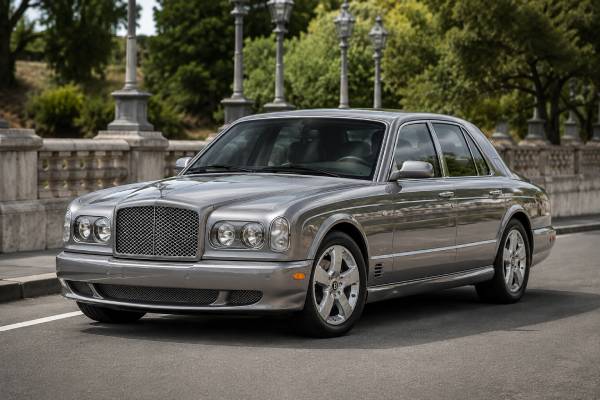
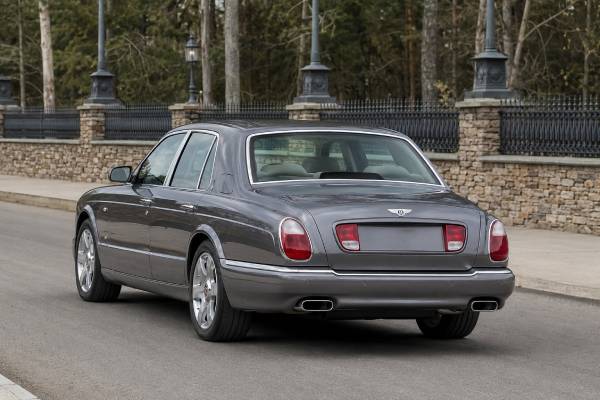
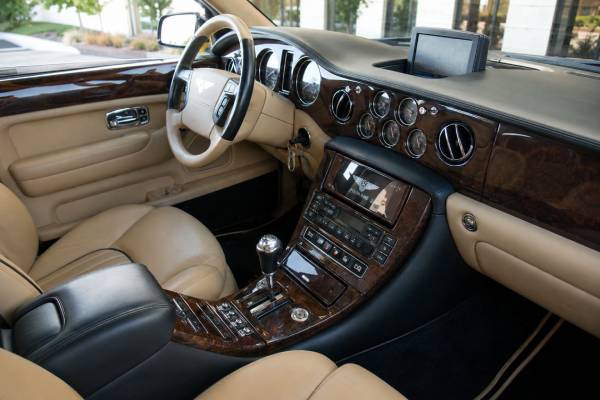
The Bentley Arnage Le Mans is a 153-car commemorative edition based on the 400 bhp Red Label and created for Bentley’s return to the 24 Hours of Le Mans in 2001. It combines the single-turbo 6.75-liter V8, four-speed automatic, strengthened Arnage chassis, and 155 mph capability with a concentrated set of visual and cabin details: front-wing vents, quad exhaust finishers, sport bumpers and arches, red brake calipers, special wheels, dark Racing Green instruments, unique inlays, embroidered headrests, drilled pedals, and edition treadplates. Its significance comes from context and authenticity rather than extra engine output. A genuine car should have documentary proof linking its chassis to the edition and should retain the features listed on its build record. Mechanical health remains just as important. The Le Mans badge cannot compensate for coolant loss, oil leaks, tired adaptive dampers, weak brakes, obsolete tires, electrical faults, or poor body repairs. Buyers need to evaluate it as both a rare collectible and a 2.5-tonne performance saloon.
Table of Contents
- Why Bentley Built the Arnage Le Mans
- Exterior and Interior Identification
- Le Mans Technical Data
- Performance Without a Power Increase
- A Practical Authenticity Audit
- Maintenance That Preserves the Edition
- Buying and Valuing an Arnage Le Mans
Why Bentley Built the Arnage Le Mans
The Arnage Le Mans marked Bentley’s return to factory-supported racing at Le Mans after 71 years. It was not produced to homologate a race car or introduce a new engine; it was a road-going celebration that connected the current flagship saloon to the marque’s defining competition history.
Bentley planned a limited group of Le Mans editions across several model lines. The Arnage version was the most numerous, with 153 completed rather than the originally discussed 150. It used the Red Label as its foundation because that car had restored Bentley’s own 6.75-liter V8 and the effortless torque that enthusiasts associated with the marque.
The timing is important. In 2001 Bentley had returned to the Circuit de la Sarthe with the EXP Speed 8 program, while the road-car business was being rebuilt under Volkswagen ownership. The special edition allowed customers to participate in that revival before Bentley achieved its sixth overall Le Mans victory in 2003.
Unlike later T-24 models, which referenced the 2003 winning car with carbon fiber and more aggressive treatment, the 2001–2002 Le Mans edition remained rooted in the single-turbo Red Label. Its performance numbers were essentially unchanged. The edition’s value comes from limited production, coherent design cues, and direct association with the return-to-racing moment.
The name can create confusion because “Le Mans” appears in Bentley history across numerous road and competition cars. A seller’s description must be tied to the exact Arnage edition, not a later styling package or a standard Red Label with vents and badges added. Production records, VIN information, and the original order are central.
The Le Mans edition also demonstrates how Bentley used visual detail to alter the character of a formal saloon. Vented front wings, wider-looking arches, red calipers, five-spoke wheels, quad exhaust outlets, and darker interior finishes make the car feel more sporting without changing its basic body structure or engine output.
For ownership, this means two parallel responsibilities. The car must be maintained mechanically as a Red Label, while edition-specific parts must be preserved as historical objects. A correct front wing, instrument face, treadplate, inlay, or wheel can be more difficult to replace than a routine service component.
Exterior and Interior Identification
A genuine Arnage Le Mans should present a coordinated set of features, not one badge or one exhaust modification. Authentication begins with the build record and chassis, then uses physical details to confirm that the car remains faithful to its specification.
At the front, the wing vents are the most obvious cue. They should be properly integrated into the panels with factory-level finish and symmetry. Examine the underside and inner wing to distinguish original construction from a later cut-and-bond modification. Poorly fitted vents can trap moisture or reveal accident repair.
The sport bumpers and widened visual treatment around the arches should align cleanly with adjacent panels. Look for cracks, distortion, overspray, inconsistent fasteners, and evidence that ordinary Red Label parts were substituted after damage. Correct parts are valuable enough that a car may have been repaired with whatever was available.
Red brake calipers and five-spoke sport wheels add color and stance. Caliper paint alone proves nothing; check casting, brake dimensions, wheel markings, offsets, finish, and the spare. Original wheels are vulnerable to curb damage and refinishing. A high-quality restoration is acceptable when documented, but polished or painted finishes should match the factory appearance.
At the rear, quad exhaust finishers sit beneath the bumper. Verify that the exhaust system is properly supported and sealed rather than cosmetically split at the last section. Misaligned tips, soot on one side, rattles, or scorched trim indicate poor repair or internal exhaust issues.
Badges on the front quarter panels should read “Le Mans Series” and should be correctly positioned. Inspect surrounding paint for extra holes or double-sided-tape shadows. Original badge placement can be compared with period images and build documentation.
Inside, dark Racing Green instrument faces with Le Mans markings are among the most important features. Check that all gauges work, illumination is even, needles rest correctly, and the odometer history is documented. A replacement cluster may affect mileage credibility and edition originality.
Dark-finished burr walnut and Bentley-wing inlays create a more purposeful cabin than the usual bright veneer. The pieces should match in color and grain. Cracks around inlays or replacement panels that lack the correct motif reduce completeness. Because veneer ages under ultraviolet light, a newly made panel may be difficult to blend.
Two-tone perforated hide, winged-B headrest embroidery, a chrome-and-leather gear lever, drilled pedals, and unique treadplates complete the package. Bentley’s custom-order system allowed color variation, so use the build sheet rather than insisting every car match one promotional photograph.
Le Mans Technical Data
The Arnage Le Mans is an internal-combustion, front-engine, rear-wheel-drive saloon with Red Label mechanicals. Its 400 bhp single-turbo L-series V8, four-speed automatic, adaptive damping, self-leveling rear suspension, and large ventilated brakes are unchanged in principle from the standard model.
| Specification | Value |
|---|---|
| Model years | 2001–2002 |
| Recorded production | 153 cars |
| Mechanical base | Bentley Arnage Red Label |
| Commemorative purpose | Bentley’s return to the 24 Hours of Le Mans after a 71-year absence |
| Exterior identifiers | Front-wing vents, wider arches/sport bumpers, quad exhaust finishers, red brake calipers, Le Mans Series badges |
| Wheels | Distinctive five-spoke sport wheels |
| Original colors cited for the series | Silver Storm, Black Oriole, and Le Mans Racing Green |
| Specification | Value |
|---|---|
| Engine family/code | Bentley L-series L410MT V8 |
| Displacement | 6,750 cc (6.75 L) |
| Valve gear | OHV pushrod, two valves per cylinder, hydraulic tappets |
| Induction | Single turbocharger with intercooling |
| Engine management | Electronic port fuel injection |
| Power | 400 bhp (298 kW) at 4,000 rpm |
| Torque | 835 Nm (616 lb-ft) at low engine speed |
| Transmission | Four-speed automatic |
| Drive | Rear-wheel drive |
| Specification | Value |
|---|---|
| 0–100 km/h | Approximately 6.3 seconds |
| 0–60 mph | About 5.9 seconds |
| Maximum speed | 249 km/h (155 mph), governed |
| Fuel-tank capacity | 100 L (26.4 US gal) |
| Kerb weight | About 2,520 kg (5,556 lb) |
| Boot capacity | About 374 L (13.2 cu ft) |
| Specification | Value |
|---|---|
| Length | 5,390 mm (212.2 in) |
| Width without mirrors | About 1,930 mm (76.0 in) |
| Height | 1,515 mm (59.6 in) |
| Wheelbase | 3,116 mm (122.7 in) |
| Front suspension | Independent wishbones with adaptive damping |
| Rear suspension | Independent wishbones with self-leveling and adaptive damping |
| Brakes | Large ventilated discs with ABS; red-painted calipers are an edition identifier |
| Steering | Speed-sensitive hydraulic rack-and-pinion |
| Specification | Value |
|---|---|
| Instruments | Dark Racing Green faces with Le Mans Series markings |
| Veneer | Dark-finished burr walnut with Bentley-wing inlays |
| Upholstery | Two-tone perforated hide |
| Headrests | Embroidered winged-B motifs |
| Driver controls | Chrome-and-leather gear lever and drilled pedals |
| Entry trim | Unique Le Mans treadplates |
| Authentication note | Build record must confirm the exact combination because repairs and later customization can alter these features |
Because the edition did not introduce a higher-output engine, claims of factory power beyond 400 bhp require individual documentation. Some cars may have received later upgrades during their lives, but such changes should be identified separately from original Le Mans specification.
Performance Without a Power Increase
The Le Mans edition feels more sporting mainly because of its presentation, tires, and driver environment; its core acceleration is Red Label acceleration. That is not a weakness, because 835 Nm and a 155 mph maximum already made the standard car exceptionally capable.
The engine delivers its best work at low rpm. The four-speed automatic can hold a high gear and use torque rather than shifting repeatedly. A healthy car should accelerate from moderate speed with a clean, continuous surge. Hesitation, smoke, boost inconsistency, or a sudden transmission kick is not part of the character.
The single large turbocharger can make its contribution more noticeable than the later twin-turbo Arnage R and T system. The transition should still be controlled. A harsh step in power, overboost fault, or weak response can result from wastegate, hose, intake, ignition, fuel, or engine-management problems.
The sportier visual cues may encourage aggressive driving, but the car remains heavy and softly isolated by modern performance standards. Smooth inputs produce the best results. Brake in a straight line, allow the body to take a set, and use torque on exit. Repeated hard launches or track use add stress without revealing the qualities the car was designed to deliver.
Adaptive damping should keep the body composed while preserving ride comfort. A Le Mans on correct wheels and tires should not crash over minor ridges. If it does, inspect tire pressure, tire age, wheel damage, bush wear, damper function, and ride height.
Red calipers attract attention, which makes poor brake condition especially embarrassing. The pedal should be firm, the car should stop straight, and all four brakes should release. Inspect inner disc faces, flexible hoses, caliper seals, ABS sensors, and parking-brake components.
The exhaust note should be subdued at cruise and more audible under load. Quad outlets do not justify drone, leaks, or rattles. Check heat shields and clearances around the rear bumper.
At motorway speed, the edition’s strongest quality is stable, quiet pace. The steering should hold a line without constant correction, and the cabin should remain free of wind noise around the modified exterior pieces. A noisy vent or poorly sealed panel may indicate repair.
The driver sees the Racing Green dials and drilled pedals, but the mechanical sensations remain unmistakably Red Label: slow engine speed, large torque, substantial controls, and a sense that the car is working well below its limit.
A Practical Authenticity Audit
An authenticity audit should establish three things: the chassis was built as an Arnage Le Mans, the car retains its commissioned features, and later repairs have not created a misleading mixture.
Obtain the VIN and build record before traveling to see the car. Compare the chassis with recognized production data and check the original market, steering position, paint, hide, veneer, wheel design, and optional equipment. The Arnage Le Mans shares broad VIN model identification with the Red Label, so the edition cannot be proven by the basic model code alone.
Ask for original sales invoices, certificates, books, photographs, and service documents. Period photos are especially useful because they show whether vents, wheels, badges, exhaust, instruments, and upholstery were present before later restorations.
Inspect each special feature:
- Front-wing vents should be integrated and symmetrical.
- Le Mans Series badges should be correctly placed.
- Wheels should have the proper design and markings.
- Red calipers should match the brake hardware, not merely the paint.
- Quad exhaust finishers should connect to a correctly made system.
- Racing Green instruments should function and agree with mileage records.
- Veneer inlays, headrest embroidery, treadplates, pedals, and gear lever should match the build specification.
Check the three cited series colors, but do not reject another finish without research. Bentley commissioning and later factory repainting can complicate simple rules. What matters is whether the present color is documented and whether a color change was performed to a high standard.
Use paint-depth readings as a guide, not a verdict. Hand-finished low-volume cars and previous cosmetic refinishing can produce uneven values. Look at seams, bolts, sealant, overspray, glass dates, lamp dates, bumper mounts, and corrosion protection.
Confirm the engine type and output. A Le Mans should use the 400 bhp Red Label mechanical package. A later twin-turbo conversion, remap, exhaust, or wheel upgrade may improve usability but alters originality. The seller should disclose who did the work and retain removed parts.
Mileage authentication requires several records. Compare odometer readings with inspection certificates, invoices, electronic diagnosis, tire dates, seat wear, pedal surfaces, steering rim, and switch wear. A cluster replacement is manageable when fully documented.
Finally, evaluate completeness. Correct spare wheel, tools, keys, manuals, navigation media, telephone equipment, badges, trim pieces, and removed original components all matter because edition-specific replacements are scarce.
Maintenance That Preserves the Edition
The maintenance goal is to keep the car usable without losing its rare details. Mechanical repairs should follow official procedures, and cosmetic work should conserve original material whenever possible.
Cooling-system care comes first. Inspect radiator efficiency, fan stages, thermostat, pump, expansion tank, cap, hoses, clamps, heater circuits, turbo plumbing, and dried residue. Verify stable temperature at idle with air conditioning operating and after a hard road section.
Oil leaks should be corrected before they contaminate mounts, wiring, or exhaust components. Check rocker covers, sump areas, turbo feed and return lines, seals, and joints. Use the correct oil and filter selected from vehicle-specific service information.
The boost, fuel, ignition, and emissions systems require diagnosis rather than guesswork. Smoke testing, live data, fuel-pressure measurement, and controlled boost testing can separate air leaks from sensor, ignition, or turbo faults. The single-turbo arrangement is robust when hoses and controls remain sound.
The four-speed automatic needs correct fluid, cooling, and mount condition. Delayed engagement or flare is a repair issue. A generic flush is not a cure for internal wear. Service should be based on history, fluid condition, and specialist advice.
Adaptive dampers, self-leveling components, bushes, ball joints, steering hoses, wheel bearings, and alignment must be maintained as a system. Correct ride height is essential before alignment. Keep the car on appropriate 18-inch wheels and load-rated tires unless a documented factory alternative applies.
Edition wheels should be inspected for cracks and straightness before refinishing. Preserve casting marks and the correct surface treatment. Store an extra correct wheel carefully if one becomes available; it may be more useful than a cosmetic accessory.
Clean the wing vents and drainage areas gently. Dirt trapped around trim or vent openings can hold moisture. Do not use aggressive pressure washing that forces water behind seals. Inspect the inner wing during routine service.
Veneer, embroidered hide, and treadplates need conservation. Use gentle cleaners, avoid soaking perforated leather, protect the cabin from ultraviolet heat, and repair loose lacquer before moisture reaches the substrate. Refinish only when necessary, and photograph original markings before disassembly.
Battery health protects rare instruments and electronics. Use the correct battery, clean grounds, and an appropriate maintainer during storage. Investigate drain from alarms, telephones, navigation, or aftermarket equipment. Do not repeatedly jump-start a low-voltage car.
Run the car regularly and long enough to reach temperature. Exercise parking sensors, navigation mechanism, seats, windows, locks, mirrors, air conditioning, and rear controls. A limited edition kept static can deteriorate faster than one driven carefully.
Buying and Valuing an Arnage Le Mans
An Arnage Le Mans deserves a premium only when its identity, completeness, and condition are proven. A standard Red Label with copied details should be valued as a modified Red Label, not as one of the 153 cars.
Begin with provenance, then commission a Bentley-specialist inspection. The inspection should start cold, include a full road test and heat-soak restart, scan all accessible modules, and end on a lift. The specialist should also have enough body and trim knowledge to assess edition features.
The service file should show regular care rather than occasional large rescues. Look for cooling prevention, oil-leak repairs, brake fluid, transmission attention, suspension work, batteries, tires by age, air-conditioning service, and electrical diagnosis. Gaps matter more on a car that may have spent years in collections.
Evaluate accident history carefully. Edition-specific wings, bumpers, wheels, and exhaust parts may have been substituted. A professional repair does not necessarily destroy value, but it should be documented and geometrically correct.
Tires and brakes are immediate safety costs. A car with old tires or corroded discs should not be test-driven at performance speeds. Add the cost of correct replacements to the purchase calculation.
Estimate restoration of special trim before buying. Recreating instrument faces, inlaid veneer, embroidered hide, treadplates, or factory-looking vents can require specialist craft. A missing set of details may erase the price advantage of a cheaper car.
Avoid assigning value based only on production number. Color combination, steering position, ownership history, documentation, mileage credibility, originality, and market location all affect desirability. A highly original car may command collector interest, while a sympathetically updated driver can be more usable.
The strongest example will have a continuous narrative: factory specification, known owners, invoices, period photographs, correct special features, clean structure, stable cooling, strong drivetrain, composed suspension, and functioning cabin. The weakest will rely on a plaque and an auction description.
The Le Mans edition is rewarding because its historical story is visible every time the driver approaches the vented wings or looks at the green instruments. That story remains convincing only when the car’s physical evidence supports it. Buy the evidence, maintain the machinery, and treat the rare trim as seriously as the engine.
References
- Bentley Arnage Le Mans 2026 (Production and Model Data)
- Bentley Arnage Le Mans 2026 (Edition Features and Parts Context)
- BENTLEY NEWSROOM : 2001 Arnage Red Label Y662SEO 2021 (Mechanical Base)
- CD03 ARNAGE LAYOUT 2000 (Technical Sheet)
- 1998-2009 2022 (Bentley Heritage Technical Library)
- Used car buying guide: Bentley Arnage | Autocar 2018 (Buying Guide)
Disclaimer
This article is for informational purposes and is not a substitute for professional diagnosis, repair, authentication, or valuation. Specifications, torque values, procedures, service intervals, and equipment can differ by VIN, market, and commission; verify all work with the official documentation for the specific vehicle.
Please share this article on Facebook, X/Twitter, or a Bentley enthusiast group if it supports accurate identification and preservation of the Arnage Le Mans.