
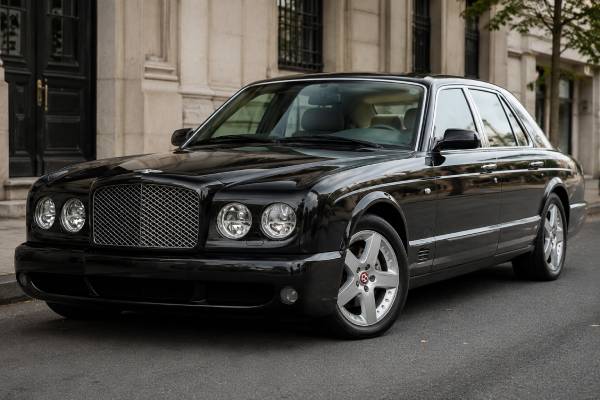
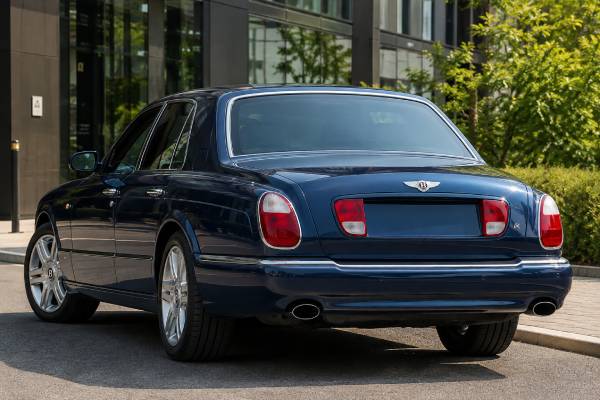
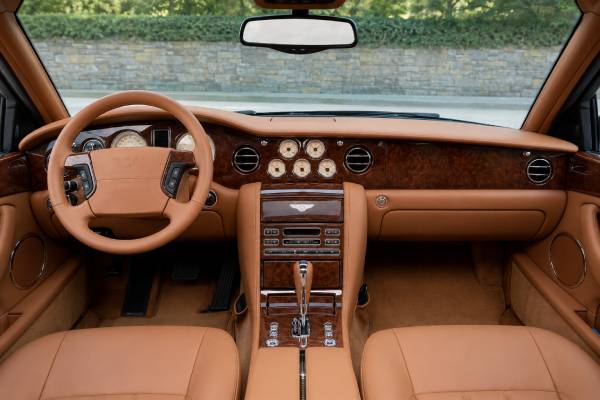
The 2002–2006 Bentley Arnage R is the relaxed, long-legged member of the mature Arnage family. It uses Bentley’s traditional 6.75-liter L410MT V8 with two turbochargers, producing 400 bhp and 835 Nm through a four-speed automatic. Those figures matter less than the delivery: the R accelerates on immense low-rev torque, settles into a quiet cruise, and rides with more compliance than the sharper 450 bhp Arnage T. It is not a simple continuation of the earlier single-turbo Red Label. Bentley’s reworked twin-turbo installation, revised management, strengthened structure, adaptive chassis, and growing electronic complexity created a distinctly developed car. The 2002–2006 span also covers detail changes and increasingly individualized specifications, so VIN-level records remain more reliable than generic model-year assumptions. As a used purchase, the Arnage R can be deeply rewarding when cooling, boost plumbing, transmission, suspension, brakes, electrical supply, and cabin systems have been maintained together. A low advertised price without that evidence is rarely a bargain.
Table of Contents
- The Arnage R’s place in the range
- The twin-turbo L410MT evolution
- Arnage R specifications and data
- Grand-touring performance and comfort
- Age-related systems to monitor
- A practical maintenance plan
- Inspection, costs, and buyer fit
The Arnage R’s place in the range
The Arnage R was designed for owners who wanted traditional Bentley pace and comfort without the Arnage T’s more aggressive calibration. Its defining strengths are torque, composure, rear-seat civility, and the ability to cover distance at high speed without making the driver or passengers work for it.
When the R arrived for the 2002 model year, the Arnage platform had already changed substantially from the BMW-powered 1998 launch car and the early single-turbo Red Label. Bentley retained the historic 6.75-liter V8 but continued modernizing its induction, management, chassis, structure, and safety systems. The R emerged as the refined expression of that work, while the T occupied the overtly sporting position.
The distinction is one of character rather than basic body architecture. Both use a large four-door saloon body, rear-wheel drive, adaptive damping, and a version of the L-series V8. In the R, 400 bhp and 835 Nm are enough to move the heavy car from rest to 60 mph in a published 5.9 seconds. The response is deliberately progressive, and the suspension favors a smoother primary ride.
That makes the R especially suitable for mixed use. It can carry four adults and luggage in genuine comfort, operate quietly in town, and produce effortless passing speed on an open road. Its steering and double-wishbone suspension still give the driver a clear sense of the front tires, but the experience is never built around chasing a lap time.
Model-year boundaries should be handled carefully. Production changes do not always align neatly with registration dates, and cars were frequently ordered with expensive options or Mulliner personalization. Later examples may have updated appearance, cabin electronics, or equipment, while market specifications affect lighting, emissions hardware, instruments, and safety labeling. The VIN and build sheet settle those questions more reliably than a sales listing.
The R is also a different ownership proposition from a modern luxury saloon. Its structure and major mechanical systems are robust when properly maintained, but they are surrounded by heat-sensitive hoses, hydraulic and electronic subsystems, hand-finished trim, and labor-intensive packaging. Running one well requires planned maintenance rather than reaction to warning lights.
Why the softer model can be the better driver’s choice
A softer calibration is not automatically less capable. On broken real-world surfaces, compliance helps the tires remain in contact and reduces the body’s tendency to skip across sharp ridges. The R can therefore feel more settled and confident than a poorly maintained T on oversized or inappropriate tires.
Its lower-output tune also places less emphasis on exploiting maximum boost. That does not eliminate mechanical risk, but it encourages a style of driving that suits the engine and transmission: use the broad middle of the torque curve, allow the car to build speed, and brake early enough to keep its mass composed. Owners who understand that rhythm often find the R more satisfying over a full day than a harder-edged alternative.
The twin-turbo L410MT evolution
The R’s engine is a modernized version of Bentley’s long-lived pushrod V8, using two turbochargers and Bosch management to deliver stronger control, response, and emissions performance. It should not be described as merely the early Red Label engine with another turbo bolted on.
The underlying architecture is intentionally traditional: a 90-degree V8, 6,750 cc displacement, camshaft in the block, and two valves per cylinder. What changed over decades was the surrounding engineering. Fuel injection, ignition control, turbocharging, charge cooling, sensors, catalysts, and diagnostic systems transformed how the engine behaved and how it had to be serviced.
Using two smaller turbochargers helped the later Arnage develop boost progressively and distribute airflow across the V8. The goal was not a peaky burst at high engine speed. Maximum power arrives at only 4,000 rpm, and the torque peak is at 3,250 rpm. In normal driving, the engine frequently operates below those points and still produces more than enough force.
The four-speed automatic makes sense within that torque-rich strategy. A modern gearbox might offer twice as many ratios, but the Bentley does not need constant shifting to stay productive. The transmission can hold a gear, accept a moderate throttle input, and let the V8 pull. Its condition matters enormously, however: flare, delayed engagement, rough shifts, or repeated hunting interrupt the very quality the powertrain was designed to provide.
Heat is the central maintenance challenge. Turbochargers, exhaust manifolds, catalysts, and a tightly packed engine bay expose hoses, wiring, seals, and fluids to sustained temperature. Cooling-system efficiency and correct heat shielding therefore affect more than the temperature gauge. They influence intake consistency, electrical reliability, oil life, and the durability of nearby materials.
Air leaks also matter. A split hose, loose clamp, tired vacuum line, or leaking joint can alter boost and fueling, producing weak performance, rough running, or fault codes that tempt parts replacement. The proper method combines visual inspection, pressure or smoke testing, live data, and knowledge of how the specific system is arranged.
The engine should feel smooth and almost unstressed. Mechanical clatter, rhythmic misfire, heavy smoke, strong fuel odor, unstable idle, or a sharp change in boost delivery is not “old Bentley character.” Investigate symptoms while they remain small, because continued driving can damage catalysts, contaminate oil, overheat components, or place extra load on the transmission.
Arnage R specifications and data
The Arnage R is a petrol-only, rear-wheel-drive luxury saloon with a 6,750 cc twin-turbo V8 and four-speed automatic. The tables describe the 400 bhp 2002–2006 assignment scope; individual equipment, market homologation, wheels, and later running changes should be checked from the VIN-specific record.
| Specification | Value |
|---|---|
| Engine | Bentley L410MT 90-degree V8 |
| Displacement | 6,750 cc |
| Bore × stroke | 104.1 × 99.1 mm |
| Valve gear | OHV, two valves per cylinder |
| Induction | Two turbochargers with charge cooling |
| Power | 400 bhp (298 kW) at 4,000 rpm |
| Torque | 835 Nm (616 lb-ft) at 3,250 rpm |
| Engine management | Bosch Motronic |
| Specification | Value |
|---|---|
| Transmission | Four-speed automatic |
| Driven wheels | Rear-wheel drive |
| 0–60 mph | 5.9 seconds, published figure |
| 0–100 km/h | 6.3 seconds, published figure |
| Maximum speed | 155 mph (250 km/h), electronically limited |
| Specification | Value |
|---|---|
| Length | 5,390 mm |
| Width | 1,932 mm |
| Height | 1,515 mm |
| Wheelbase | 3,116 mm |
| Published kerb weight | Approximately 2,585 kg |
| Turning circle | Approximately 12.4 m |
| Specification | Value |
|---|---|
| Front suspension | Independent double wishbones, coil springs, adaptive damping |
| Rear suspension | Independent double wishbones, self-leveling, adaptive damping |
| Steering | Power-assisted rack and pinion |
| Brakes | Ventilated discs with ABS |
| Tire reference | 255/50 R18 |
| Fuel tank | 100 liters |
| Luggage compartment | Approximately 374 liters |
| Specification | Value |
|---|---|
| EU combined consumption | 20.6 L/100 km |
| Published CO₂ emissions | 495 g/km |
| Fuel grade | Premium unleaded petrol |
| Seating | Five |
The 155 mph maximum is an electronically controlled figure, not an invitation to judge a used car through maximum-speed testing. What is more useful during inspection is whether the engine reaches boost cleanly, the gearbox shifts consistently, coolant temperature remains stable, and the chassis tracks without vibration at normal legal speeds.
The published combined fuel figure belongs to the period EU test procedure. Real use can be materially heavier, especially in short-distance traffic where the engine rarely reaches full temperature and the car repeatedly accelerates its mass from rest. Fuel cost should be treated as one part of a larger operating budget that includes tires, brake components, fluids, specialist labor, and age-related renewal.
Curb-weight numbers can differ between references because of market equipment and measurement conventions. The approximately 2,585 kg figure provides the right scale, but it should not be used to calculate payload or substitute for a vehicle-specific plated limit. The important practical message is that every dynamic component works hard.
Grand-touring performance and comfort
The Arnage R is at its best on a long journey, where the torque, stable wheelbase, supportive seats, quiet cabin, and compliant damping work together. A healthy example should reduce effort as speed rises rather than feeling loose, noisy, or strained.
In urban use, the car’s width and long nose require attention, but the steering is more accurate than the dimensions suggest. Parking sensors are valuable and should be tested individually. Visibility is generally straightforward for a formal saloon, though modern drivers may need time to adjust to the thick pillars and lack of contemporary camera coverage.
Initial throttle response should be calm. The car eases away with dignity, and deeper pressure calls up boost without a sudden step. This gives passengers a smooth ride and helps the driver meter torque on wet surfaces. Any hesitation followed by an abrupt surge can point to throttle, boost-control, fueling, or transmission issues.
At speed, listen beyond the expected wind and tire noise. A low-frequency vibration may come from tires, wheels, propeller-shaft components, or driveline mounts. A hum that changes with cornering load can indicate a wheel bearing. Steering shimmy under braking often directs attention to disc runout or front suspension wear. Diagnosis should be based on conditions and measurements, not a single assumption.
The suspension is meant to isolate small impacts while controlling the body after larger movements. Push down on a corner in the workshop only as a rough check; a road test over varied surfaces is far more informative. The car should recover after a crest without repeated oscillation and should not crash over expansion joints.
Rear self-leveling is important when passengers or luggage are added. A low rear stance, persistent pump operation, uneven height, or delayed correction needs inspection. Do not mask a height fault with alignment or new tires, because suspension geometry depends on the car sitting correctly.
Cabin comfort systems are part of the driving experience, not optional luxuries to ignore. Climate control should maintain temperature through all zones, fans should operate quietly, heated functions should work, and seat and steering-column adjustments should move without hesitation. A long trip exposes weak air conditioning, noisy blower motors, and intermittent seat modules quickly.
Road-test sequence
A useful test begins before the engine starts. Check battery voltage, confirm warning lamps illuminate, and note whether the suspension sits level. Start from cold, observe idle and exhaust, then drive gently until fully warm. Test low-speed shifts, steady cruise, moderate acceleration, a brief higher-load pull, progressive braking, rough-road response, tight turns, and reverse engagement.
Afterward, let the car idle with the climate system operating. Watch temperature behavior, inspect for fresh leaks, smell for coolant or burning oil, and compare wheel heat cautiously with a noncontact method. Re-scan control modules because some faults appear only after a complete drive cycle.
Age-related systems to monitor
Age affects an Arnage R even when mileage is low. Rubber hardens, fluids absorb moisture, electrical contacts corrode, batteries weaken, adhesives release, and seals take a set while a car sits. Service history should therefore show time-based care as well as distance-based work.
Cooling-system age is the first concern. Inspect every accessible hose, junction, tank, cap, fan, radiator surface, and sign of dried residue. A pressure test can expose leaks that do not drip when cold. Check that the heater works, because cabin heat behavior can reveal circulation problems or trapped air.
Turbocharger and intake plumbing deteriorate through heat and oil vapor. Look for softness, cracking, swelling, loose clamps, rubbed-through sections, and oil accumulation. A light film can be normal in a forced-induction intake; pooling oil, smoke, or rapidly falling level requires diagnosis.
Engine and transmission mounts can soften or collapse. Symptoms include vibration at idle, a thump during gear engagement, excessive drivetrain movement, and contact between components. Mount condition also affects hoses and exhaust alignment, so replacing a failed mount can prevent secondary damage.
Suspension bushes and ball joints often degrade gradually, allowing the driver to adapt without noticing. Uneven tire wear, wandering, braking instability, and clunks are later clues. Inspect with the suspension appropriately loaded and understand that not every joint reveals play while hanging freely.
Electrical reliability begins with voltage and dryness. A marginal battery can cause warning messages, memory loss, slow motors, and modules that fail to communicate. Check charging output and grounds before condemning expensive controllers. Search the cabin, boot, windscreen edges, door seals, and plenum areas for water paths.
Interior materials also age. Leather dries or loses its coating at high-contact points, veneer lacquer cracks, headlining can release, soft-touch finishes mark, and switch legends wear. A carefully preserved original cabin is usually preferable to a shiny, over-restored one. Cosmetic work should respect the factory color, grain, stitch pattern, and sheen.
Corrosion is not the first issue many buyers associate with an Arnage, but it cannot be ignored. Examine lower body edges, wheel arches, jacking points, underbody seams, subframes, brake and fuel lines, exhaust supports, boot floor, and previous repair areas. Road salt and blocked drainage can create local damage even on a low-mileage car.
A practical maintenance plan
A good service plan establishes the car’s current condition, addresses safety and heat management first, and then renews systems before failure. Annual mileage alone should not determine the work list.
During the first month of ownership, collect all records and build a date-and-mileage timeline. Confirm engine oil, coolant, brake fluid, transmission and final-drive service history, filters, spark plugs, belts, hoses, battery age, tire dates, brake measurements, and suspension findings. Where evidence is absent, make a deliberate baseline decision with a Bentley specialist.
Every routine visit should include a leak map, fluid-level check, diagnostic scan, tire inspection, battery test, and road test. Saving scan reports allows trends to appear. A recurring pending fault is more useful when compared over time than when repeatedly erased.
Cooling-system service must use the correct coolant specification and bleeding method. Mixing incompatible products or leaving air in the system can cause corrosion and localized overheating. Replace aged clamps and hoses by condition and access opportunity, but avoid indiscriminate part swapping without confirming the route and source of a leak.
Brake fluid is time-sensitive because it absorbs moisture. Tires are similarly governed by age and condition, not tread depth alone. Match all four for model, size, load rating, speed rating, and construction. A premium touring tire with the correct specification usually suits the R better than an extreme performance design chosen only for appearance.
Transmission decisions require history and specialist judgment. Check level and condition according to the correct procedure, repair leaks, and use the specified fluid and filter components. A forceful universal flush on a unit without documented service history is not a substitute for diagnosis. If shift behavior is abnormal, capture fault data and hydraulic or electrical evidence before approving major work.
Exercise the car regularly. A properly warmed 30- to 60-minute drive is more beneficial than repeated short starts in storage. Use the climate control, seat motors, windows, locks, and other functions so developing problems are discovered. Keep the battery supported with an appropriate maintainer when the car is parked for extended periods.
Inspection, costs, and buyer fit
A pre-purchase inspection by an Arnage-experienced specialist is essential because a single test drive cannot expose the full condition of the car. The inspection should quantify immediate needs and separate normal cosmetic aging from expensive mechanical or structural neglect.
Before viewing, ask for the VIN, build sheet, service invoices, mileage history, cold-start video, underside images, tire date codes, and disclosure of nonworking functions. Check national recall and safety-campaign databases with the exact VIN. Market and production date can determine applicability.
At the car, verify identity and inspect it cold. Look for warning-light self-tests, clean idle, stable fluids, smoke, unusual noise, and evidence that the engine was warmed before arrival. Scan every accessible module without clearing codes. On a lift, inspect leaks, hoses, lines, suspension, brakes, tires, wheel damage, corrosion, exhaust, and previous repairs.
The body deserves specialist assessment because hand-finished panels and expensive paint can hide costly work. Check alignment, paint depth, texture, overspray, sealant, fasteners, lamp dates, glass markings, and underbody structures. Good repair is acceptable when documented; poor repair affects both safety and value.
Build a 12-month budget from the inspection, not from online averages. Prioritize tires, brakes, cooling, steering and suspension, fluid leaks near heat, and electrical supply. Then account for air conditioning, seat and window systems, infotainment, leather, veneer, and paint. A car that needs “only small things” in every category can exceed the cost of a better example.
The ideal Arnage R owner wants a traditional Bentley experience and accepts specialist maintenance as part of preserving it. The car suits long trips, formal occasions, weekend use, and collectors who prefer understated ability to overt styling. It does not suit someone seeking modern fuel economy, inexpensive generic parts, or an appliance that can tolerate years of deferred service.
Choose the example that drives cohesively and has evidence behind that feeling. Fresh detailing, low mileage, and a prestigious registration can attract attention, but stable temperature, smooth boost, consistent shifts, level suspension, strong brakes, correct tires, dry electronics, and detailed invoices are what make ownership work.
References
- 1998-2009 2022 (Bentley Heritage Technical Library)
- BENTLEY ARNAGE R 2002 (Manufacturer Brochure)
- 2004 Bentley Arnage R – Road Test & First Drive – Motor Trend 2004 (Road Test)
- Used car buying guide: Bentley Arnage | Autocar 2018 (Buying Guide)
- Bentley Arnage RL 2026 (Model and Production Data)
- Search Safety Issues | NHTSA 2026 (Recall Database)
Disclaimer
This article is general educational information rather than a repair manual, valuation, or vehicle-specific diagnosis. Bentley changed equipment and procedures during production, and market specification, options, prior work, and VIN-specific campaigns can alter what applies. Use the correct factory literature and a qualified Arnage specialist before servicing, modifying, or purchasing a particular car.
Share this Arnage R guide with an owner group or prospective buyer when it can help turn a tempting advertisement into a properly informed decision.