
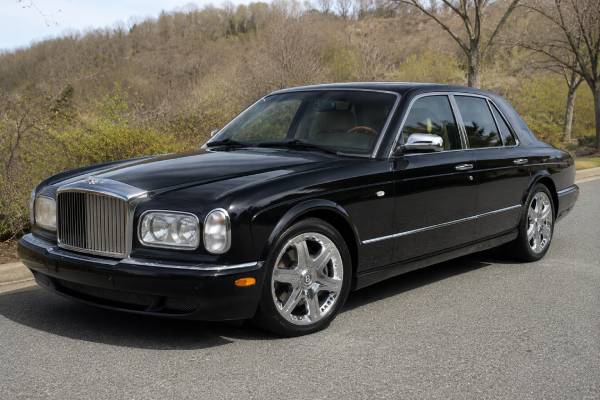
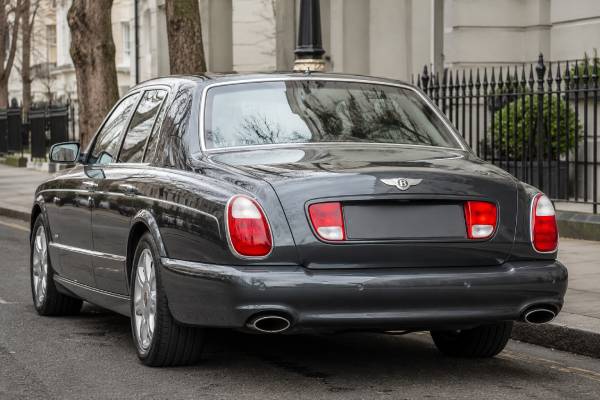
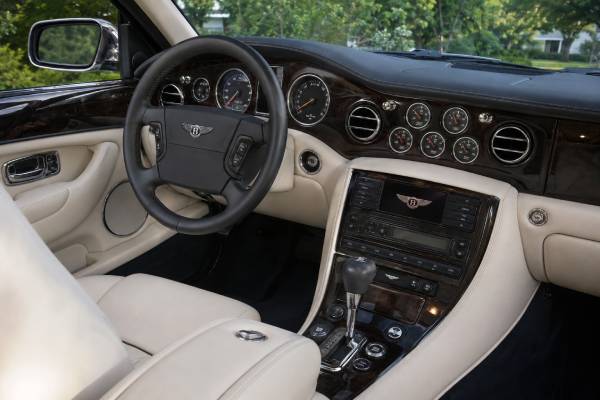
The 2004 Bentley Arnage R Mulliner is best understood as a highly individualized version of the comfort-focused Arnage R, not as a separate high-output model with one universal specification. Its mechanical foundation is the 400 bhp, twin-turbo 6.75-liter L410MT V8, four-speed automatic transmission, rear-wheel drive, and adaptive chassis used by the contemporary Arnage R. Mulliner involvement added commissioning freedom: special hides, veneers, stitching, embroidery, color combinations, wheels, rear-cabin appointments, and other details chosen for a particular customer. That makes documentation unusually important. Two cars carrying similar badges may differ materially in trim and equipment, while an apparently ordinary R may have genuine factory Mulliner content recorded only on its build sheet. Buying combines mechanical scrutiny with authentication of the original order. A strong example offers enormous torque, quiet long-distance speed, and craftsmanship that feels personal rather than mass-produced, but neglected bespoke trim can be as difficult to restore correctly as the mechanical systems.
Table of Contents
- What the R Mulliner designation means
- Authenticating the original commission
- 2004 Arnage R Mulliner technical data
- How the R Mulliner drives
- Caring for Mulliner craftsmanship
- Mechanical maintenance priorities
- Buying, inspecting, and valuing one
What the R Mulliner designation means
The practical point is that “R Mulliner” describes an Arnage R shaped by Bentley’s bespoke commissioning division, while the underlying performance specification remains the 400 bhp Arnage R unless the factory record proves otherwise. It should not automatically be interpreted as the 450 bhp Arnage T, a later power upgrade, or a single catalog package whose contents were identical on every car.
Mulliner is one of Bentley’s oldest coachbuilding names, and by the Arnage era it represented the factory route for customers who wanted choices beyond the normal color and trim list. A commission could be restrained—perhaps a special paint, contrasting seat piping, and a nonstandard veneer—or conspicuous, with unique embroidery, polished or chromed exterior pieces, rear-cabin equipment, monograms, special wheels, and coordinated luggage. Some cars were ordered through a dealer using a defined collection of Mulliner options; others were effectively individual design projects.
That flexibility creates both appeal and confusion. Sellers often use “Mulliner” loosely because it sounds valuable. A steering wheel, diamond quilting, or later wheels can be fitted after delivery, and a badge alone is weak evidence. Conversely, a genuine commission may not display every visual cue that enthusiasts expect. The safest definition is documentary: the car is an Arnage R, and the factory build information identifies the Mulliner features supplied when new.
The R part of the name matters equally. Bentley positioned the Arnage R as the more composed and traditional member of the range. It used the reworked 6.75-liter V8 with twin turbochargers, but its tuning emphasized a broad, quiet surge rather than the sharper response and firmer chassis character of the Arnage T. The engine still produced formidable torque at low speed, so “comfort-focused” never meant slow. It meant that the controls, damping, throttle calibration, and cabin atmosphere supported effortless travel.
For an owner, this combination has a clear benefit: the R Mulliner can deliver the best qualities of a standard R while looking and feeling substantially more personal. The corresponding responsibility is to preserve exactly what makes the car unusual. Replacing a damaged special veneer with a close-looking standard panel, recoloring rare leather without matching the original grain and tone, or fitting fashionable wheels can erase the commission’s integrity even when the car remains attractive.
What Mulliner usually changed
The most common areas of customization were visible and tactile. These included paint outside the ordinary palette, two-tone or fine-line treatments, special hide colors, contrasting piping, perforation patterns, embroidered headrests, alternative carpet and lambswool-rug colors, turned-metal or unusual wood veneers, engraved treadplates, picnic tables, rear vanity equipment, and customer-selected wheel finishes. Exact content must be established car by car.
Mechanical Mulliner changes are possible, but they should never be assumed. A build sheet may record a sport suspension, particular brake or wheel specification, or other factory option. Those items have practical implications because tire size, damper calibration, brake parts, and ride quality can differ. The record—not a sales advertisement written years later—should drive parts ordering and valuation.
Authenticating the original commission
A convincing R Mulliner should have a continuous identity trail from chassis number to factory order, delivered specification, and present condition. Begin with the VIN and original build information, then inspect every claimed special feature against period evidence instead of trying to authenticate the car from photographs alone.
The VIN plates, stamped identifiers, registration documents, and service records should agree. Look for normal aging and attachment around identity plates; fresh fasteners, disturbed paint, or inconsistent typography deserve explanation. This is ordinary due diligence for any Arnage, but it is especially important when a seller attaches a premium to rarity or bespoke specification.
Ask for the original order form, build specification, sales invoice, certificate or correspondence from Bentley, handbook pack, and early photographs. A factory heritage inquiry can be valuable when the paper file is incomplete. The goal is not merely to prove that the vehicle existed; it is to establish which features were installed at Crewe and which were added later.
Create a simple feature inventory during inspection. Record the exterior paint code and finish, wheel design and size, grille and brightwork treatment, lamp surrounds, badges, treadplates, veneer type, leather colors, stitching, piping, embroidery, headlining, carpets, rear tables, entertainment or telephone equipment, and any monograms. Photograph each item and compare it with the build description. This disciplined approach prevents an attractive cabin from substituting for evidence.
Originality versus sympathetic renewal
Originality does not require leaving a car shabby. Leather can be cleaned and carefully recolored, veneer can be repaired, carpets can be renewed, and mechanical components should be maintained. The distinction is between preservation-led work that respects the commission and generic refurbishment that overwrites it.
A repaired seat should retain the correct perforation, seam position, piping diameter, grain, and sheen. Veneer repairs should match the species, cut, color, and book-matching pattern. Embroidery should not be “improved” into a modern font. When a unique material is unobtainable, a high-quality reversible repair is preferable to replacing an entire matched set with something merely similar.
Mechanical numbers also need careful wording. Published figures for the 2004 Arnage R provide the correct baseline, but options and individual equipment can affect curb weight, wheels, and ride. Do not reject a genuine car because one dimension in a secondary database differs slightly; instead, separate fixed engineering facts from equipment-dependent details and verify the specific VIN.
2004 Arnage R Mulliner technical data
The R Mulliner is an internal-combustion, rear-wheel-drive luxury saloon built around Bentley’s 6,750 cc L410MT V8. For 2004 Arnage R specification, the twin-turbo engine delivers 400 bhp and 835 Nm through a four-speed automatic; Mulliner content primarily changes finish and equipment, so the following data is the mechanical baseline rather than a promise that every commissioned detail is identical.
| Specification | Value |
|---|---|
| Engine code and family | L410MT, Bentley 90-degree V8 |
| Displacement | 6,750 cc |
| Construction | OHV, 16 valves, aluminum cylinder heads |
| Induction | Two turbochargers with charge cooling |
| Fuel and management | Premium unleaded; Bosch Motronic engine management |
| Maximum power | 400 bhp (298 kW) at 4,000 rpm |
| Maximum torque | 835 Nm (616 lb-ft) at 3,250 rpm |
| Specification | Value |
|---|---|
| Transmission | Four-speed automatic |
| Driven wheels | Rear-wheel drive |
| 0–60 mph | 5.9 seconds, published figure |
| 0–100 km/h | 6.3 seconds, published figure |
| Maximum speed | 155 mph (250 km/h), electronically limited |
| Specification | Value |
|---|---|
| Body style | Four-door, five-seat luxury saloon |
| Length | 5,390 mm |
| Width | 1,932 mm |
| Height | 1,515 mm |
| Wheelbase | 3,116 mm |
| Published kerb weight | Approximately 2,585 kg |
| Fuel-tank capacity | 100 liters |
| Luggage capacity | Approximately 374 liters |
| Specification | Value |
|---|---|
| Front suspension | Independent double wishbones with coil springs and adaptive damping |
| Rear suspension | Independent double wishbones with self-leveling and adaptive damping |
| Steering | Power-assisted rack and pinion |
| Brakes | Ventilated discs with ABS; electronic stability and traction systems |
| Standard tire reference | 255/50 R18 |
| Mulliner wheel note | Wheel design and diameter can differ by individual commission |
| Specification | Value |
|---|---|
| Combined fuel consumption | 20.6 L/100 km, EU combined figure |
| Carbon-dioxide emissions | 495 g/km, published EU figure |
| Recommended fuel | High-octane premium unleaded |
| Service approach | Condition-led inspection supported by scheduled maintenance |
These figures explain the car’s character better than the power number alone. Maximum torque arrives at 3,250 rpm, but substantial thrust is available well before that point. The four-speed transmission therefore does not need to chase revs or make frequent shifts. In normal use, the Arnage gathers speed on a deep wave of torque, often remaining in a high gear while lighter cars would downshift.
Wheel specification requires special attention on a Mulliner car. The standard R reference used 18-inch tires, but a commission may legitimately have a different factory wheel. Confirm diameter, width, offset, tire load and speed ratings, center-bore fit, fastener type, and compatibility with the brake package. The appearance of a polished multi-piece wheel does not prove that it belongs on the car.
How the R Mulliner drives
A healthy Arnage R Mulliner should feel exceptionally strong without feeling busy. Its best dynamic quality is the way it combines low-rev acceleration with a settled, absorbent ride, accurate straight-line tracking, and steering that makes the large body easier to place than its dimensions suggest.
Start gently from rest and the car should move away smoothly, with no flare between gears, driveline clunk, or delayed engagement. The throttle is intentionally progressive. Under a larger input, boost builds and the nose rises slightly as the V8 delivers a sustained surge. There should be no abrupt torque interruption, misfire, warning message, or smoke plume in the mirror.
The four-speed automatic is part of the period character. It has fewer ratios than later luxury cars, but the engine’s torque spread makes that less limiting than the specification sheet implies. What matters is shift quality. Harsh engagement when selecting Drive or Reverse, repeated hunting, slipping under load, or a burnt smell from the fluid area deserves immediate specialist diagnosis. A software or electrical fault can mimic a mechanical transmission problem, so proper fault-code and live-data checks come before assumptions.
Ride quality should be controlled rather than floaty. The adaptive damping and self-leveling rear suspension allow a compliant response over small disturbances while containing large body movements. A car that bounces after a crest, leans unevenly, sits low at one corner, or thumps over minor bumps may have tired dampers, accumulators, bushes, mounts, height-control components, or an inappropriate wheel-and-tire setup.
Steering effort is substantial enough to communicate the car’s mass, yet the response should be clean around center. Tramlining can result from wide or mismatched tires, worn suspension joints, poor alignment, or damaged wheels. Because a Mulliner commission may wear special wheels, do not accept poor behavior as an unavoidable consequence of the package.
Braking should be powerful and straight. The pedal should remain consistent through repeated stops, without steering shake or vibration through the body. Long periods of light use can leave corrosion on disc surfaces, while seized or sluggish caliper components may cause heat differences side to side. After a test drive, a specialist can compare wheel temperatures without touching hot components.
R versus T character
The Arnage T is the obvious performance comparison, but the R should not be judged as a lesser T. The R’s 400 bhp tune, softer dynamic emphasis, and quieter demeanor are deliberate. It suits drivers who value unforced pace, rear-seat comfort, and long journeys over the T’s more aggressive response and presentation.
For many roads, the R’s balance is more usable. Its tremendous torque allows rapid overtaking, while the more compliant setup helps the tires maintain contact on broken surfaces. A Mulliner cabin can intensify that sense of occasion without changing the essential road behavior. Choose the R because its character matches the intended use, not because it is the cheaper route to Arnage ownership.
Caring for Mulliner craftsmanship
Bespoke trim must be maintained as a coordinated collection, not as unrelated pieces. The correct aim is to stabilize original materials, document every intervention, and use specialists who can reproduce Crewe-era techniques before damage spreads across matched leather, veneer, metal, and carpet.
Leather benefits from gentle, regular cleaning rather than occasional aggressive restoration. Vacuum seams with a soft tool, remove grit before wiping, and use products compatible with coated automotive hide. Avoid saturating perforations or stitching. Heavy conditioners can leave an unnatural gloss, attract dirt, and soften adhesives. Color transfer from dark clothing should be addressed early, before repeated abrasion embeds it.
Examine the driver’s bolster, seat-base piping, armrests, door pulls, steering wheel, rear-seat entry points, and edges of picnic tables. These areas reveal how the car has been used and whether previous repair work matches. Cracking at a seam is more urgent than broad, shallow creasing because it can become a torn panel. A trimmer should preserve serviceable original hide wherever possible and replace only what is necessary.
Veneer dislikes moisture, prolonged ultraviolet exposure, and large temperature swings. Inspect around air vents, door tops, switch apertures, the center console, and rear tables for cloudy lacquer, lifting edges, cracks, or distortion. Do not sand or refinish a single panel casually; Arnage veneer is selected and matched across the cabin, and changing one panel’s tone can make the entire set look inconsistent.
Metal details deserve similar restraint. Polished, chromed, or engraved pieces can lose their edge definition through heavy machine polishing. Use nonabrasive methods first. If a treadplate or plaque carries a customer inscription or commission number, photograph it before work and protect it during servicing. Reproducing such a piece without documentation can undermine authenticity.
Older rear-cabin electronics present a special problem. Navigation, telephone, television, audio, and remote-control systems may be obsolete even when the trim around them is unique. The best upgrades are discreet and reversible: retain original fascias, avoid enlarging apertures, preserve removed modules, and document wiring changes. A modern interface hidden behind the original presentation is usually preferable to a conspicuous screen cut into rare veneer.
Mechanical maintenance priorities
The cheapest Arnage R Mulliner to own is usually the one with the clearest evidence of continuous specialist care. Deferred work compounds quickly because heat, hydraulic pressure, vehicle mass, complex electronics, and limited access can turn a small leak or weak component into several linked repairs.
Begin with fluids and cooling. The 6.75-liter engine creates considerable heat, and the cooling system must maintain pressure and flow under load. Inspect the radiator and condenser faces, hoses, clamps, expansion tank, cap, pump area, thermostat operation, cooling fans, and evidence of dried coolant. Any temperature instability during traffic or a sustained climb is a stop-and-diagnose issue, not a characteristic.
Oil seepage should be mapped rather than dismissed. Clean the area, establish whether the source is fresh, and check how quickly it returns. Oil can travel across covers and undertrays, making the lowest wet point misleading. A leak near hot exhaust or turbocharger components raises a fire and smoke risk. Service history should show correct lubricant, sensible intervals, and attention to level between services.
The turbocharging and intake system should be checked for hose deterioration, loose joints, oil accumulation beyond a light film, damaged charge-cooler plumbing, and inconsistent boost. Whistling, hissing, smoke, or a sudden drop in performance needs investigation. Replacing random hoses without pressure-testing the system is an expensive way to miss the actual fault.
Ignition and engine management deserve a full diagnostic scan even when no warning lamp is illuminated. Stored and pending faults, misfire counts, fuel trims, temperature readings, throttle data, and sensor plausibility can expose emerging problems. A weak battery or poor charging voltage can create multiple unrelated messages, so electrical baseline tests belong at the start of diagnosis.
The suspension must be inspected under load and on a lift. Check dampers, hydraulic or self-leveling components, bushes, ball joints, anti-roll-bar links, wheel bearings, springs, mounts, and evidence of tire contact. Uneven tire wear is valuable evidence: it can identify alignment drift, worn joints, bent wheels, or a ride-height problem before the driver notices severe symptoms.
Brake maintenance should include fluid condition, hoses, hard lines, caliper movement, pad wear, disc thickness and runout, parking-brake operation, and ABS diagnostics. The car’s weight means marginal brakes and low-quality tires are unacceptable. Fit tires with the correct load and speed ratings, use a matched set, and replace age-hardened rubber even when tread remains.
Finally, exercise every comfort system. Test seat motors and memory, steering-column adjustment, mirrors, windows, locks, sunroof, climate zones, heated functions, parking sensors, audio, rear controls, lamps, and dashboard displays. A single failed function may be minor; several unrelated failures can indicate low voltage, water ingress, damaged wiring, or years of postponed repairs.
Build a service baseline
A newly purchased car benefits from a documented baseline even when the seller describes it as fully serviced. Confirm all fluids by date and specification, inspect belts and hoses, test the battery and alternator, scan every available control module, measure tire age and condition, check brakes and suspension, and verify that recalls or service campaigns relevant to the VIN have been addressed.
Use a Bentley specialist who understands Arnage-era systems and has access to appropriate diagnostic information. General competence is valuable, but model-specific knowledge saves labor when locating components, interpreting fault behavior, and distinguishing normal operation from a developing failure. Keep invoices detailed enough to show parts, fluids, findings, and measurements; that record protects both reliability and future value.
Buying, inspecting, and valuing one
Buy on condition, provenance, and the quality of the Mulliner commission—not on badge count. The best car is the one whose identity, bespoke content, mechanical health, and maintenance file support the asking price as a complete story.
Before traveling, request the VIN, build information, current mileage, ownership history, service invoices, cold-start video, underside photographs, tire date codes, warning-light photograph with ignition on, and a list of nonworking equipment. Ask directly about accident repair, paintwork, corrosion, coolant loss, oil leaks, overheating, transmission work, suspension work, and electrical faults. Evasive answers are useful information.
Inspect the car cold. Confirm that the engine has not been pre-warmed, listen for abnormal mechanical noise, watch the exhaust, and observe idle quality as systems initialize. Check that all warning lamps perform their normal self-test and extinguish appropriately. During the road test, use urban speeds, rough surfaces, a steady cruise, and a controlled full-load acceleration only after the fluids are warm.
Body inspection should cover panel gaps, paint depth and texture, lower edges, wheel arches, jacking areas, underbody structures, boot well, door seals, lamp units, and signs of water entry. The large, hand-finished body can be repaired well, but poor work is costly to correct. Special paint makes matching more difficult, so assess refinished panels in daylight from several angles.
Value the Mulliner content conservatively. A documented, coherent, well-preserved commission can make a car more desirable, especially when the colors and features have broad appeal. Highly personal monograms or unusual combinations may be historically interesting yet narrow the buyer pool. Expensive options when new do not automatically add their original cost to today’s price.
Budget beyond the purchase. Reserve funds for immediate baseline work, tires, brakes, suspension, cooling, air conditioning, and trim conservation. A pre-purchase inspection should include diagnostic scanning, lift inspection, road test, fluid and leak assessment, tire and brake measurements, and confirmation of bespoke equipment. It is reasonable to walk away if the seller will not permit that level of examination.
The ownership case is strongest for someone who genuinely wants a Crewe-built, traditional Bentley saloon and appreciates individual craftsmanship. A sound R Mulliner rewards gentle use, long-distance driving, and careful stewardship. It is a poor choice for a buyer focused only on low acquisition price, modern infotainment, or minimal running costs. The difference between those two expectations determines whether the car feels extraordinary or burdensome.
References
- 1998-2009 2022 (Bentley Heritage Technical Library)
- BENTLEY ARNAGE R 2002 (Manufacturer Brochure)
- 2004 Bentley Arnage R Mulliner VIN: SCBLC37F44CH09993 – CLASSIC.COM 2025 (Vehicle Identity and Specification)
- Used 2004 Bentley Arnage R Specs & Features | Edmunds 2026 (Technical Data)
- 2004 Bentley Arnage R – Road Test & First Drive – Motor Trend 2004 (Road Test)
- Search Safety Issues | NHTSA 2026 (Recall Database)
Disclaimer
This article is an informational guide, not a substitute for factory workshop instructions, a VIN-specific build record, or an inspection by a qualified Bentley specialist. Specifications, bespoke equipment, service procedures, fluids, fasteners, and safety campaigns can differ by market, production date, and individual commission; verify every decision against official documentation for the exact vehicle.
Share this guide with a Bentley club, collector group, or social community if it helps another owner preserve an Arnage R Mulliner accurately.