
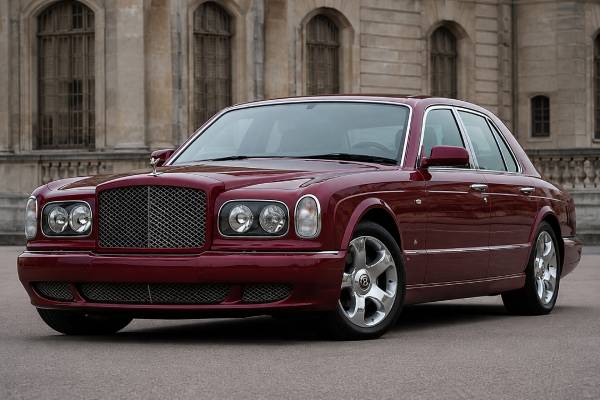
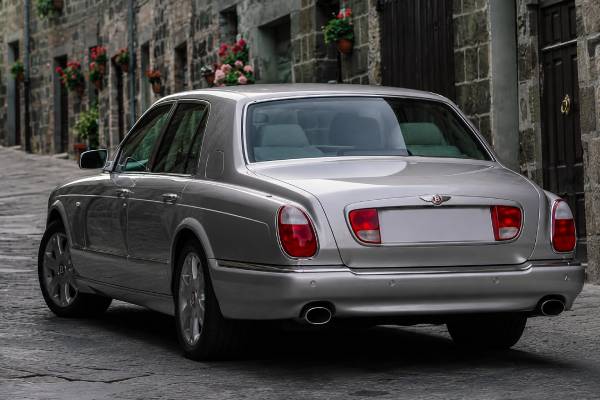
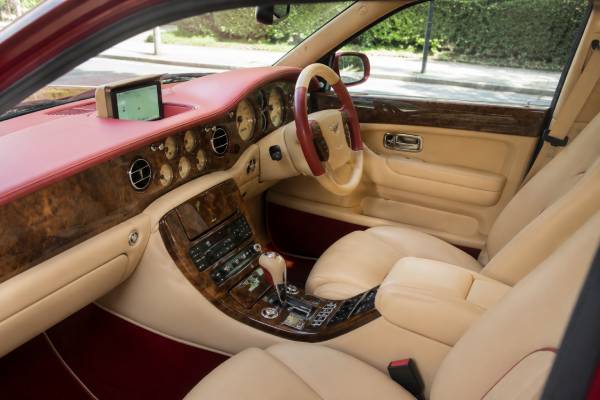
The Bentley Arnage Red Label is the model that restored the marque’s 6.75-liter V8 to its flagship saloon. Announced for the 2000 model year and produced from 1999 through 2002, it replaced the first Arnage’s BMW-derived 4.4-liter engine with a deeply revised Bentley L-series V8, one large turbocharger, 400 bhp, and 835 Nm of torque. The result is not simply a faster Green Label. The Red Label has a strengthened body, stiffer suspension, larger brakes, revised steering, improved rear seating, a four-speed heavy-duty automatic, and a distinctly different way of delivering performance. It moves on low engine speed and enormous torque rather than revs. This traditional character explains its enduring appeal, but age, heat, mass, and complexity make maintenance history decisive. A well-kept Red Label feels calm, forceful, and exceptionally solid. A neglected one can hide costly cooling, oil-leak, brake, suspension, electrical, and body problems beneath an immaculate-looking cabin.
Table of Contents
- Why Bentley Re-Engineered the Arnage
- Red Label Specifications and Technical Data
- The Single-Turbo Torque Character
- Body, Chassis, and Brake Revisions
- Maintaining the 6.75-Liter L-Series Package
- Inspecting a Red Label Before Purchase
- The Ownership Case for the Red Label
Why Bentley Re-Engineered the Arnage
Bentley created the Red Label to give the Arnage an unmistakably Bentley powertrain and a stronger traditional personality. The revived 6.75-liter V8 produced only 50 bhp more than the 4.4-liter Green Label, but its 835 Nm torque figure exceeded the smaller engine’s output by roughly 265 Nm.
That difference changes every ordinary driving situation. The Red Label can accelerate hard without high rpm, and the four-speed automatic does not need to shift frequently. The sensation is a deep, uninterrupted push rather than a rising, multi-gear rush. This “wave of torque” connects the Arnage to the Turbo R and earlier high-performance Bentleys.
The powertrain change required substantial engineering. The L-series V8 is physically larger and heavier than the BMW-derived engine. Bentley strengthened the bodyshell, revised the front suspension, recalibrated steering and traction systems, enlarged the brakes, changed wheels and tires, and adjusted packaging. The 1998 Arnage shell had already been much stiffer than the Turbo R body; Bentley states that the 2000-model structure gained a further 20 percent in torsional stiffness.
The engine itself was not merely taken from an older car. It used an aluminum block and heads, a central camshaft with pushrods and hydraulic tappets, electronic fuel injection, modern engine management, intercooling, and a Garrett turbocharger. The old architecture allowed enormous displacement in a relatively compact, low-revving package, while updated controls made 400 bhp and emissions compliance possible.
The GM four-speed automatic was chosen for its ability to manage the torque. Four ratios may sound dated next to the Green Label’s five-speed unit, but the engine’s broad output reduces the need for close spacing. In a healthy car, the transmission should engage smoothly and shift with authority rather than harshness.
The Red Label also brought practical improvements. Front and rear parking sensors, redesigned seats, roughly 50 mm more rear legroom, a standard pop-up navigation system in many markets, revised headlamp covers, and larger brakes made it a more complete flagship. Some details vary by market and commissioning specification, so the build record remains important.
Production records commonly list 2,273 Red Labels. That makes it much less rare than the Birkin or Le Mans editions, but still a low-volume luxury car by normal standards. The larger surviving population improves parts knowledge and specialist experience, yet condition differences between cars are enormous.
Red Label Specifications and Technical Data
The Red Label is a petrol-only, front-engine, rear-wheel-drive saloon using a single-turbo 6.75-liter Bentley V8 and a four-speed automatic. The technical values below apply to the 400 bhp Red Label, not the later twin-turbo Arnage R or 450 bhp Arnage T.
| Specification | Value |
|---|---|
| Engine code/family | L410MT, Bentley L-series V8 |
| Displacement | 6,750 cc (6.75 L; period sources also list 6,748 cc) |
| Construction | Aluminum block and cylinder heads |
| Valve gear | Central gear-driven camshaft, pushrods, hydraulic tappets, two valves per cylinder |
| Induction | Single Garrett AiResearch turbocharger with intercooling |
| Fuel and management | Premium unleaded petrol; Zytek electronic engine management and port injection |
| Maximum power | 400 bhp (298 kW) at 4,000 rpm |
| Maximum torque | 835 Nm (616 lb-ft) at about 2,500 rpm |
| Bore × stroke | 104.1 × 99.1 mm |
| Compression ratio | 8.0:1 |
| Specification | Value |
|---|---|
| Transmission | GM Turbo Hydra-Matic/4L80-E four-speed automatic |
| Drive | Rear-wheel drive |
| Final drive | 2.69:1 |
| 0–100 km/h | 6.3 seconds |
| 0–60 mph | About 5.9 seconds in period manufacturer data |
| Top speed | 249 km/h (155 mph), governed |
| Driving emphasis | Very high low-rpm torque and relaxed, infrequent shifting |
| Specification | Value |
|---|---|
| Fuel-tank capacity | 100 L (26.4 US gal) |
| Listed Australian combined consumption | 15.3 L/100 km for the 2000 Red Label |
| EU combined consumption for closely related Series 2 400 bhp cars | 20.6 L/100 km; test cycle and model year differ |
| Engine-oil capacity | About 9.4 L (9.9 US qt), verify by VIN and service procedure |
| Cooling-system capacity | About 20 L (21.1 US qt), verify exact filling procedure |
| Specification | Value |
|---|---|
| Body | Four-door, five-seat saloon |
| Length | 5,390 mm (212.2 in) |
| Width without mirrors | About 1,930 mm (76.0 in) |
| Height | 1,515 mm (59.6 in) |
| Wheelbase | 3,116 mm (122.7 in) |
| Kerb weight | 2,520 kg (5,556 lb) |
| Boot capacity | About 374 L (13.2 cu ft) |
| Rear-seat change | Bench mounted lower and farther rearward for about 50 mm more legroom |
| Specification | Value |
|---|---|
| Body structure | Steel monocoque with front and rear subframes; approximately 20% stiffer than the first 1998 shell |
| Front suspension | Independent wishbones, coil springs, anti-roll bar, adaptive electro-hydraulic damping |
| Rear suspension | Independent wishbones with self-leveling and adaptive damping |
| Steering | Speed-sensitive hydraulic rack-and-pinion |
| Brakes | Larger ventilated discs with four-channel ABS |
| Electronic aids | Traction/stability system calibration specific to the Red Label era |
| Typical wheel and tire | 8J × 18 wheel with 255/50 ZR18 tire |
Fuel-consumption data needs careful labeling because different markets and test cycles produce very different numbers. The Australian-market combined listing of 15.3 L/100 km is significantly lower than the 20.6 L/100 km EU combined figure published for closely related later 400 bhp cars. Neither should be presented as a guaranteed owner result. Urban use, short journeys, boost, climate control, and mechanical condition can push consumption beyond either figure.
The kerb weight is equally important. At about 2,520 kg, the Red Label asks a great deal of tires, brakes, dampers, bushes, wheel bearings, and cooling systems. Components that might tolerate mild wear on a lighter car can noticeably alter this Bentley’s safety and refinement.
The Single-Turbo Torque Character
The Red Label is defined by effortless midrange thrust. Its engine reaches maximum power at only 4,000 rpm and delivers peak torque around 2,500 rpm, so the useful performance zone is low and broad.
From a standstill, the car should move away smoothly with little throttle. Press harder and the single turbo builds boost, producing a strong surge that continues without needing high revs. There can be a clear transition as boost arrives, but it should not be accompanied by hesitation, detonation, misfire, smoke, or a sudden change in engine note.
At motorway speed, the car rarely feels short of reserve. A small throttle movement can increase speed without a downshift; a larger request prompts the transmission to select a lower ratio and the car advances with surprising urgency. Period 0–100 km/h performance of 6.3 seconds and a governed 155 mph maximum are impressive for a formal saloon weighing more than 2.5 tonnes.
The four-speed automatic should suit that delivery. Delayed engagement, a flare between ratios, hard shifts when warm, or shudder under load require diagnosis. A transmission that has been repeatedly overheated by cooling faults or driven with incorrect fluid can become an expensive problem. Check for leaks at lines, cooler connections, pan, and seals.
Turbo condition cannot be judged from sound alone. The inspection should include oil consumption, exhaust smoke, boost response, intake and charge hoses, wastegate control, oil feed and return lines, and fault data. A small leak can reduce performance and enrich mixture without producing an obvious warning.
The Red Label is most satisfying when driven on torque rather than launched repeatedly. Smooth acceleration preserves driveline components and matches the chassis. The car’s pace is real, but its greatest talent is making rapid travel feel unhurried.
Exhaust condition affects both performance and refinement. Leaks ahead of oxygen sensing can distort mixture control, while failed mounts can transmit vibration into the body. Catalytic converters and silencers are costly, so inspect corrosion, heat shields, hangers, and repair quality.
Body, Chassis, and Brake Revisions
The Red Label’s additional engine mass and torque were matched by meaningful structural and running-gear changes. A correct car should feel more solid and controlled than a tired early Arnage, not simply heavier.
The strengthened monocoque gives the suspension a firmer reference. On a diagonal driveway or uneven road, the body should not creak excessively around door openings. Doors should close with consistent alignment, and glass should seal properly. Unusual movement can indicate structural repair, corrosion, worn mounts, or improperly adjusted closures.
Front suspension calibration was stiffened to manage the heavier engine. The rear retained self-leveling, allowing the car to maintain its stance with passengers and luggage. Adaptive electro-hydraulic dampers alter control according to vehicle motion. When the system works, the ride is supple at low disturbance but disciplined over larger movements.
A floaty rear, repeated bouncing, uneven ride height, warning messages, or fluid leakage requires attention. Replacement parts can be expensive, and converting away from the original system may change the car’s character and value. Buyers should understand exactly what has been fitted.
Speed-sensitive steering should be light during parking and stable at speed. Excessive heaviness can come from low hydraulic pressure, pump or rack faults, seized joints, incorrect tire pressure, or wrong wheel geometry. Vague response may indicate worn bushes, track-rod ends, steering play, or unsuitable tires.
The larger brakes were necessary for the increased weight and speed. The pedal should feel firm and linear, with no pull, vibration, grinding, or delayed release. Inspect inner and outer disc faces, caliper boots, flexible hoses, hard lines, pad wear, ABS wiring, and parking-brake operation.
Correct 18-inch wheels and properly rated 255/50 tires contribute to the Red Label’s balance. Oversized wheels can introduce impact harshness and steering tramlining. Old tires can look excellent while having hardened beyond safe use. Check date codes, sidewall cracking, previous puncture repairs, load index, speed rating, and whether all four tires match.
Alignment should be performed by a workshop that can assess ride height and worn joints first. Adjusting geometry around failed bushes gives only a temporary result. A Red Label that tracks straight, brakes evenly, and settles after one body movement is likely to have received better chassis care than one with shiny wheels and vague road manners.
Maintaining the 6.75-Liter L-Series Package
The L-series engine is durable when kept cool, lubricated, sealed, and correctly adjusted. Its long history should not be confused with simplicity: the Red Label installation includes turbocharging, electronic management, extensive cooling, emissions hardware, and a tightly packed luxury-car engine bay.
Cooling-system inspection is the first recurring task. Check radiator efficiency, fan operation, thermostat behavior, pump condition, expansion tank and cap, every accessible hose and clamp, heater circuits, turbo-related plumbing, and signs of dried coolant. The temperature must remain stable in traffic with the air conditioning running.
Oil leaks deserve early action. Rocker covers, sump areas, seals, turbo lines, and joints can weep. A small leak can contaminate mounts, hoses, wiring, or exhaust surfaces. Period specialist guidance also emphasizes checking fastener torque where the official maintenance schedule requires it; this must be done only to the correct procedure and values.
The secondary-air injection and emissions pipework on later L-series installations can become difficult and labor-intensive to repair. On any Red Label, investigate exhaust leaks, cold-start noise, emissions faults, and damaged pipes rather than ignoring them. Confirm the exact system fitted to the VIN and market.
Hoses and clamps should be treated as age-sensitive components. Heat cycles harden rubber, while a heavy engine moving on tired mounts can stress connections. Replacing a failed hose without checking adjacent hoses, mounts, clips, and cooling pressure can lead to another breakdown.
Ignition, injection, and boost control should be diagnosed as a system. Uneven idle, weak performance, high fuel use, or warning lamps may result from plugs, coils where applicable, injectors, oxygen sensing, air leaks, throttle control, fuel pressure, or turbo control. Use live data and pressure tests instead of guessing.
The transmission needs correct fluid, cooling, and leak control. Service history should show informed work rather than universal “lifetime fluid” claims. A specialist should decide whether a fluid and filter service is appropriate based on condition and records. Avoid generic power flushing.
Suspension and steering maintenance includes bushes, ball joints, dampers, self-leveling components, accumulators where fitted, hoses, mounts, and wheel bearings. The car’s isolation can hide gradual wear, so inspection on a lift is essential.
Electrical stability starts with battery capacity and clean grounds. Low voltage can trigger several warnings at once. Test charging under load, investigate parasitic drain, and inspect aftermarket alarms, trackers, phones, or audio equipment. Water entry under carpets or around modules must be corrected before electrical repair.
The cabin and body need preservation equal to the mechanical work. Keep drains clear, inspect seals, condition leather, protect veneer from heat, and address corrosion or paint bubbling early. A perfect engine does not compensate for a damp, damaged cabin whose trim costs more than the car’s purchase price.
Inspecting a Red Label Before Purchase
A pre-purchase inspection should determine whether the car is truly a Red Label, whether it reaches and controls operating temperature, and whether its chassis can safely manage its mass and torque. Cosmetic presentation comes after those questions.
Verify the VIN and build specification. Red Label chassis identity differs from the B-series 4.4-liter cars, although the Le Mans special edition shares the same broad model identification. Confirm engine, transmission, wheelbase, steering position, original colors, trim, and major equipment.
Review invoices in date order. Look for regular oil and brake-fluid service, cooling work, transmission attention, suspension repairs, tires by age, battery replacements, and recurring fault patterns. A stamped book without itemized invoices cannot show whether known problems were diagnosed.
Insist on a cold start. Listen for prolonged cranking, heavy mechanical knocks, exhaust leaks, or irregular idle. Watch for blue, white, or black smoke and smell for fuel or coolant. Allow the car to warm fully, then test it after a heat-soak restart.
Drive gently until warm. The steering should center naturally, the ride should settle after bumps, and the brakes should release completely. Build throttle progressively and check that boost arrives cleanly. The transmission should not flare, hesitate, or strike into gear.
Test all electrical and comfort equipment repeatedly: parking sensors, navigation mechanism, windows, seat movements and memories, rear-seat controls, climate zones, mirrors, locks, alarm, instruments, lights, wipers, washers, audio, trunk, and fuel flap. Intermittent operation is still a fault.
A lift inspection should examine cooling and oil leaks, engine and transmission mounts, turbo plumbing, exhaust, brake pipes, discs, calipers, suspension joints, dampers, self-leveling hardware, steering rack and hoses, tires, corrosion, and accident repair. Pay attention to undertrays that may conceal fresh leakage.
Diagnostic scanning should include engine, transmission, ABS, stability, suspension, climate, body, and security modules where accessible. Record stored and current faults before clearing anything. If symptoms justify it, add compression, leak-down, oil-pressure, cooling-pressure, fuel-pressure, and boost tests.
Check recall status by VIN in the relevant national database and with a Bentley retailer or heritage specialist. Do not assume a car is clear because it passed an annual roadworthiness test.
Prepare a first-year budget using the inspection report. Include baseline fluids, tires, battery, alignment, air-conditioning service, and every fault found. Add a contingency for one hidden cooling, electrical, or hydraulic issue. Walk away if the purchase only works financially when nothing goes wrong.
The Ownership Case for the Red Label
The Red Label is the right Arnage for an owner who wants traditional Bentley torque, early styling, and the strongest connection to the marque’s long-running V8. It is not the rational choice for low operating cost or casual maintenance.
Compared with the Green Label, it feels more muscular and less eager to rev. The four-speed gearbox and large engine create a deliberate rhythm, while the BMW-powered car is smoother through the upper rev range and uses more ratios. The Red Label’s added weight can be felt in tight corners, but its strengthened shell and revised chassis provide confidence when maintained correctly.
Compared with the later Arnage R, the Red Label is more mechanically dramatic. The R’s twin-turbo system and Series 2 revisions deliver smoother, more controlled power and updated safety electronics. The Red Label retains the stronger single-turbo transition and earlier body details that some owners prefer.
Values depend on condition, history, color combination, market, mileage credibility, originality, and immediate needs. Production of 2,273 cars means buyers can be selective. It is usually better to pay more for a complete car with a known specialist than to rescue the cheapest example.
Regular use is beneficial when journeys are long enough to warm the engine and dry the exhaust. The car should be stored dry, kept on a suitable battery maintainer when necessary, and exercised through all cabin functions. Long inactivity can create seals, battery, brake, tire, fuel, and air-conditioning problems.
The Red Label’s most persuasive quality is the way it compresses distance. It can move five occupants and luggage at serious speed while the engine barely seems busy. That ability survives only when tires, brakes, suspension, cooling, and electronics receive the same care as the famous V8.
Buy one after a specialist proves that the car is structurally sound, thermally stable, electrically healthy, and mechanically honest. Then maintain it before symptoms become failures. Under those conditions, the Red Label is not merely an old luxury saloon; it is the model that re-established the engineering identity Bentley carried into the next century.
References
- BENTLEY NEWSROOM : 2001 Arnage Red Label Y662SEO 2021 (Bentley Heritage Collection)
- Bentley Arnage Red Label 2026 (Production and Model Data)
- CD03 ARNAGE LAYOUT 2000 (Instrumented Technical Sheet)
- Bentley Arnage 2000 | CarsGuide 2024 (Market Specifications)
- Used car buying guide: Bentley Arnage | Autocar 2018 (Buying Guide)
- Search Safety Issues | NHTSA 2026 (Recall Database)
Disclaimer
This article is for informational use and cannot substitute for professional diagnosis, repair, or a vehicle-specific inspection. Specifications, fluid types, service procedures, intervals, and torque values vary by VIN, market, production date, and equipment; check the official Bentley workshop information for the exact vehicle.
Please share this guide on Facebook, X/Twitter, or a Bentley owner group if it helps someone evaluate an Arnage Red Label more carefully.