
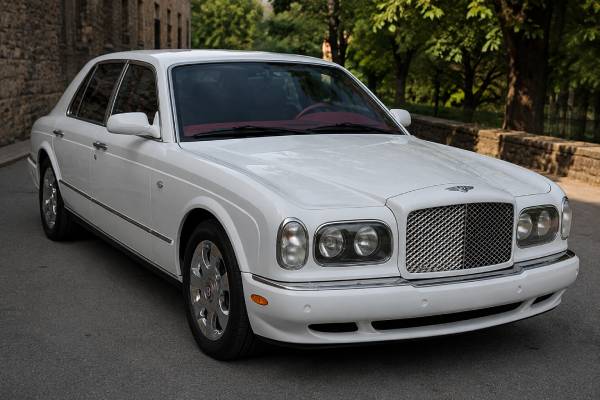
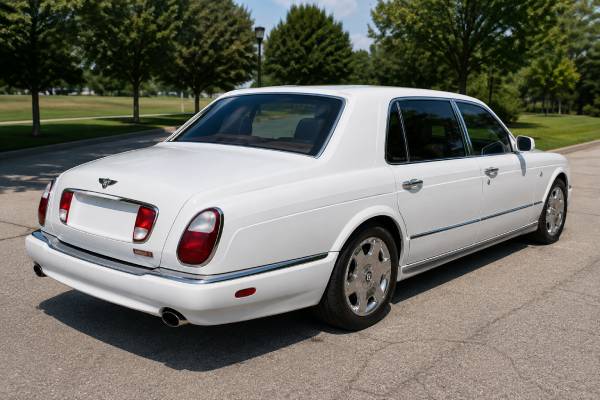
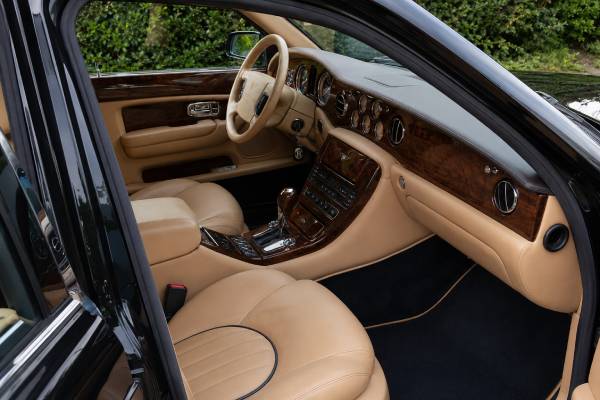
The Bentley Arnage Red Label LWB is a factory long-wheelbase interpretation of the 400 bhp Arnage, created for owners who wanted substantially more rear space without abandoning the driver-focused Bentley identity. Built in very small numbers from 2000 to 2002, it adds 250 mm to the wheelbase through extensive body changes rather than a simple spacer section. The result is a 5.64-meter saloon with longer doors, a reworked rear body structure, LWB-specific suspension tuning, bespoke Mulliner commissioning, and a kerb weight of about 2,655 kg before unusual equipment or armor. Its 6.75-liter L-series V8 still produces 835 Nm, so the car can move with surprising authority, but rear comfort, structural condition, and correct operation of custom equipment matter as much as acceleration. Because only around 96 were made, every example may differ. Buyers must authenticate the chassis, understand the exact build specification, and inspect the body conversion, cooling, drivetrain, self-leveling suspension, brakes, electronics, and rear-cabin systems as one integrated vehicle.
Table of Contents
- Why the Red Label LWB Exists
- How Bentley Created the Extra Space
- Long-Wheelbase Technical Data
- Driving and Chauffeur Dynamics
- Bespoke Rear-Cabin Systems
- Maintenance for a Heavy, Rare Arnage
- How to Inspect and Value an LWB
Why the Red Label LWB Exists
The Red Label LWB was designed to give rear passengers limousine-like room while retaining the appearance and road behavior of an Arnage. It was not merely a standard car with a longer rear footwell; Bentley and its Mulliner operation reworked the doors, pillars, floor, roof relationships, and suspension to create a coherent factory product.
The standard Arnage already offered a generous cabin, but it remained a driver’s Bentley rather than a formal chauffeur car. Adding 250 mm gave customers a more credible alternative to larger bespoke limousines and the new generation of ultra-luxury flagships arriving in the early 2000s. Approximately 50 mm of the extra length was allocated forward and roughly 200 mm benefited the rear compartment.
This distribution is visible in the door and wheel-arch geometry. The rear door is longer, the wheel arch sits farther back relative to the opening, and the body side has been altered in more than one place. In coachbuilding language, this is often described as a double-cut style conversion. The aim is to avoid the awkward proportions of a single inserted center section.
Production records identify 96 cars. A prototype or very early example may carry a different model-designation letter in the VIN from the subsequent cars, which means authentication requires more than a generic chassis decoder. The build file, original sales documents, and specialist production records should agree on wheelbase, market, steering position, and commissioned equipment.
The LWB was sold through Bentley’s bespoke process. That means two cars can differ in seating, tables, communications equipment, entertainment, refrigeration, privacy features, partition arrangements, paint, leather, veneer, and security equipment. A standard list cannot capture every car. The individual build specification is the only reliable reference.
Some examples were ordered with protective or armored elements. Armor changes weight, tire requirements, braking loads, door-hinge stress, glass mechanisms, suspension setup, and cooling demand. A seller should provide documentation from the original conversion or a recognized specialist. An undocumented “armored” claim is not a benefit; it is a reason for a deeper structural and systems inspection.
The LWB’s rarity makes originality important, but usability remains central. A rear compartment full of obsolete electronics may be historically interesting yet nonfunctional. The best solutions preserve original hardware or trim while updating hidden components in a reversible, professionally documented way.
How Bentley Created the Extra Space
The 250 mm extension changes far more than legroom. It increases bending and torsional loads, adds mass between the axles, lengthens wiring and ducts, alters door openings, and changes how the suspension manages pitch and rear occupancy.
The body shell must remain rigid around longer apertures. Inspect door alignment carefully: each door should open smoothly, hold position, and close without lifting or slamming. Uneven gaps, contact marks, cracked paint near hinges, wind noise, or water entry can indicate worn hinges, poor previous repair, or structural movement.
The roof and floor are equally important. Look for corrosion or repair along seams, under carpets, around seat mounts, and beneath exterior trim. A long-wheelbase body may have unique panels that are difficult to replace. Repairs should preserve drainage and corrosion protection, not merely make the outer surface look straight.
Longer rear doors place more leverage on hinges and check straps. Power window mechanisms also move large, heavy glass. Test every window repeatedly from front and rear switches, listening for slowing, crunching, or glass movement in the frame. Check soft-close or locking behavior where fitted.
Suspension tuning was revised for the extra weight. The rear self-leveling system is essential because the load can change greatly between an empty car and one carrying passengers, luggage, and equipment. The car should sit evenly, raise or settle normally after loading, and avoid repeated bouncing.
The powertrain was also developed beyond the earliest single-turbo Red Label specification. Production-history sources describe the LWB’s 400 bhp engine with Bosch Motronic management and two smaller Garrett turbochargers, an arrangement that points toward the later Arnage R package. Because very early cars and market descriptions can differ, identify the actual induction and engine-management hardware on the individual chassis rather than assuming every “Red Label LWB” is identical.
The four-speed automatic remains appropriate because 835 Nm is available at low speed. In a properly sorted car, it should pull away without strain and shift infrequently. Additional mass does not excuse delayed engagement, flare, harsh changes, or vibration.
Brakes, tires, and wheels carry greater responsibility on the LWB. Correct load ratings are mandatory, especially if the car has armor or unusually heavy equipment. Never infer safe capacity from appearance. Determine actual vehicle mass and factory requirements.
Long-Wheelbase Technical Data
The Red Label LWB is a petrol-powered, rear-wheel-drive, factory-stretched luxury saloon. Its key facts are a 250 mm wheelbase extension, 400 bhp L-series V8, 835 Nm of torque, four-speed automatic, self-leveling rear suspension, and bespoke Mulliner specification.
| Specification | Value |
|---|---|
| Model years | 2000–2002; market launch centered on model year 2001 |
| Recorded production | 96 cars |
| Wheelbase extension | 250 mm (9.8 in) over the standard Arnage |
| Overall length | 5,640 mm (222.0 in) |
| Width without mirrors | About 1,930 mm (76.0 in) |
| Height | About 1,520 mm (59.8 in) |
| Wheelbase | Approximately 3,366–3,370 mm (132.5–132.7 in) |
| Kerb weight | 2,655 kg (5,853 lb) |
| Construction method | Factory/Mulliner double-cut style extension involving doors and rear body structure |
| Specification | Value |
|---|---|
| Engine family | Bentley L-series V8, L410MT development |
| Displacement | 6,750 cc (6.75 L) |
| Valve gear | Pushrod OHV, two valves per cylinder, hydraulic tappets |
| Induction | Turbocharged and intercooled; production records describe twin Garrett T3 turbos on the developed LWB engine |
| Engine management | Bosch Motronic ME7.1.1 on the developed production package |
| Power | 399–400 bhp (298 kW) at 4,000 rpm |
| Torque | 835 Nm (616 lb-ft) at low engine speed |
| Transmission | Four-speed automatic |
| Drive | Rear-wheel drive |
| Specification | Value |
|---|---|
| 0–100 km/h | About 6.9 seconds |
| Documented maximum speed | 200 km/h (124 mph) in specialist production records |
| Alternative period database listing | 249 km/h (155 mph); confirm the exact market and limiter calibration |
| Fuel-tank capacity | 100 L (26.4 US gal) |
| Listed combined consumption | About 19.2 L/100 km (12 mpg US) |
| Practical load note | Rear occupants, bespoke equipment, and armor options can materially increase operating mass |
| Specification | Value |
|---|---|
| Front suspension | Independent double wishbones with coil springs, anti-roll bar, and adaptive damping |
| Rear suspension | Independent wishbones with self-leveling and LWB-specific tuning |
| Steering | Hydraulically assisted rack-and-pinion |
| Front brakes | Ventilated discs, approximately 348 mm |
| Rear brakes | Ventilated discs, approximately 345 mm |
| Electronic aids | ABS and traction/stability support appropriate to production specification |
| Typical wheels and tires | 18-inch wheels with 255/50 R18 tires |
| Specification | Value |
|---|---|
| Seating | Normally four or five seats depending on commission |
| Added room distribution | About 50 mm added forward and 200 mm added to the rear compartment |
| Rear-door treatment | Longer rear doors and repositioned rear wheel-arch relationship |
| Commissioning | Individual Mulliner specification, potentially including communications, tables, refrigeration, or privacy equipment |
| Armoring | Some protective equipment could be ordered; weight and servicing implications must be documented |
| Boot capacity | Approximately 374 L (13.2 cu ft) before bespoke equipment intrudes |
Published maximum-speed figures conflict. Specialist production records list 200 km/h, while some technical databases give 249 km/h. Limiter calibration, market, development stage, tires, armor, and model description may explain the difference. The responsible approach is to document the discrepancy and verify the exact car’s factory specification rather than choosing the more dramatic number.
A similar caution applies to engine configuration. The assignment scope identifies the 400 bhp L410MT family, but production sources describe evolved twin-turbo hardware on the LWB while the standard early Red Label used one larger turbocharger. Inspection of the car and its build documentation is essential.
Driving and Chauffeur Dynamics
The LWB should be driven for passenger comfort first, but it still needs to feel like a Bentley rather than a converted limousine. Smooth controls, stable body motion, powerful low-rpm acceleration, and confident brakes are the benchmarks.
The longer wheelbase improves straight-line composure and can reduce the sharpness of pitch over widely spaced bumps. It also increases the turning circle and makes urban positioning more difficult. Drivers must plan entrances, ramps, curb clearance, and parking maneuvers. Front and rear parking sensors are useful only when every sensor and buzzer works correctly.
At low speed, steering should remain light enough for precise positioning. Heavy steering can indicate hydraulic faults, tire-pressure problems, incorrect alignment, seized joints, or excessive load. Vague steering suggests worn bushes, track rods, wheel bearings, or unsuitable tires.
The 6.75-liter V8 moves the LWB with little apparent effort. A 0–100 km/h time near 6.9 seconds is remarkable for the mass and purpose. In chauffeur use, the more important quality is clean acceleration from 30 to 80 km/h without abrupt downshifts or a sudden boost spike that disturbs rear passengers.
Throttle calibration, engine mounts, transmission mounts, and driveline joints all affect smoothness. A clunk when selecting Drive, vibration under load, or a thump on throttle lift is unacceptable in a car designed around refinement. These symptoms should be traced before purchase.
Rear ride quality should be assessed from the back seat, not only the driver’s seat. Have a second person drive over urban seams, speed humps, coarse surfaces, and a flowing road while you listen and feel for vertical shake, side-to-side head toss, door movement, trim rattles, and climate noise.
Braking should be progressive enough for smooth stops yet strong when required. A heavy LWB magnifies any disc thickness variation, sticky caliper, old tire, or tired damper. Test repeated moderate stops after the system is warm and check that the car remains straight.
Wind noise around extended doors and pillars is an important diagnostic clue. A properly aligned, well-sealed body should be quiet at speed. Whistling can result from hardened seals, glass adjustment, door sag, accident repair, or an imperfect body conversion repair.
The chauffeur’s environment matters too. Check seat comfort, visibility, mirror movement, steering-column adjustment, navigation mechanism, ventilation, and control illumination. A driver who cannot see or operate the car comfortably will not deliver smooth passenger service.
Bespoke Rear-Cabin Systems
The rear compartment can be the most valuable and the most expensive part of an LWB. Every table, screen, telephone, cooler, blind, light, seat, switch, and storage unit should be treated as part of a custom installation rather than a generic Arnage accessory.
Begin with an inventory. Compare installed equipment with the build specification and photograph every feature. Identify which systems are factory, Mulliner, dealer-installed, or later aftermarket additions. This distinction affects wiring diagrams, parts sourcing, authenticity, and repair responsibility.
Test rear seats through their full movement, including memories, heating, lumbar functions, head restraints, and any footrests. Listen for motors straining against hardened mechanisms. Check that seat movement does not pinch wiring or damage carpets.
Tables should deploy smoothly and lock securely. Veneer must be inspected at hinges and edges where stress can crack the lacquer or substrate. A loose table is not only cosmetic; it can become dangerous in a crash.
Entertainment and communications equipment from this era may be obsolete. Screens can fail, analog television tuners no longer receive broadcasts in many countries, early navigation media are outdated, and period telephones may not connect to current networks. Restoration can prioritize appearance and local playback rather than pretending every original function is practical.
Any modern conversion should have proper power management. Large screens, amplifiers, routers, chargers, and refrigeration can overload old circuits or create battery drain. The installation should use correct fusing, relays, cable sizing, ventilation, and grounding without cutting original harnesses unnecessarily.
Rear climate control must cool and heat effectively. Long ducts, extra cabin volume, solar load, and possible privacy glass increase demand. Check vent temperature, blower speeds, distribution flaps, compressor operation, refrigerant leaks, condensate drainage, and any independent rear unit.
Coolers and drinks cabinets need inspection for leaks, odor, corrosion, and electrical load. A nonfunctional cooler can conceal moisture damage inside cabinetry. If it is no longer used, it should still be secured and electrically isolated correctly.
Privacy curtains or blinds should move evenly and retract fully. Heavy armored glass, if fitted, may strain regulators. Confirm whether replacement glass remains available and whether the car’s doors, hinges, and window channels were serviced for the extra mass.
Maintenance for a Heavy, Rare Arnage
LWB maintenance must account for weight, bespoke systems, and unique body parts. The normal Arnage service list is only the starting point.
Cooling is the first mechanical priority. Inspect radiator efficiency, fans, thermostat, water pump, expansion tank, cap, hoses, clamps, heater circuits, turbo plumbing, and any auxiliary cooling added for equipment or armor. Verify stable temperature while idling with both climate systems and electrical loads operating.
Engine oil, filters, boost control, ignition, injection, emissions hardware, and crankcase ventilation need scheduled attention. Oil leaks should be repaired early because they can damage mounts, wiring, and exhaust components. Diagnose boost or mixture faults with pressure testing and live data.
The transmission and differential must handle high torque and mass. Check fluid condition, leaks, cooler lines, mount condition, shift quality, and driveline joints. Service with the exact fluid and procedure for the fitted unit.
Self-leveling suspension deserves frequent inspection. An LWB that is stored for long periods can develop leaks, seized height components, tired dampers, and flat-spotted tires. Measure ride height and compare side to side. Do not align the car until the suspension is correct.
Brake service should include fluid, hoses, pipes, calipers, both disc faces, parking brake, ABS sensors, and wheel-bolt condition. Heavy or armored examples may have special requirements. Recall completion should be verified by VIN.
Tires should be selected by size, load index, speed rating, and actual vehicle weight. Replace by age even when tread remains. A tire failure on a 2.7-tonne bespoke saloon can cause extensive body damage before the driver stops.
The body needs regular drain and seal inspection. Clean door, sunroof, and climate drains; check extended seams; lift carpets where dampness is suspected; lubricate hinges and latches; and monitor door sag. Corrosion caught early is far cheaper than reconstructing a unique sill or pillar.
Electrical maintenance begins with battery capacity, charging output, grounds, and a measured parasitic-draw test. Bespoke electronics should have their own circuit documentation. Keep a labeled wiring diagram with the car after any repair or modernization.
Storage should be dry, level, and spacious enough to open the long doors without damage. Use an appropriate battery maintainer, maintain tire pressure, move the car regularly, and run it long enough to reach full operating temperature. Exercise every rear feature, not just the engine.
How to Inspect and Value an LWB
Value an LWB by authenticity, structure, mechanical condition, and completeness of its commission. Mileage and paint shine are secondary.
First, verify that the VIN corresponds to a factory long-wheelbase car. Early prototype identity may differ from later production, so obtain specialist confirmation. Match the chassis to the original order, colors, interior, steering position, and equipment.
Second, inspect the conversion areas. Measure panel gaps, check roof and floor seams, examine sills and pillars, test long doors for sag, look for water entry, and review paint depth and repair evidence. A professional accident repair can be acceptable; undocumented structural work is not.
Third, weigh or document the car if it has armor or heavy equipment. Confirm tire and wheel ratings, suspension setup, brake specification, and legal registration. Protective glass can delaminate and may be extremely expensive to replace.
Fourth, perform a cold-to-hot mechanical test. Monitor cooling, boost, transmission shifts, steering, brakes, self-leveling, ride height, air conditioning, and heat-soak restart. Scan all available modules and record stored faults.
Fifth, operate every bespoke feature. A row of dead screens and switches can require custom restoration even when the standard Arnage systems work. Obtain quotations before purchase, because ordinary labor guides do not apply to hand-built cabinetry and one-off wiring.
Sixth, review parts availability. Unique doors, glass, seals, trim, wiring, tables, screens, and body panels may require repair rather than replacement. A complete car with worn parts can be easier to restore than a cosmetically nicer car missing rare pieces.
Price should reflect a realistic first-year plan: baseline service, tires, brakes, suspension, battery, climate work, body sealing, electronic repair, and a contingency. An LWB bought cheaply because “the rear equipment is only cosmetic” can exceed the cost of a sorted example.
The Red Label LWB is compelling when its extra length remains invisible in the way it drives and obvious in the comfort it provides. That standard is demanding, but it is the point of the model. Buy only when the car behaves as a single factory-engineered Bentley rather than a collection of stretched bodywork and aging accessories.
References
- Bentley Arnage (Red label) LWB 2026 (Production and Model History)
- Bentley Arnage Red Label LWB Specs, Performance, Comparisons 2026 (Technical Data)
- Bentley Arnage Red Label LWB specs (2001-2002), performance, dimensions & technical specifications – encyCARpedia 2025 (Technical Data)
- 1998-2009 2022 (Bentley Heritage Technical Library)
- Used 2001 Bentley Arnage Sedan Red Label Specs & Features | Edmunds 2026 (Fuel and Equipment Data)
- Search Safety Issues | NHTSA 2026 (Recall Database)
Disclaimer
This article is informational and does not replace professional diagnosis, body-structure assessment, authentication, or repair. Specifications, capacities, procedures, service intervals, and torque values differ by VIN, market, build stage, armor, and bespoke equipment; verify them against the official documentation for the exact vehicle.
Please share this guide on Facebook, X/Twitter, or a specialist Bentley forum if it helps another buyer understand the unusual Red Label LWB.