
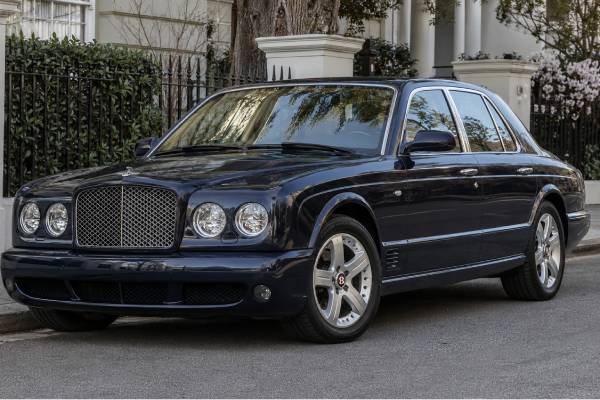
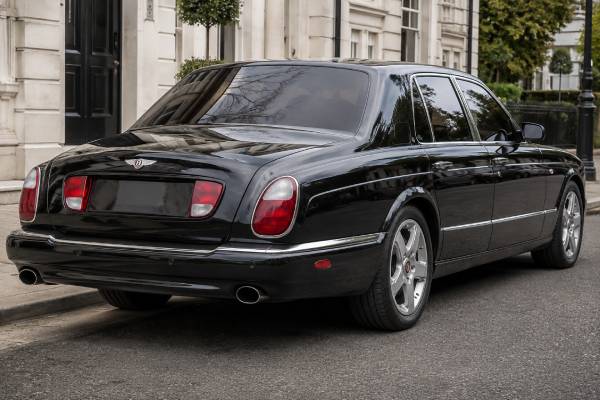
The 2003–2006 Bentley Arnage RL is the long-wheelbase, chauffeur-friendly member of the Series Two Arnage family, combining a 400 hp twin-turbo 6.75-liter V8 with an extra 250 mm of wheelbase. It is not simply an Arnage R with a spacer inserted in the middle: Bentley Mulliner treated the RL as a bespoke flagship, using the additional length to create genuinely useful rear legroom while retaining the standard car’s formal proportions, traditional rear-wheel-drive layout, and immense low-speed torque.
For buyers today, the central question is not whether the RL feels special—it does—but whether a particular example has been maintained to the standard its complexity demands. A low purchase price can conceal major needs in cooling, suspension, braking, electronics, trim, or bespoke rear-cabin equipment. The best cars have complete histories, correct tires, smooth hydraulic and electrical operation, and evidence of regular specialist attention rather than long periods of cosmetic-only care.
Table of Contents
- What Makes the RL Different
- Specifications and Technical Data
- Long-Wheelbase Engineering and Cabin Design
- Performance and Road Manners
- Maintenance Priorities
- Pre-Purchase Inspection
- Ownership and Market Fit
What Makes the 2003–2006 Arnage RL Different
The RL is the Arnage for owners who place rear-seat space and Mulliner personalization above ultimate sporting sharpness. Its 3,366 mm wheelbase is 250 mm longer than the standard Arnage R, and nearly all of that benefit is felt in the rear compartment rather than being consumed by a larger engine bay or luggage area.
Bentley introduced the RL as the formal end of the Series Two range. The short-wheelbase Arnage R was the comfort-focused driver’s saloon, the Arnage T emphasized speed and firmer responses, and the RL turned the same basic architecture into a credible limousine. It remained rear-wheel drive and retained the traditional Crewe-built pushrod V8, so it still delivered the characteristic Bentley sensation of effortless thrust rather than the isolated, low-output demeanor associated with some conventional limousines.
The “RL” name is important when shopping because the market also contains earlier long-wheelbase Arnages, later 450 hp RLs, heavily personalized Mulliner commissions, and separate extended limousines. A 2003–2006 RL should normally have the 400 hp engine, 835 Nm of torque, four-speed GM automatic transmission, and a wheelbase approximately 250 mm longer than the standard saloon. A seller who describes any stretched Arnage as an RL may be overlooking meaningful differences in model year, engine calibration, body conversion, or factory provenance.
Model-year changes also matter. Early examples have the pre-2005 front styling, while 2005-model-year cars gained the individual round headlamps, revised bonnet and radiator treatment, updated instruments and controls, an improved navigation installation, and revised rear-suspension settings. These changes do not automatically make a later car better; condition and maintenance remain more important. They do, however, affect parts identification, appearance, equipment, and market preference.
Because the RL was built through Bentley Mulliner and could be extensively customized, two cars of the same year can differ substantially. Rear entertainment systems, telephones, writing tables, cocktail cabinets, coolers, special veneers, privacy arrangements, monograms, and nonstandard electrical equipment may all be present. That individuality is a major attraction, but it also means a buyer must inspect the exact car rather than relying on a generic equipment list.
Bentley Arnage RL Specifications and Technical Data
The 2003–2006 RL is an internal-combustion, rear-wheel-drive luxury saloon powered by Bentley’s L410MT-family 6.75-liter twin-turbo V8. The engine’s defining feature is not high engine speed but 835 Nm of torque delivered through a heavy-duty four-speed automatic, giving a 2.6-tonne limousine strong, calm acceleration with little need to rev.
| Specification | 2003–2006 Arnage RL |
|---|---|
| Engine type | 90-degree aluminum V8, overhead valves, 2 valves per cylinder |
| Engine family | Bentley L410MT-series |
| Displacement | 6,750 cc |
| Induction | Twin Garrett T3 turbochargers with intercooling |
| Maximum power | 400 bhp (298 kW) at 4,000 rpm |
| Maximum torque | 835 Nm (616 lb-ft) at approximately 3,250 rpm |
| Fuel | Premium unleaded gasoline; use the octane grade specified for the car’s market |
| Specification | Details |
|---|---|
| Transmission | GM 4L80-E electronically controlled 4-speed automatic |
| Drive layout | Front engine, rear-wheel drive |
| Final drive | Conventional rear differential |
| Stability systems | ABS, traction control, and electronic stability functions according to model year and market |
| Driving emphasis | Low-rev torque, smooth progress, and sustained high-speed touring |
| Measurement | Value |
|---|---|
| Body style | Four-door long-wheelbase luxury saloon |
| Wheelbase | 3,366 mm (132.5 in) |
| Overall length | Approximately 5,640 mm (222.0 in) |
| Body width | Approximately 1,932 mm excluding mirrors |
| Overall width | Approximately 2,125 mm including mirrors |
| Height | Approximately 1,515 mm |
| Kerb weight | Approximately 2,655 kg; equipment can increase mass |
| Specification | Published figure or context |
|---|---|
| Top speed | Up to 155 mph (250 km/h) for later 400 hp specification |
| 0–60 mph | About 6.0 seconds in representative published data |
| Fuel tank | Approximately 96 liters |
| Luggage capacity | Approximately 374 liters |
| Seating | Usually four or five, depending on rear-cabin commission |
| System | Configuration |
|---|---|
| Structure | Steel monocoque with subframes and model-specific long-wheelbase bodywork |
| Suspension | Independent double-wishbone layout with coil springs, self-leveling, and adaptive electro-hydraulic damping |
| Steering | Power-assisted rack and pinion |
| Brakes | Ventilated discs with ABS; inspect exact rotor and caliper specification by VIN |
| Standard wheel size | 18-inch alloy wheels on many cars |
| Optional wheel size | 19-inch packages were offered; tire specification must match the fitted factory wheel |
Published figures can differ slightly by market, measurement convention, emissions package, and equipment. Bespoke Mulliner additions can also change weight and seating. For service work, use the vehicle identification number and official workshop information rather than assuming that a value for a visually similar Arnage applies.
Long-Wheelbase Engineering and Cabin Design
The extra 250 mm transforms rear accommodation without making the RL look like an obvious aftermarket stretch. Bentley integrated the additional length into the body and wheelbase, preserving the upright roofline, formal rear quarter, and balanced relationship between the doors and wheel openings.
That engineering choice matters in practical use. The rear doors open onto a much larger footwell, and passengers can sit behind a tall front-seat occupant without forcing either seat into an awkward position. The benefit is especially noticeable when the front passenger seat is used normally rather than pushed unrealistically forward. The RL therefore works as intended with a chauffeur, but it also suits owners who drive themselves and frequently carry adults in the back.
The long body imposes tradeoffs. The turning circle, parking length, curb clearance, and breakover over steep ramps require more attention than in the standard Arnage. The rear doors and long sills also create more areas where seals, alignment, paint repairs, and corrosion protection must be inspected. A car that appears straight from several meters away may still reveal uneven door gaps, wind noise, water entry, or previous structural work when examined closely.
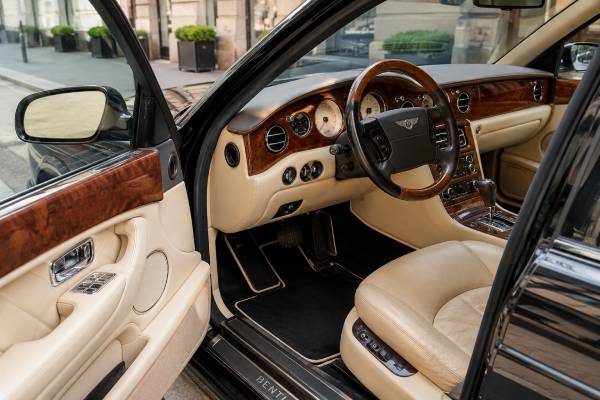
Mulliner content is central to the RL experience. Many cars use electric rear seats, veneered picnic tables, special storage, rear climate controls, communications equipment, or entertainment systems. On a new car, these features demonstrated Crewe craftsmanship. Two decades later, they are individual systems with wiring, relays, screens, motors, obsolete media formats, and custom trim that may be difficult to replace.
A buyer should test every rear-cabin function from the passenger’s position. Confirm that both seat bases, backrests, head restraints, heaters, tables, blinds, lamps, intercoms, coolers, telephones, screens, and audio controls operate correctly. Do not accept “probably a fuse” as a diagnosis. A failure may be a simple switch, but it may also involve unique harnesses or components installed for one commission.
The craftsmanship itself deserves the same scrutiny as the mechanical systems. Check veneer for lifting or clouding, leather for shrinkage around airbag seams and seat edges, headlining for sagging, lambswool carpets for moisture, and plated fittings for pitting. Originality adds value, but preservation is preferable to neglected originality. High-quality retrimming can be appropriate when documented and executed in a manner consistent with the car’s materials.
Performance and Road Manners
The RL is fast enough to feel effortless rather than frantic. Its 400 hp figure is less revealing than the 835 Nm torque output, which allows the car to gather speed with minimal throttle movement and only occasional downshifts from the four-speed automatic.
At urban speeds, the long throttle travel and substantial mass encourage smooth inputs. The car should pull away cleanly without shudder, flare, or a harsh engagement. Turbo response is progressive when the engine and controls are healthy. Hesitation, uneven boost, smoke, a hunting idle, or a dramatic surge after a dead spot deserves investigation rather than being dismissed as old-car character.
On a motorway, the RL’s purpose becomes clear. The long wheelbase settles vertical movements, the cabin isolates passengers from much of the road noise, and the engine can sustain high speed without sounding strained. The adaptive dampers should control the body without making it float repeatedly after a crest. A car that bounces, leans excessively, sits low at one corner, or displays suspension warnings may need more than routine alignment.
The steering is lighter and slower than that of a modern performance saloon, yet a sound Arnage tracks accurately and communicates its size. Excess play, steering-column knocks, persistent pulling, or vibration under braking are faults, not inherent qualities. Large wheels may sharpen initial response but can make the ride busier and increase the cost of replacing age-hardened tires.
Braking feel should be progressive and confidence-inspiring. The RL carries considerable kinetic energy, so rotor condition, caliper operation, hydraulic integrity, tire grip, and suspension geometry all matter. A car that has covered little annual mileage may still need extensive brake work because corrosion, seized components, and aged hoses depend on time and storage conditions as much as distance.
The RL is not an ideal car for repeated short journeys. Its large engine, complex climate system, multiple batteries and control modules, and substantial fluids all benefit from proper operating temperature and regular use. A long drive during inspection is more informative than a brief circuit around a dealer’s block: it reveals hot restart behavior, transmission operation, temperature stability, charging performance, cabin noises, and whether warning messages return after being cleared.
Maintenance Priorities for the 400 hp RL
Preventive maintenance is cheaper than recovering an Arnage RL after years of deferred work. The correct approach is to maintain the whole car as an integrated system rather than fixing only the fault that currently prevents it from moving.
Cooling and engine health
The 6.75-liter V8 generates substantial heat, and cooling-system condition is fundamental. Inspect the radiator, expansion tank, hoses, auxiliary fans, thermostat behavior, coolant quality, and evidence of dried residue around joints. The temperature indication should remain stable in traffic and after a hard climb. Any history of overheating warrants careful specialist investigation because the consequences can extend well beyond replacing a hose.
Oil leaks need context. Light misting on an older hand-built V8 is different from active leakage onto exhaust components, a rapidly falling level, or a contaminated undertray. Check cold-start oil pressure behavior, listen for abnormal valvetrain noise, and verify that the engine remains smooth when fully hot. Service records should identify oil changes by date as well as mileage, because many RLs cover too few miles to reach distance-based intervals.
Turbocharging, ignition, and fuel delivery
Both turbochargers, their oil and coolant connections, intake plumbing, boost-control hardware, ignition components, and fuel system must work together. Uneven power, misfire under load, fuel odor, excessive smoke, or oil in intake plumbing should be diagnosed before purchase. Replacing one visibly failed component without addressing aged hoses, heat-damaged wiring, or the cause of contamination can produce repeat failures.
Fuel-line recall and campaign history should be checked by VIN. Even when a campaign is old, proof of completion is preferable to assumption. Cars that have changed countries may have incomplete records across national databases, so a Bentley dealer or marque specialist may need to confirm campaign status.
Transmission and driveline
The GM 4L80-E is strong but not immune to neglect. Fluid condition, cooling, electrical controls, mounts, and correct adaptation all affect shift quality. During a drive, test light-throttle changes, full-throttle kickdown, manual range selection, reverse engagement, and operation after the transmission is hot. Delayed engagement, slipping, repeated hunting, or a heavy clunk should be assessed by a specialist familiar with the Bentley installation rather than a generic transmission shop alone.
Inspect the propeller shaft, differential, driveshaft joints, and mounts for leaks, vibration, or backlash. A vibration that appears only under load or at a narrow speed range may be driveline-related even if the wheels have recently been balanced.
Suspension, brakes, and tires
The adaptive damping and self-leveling arrangement is essential to the RL’s ride quality. Check ride height after the car has stood, listen for pump activity, inspect dampers and bushes, and confirm that the selected suspension modes make an appropriate difference. Because the car is heavy, tired bushes can create vague steering and accelerated tire wear before they produce obvious noise.
Use premium tires of the correct load and speed rating, fitted as a matched set where practical. Old tires can look unworn while offering poor wet grip and causing vibration. Check date codes, inner shoulders, sidewalls, wheel runout, and evidence of incorrect jacking. Brakes should be measured rather than judged through the wheel openings; large rotors can retain a usable-looking outer face while the inner surfaces deteriorate.
Electrical systems and batteries
Low voltage creates misleading faults. Confirm battery age, charging voltage, sleep current, alarm behavior, key operation, window indexing, central locking, seat memories, climate control, navigation, parking aids, and all warning lamps. A battery maintainer is useful for storage, but it should not be used to conceal a parasitic drain or failing alternator.
Bespoke equipment requires documentation. Keep wiring diagrams, remote controls, security codes, invoices, and instructions with the car. Removing obsolete equipment can be sensible, but alterations should be reversible and professionally integrated so that original harnesses, trim, and vehicle networks are not damaged.
How to Inspect an Arnage RL Before Buying
A specialist pre-purchase inspection is essential because the difference between a good RL and a superficially attractive one can exceed the purchase price of the car. The inspection should include diagnostic scanning, a cold start, an extended road test, lift access, body measurement where repairs are suspected, and verification of the exact factory specification.
Start with identity and provenance:
- Match the VIN on the car, documents, service invoices, and diagnostic records.
- Confirm that it is a factory RL rather than an earlier LWB, later 450 hp car, or third-party conversion.
- Obtain the original build specification or Mulliner record when possible.
- Check ownership, registration, import, accident, and recall history in every relevant market.
- Look for continuous specialist invoices, not only stamped service-book entries.
Then assess condition systematically. The engine should be cold when first seen. Inspect all fluid levels and colors before starting. Watch the exhaust during start-up and after idling, listen as the idle settles, and verify that every warning lamp illuminates and then behaves correctly. A recently cleared fault memory or disconnected battery can temporarily hide symptoms, so rescan after the road test.
On the lift, examine corrosion around subframes, brake pipes, fuel lines, suspension mounts, jacking points, sills, exhaust supports, and underbody seams. Check for crushed lifting points and mismatched undertrays. Long-wheelbase cars deserve extra attention along the extended floor and door apertures, particularly if paint readings or trim alignment suggest previous repair.
During the drive, use rough and smooth roads, low-speed steering lock, moderate braking, motorway speed, and a hot restart. Test the climate system at both temperature extremes. A quiet cabin makes subtle wheel-bearing, differential, trim, and wind noises easier to hear, so switch the audio system off for part of the test.
Finally, price the work before negotiating. A list marked “minor” can become expensive when it includes four tires, dampers, brake rotors, air-conditioning repair, seat modules, veneer restoration, and overdue fluids. The rational buy is usually the more expensive car with recent evidence of correct work, not the cheapest example with an impressive exterior detail.
Who the Arnage RL Suits—and Who Should Avoid It
The 400 hp RL suits an owner who wants traditional Bentley character, genuine rear-seat comfort, and the rarity of a Mulliner-built long-wheelbase saloon. It is especially compelling for collectors who value hand-finished interiors and for families or businesses that will actually use the rear compartment rather than treating the car as a static ornament.
It is less suitable for anyone seeking predictable economy-car running costs, easy parking, modern infotainment, or a vehicle that can be neglected between occasional events. Fuel use is high, routine consumables are expensive, storage space must accommodate a 5.64-meter car, and specialist knowledge is more important than proximity to a generic repair shop.
When comparing it with a standard Arnage R, choose the RL only if the extra rear room and bespoke specification have real value to you. The shorter car is easier to place and may feel slightly more cohesive on narrow roads. Against the later 450 hp RL, the 2003–2006 model has the older four-speed transmission and less power but preserves the earlier drivetrain character and may be simpler in some respects. Condition should decide the purchase before output figures do.
Market value is influenced by far more than mileage. Color combination, Mulliner options, rear-cabin layout, original documents, paint quality, mechanical history, market provenance, and the usability of bespoke features all matter. Very low mileage can be attractive, but only when storage and recommissioning have been handled correctly. Regularly used, continuously serviced cars often drive better than examples that spent years inactive.
The best ownership strategy is to establish a baseline immediately. Have a knowledgeable specialist inspect the vehicle, correct safety issues first, replace age-expired fluids and tires, document current fault codes, and create a prioritized plan for mechanical, electrical, and cosmetic work. Once sorted, the RL can deliver the experience Bentley intended: near-silent high-speed travel, vast low-rev torque, and a rear cabin that feels individually made rather than mass-produced.
References
- 2002 – 2004 Bentley Arnage RL Specifications – Ultimatecarpage.com 2004
- 2002 – 2004 Bentley Arnage RL – Images, Specifications and Information 2004
- Bentley Arnage RL 2003
- Used 2003 Bentley Arnage RL Specs & Features 2003
- 2003 Bentley Arnage: What’s New 2003
- Bentley Arnage Recalls 2026 (Recall Database)
Disclaimer
This article is for informational purposes and is not a substitute for professional diagnosis, repair, or vehicle-specific technical guidance. Specifications, torque values, service intervals, equipment, and procedures can vary by VIN, market, model year, and Mulliner commission; verify all work against official Bentley service documentation for the exact car. Please share this guide on Facebook, X/Twitter, or another platform if it helped you.