
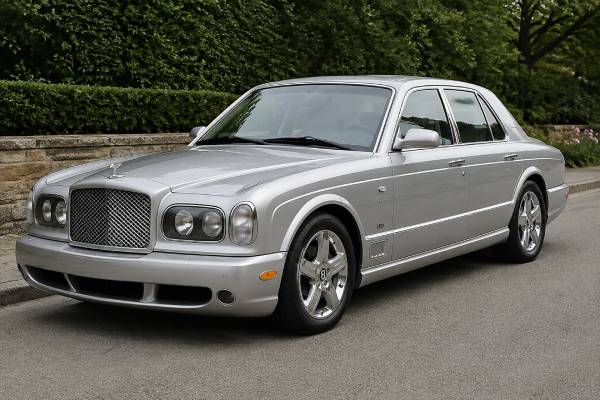
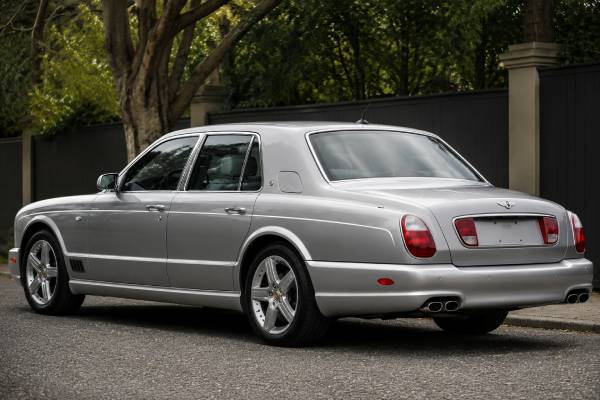
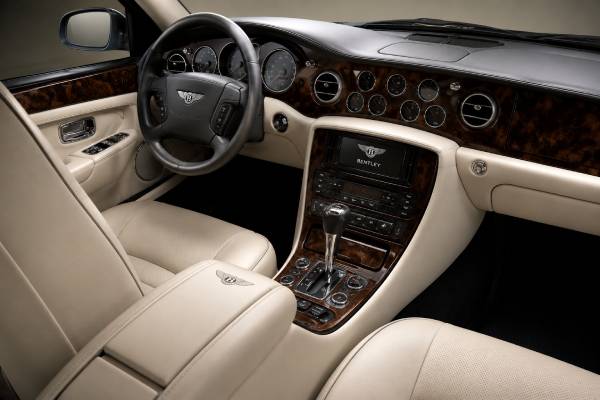
The 2004 Bentley Arnage T-24 Mulliner is a limited-edition celebration of Bentley’s return to victory at the 24 Hours of Le Mans in 2003. It combines the 450 bhp, twin-turbo 6.75-liter Arnage T with a focused set of Mulliner details: Le Mans-style front-wing vents, polished split-rim 19-inch wheels, four oval exhaust outlets, body-color lamp bezels, carbon-fiber cabin trim, special treadplates, and numbered identity. Twenty-four cars were allocated to the United States, with a small additional group for the United Kingdom and Europe, so market history matters when judging rarity. The mechanical package is fundamentally Arnage T rather than race-derived hardware, but that is no disappointment. Its 875 Nm of torque, adaptive chassis, and 168 mph published maximum give the T-24 genuine high-speed authority while retaining a hand-finished, full-size Bentley interior. For buyers, originality is central: missing wheels, altered carbon trim, incorrect badges, or weak documentation can remove much of the edition’s meaning even when the underlying car drives well.
Table of Contents
- Why the T-24 was created
- Factory features and identification
- Arnage T-24 technical data
- Performance and road behavior
- Preserving a limited-edition T-24
- Mechanical and electronic service strategy
- Collector-grade inspection and purchase
Why the T-24 was created
The T-24 was Bentley’s road-car salute to its outright win at Le Mans in June 2003, not a homologation special or a mechanically radical competition derivative. Mulliner used the established Arnage T platform and gave it visual, material, and numbered-edition links to the 24-hour race.
That distinction protects buyers from two opposite mistakes. The first is dismissing the car as a badge exercise: the base Arnage T was already Bentley’s most forceful saloon, with 450 bhp, 875 Nm, a firmer dynamic setup, and a published 168 mph maximum. The second is assuming that the Le Mans connection brought unique engine internals, race suspension, or a different transmission. Contemporary Bentley material describes a special edition built around the T, with the emphasis on equipment and symbolism.
The timing gave the model unusual resonance. Bentley had returned to the top class at Le Mans in 2001 and won in 2003 with the Speed 8, finishing first and second. That victory revived a central part of the marque’s identity: the original Bentley Boys had established the company’s reputation through endurance-racing success in the 1920s. The T-24 connected the Crewe luxury saloon to that renewed public confidence.
For the United States, the number was literal. Twenty-four individually numbered cars were offered, making the allocation easy to explain and market. Period reporting also identifies a small number for the United Kingdom and Europe. A seller should therefore specify the car’s original market and explain its numbering rather than repeating a universal “one of 24” claim without context.
Mulliner’s treatment was bolder than the subtle personalization found on many Arnage R commissions. The T-24 had a recognizable group of exterior features and an intentionally technical cabin. Carbon fiber replaced traditional wood across prominent surfaces, while vents, polished wheels, and quad outlets gave the body a more urgent appearance. The result is one of the clearest factory-defined special editions in the Arnage range.
What the Le Mans link does—and does not—prove
The name gives the car historical context, but a Le Mans narrative cannot authenticate a particular vehicle. Numbered plaques, treadplates, badges, wheels, and trim can be moved, copied, or replaced. A genuine example needs VIN-linked factory or dealer documentation showing that it was delivered as a T-24.
Nor should racing imagery excuse poor road-car maintenance. The Arnage remains a very heavy, complex luxury saloon. Cooling, turbocharger plumbing, adaptive suspension, brakes, tires, electrical systems, and bespoke trim all require disciplined care. Its collector story is strongest when the edition details and the engineering beneath them are equally sound.
Factory features and identification
A correct T-24 should present its special details as one coherent factory package. Authentication starts with the VIN and build record, then moves outward to the numbered identity, body fittings, wheels, exhaust treatment, carbon-fiber trim, and market-specific equipment.
The front-wing vents are the quickest exterior clue. They echo the vents used on the earlier Arnage Le Mans edition and visually relieve the broad front fenders. Inspect the apertures from both sides. Factory installation should show consistent finishing, attachment, and paint coverage; rough cuts, exposed edges, improvised mesh, or sealer inconsistent with surrounding construction suggest later work or repair.
The polished split-rim 19-inch wheels are another defining element. Check that all four match in design, dimensions, fasteners, center caps, and finish. Multi-piece-looking wheels require close examination for cracks, distortion, corrosion around joints, peeling lacquer, and evidence of poor refinishing. Confirm that the spare or inflation equipment corresponds with the delivered specification.
At the rear, four oval exhaust tips and the associated bumper treatment separate the T-24 from a standard presentation. Alignment should be even, with adequate clearance around the bumper openings. Soot concentrated on one side, rattling, contact marks, or fresh welding may indicate exhaust damage or modification. The tips themselves are not proof; their relationship to the full system and factory records matters.
Body-color lamp bezels change the face of the car, while Union Flag and “24” graphics provide the edition’s most explicit visual reference. Compare placement, dimensions, finish, and aging with period photographs. Recently applied decals on an otherwise patinated car need an explanation. Replacement after paintwork is not necessarily wrong, but it should be documented.
Inside, the carbon-fiber fascia, waist rails, and rear picnic tables create a very different atmosphere from the traditional veneer of most Arnages. The pattern and gloss should be consistent across the matched set. Look for cracks around switch openings, lifting edges, cloudy lacquer, chips at table corners, and mismatched weave or tone that may reveal a replacement panel.
T-24 treadplates and the individually numbered identification deserve careful photography. Check typography, spacing, fasteners, surface wear, and whether the number corresponds with the documentation. A plaque is evidence only when supported by the car’s wider identity trail. Keep in mind that market specifications may affect other cabin equipment, warning labels, lighting, and navigation or telephone systems.
Accident repair and special-edition details
The fender vents, painted lamp surrounds, special rear bumper, and polished wheels make collision repair more complicated. A high-quality repair can preserve the car, but the estimate and invoices should identify how edition-specific parts were sourced or restored. Generic T components fitted after damage may leave an outwardly tidy car that is no longer complete.
Measure paint depth across adjacent panels, inspect panel gaps and mounting points, and view metallic paint in direct and diffuse light. Carbon-fiber pieces should be inspected under angled light for refinishing. The purpose is not to reject all restoration; it is to understand what remains original and whether replacements match the factory specification.
Arnage T-24 technical data
The T-24 is a petrol internal-combustion saloon using Bentley’s 6,750 cc L410MT V8, two turbochargers, a four-speed automatic, and rear-wheel drive. Its performance data follows the 450 bhp Arnage T foundation, while the limited-edition specification is identified by Mulliner body and cabin details rather than a separate engine tune.
| Specification | Value |
|---|---|
| Model year | 2004 |
| Mechanical base | Bentley Arnage T |
| Named for | Bentley’s 2003 24 Hours of Le Mans victory |
| United States allocation | 24 individually numbered cars |
| Additional production | A small number for the United Kingdom and Europe |
| Commissioning division | Mulliner |
| Specification | Value |
|---|---|
| Engine code and family | L410MT, Bentley 90-degree V8 |
| Displacement | 6,750 cc |
| Valve gear | OHV, 16 valves |
| Induction | Twin turbochargers with charge cooling |
| Maximum power | 450 bhp (336 kW) at 4,100 rpm |
| Maximum torque | 875 Nm (645 lb-ft) at 3,250 rpm |
| Transmission | Four-speed automatic |
| Drive | Rear-wheel drive |
| Specification | Value |
|---|---|
| 0–60 mph | Approximately 5.5–5.7 seconds |
| 0–100 km/h | Approximately 5.8 seconds |
| Maximum speed | 168 mph (270 km/h) |
| Performance context | Period manufacturer figures for the 450 bhp Arnage T platform |
| Specification | Value |
|---|---|
| Body style | Four-door, five-seat luxury saloon |
| Length | 5,390 mm |
| Width | 1,932 mm |
| Height | 1,515 mm |
| Wheelbase | 3,116 mm |
| Published kerb weight | Approximately 2,585 kg |
| Suspension | Independent double wishbones with adaptive damping and rear self-leveling |
| T-24 wheels | Polished, split-rim 19-inch alloy wheels |
| Specification | Value |
|---|---|
| Front fenders | Le Mans-style cooling vents |
| Badging | Union Flag and “24” motif; individually numbered designation |
| Exterior details | Body-color lamp bezels and revised rear bumper treatment |
| Exhaust | Four oval tailpipes |
| Cabin trim | Carbon-fiber fascia, waist rails, and rear picnic tables |
| Entry trim | T-24 treadplates |
The broad torque peak is the central engineering fact. At 875 Nm, the engine can accelerate the heavy body without relying on high revs or frequent downshifts. That creates the T’s distinctive sensation: the car does not feel light, but it gains speed with a force that seems disproportionate to the modest engine note and relaxed shift strategy.
Published acceleration numbers vary slightly with test method, market literature, surface, and vehicle condition. A 5.5-second manufacturer-style 0–60 mph claim and period independent results around 5.7 seconds are both plausible references for the 450 bhp platform. They should not be mixed into a false precision for a specific car. Tire age, temperature, fuel, load, and transmission health can make a significant difference.
The dimensions explain why condition of the chassis matters so much. At roughly 2.6 metric tons and more than 5.3 meters long, the T-24 places heavy demands on brakes, dampers, bushes, wheel bearings, and tires. Special 19-inch wheels can sharpen response but also transmit more impact and are costly to repair correctly. A beautiful polished finish does not compensate for a bent rim or unsuitable tire.
Performance and road behavior
A well-sorted T-24 should feel urgent, stable, and surprisingly precise for its size. It is firmer and more immediate than an Arnage R, yet it remains a luxury saloon; harshness, nervous steering, or violent transmission behavior indicates a fault or an unsuitable setup rather than authentic sporting character.
On a cold start, the V8 should settle cleanly after its initial fast idle. Do not demand boost until coolant and oil have warmed. Once ready, a full-throttle run should produce one continuous surge, clean gear changes, and no misfire, smoke, warning message, or sudden loss of power. The four-speed automatic will hold ratios longer under load, but it should not flare or bang into the next gear.
Throttle progression is useful in normal driving. Small inputs move the car smoothly, while a deeper opening releases substantial torque. This makes the T-24 easy to drive gently in traffic despite its output. It also means that worn rear tires, wet roads, or an intrusive alignment fault can become serious quickly. Electronic stability assistance is important, but it cannot restore grip to aged or mismatched rubber.
At motorway speed, the car should track calmly with minimal correction. Steering shake often points to wheel balance, wheel distortion, tire defects, worn joints, or brake-disc issues. Because polished split-rim wheels can be damaged by potholes or improper tire fitting, runout measurement is more useful than a visual check alone.
The adaptive damping should control heave and roll without making sharp edges punishing. Repeated bouncing, diagonal pitching, clunks, a low rear stance, or changing ride height suggests problems with dampers, bushes, mounts, or self-leveling equipment. Compare behavior in normal and firmer settings where fitted and confirm that dashboard indications agree with the actual response.
Brakes must remain consistent after several progressively harder stops. Vibration through the wheel can indicate front disc runout, while vibration through the seat may point toward rear components. A long pedal, pull, burning smell, or unusually hot wheel requires investigation. The T-24’s speed potential makes “good enough” brake condition unacceptable.
Use the performance rather than proving it
The car is most satisfying when its torque is used for decisive overtaking and effortless long-distance progress. Repeated launch-style acceleration adds heat to the transmission, tires, brakes, and driveline without revealing much about real health. A controlled specialist road test can assess boost, shifts, temperatures, and stability with far less abuse.
Owners should also respect the gap between capability and modern safety engineering. The T-24 has ABS, traction and stability support, airbags, and a strong structure, but its mass, tire technology, lighting, and electronic architecture belong to the early 2000s. Leaving generous braking distance and fitting premium current-production tires are more valuable than chasing a period acceleration figure.
Preserving a limited-edition T-24
Preservation means keeping the numbered car complete, usable, and documentable. Store removed parts, photograph all work, favor reversible upgrades, and repair edition-specific components before substituting standard Arnage pieces.
The carbon-fiber trim is a focal point. Clean it with a soft cloth and mild product suitable for the clear finish; abrasive compounds can create haze and cut through edges. Inspect the picnic-table hinges, supports, catches, and surrounding leather so the weight of the table does not stress a cracked panel. If refinishing is necessary, use a specialist who can retain weave clarity and match the gloss across the entire set.
Leather and carpet need ordinary but careful stewardship. Remove grit from piping and perforations, address dye transfer early, and avoid leaving damp lambswool rugs against the carpet. Check beneath mats and in the boot for water. Moisture can damage control modules and wiring long before an odor becomes obvious.
Polished wheels should be washed when cool with nonacidic products. Harsh chemicals can attack lacquer and exposed metal around fasteners. Record wheel serials or markings during restoration, and insist on a shop experienced with high-value multi-piece wheels. Welding, straightening, or splitting a wheel must be evaluated for structural safety, not just cosmetic outcome.
Edition decals, badges, and plaques should not be polished aggressively. Photograph their position with measurements before bodywork. When a replacement is unavoidable, retain the removed item and invoice. That package allows a future owner to distinguish a responsible repair from an unexplained reproduction.
Period electronics are best modernized invisibly. Bluetooth, phone integration, or navigation can often be added without cutting the carbon fascia. Preserve original head units, modules, wiring adapters, and remote controls. A reversible solution protects historical presentation and makes diagnosis easier because future technicians can see exactly what changed.
Finally, use the car. Regular, properly warmed journeys circulate fluids, exercise seals, keep brake surfaces clean, and reveal small faults. Storage should include a compatible battery maintainer, controlled humidity, correct tire pressures, ventilation, and periodic inspection for pests or moisture. Static display without maintenance is not preservation.
Mechanical and electronic service strategy
Treat the T-24 mechanically as a high-output Arnage T and cosmetically as a limited edition. The service plan must cover heat management, turbocharger and intake integrity, four-speed transmission behavior, suspension and brakes, electrical voltage, and every bespoke component.
Cooling is the first priority. Inspect radiator and condenser faces for blockage, verify both fan operation and temperature data, pressure-test the system when appropriate, and examine tanks, hoses, clamps, pump area, and dried residue. A gauge that remains centered is not the whole test; scan-tool data and behavior under traffic and load provide a better picture.
Engine oil level and leak control matter because turbochargers and exhaust components generate intense local heat. Map seepage after cleaning rather than replacing parts at random. Check oil-service evidence, breather function, and smoke behavior after idle and acceleration. Any burning-oil smell near hot components deserves immediate attention.
Pressure-test intake and boost plumbing when performance is inconsistent. A loose joint or deteriorated hose can cause lost boost, rich or lean corrections, and misleading downstream symptoms. Inspect charge-cooling circuits and pumps where applicable, along with vacuum lines and actuator operation. Diagnostic data should support physical testing.
The automatic transmission needs smooth cold and hot operation. Confirm immediate engagement, consistent shifts, kickdown, and absence of fluid leaks or burnt odor. Service choices should follow Bentley documentation and specialist judgment for the exact unit and history. Universal fluid and power-flush assumptions are inappropriate for an expensive, older transmission without documented maintenance.
Suspension inspection must include dampers, bushes, ball joints, links, mounts, rear self-leveling components, wheel bearings, alignment, and ride-height consistency. The special wheels increase the value of runout measurements and careful tire fitting. Use only tires with suitable size, load rating, speed rating, and matched construction.
Brake service should measure rather than guess. Record pad thickness, disc thickness and runout, hose and line condition, caliper movement, fluid age, parking-brake operation, and ABS faults. Check recall and campaign status by VIN with the appropriate national database and Bentley network; model names and production dates alone are insufficient.
Electrical diagnosis begins with the battery, charging system, grounds, and water ingress. Low voltage can trigger multiple messages and disrupt seat, steering-column, climate, security, and infotainment functions. Scan all accessible modules before clearing codes, save the report, then test each cabin function individually. That sequence preserves evidence.
Collector-grade inspection and purchase
The best T-24 is not merely the lowest-mileage car; it is the most complete, correctly documented, mechanically exercised, and honestly maintained example. A long period of inactivity can create more immediate work than sensible regular use.
Request the VIN, factory build record, original invoice, numbered-edition documents, handbook and tool kits, service invoices, ownership history, and photographs of every T-24-specific feature. Confirm the original market and avoid repeating the U.S. allocation figure as the entire global production story. Ask whether the wheels, carbon trim, fenders, rear bumper, exhaust, treadplates, badges, or plaque have been repaired or replaced.
Commission a specialist pre-purchase inspection with a cold start, full diagnostic scan, lift examination, road test, cooling-system assessment, boost and transmission evaluation, brake and tire measurements, wheel runout check, paint-depth survey, and water-ingress search. The inspection should name faults and rank them by safety, reliability, authenticity, and cosmetic importance.
Mileage must be supported by service records and condition. Compare pedal surfaces, seat bolsters, steering wheel, switchgear, door hinges, brake wear, and historical inspection entries. Low mileage with heavily renewed touch points is not automatic fraud, but it requires a coherent explanation.
Calculate a correction budget before negotiating. Include mechanical work, all four correct tires, wheel restoration, carbon repair, paint correction, missing edition pieces, obsolete electronics, and transport to an appropriate specialist. Rare trim can create long lead times, so cost is only one constraint.
A documented T-24 deserves a premium over an equivalent ordinary T when its special components remain intact and the buyer values the Le Mans connection. The premium should shrink sharply when identity rests on a plaque, the wheels have been substituted, or carbon panels do not match. Mechanical excellence cannot recreate missing provenance, and provenance cannot make a neglected chassis safe.
For the right owner, the appeal is unusually complete: a direct historical theme, unmistakable factory details, huge low-speed torque, and a cabin that rejects the usual wood-and-leather formula for something more technical. Purchase it as a car to preserve and drive, not as a number to advertise. That approach protects both the experience and the edition.
References
- 1998-2009 2022 (Bentley Heritage Technical Library)
- Bentley Motors Media: Bentley Arnage T-24 Mulliner 2004 (Manufacturer Media Release)
- 2004 Bentley Arnage T-24 Mulliner – Images, Specifications and Information 2004 (Manufacturer Release Archive)
- Bentley at Detroit 2004 – New Arnage T-24 and RL Mulliner announced | Classic Driver Magazine 2004 (Model Announcement)
- 2002 Bentley Arnage T Road Test – Review – Car and Driver 2002 (Instrumented Road Test)
- Search Safety Issues | NHTSA 2026 (Recall Database)
Disclaimer
This guide provides general historical, technical, maintenance, and buying information. It does not replace a VIN-specific Bentley build record, factory workshop instructions, safety-campaign lookup, or hands-on inspection by a technician familiar with the Arnage T. Confirm specifications, parts, fluids, torque procedures, wheel suitability, and limited-edition equipment for the exact car before purchase or repair.
Please share this article with a Bentley enthusiast, Le Mans history group, or collector community to help protect another T-24 from incomplete restoration.