
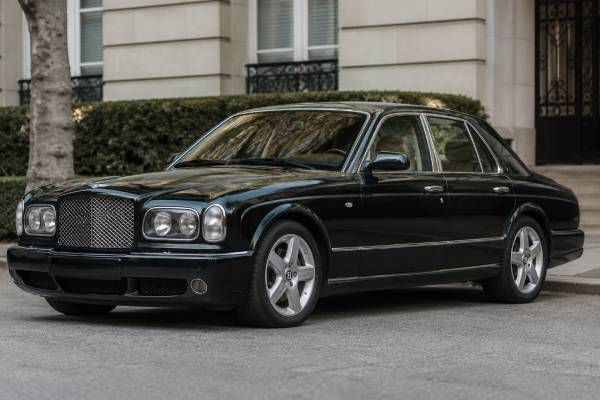
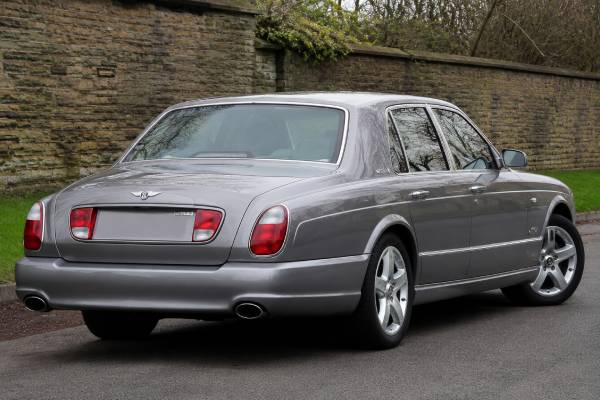
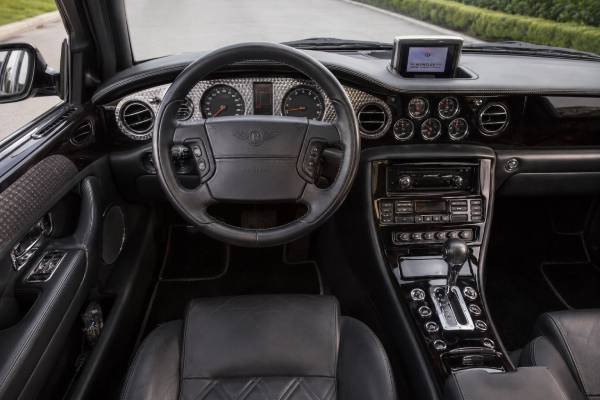
The 2002–2006 Bentley Arnage T is the performance-led version of the Crewe flagship, pairing a 450 bhp twin-turbo 6.75-liter V8 with 875 Nm of torque, rear-wheel drive, and a four-speed automatic. Its numbers are dramatic for a saloon weighing roughly 2.6 tons: Bentley quoted about 5.5 seconds to 60 mph and a 168 mph maximum, while period instrumented testing confirmed that the car could reach 60 mph in the high-five-second range. The T is more than an engine tune. Firmer responses, large brakes, performance-oriented wheel choices, and a more assertive presentation give it a different purpose from the softer Arnage R. Yet it remains an Arnage, with hand-finished leather and veneer, a substantial rear cabin, adaptive damping, and immense long-distance ability. Today, condition matters more than headline speed. Old tires, weak cooling, boost leaks, tired suspension, voltage faults, or incomplete transmission care can turn the most exciting derivative into the riskiest one.
Table of Contents
- What makes the Arnage T different
- 450 bhp L410MT power delivery
- Arnage T specification data
- Chassis, braking, and high-speed behavior
- Symptom-led fault finding
- Ownership routine and preventive care
- Pre-purchase verdict and suitability
What makes the Arnage T different
The Arnage T is the range’s driver-focused saloon: it has more power and torque than the 400 bhp Arnage R, a higher 168 mph published maximum, and a chassis presentation intended to make the large car respond with greater urgency. Buy it for that blend of traditional Bentley scale and unusually forceful acceleration, not because it is merely the most expensive badge.
Bentley introduced the T after the Arnage platform had undergone major redevelopment. The early BMW-powered car and the single-turbo Red Label established different chapters, but the T belongs to the twin-turbo, modernized L-series generation. Its 6.75-liter V8 uses two turbochargers, electronic management, charge cooling, and extensive supporting systems to produce 450 bhp at a low 4,100 rpm.
The torque figure is even more revealing: 875 Nm at 3,250 rpm. The engine does not need to spin rapidly, and the four-speed automatic does not need a dense stack of ratios. A firm throttle request produces immediate, sustained thrust, while lighter inputs allow the car to move with the calm expected of a Bentley.
Compared with an Arnage R, the T feels more alert through the throttle and chassis. Wheel and tire packages can sharpen steering response, while the suspension contains body movement more decisively. That does not make every T harsh; a correct car should still absorb ordinary road texture. A crashing ride usually reflects tired dampers, damaged wheels, unsuitable tires, incorrect pressures, or worn joints rather than factory intent.
The model-year range requires precision. A 2002 launch car, a 2004 special-edition base, and a 2006 example may differ in appearance, equipment, software, and options even when all carry the 450 bhp description. Registration date is not a complete guide to production configuration. VIN-specific factory information, option codes, and parts catalogs should determine what is correct.
The T’s performance also changes the inspection threshold. A marginal tire, slight brake vibration, intermittent boost fault, or aging suspension component has greater consequences when a car can build speed this quickly. The right example feels tightly integrated: engine, transmission, chassis, brakes, and electronics all respond as one system.
Performance badge versus complete car
Some used cars acquire T-style wheels, exhaust outlets, badges, or interior pieces. Those additions do not convert another Arnage into a factory T. Confirm identity through the VIN and build record, then check that its current engine-management specification, brakes, suspension, and wheels correspond with the delivered car.
The reverse problem also occurs. Owners sometimes replace expensive T components with easier-to-find standard parts after damage. A car can retain its VIN yet lose originality and dynamic balance. The purchase decision should therefore cover both identity and completeness.
450 bhp L410MT power delivery
The T’s engine is engineered around low-rev airflow and torque, not high-rpm drama. Correct performance feels like a broad pressure increase from the middle of the rev range, with no pause, misfire, smoke, or sudden step as the turbochargers work.
The L-series architecture traces its roots back decades, but the Arnage T installation is thoroughly dependent on modern supporting hardware. Bosch management coordinates fueling, ignition, throttle, sensors, boost control, and emissions equipment. Charge-cooling circuits manage intake temperature. Vacuum, air, coolant, oil, and electrical paths interact closely.
This is why symptom-led diagnosis matters. If the car feels weak, the cause may be a split boost hose, loose joint, tired actuator, incorrect sensor reading, fuel-delivery problem, ignition fault, charge-cooling issue, exhaust restriction, low voltage, or transmission behavior. Replacing a turbocharger because the car “does not boost” is not a responsible first step.
A cold start provides useful evidence. The engine should fire promptly, settle from fast idle, and run evenly. A brief vapor cloud in cold weather is different from persistent blue or black smoke. Strong fuel odor, repeated misfire, loud ticking, or unstable idle needs investigation before a road test.
Warm-up discipline is important. High load before oil and coolant are fully warm increases stress on bearings, seals, pistons, and turbocharger components. At the end of a hard drive, a short period of gentler running allows temperatures to stabilize. Extended idling is not a universal cure; sensible load management is more useful.
Oil condition supports both the engine and turbochargers. Use the exact approved specification, maintain the correct level, and shorten intervals when the car sees infrequent short trips or severe use. Investigate leaks by cleaning and tracing the source. Oil near hot exhaust components can smoke or ignite and should never be dismissed as normal sweating.
The four-speed automatic is integral to the power delivery. It should select Drive and Reverse promptly, move off without shudder, shift cleanly at light throttle, and remain composed under kickdown. A flare between ratios, delayed engagement, harsh bang, or burnt odor calls for diagnostic work. Control faults and engine data can influence shift quality, so scan the complete powertrain before condemning the gearbox.
Why period acceleration figures differ
Bentley’s 0–60 mph claim and independent road-test results use different cars, surfaces, weather, fuel, rollout conventions, and launch techniques. A difference of a few tenths does not mean one figure is false. It shows why performance claims should be labeled by source and procedure.
For a buyer, a stopwatch is less useful than repeatability. The car should deliver the same clean acceleration after several warm runs without rising temperature, warning messages, slipping shifts, or odor. Consistency is a stronger health indicator than one aggressive launch.
Arnage T specification data
The Arnage T is a petrol internal-combustion vehicle with a front-mounted 6,750 cc twin-turbo V8, four-speed automatic transmission, and rear-wheel drive. These tables cover the 450 bhp 2002–2006 assignment scope; factory options and production changes can alter wheels, trim, equipment, and some published weights.
| Specification | Value |
|---|---|
| Layout | 90-degree Bentley V8 |
| Displacement | 6,750 cc |
| Bore × stroke | 104.1 × 99.1 mm |
| Valve gear | OHV, 16 valves |
| Induction | Twin turbochargers and charge cooling |
| Maximum power | 450 bhp (336 kW) at 4,100 rpm |
| Maximum torque | 875 Nm (645 lb-ft) at 3,250 rpm |
| Engine management | Bosch Motronic |
| Specification | Value |
|---|---|
| Transmission | Four-speed automatic |
| Driven wheels | Rear-wheel drive |
| 0–60 mph | 5.5 seconds, manufacturer figure; 5.7 seconds in a period instrumented test |
| 0–100 km/h | Approximately 5.8 seconds |
| Quarter mile | 14.1 seconds in a period instrumented test |
| Maximum speed | 168 mph (270 km/h) |
| Specification | Value |
|---|---|
| Body style | Four-door, five-seat saloon |
| Length | 5,390 mm |
| Width | 1,932 mm |
| Height | 1,515 mm |
| Wheelbase | 3,116 mm |
| Published kerb weight | Approximately 2,585 kg |
| Specification | Value |
|---|---|
| Front suspension | Independent double wishbones with adaptive damping |
| Rear suspension | Independent double wishbones with self-leveling and adaptive damping |
| Steering | Power-assisted rack and pinion |
| Brakes | Large ventilated discs with ABS and stability control |
| Wheel reference | 18-inch standard specification; 19-inch packages appear on many T examples |
| Tire reference | 255/50 R18 for the standard wheel specification |
| Specification | Value |
|---|---|
| Fuel capacity | 100 liters |
| Luggage capacity | Approximately 374 liters |
| Fuel | Premium unleaded petrol |
| Published combined consumption | Approximately 20.6 L/100 km for the period Arnage platform |
| Seating capacity | Five |
The combination of mass and speed potential should shape every ownership decision. Tire quality, load and speed ratings, wheel integrity, brake condition, suspension geometry, and cooling capacity are not secondary details. They are the systems that make the engine’s output usable.
A 100-liter tank sounds generous, but the car’s appetite can still create a limited urban range. The published combined figure is a period test-cycle result rather than a promise. Cold weather, short journeys, traffic, idling, and frequent boost can raise consumption significantly. Range planning should leave a margin, especially where premium fuel is not widely available.
Published weight is also source-sensitive. Equipment and market rules can change the figure, and “kerb” conventions are not identical everywhere. Use approximately 2,585 kg to understand the vehicle’s scale, not to calculate legal payload. Consult the specific car’s plated limits for loading.
Chassis, braking, and high-speed behavior
The T should feel planted and deliberate at speed, with a calm steering center, controlled vertical movement, and brakes that remain consistent after repeated use. Nervousness or vibration is evidence to diagnose, not a personality trait to celebrate.
The double-wishbone suspension gives Bentley control over camber and wheel movement, while adaptive damping adjusts the response. Rear self-leveling helps maintain attitude with passengers and luggage. On a sound car, the body takes one composed movement over a crest and settles. Repeated floating, diagonal pitching, clunks, or a rear end that stays low signals wear or a control fault.
Wheel choice changes the experience. The standard 18-inch reference provides more sidewall, while many T cars use 19-inch wheels that sharpen response and expose damage more readily. Verify wheel dimensions and offsets, inspect inner rims as carefully as outer faces, and measure runout. Cosmetic refurbishment can hide a bent or welded wheel.
Tires should be a matched set with the correct size, load index, speed rating, and age. Mixing models or fitting budget rubber undermines steering, braking, stability-control calibration, and wet grip. Flat spots from storage can create vibration that changes as tires warm; permanent shake requires further investigation.
Alignment should follow suspension repair, wheel work, or abnormal tire wear, but alignment is not a substitute for replacing loose joints. Check ball joints, bushes, links, wheel bearings, mounts, and ride height first. A technician who simply sets toe while worn components move has not solved the problem.
The brake system must manage repeated high-energy stops. Inspect pad thickness and wear pattern, disc thickness, surface condition and runout, caliper movement, hoses, hard lines, fluid age, parking brake, ABS sensors, and stored faults. A vibration that appears only under braking should be reproduced carefully and measured.
Steering feel is substantial but should not be vague. Free play, a knock through the column, inconsistent assistance, or a pull can come from several points. Compare tire pressures, road crown, brake drag, geometry, joints, and steering components rather than assuming the rack is at fault.
Safe road-test progression
Start with low-speed steering circles, gentle stops, and light-throttle shifts. Move to a steady cruise, then use moderate acceleration and firmer braking once temperatures are stable. Only a qualified driver in safe, legal conditions should test full-load behavior. The goal is to reveal faults without using the public road as a proving ground.
After the test, inspect for coolant odor, oil smoke, fresh drips, overheated brakes, and changing ride height. Save diagnostic data before clearing anything. A fault that appears after heat soak can disappear by the time the car reaches a workshop, so immediate observation is valuable.
Symptom-led fault finding
The most efficient way to diagnose an Arnage T is to connect each symptom with operating conditions, measurements, and stored data. Random parts replacement is especially wasteful on a car whose systems interact and whose components may be difficult to access.
If performance is low, note whether the problem is constant, temperature-dependent, gear-dependent, or accompanied by noise or smoke. Scan for engine and transmission faults, compare requested and actual data, pressure-test intake plumbing, inspect fuel and ignition performance, and assess exhaust restriction. A clean engine bay does not prove the hoses are sealed under boost.
If temperature rises, stop loading the engine. Check coolant level only when safe, then investigate fan operation, radiator airflow, pressure retention, pump and thermostat behavior, coolant circulation, and combustion-gas concerns where justified. Do not normalize a gauge movement because the car is large and powerful.
If the transmission shifts harshly, confirm battery voltage and engine operation first. Misfires, throttle-data errors, and control-module communication faults can alter shift behavior. Check fluid leaks and service evidence, then use the correct diagnostic procedure. Additives and universal flushes can obscure evidence or create new problems.
If the ride is poor, separate impact harshness from uncontrolled movement. Harsh impacts can result from tire pressure, tire construction, oversized wheels, seized joints, or failed dampers. Floating and bouncing more often suggest damping or self-leveling problems. A clunk during braking can be suspension movement rather than the brake itself.
If several cabin systems fail together, test supply voltage, grounds, fuses, network communication, and water ingress before buying individual switches or modules. Inspect the boot, footwells, windscreen perimeter, door membranes, drainage paths, and areas around aftermarket electronics. Moisture can migrate far from its entry point.
If the battery repeatedly discharges, measure parasitic draw after the car has entered its sleep state. Identify the active circuit and module rather than installing successively larger batteries. Alarm, telephone, audio, seat, door, or aftermarket equipment can keep the network awake.
If the cabin smells damp or leather surfaces distort, act quickly. Remove wet mats, find the source, dry the structure with appropriate methods, and assess wiring and modules. Masking odor with detailing products allows corrosion and mold to continue.
Ownership routine and preventive care
The T responds best to frequent observation and planned use. A five-minute check before a drive and a detailed annual inspection prevent more trouble than waiting for a dashboard message.
Before each significant journey, look under the car, check fluid levels according to the handbook, inspect tire pressures and visible damage, confirm lamps, and note whether the body sits level. During warm-up, watch the instruments and listen for changes. After parking, notice coolant, oil, or hot-brake smells rather than walking away immediately.
Use the car often enough to reach full temperature. Repeated cold starts to move it around a garage add fuel and moisture to the oil, draw on the battery, and do little for seals or brakes. A proper drive should include varied load, several brake applications, and operation of the climate system.
A compatible battery maintainer is important during storage. Keep the battery terminals and grounds sound, and record replacement dates. Do not disconnect power casually without understanding security, memory, window, seat, or diagnostic consequences for the exact car.
Annual work should include fluid review, complete diagnostic scan, cooling-system inspection, brake measurements, tire date and condition check, suspension examination, leak map, air-conditioning performance test, and exercise of every electrical function. Document values, not just “checked OK.”
Time-based replacement applies to brake fluid, coolant where specified, tires, filters, and many rubber parts. Mileage does not stop corrosion or chemical aging. A car covering 1,000 miles per year can still need more age-related renewal than one driven 5,000 miles with regular service.
Keep modifications reversible. Modern audio, navigation, tracking, or charging equipment can improve usability, but poorly integrated wiring creates parasitic drains and diagnostic confusion. Save original components, use adapters where possible, fuse added circuits correctly, and include wiring diagrams in the file.
Cleanliness should support inspection. Wash wheel arches and underbody salt, clear drains, condition seals, and clean wheels when cool. Avoid aggressive engine-bay washing around old connectors and insulation. A clean, dry bay makes fresh leakage easier to identify.
Pre-purchase verdict and suitability
Choose an Arnage T only after a specialist confirms that its performance systems and luxury systems have been maintained as one car. The purchase price is the entry ticket; the condition of cooling, boost, transmission, chassis, brakes, voltage supply, body, and trim determines the real cost.
Ask the seller for the VIN, build and option record, service invoices, mileage evidence, recall status, cold-start video, underside photographs, tire dates, and a written list of faults. Clarify accident history, paintwork, overheating, coolant loss, oil use, transmission repairs, suspension replacements, wheel refinishing, and aftermarket electronics.
Inspect from cold and scan before the test drive. All warning lamps should perform their expected self-check. Record stored and pending faults, module communication failures, and voltage-related history. A recently cleared system with incomplete readiness information may require a second visit after a proper drive.
The lift inspection should cover undertrays, leaks, heat shields, exhaust, turbocharger and intake hoses, coolant pipes, brake and fuel lines, suspension, wheel bearings, tires, wheels, jacking areas, floor structure, corrosion, and collision repair. Paint-depth readings and panel inspection are appropriate because body correction is costly.
Road-test findings should be specific. “Drives well” is not enough. Record cold and hot engagement, shift timing, boost behavior, steering center, ride over sharp and broad inputs, braking from several speeds, temperature stability, climate performance, and post-drive leaks or odors.
Prepare three budgets: safety-critical work before use, reliability work in the first year, and cosmetic or originality work later. Include a contingency because access can reveal associated parts. Compare the total with a better car, not merely with the seller’s discount.
The T suits an owner who wants a commanding, analog-feeling performance saloon and is prepared to use marque specialists. It offers an experience that modern downsized engines and multi-ratio transmissions do not reproduce: vast displacement, low-rev boost, hand-built surroundings, and a sense of mass being moved by torque.
It is unsuitable as a low-cost experiment. Deferred brake, suspension, cooling, or tire work conflicts directly with the car’s abilities. Buy the most coherent example, maintain it preventively, and drive it with mechanical sympathy. When those conditions are met, the Arnage T’s extraordinary specification becomes an asset rather than a liability.
References
- 1998-2009 2022 (Bentley Heritage Technical Library)
- 2002 Bentley Arnage T Road Test – Review – Car and Driver 2002 (Instrumented Road Test)
- 2002 – 2004 Bentley Arnage T – Images, Specifications and Information 2002 (Manufacturer Release Archive)
- Used car buying guide: Bentley Arnage | Autocar 2018 (Buying Guide)
- Used 2004 Bentley Arnage T Specs & Features | Edmunds 2026 (Technical Data)
- Search Safety Issues | NHTSA 2026 (Recall Database)
Disclaimer
This material is a general guide and cannot determine the condition, correct specification, or safety of an individual Arnage T. Production changes, market equipment, options, prior repairs, and VIN-specific campaigns can alter the relevant parts and procedures. Confirm all service work with official Bentley information and a qualified specialist who has inspected the exact vehicle.
Share this guide with a performance-saloon community or Bentley owner who values careful diagnosis more than a headline horsepower figure.