
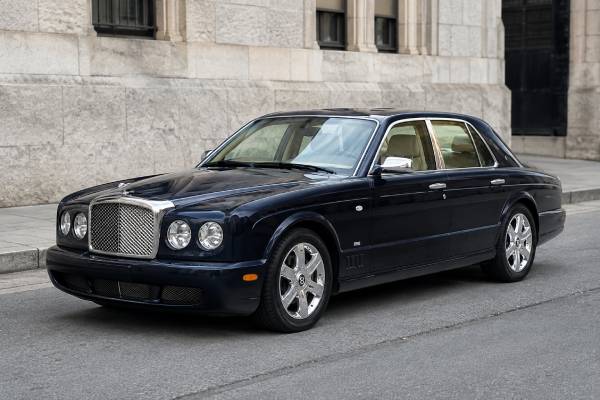
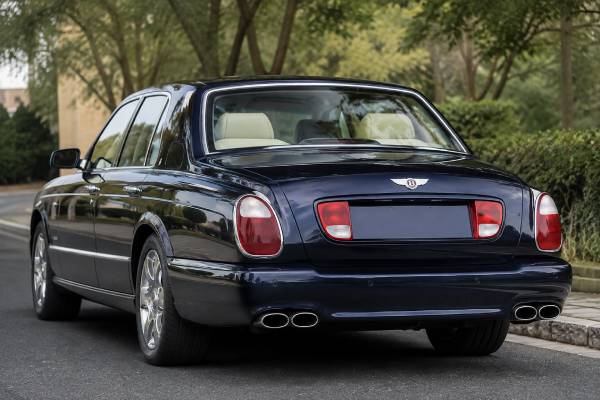
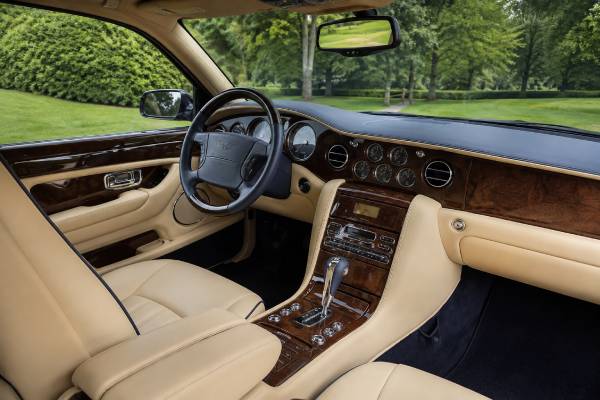
The 2006 Bentley Arnage T Blue Train is a 450 hp Mulliner special edition created to commemorate Woolf Barnato’s 1930 race against the famous express from Cannes. It uses the 6.75-liter twin-turbo V8 and performance of the contemporary Arnage T, but Bentley paired that engine with the more supple Arnage R chassis setup. Distinctive bumpers, 19-inch seven-spoke wheels, wing vents, chrome exterior details, quad exhaust outlets, black instruments, Blue Train embroidery, and special veneer identify the model.
Originally announced as a very limited run, production records commonly identify 36 cars: 30 left-hand-drive examples followed by six right-hand-drive cars. That scarcity makes provenance and completeness central to any purchase. The story is also frequently simplified: Barnato raced in an H. J. Mulliner-bodied Speed Six saloon, not the famous Gurney Nutting coupé delivered later. A correct modern Blue Train therefore deserves the same historical precision. Buyers should verify the factory build, inspect every model-specific part, and then judge the underlying Arnage as rigorously as any other aging twin-turbo flagship.
Table of Contents
- The Story Behind the Name
- Specifications and Technical Data
- Unique Design and Mulliner Details
- Touring Performance and Chassis Balance
- Identity, Production, and Provenance
- Service and Recommissioning
- Buying a Blue Train Today
The Story Behind the Blue Train Name
The Blue Train edition draws its meaning from one of Bentley’s most enduring stories: Woolf Barnato’s 1930 drive from Cannes to London against Le Train Bleu. Barnato and co-driver Dale Bourne covered the journey through France, crossed the Channel, and reached London before the train arrived at Calais.
Historical accuracy matters because the car involved is often misidentified. The dramatic Gurney Nutting Sportsman Coupé became popularly known as the Blue Train Bentley, but it was delivered after the race. Bentley’s own heritage account identifies the competitor as Barnato’s H. J. Mulliner-bodied Speed Six saloon. The 2006 edition references both the event and the visual legend that grew around it, particularly through its vertical wing vents and optional privacy-style rear backlight.
Bentley announced the modern car in late 2005 during the 75th-anniversary period. The company described it as a grand tourer based on the flagship four-door saloon, with 450 bhp, 875 Nm, 0–60 mph in 5.5 seconds, and a 168 mph top speed. Those figures were serious, but the engineering choice was more nuanced than simply applying Arnage T badges. Bentley combined the high-output engine with the refined suspension and chassis setup of the Arnage R.
That mixture captures the original story better than a track-focused treatment would have. Barnato’s achievement was not a short sprint; it was sustained, high-speed travel over long distances. The Blue Train edition therefore emphasizes effortless pace, stability, comfort, and an atmosphere of travel rather than sharp-edged circuit behavior.
The production number is another area where careful language helps. Bentley’s release referred to a limited number and said that most were intended for the United States. Specialist chassis records identify an initial plan of 30 cars and a final total of 36, comprising 30 left-hand-drive and six right-hand-drive examples. Owners should verify a particular car through its VIN and build information rather than relying solely on a plaque or sales description.
Bentley Arnage T Blue Train Specifications and Technical Data
The Blue Train is an internal-combustion, rear-wheel-drive saloon using the high-output L410MT-era 6.75-liter V8 and four-speed automatic. Its 875 Nm torque figure is central to the car’s ability to accelerate strongly without high engine speed.
| Specification | Blue Train Series |
|---|---|
| Engine | 90-degree Bentley V8, aluminum block and cylinder heads, overhead valves |
| Engine family | L410MT-series high-output specification |
| Displacement | 6,750 cc |
| Induction | Twin turbochargers with intercooling |
| Maximum power | 450 bhp (approximately 336 kW) |
| Maximum torque | 875 Nm (645 lb-ft) at approximately 3,250 rpm |
| Fuel | Premium unleaded gasoline to the applicable market specification |
| Item | Configuration |
|---|---|
| Transmission | GM 4L80-E electronically controlled 4-speed automatic |
| Drive | Rear-wheel drive |
| Suspension emphasis | Arnage R-style refined and supple chassis setup |
| Suspension hardware | Independent double wishbones, coil springs, self-leveling, adaptive damping |
| Steering | Power-assisted rack and pinion |
| Brakes | Ventilated discs with ABS |
| Measure | Published figure |
|---|---|
| 0–60 mph | 5.5 seconds |
| Top speed | 168 mph (270 km/h) |
| Fuel tank | Approximately 96 liters |
| Boot volume | Approximately 374 liters |
| Seating | Four-door saloon, normally arranged for five |
| Measurement | Approximate value |
|---|---|
| Wheelbase | 3,116 mm |
| Overall length | Approximately 5,390 mm |
| Body width | Approximately 1,932 mm excluding mirrors |
| Height | Approximately 1,515 mm |
| Kerb weight | Approximately 2,585 kg before unusual optional equipment |
| Area | Typical factory feature |
|---|---|
| Wheels | 19-inch seven-spoke alloy wheels |
| Front and rear | Blue Train-specific bumpers and quad exhaust tailpipes |
| Brightwork | Chrome radiator shell and mirror caps; stainless matrix mesh in front cooling ducts |
| Body sides | Vertical body-color vents behind the front wheel arches |
| Identification | Blue Train badges, black winged B emblems, and specific treadplates |
| Interior | Black dials, embroidered headrests, veneer inlays, contrast piping, and wood-and-hide steering wheel |
Bespoke options and market equipment can change the exact cabin specification. Confirm service data, tire information, pressures, fastener torques, and fluid requirements by VIN, because later 2007 Arnage values and ordinary R or T data are not automatically interchangeable.
Unique Design and Mulliner Details
The Blue Train’s identity depends on a complete group of details rather than one badge. The exterior was designed to look more purposeful and historically suggestive while remaining unmistakably Arnage.
The seven-spoke 19-inch wheels, sunroof, chrome radiator shell, chrome mirror caps, and four exhaust outlets create the first visual layer. Blue Train-specific front and rear bumpers add a second. At the front, stainless-steel matrix mesh fills the cooling ducts. Behind the front wheels, vertical body-color vents evoke the slatted forms associated with the celebrated pre-war car.
These parts are vulnerable to loss. Bumpers are frequently repaired after minor parking damage, wheels are refinished, vents can be removed during bodywork, and grilles may be replaced with standard Arnage pieces. A buyer should compare both sides, examine mounting quality, inspect paint edges, and check part markings where practical. Correct appearance from a distance is not proof of originality.
The black winged B theme continues inside and outside, while Blue Train badging appears on the wings and door-aperture treadplates. The cabin uses black instrument faces, a center-console badge, chrome winged-B inlays in the veneer waistrails, embroidered head restraints, additional door veneer, contrast seat piping, and a wood-and-hide steering wheel. Many cars also have picnic tables and specialized communications equipment.
An optional privacy rear backlight is particularly interesting because it references the visual mythology of Barnato’s coupé. It also changes the appearance of the rear quarter and can be difficult to reproduce correctly. Inspect sealing, glass condition, trim fit, visibility, and evidence of conversion. The build record should state whether the feature was factory supplied.
Condition is more valuable than a bright cosmetic restoration that erases details. Stainless mesh should retain its proper pattern and fit. Chrome should be sound without excessive replating that softens edges. Embroidery should remain crisp and correctly positioned. Veneer inlays need specialist repair if cracking or clouding develops. A generic retrim can make the cabin look fresh while reducing historical accuracy.
Keep every removed component. Even obsolete telephone hardware, period navigation equipment, remotes, or original center caps can help establish completeness. Reversible upgrades are preferable to cutting veneer, modifying unique trim, or discarding the equipment that made a particular commission distinctive.
Touring Performance and Chassis Balance
The Blue Train is best understood as a rapid long-distance saloon, not a softened Arnage T by accident. The R-derived chassis tuning allows the car to absorb poor surfaces while the 450 hp engine provides strong overtaking performance and sustained high-speed ability.
At low speed, the engine should feel calm and abundant. Most progress requires little throttle because torque arrives well before peak power. The four-speed automatic uses broad ratios, so the car often accelerates without a dramatic sequence of downshifts. A healthy gearbox engages promptly, changes cleanly, and does not flare between gears.
Pressing harder should produce a continuous surge rather than a sudden, uneven hit. Hesitation, misfire, smoke, boost inconsistency, or a sharp transition from no power to excessive power suggests a fault in ignition, fuel delivery, turbo plumbing, boost control, or engine management. The car’s age makes diagnosis more important than parts swapping.
The ride should be supple but disciplined. After a crest or deep compression, the body may move once, then settle. Repeated bouncing, diagonal rocking, uneven ride height, or a rear end that feels disconnected points toward dampers, self-leveling hardware, bushes, springs, tires, or alignment. The Blue Train’s relaxed setup should not be confused with worn suspension.
Steering response is deliberate by modern standards, yet the car should track accurately. Test it on a level road with consistent tire pressures. Wandering can come from tire age, mismatched brands, inner-shoulder wear, alignment, bushes, wheel damage, or steering components. Correct 19-inch tires are essential because they carry a heavy car at high speeds while preserving the intended ride.
Braking should be strong, straight, and progressive. The outer faces of large rotors may look acceptable while inner faces corrode, especially on low-mileage cars. Inspect pads, calipers, hoses, pipes, fluid, wheel bearings, and suspension joints. A vibration during braking may not be a rotor problem alone.
A proper test drive should include a cold start, urban traffic, rough pavement, steady cruising, moderate acceleration, repeated normal braking, tight turns, a hot restart, and diagnostic scanning afterward. The Blue Train’s refined cabin can hide mechanical noise, so drive part of the route with climate fans and audio switched low.
Identity, Production, and Provenance
A claimed Blue Train should be authenticated through factory documentation and the physical car. Rarity has encouraged inconsistent descriptions, and some auction or registration systems call the model an Arnage R Blue Train because of its VIN coding or chassis basis.
Start with the VIN and build sheet. Specialist production records identify Blue Train cars within a defined chassis-number group and indicate 36 completed examples. The VIN alone may share model characters with other Arnage derivatives, so it should be combined with Bentley build information rather than treated as a complete decoder.
Documents worth obtaining include:
- Original order and Mulliner specification
- Supplying-dealer invoice and delivery papers
- Service book, handbooks, keys, security codes, and remotes
- Invoices showing engine, transmission, suspension, brake, and body work
- Photographs before any restoration or repainting
- Import, registration, title, and recall records from every country of use
- Correspondence confirming the Blue Train build or production sequence
Inspect the car against those records. Exterior color, upholstery, piping, veneer, privacy glass, rear equipment, and wheel finish should match. Deviations may be legitimate repairs or owner-requested changes, but they should be explained. An undocumented repaint or retrim is more concerning when it affects unique details.
Do not confuse commemorative narrative with actual historical ownership. A 2006 Blue Train is a tribute, not Barnato’s original car. Claims linking an example to a celebrity, royal household, special tour, or Bentley event need separate evidence. Photographs, dated documents, and verifiable ownership records are stronger than repeated auction-catalog prose.
Mileage should be checked across service invoices, inspection records, diagnostic data, and wear. Low mileage is plausible for a collector edition, but seat bolsters, steering-wheel finish, pedal surfaces, door hinges, tire dates, and service chronology should tell a consistent story. Long inactivity can be more damaging than regular use, so “stored in a collection” is not automatically reassuring.
Because the car is rare, insurance documentation should describe it accurately. Generic “2006 Bentley Arnage” valuation may not reflect unique parts and restoration costs. Keep a photographic inventory of model-specific items, tools, books, and accessories away from the vehicle.
Ownership history can add interest without replacing condition. Participation in the 75th-anniversary route, Bentley club events, concours displays, or documented long-term ownership may strengthen a car’s narrative, but each claim needs dates and evidence. Period photographs should show the same VIN-linked car and recognizable details. Event stickers or plaques can be transferred, and stories often become less precise as they pass between dealers.
A provenance file should therefore separate factory facts, later history, and owner recollections. Factory facts include the build specification and delivery record. Later history includes registrations, invoices, inspections, and event entries. Recollections can still be valuable, especially from an original owner, but should be labeled and supported where possible. This disciplined approach makes the car easier to insure, value, restore, and sell, while preventing the famous Blue Train story from overwhelming the evidence attached to the individual example. It also helps a future workshop understand which features are standard Arnage components, which belong to the Blue Train package, and which were commissioned specially for that one car. That distinction can prevent correct rare parts from being discarded during routine repair, refurbishment, transport preparation, or later modernization work by technicians unfamiliar with the edition.
Service and Recommissioning Priorities
Recommissioning should begin with safety and heat management, then proceed through driveline, chassis, electrical systems, and special trim. Trying to make the car cosmetically perfect before establishing mechanical health is the wrong order.
Cooling and engine condition
Inspect the radiator, expansion tank, hoses, fan operation, thermostat behavior, coolant quality, and evidence of leaks. The temperature should remain stable in traffic and after sustained load. Any overheating history requires a specialist assessment because the 6.75-liter V8’s repair costs can be substantial.
Check engine oil level and condition before starting, then listen cold and hot. Look for active leaks near exhaust heat, smoke at startup or after idling, uneven idle, and abnormal valvetrain sounds. Service intervals must be considered by time as well as mileage.
Turbo, fuel, and ignition systems
Inspect turbo oil and coolant lines, intake hoses, intercooler connections, boost-control plumbing, coils, plugs, injectors, wiring, and heat shields. Fuel odor must be investigated immediately. Verify recall and campaign completion by VIN, particularly where fuel lines, wheel fasteners, or retractable mascot mechanisms may be involved.
Four-speed automatic and rear driveline
Test Drive and Reverse engagement cold and hot, light-throttle shifts, kickdown, manual range selection, and behavior after a prolonged drive. Inspect fluid leaks, cooler lines, mounts, propeller shaft, differential, and driveshaft joints. A specialist should distinguish gearbox symptoms from engine-management or driveline-mount faults.
Suspension, brakes, and wheels
Confirm even ride height after standing and after driving. Inspect dampers, springs, bushes, ball joints, steering rack, wheel bearings, brake rotors on both faces, calipers, hoses, pipes, and parking-brake operation. Check the special wheels for bends, cracks, poor welding, bead corrosion, and inaccurate refinishing.
Batteries and special equipment
Low voltage can produce multiple false symptoms. Test battery health, alternator output, sleep current, and charging behavior before diagnosing cabin electronics. Then operate every seat, heater, window, mirror, lock, lamp, blind, table, phone, screen, audio source, parking aid, and alarm function. Preserve original remotes and wiring information.
For a car that has been stored, replace age-expired tires and fluids, inspect belts and hoses, service the brakes, clean fuel where needed, and build up road use gradually. A brief start every few months is not adequate exercise and can add condensation without reaching full operating temperature.
How to Buy a Blue Train Today
The right car is the one that proves its identity, retains its special parts, and passes a thorough Arnage-specialist inspection. Rarity should raise the standard of evidence, not lower the standard of condition.
Ask the inspector to confirm the factory build, scan all systems, start the engine cold, road-test the car until fully hot, inspect the underside on a lift, measure brakes and tires, and evaluate prior bodywork. A general inspection that focuses on paint and fluid levels will miss much of the risk.
Budget in layers. Safety items come first: tires, brakes, steering, fuel integrity, structural condition, recalls, and secure wheel fasteners. Reliability comes next: cooling, batteries, charging, turbo plumbing, ignition, gearbox service, suspension control, and air conditioning. Collector details follow: wheels, stainless mesh, badges, vents, embroidery, veneer, privacy glass, and original electronics.
Compare any candidate with ordinary 2006 Arnage T and R models. A standard T may deliver similar acceleration for less money, while an R can provide comparable comfort without rare trim. The Blue Train premium is justified only when the history, complete specification, and particular story matter to the buyer.
Color and equipment influence appeal, but originality is not absolute perfection. Sympathetic paintwork, properly matched leather repairs, rebuilt mechanical components, and professionally restored wheels can make a car better. The key is documentation and accuracy. A restored feature should reproduce the original material and form rather than impose a modern interpretation.
Plan for regular use. Long drives at proper operating temperature, periodic exercise of all electrical systems, controlled storage, battery maintenance, and annual specialist review are more helpful than leaving the car static. Keep a log of fluid dates, tire codes, battery tests, diagnostic scans, and faults observed.
The Blue Train is one of the most narrative-rich modern Arnages, but the story alone does not maintain it. Buy the car beneath the legend: a heavy, fast, complex Crewe saloon that rewards preventive care. When the mechanical condition and historical details are both right, it offers a rare combination of genuine 168 mph capability, relaxed R-style ride quality, hand-built Mulliner atmosphere, and a direct link to Bentley’s culture of long-distance speed.
References
- 2005 Bentley Arnage Blue Train Series 2005
- Bentley Arnage T Blue Train 2006
- 2005 Bentley Arnage Blue Train 2005
- BENTLEY NEWSROOM : 1929 Speed Six GU407 2026
- 2006 Bentley Arnage R Blue Train VIN: SCBLC43F46CX11237 – CLASSIC.COM 2025
- Bentley Arnage Recalls 2026 (Recall Database)
Disclaimer
This article is for informational purposes and is not a substitute for professional diagnosis or repair. Specifications, torque values, intervals, equipment, and procedures vary by VIN, market, and Mulliner commission; verify all work against official Bentley service documentation for the exact car. Please share this article on Facebook, X/Twitter, or another platform if it helped your research.