
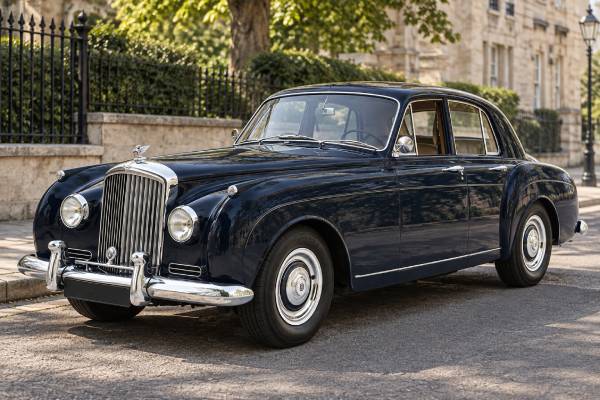
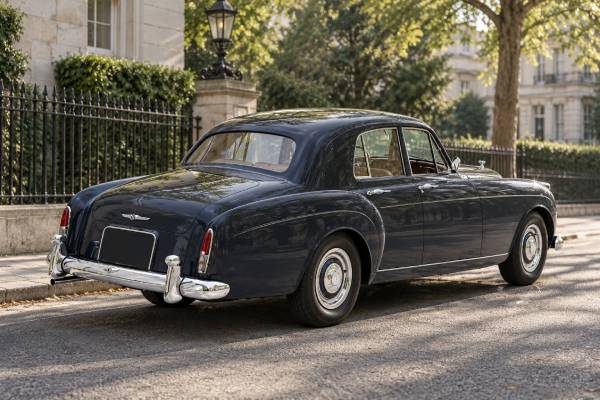
The first Bentley Continental Flying Spur was not a mass-produced luxury sedan. It was a hand-built, four-door grand tourer created by H.J. Mulliner on the high-performance S1 Continental chassis. That distinction explains both its appeal and its complexity. The light-alloy coachwork, long-legged gearing, 4.9-liter straight-six, and unusually discreet shape made it one of the fastest and most usable formal cars of the late 1950s. It also means that no two surviving examples should be judged only by paint, mileage, or a brief road test. Chassis identity, coachwork records, corrosion between dissimilar metals, hydraulic and mechanical brake condition, cooling-system health, and the quality of past restoration matter far more. This guide focuses on the 1957–1959 S1 Continental Flying Spur with the commonly cited 180 hp specification, while noting where equipment and details differed by chassis, market, and owner commission.
Table of Contents
- How the Original Flying Spur Was Created
- S1 Flying Spur Technical Data
- Performance and Road Character
- Coachbuilt Body and Chassis Engineering
- Maintenance Priorities for Reliable Use
- Inspection, Authenticity, and Value
- Who Should Buy an S1 Flying Spur
How the Original Flying Spur Was Created
The S1 Continental Flying Spur is best understood as a four-door version of Bentley’s elite Continental idea, not as a standard S1 saloon with a different roof. H.J. Mulliner developed its aluminium sports-saloon body for customers who wanted Continental pace and distinction without sacrificing rear-door access.
Bentley’s postwar S-Series still used a separate steel chassis. Buyers could order the ordinary factory body or send a chassis to a specialist coachbuilder. The Continental chassis received higher-performance tuning and gearing, while the bodybuilder controlled the shape, interior layout, fittings, and much of the car’s final weight. H.J. Mulliner’s Flying Spur design used a low roof, restrained ornament, a generous glass area, and a clean rear quarter rather than the upright proportions of a formal limousine.
The name came from the heraldic emblem of H.J. Mulliner managing director Arthur Talbot Johnstone’s family. Bentley revived it decades later, but the original car had no connection to the Volkswagen-era Continental platform. It was a rare, expensive commission in an era when even a normal Bentley represented extraordinary wealth.
Production figures can be confusing because records may group S-Series Continentals by chassis, body design, or coachbuilder. The safe approach is to verify the individual chassis card, body number, and build sheet rather than rely on a seller’s broad statement about rarity. A genuine car should have a traceable Continental chassis identity and coachwork documentation consistent with its body.
The assignment’s “B60” label should also be treated carefully. The car’s engine belongs to Bentley’s long-running inline-six family and is usually described in period and marque literature by displacement and configuration rather than by a modern engine-code convention. The important facts are the 4,887 cc F-head straight-six, its Continental tune, and the engine number’s relationship to the chassis records.
S1 Flying Spur Technical Data
The S1 Flying Spur is a front-engine, rear-wheel-drive ICE vehicle with a 4.9-liter naturally aspirated straight-six and a separate chassis. Its mechanical specification is simple by modern standards, but the interaction between coachbuilt body, chassis lubrication, drum brakes, cooling system, and period electrical equipment demands specialist knowledge.
| Specification | Value | Notes |
|---|---|---|
| Engine type | Inline six-cylinder petrol engine | Cast-iron block, aluminium cylinder head |
| Displacement | 4,887 cc (4.9 L) | Continental-specification S1 engine |
| Valve arrangement | F-head, inlet-over-exhaust | Overhead inlet valves and side exhaust valves |
| Induction | Naturally aspirated | Twin carburettors on Continental applications |
| Maximum power | About 180 bhp (134 kW) at 4,000 rpm | Commonly cited for the H.J. Mulliner Flying Spur specification |
| Fuel | Petrol | Use fuel compatible with compression ratio, ignition setting, and valve condition |
| Specification | Value | Configuration |
|---|---|---|
| Drive | Rear-wheel drive | Hypoid final drive |
| Transmission | Four-speed manual or four-speed automatic | Equipment depended on chassis and order |
| Front suspension | Independent wishbones with coil springs | Lever-arm damping and period ride-control hardware |
| Rear suspension | Live axle with semi-elliptic leaf springs | Conventional separate-chassis layout |
| Brakes | Four-wheel drums with servo assistance | Condition and adjustment strongly affect pedal feel |
| Steering | Manual or optional power assistance | Specification varies by car |
| Specification | Value | Notes |
|---|---|---|
| Body | Four-door sports saloon | H.J. Mulliner coachwork, largely light alloy |
| Chassis | Steel box-section frame with cross-bracing | Separate body and chassis construction |
| Wheelbase | 3,124 mm (10 ft 3 in) | Continental S1 chassis |
| Length | About 5,385 mm (212 in) | Coachwork details can create small differences |
| Kerb weight | About 1,766 kg (3,895 lb) | Bentley Heritage Collection example |
| Seating | Four or five occupants | Interior arrangement depended on commission |
| Measure | Value | Context |
|---|---|---|
| Maximum speed | About 119 mph (192 km/h) | Bentley figure for its 1958 Heritage Collection car |
| Acceleration | Strong for a late-1950s four-door grand tourer | Results depend on gearbox, axle ratio, tune, and test method |
| Cruising character | Long-legged high-speed touring | The Continental specification prioritized sustained pace |
| Item | Practical requirement |
|---|---|
| Engine oil | Select viscosity and additive package with a marque specialist based on bearing clearances, climate, and rebuild specification |
| Chassis lubrication | Follow the complete period lubrication chart; infrequent use does not remove time-based needs |
| Brake fluid and hydraulics | Inspect for moisture, internal corrosion, aged hoses, cylinder leakage, and servo condition |
| Cooling system | Maintain correct coolant chemistry and inspect radiator core, water pump, hoses, and block passages |
| Tires | Use correctly rated tires with an appropriate period profile; replace by age as well as tread depth |
Performance and Road Character
A healthy S1 Flying Spur should feel composed, quiet, and surprisingly fast rather than aggressive. Its appeal lies in gathering speed with little drama and holding a sustained touring pace that was exceptional for a four-door car in 1957.
The large straight-six develops its best response through smooth torque, not high engine speed. Correct carburettor balance, ignition timing, compression, valve adjustment, and cooling are therefore more important to the experience than chasing a nominal horsepower number. An engine that starts cleanly, pulls evenly from low speed, maintains oil pressure when hot, and does not overheat is more desirable than one advertised with an undocumented power upgrade.
The manual gearbox gives the car a more mechanical character, but many Flying Spurs were ordered with automatic transmission because the effortless nature suited their role. An automatic should engage without excessive delay, shift cleanly when warm, and avoid flare or harshness. A manual car should have a progressive clutch, manageable synchromesh behavior for its age, and no persistent gear whine beyond normal period sounds.
Steering is deliberate at parking speed. Optional power assistance reduces effort, but excessive free play, wandering, or a need for constant correction is not simply “how old cars drive.” It can point to worn joints, steering-box adjustment, poor alignment, tired tires, or chassis problems. On the road, a sorted car tracks confidently and rides with a supple but controlled motion.
The drum brakes require anticipation. They can be effective when round, correctly adjusted, dry, and supported by a healthy servo, yet repeated heavy stops create heat that modern discs manage better. A pull to one side, changing pedal height, grabbing after storage, or weak assistance deserves investigation. Owners should preserve generous following distances and avoid treating a period top-speed figure as a modern invitation.
Wind noise, body movement, and minor trim sounds vary because every body was hand-finished and many cars have been restored. The benchmark is coherence: doors should close cleanly, the body should not flex visibly over driveways, and the cabin should remain dignified at touring speed.
Coachbuilt Body and Chassis Engineering
The most expensive problems are often in the structure and coachwork, not the engine. Aluminium panels fitted around steel structures can suffer electrolytic corrosion, while previous repairs may hide deterioration beneath filler, paint, sealant, or interior trim.
The separate chassis allows major mechanical assemblies to be repaired without the body carrying suspension loads in the modern monocoque sense. That does not make body restoration easy. Door fit, roof alignment, window frames, gutters, sill structures, mounting points, and rear-quarter contours all depend on skilled handwork. A shop familiar with ordinary steel classics may not have the tools or experience to reproduce H.J. Mulliner construction faithfully.
Inspect panel edges and joints for bubbling that returns after repainting. Look at the lower doors, wheel openings, sill areas, boot floor edges, windscreen and rear-window surrounds, and points where aluminium meets steel. Small surface blisters may conceal broader corrosion at the interface. Ask whether a restoration separated materials, treated the underlying structure, and used suitable barriers rather than simply refinishing the visible skin.
The steel chassis should be checked for corrosion, cracks, accident distortion, poor welding, and damage caused by incorrect jacking. Measure alignment if door gaps or wheel positions look inconsistent. Body mounts and insulating materials can compress or deteriorate, changing panel fit and allowing movement or noise.
Originality has layers. A changed color or retrim does not automatically make a car poor, while original leather and veneers with honest wear may add historical value. More serious concerns include an engine or body number that conflicts with factory records, a replacement body represented as original, missing Continental-specific components, or major modifications performed without documentation.
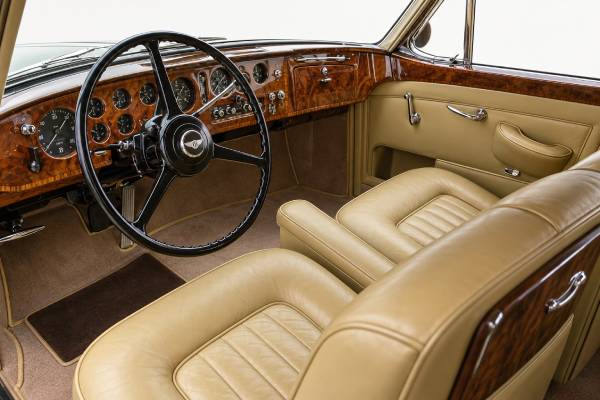
Interior restoration deserves the same scrutiny as exterior paint. Correct veneer matching, hide grain, stitching, headlining, switchgear, instruments, carpets, and plated hardware require extensive labor. A glossy cabin can still be inaccurate. Photographs taken before and during work are valuable because they reveal what was preserved and what was recreated.
Maintenance Priorities for Reliable Use
Reliability comes from regular use, disciplined lubrication, and preventive work by specialists. Long storage followed by a long tour is riskier than frequent short inspections and progressively longer drives.
Start with a baseline service if the history is incomplete. That means testing compression and oil pressure, checking valve clearances and ignition, cleaning and balancing carburettors, examining fuel lines, inspecting cooling passages and hoses, testing charging output, servicing the braking system, and lubricating every chassis point. Replace aged tires even when the tread looks new.
The cooling system deserves special attention. Sediment, old hoses, a restricted radiator, weak water-pump performance, incorrect ignition timing, and a lean mixture can combine to cause overheating. Temperature should stabilize in traffic and recover after a climb. Repeated coolant loss, bubbling, oil contamination, or pressure after a cold start requires diagnosis rather than a stronger radiator cap.
Oil leaks are common on old British machinery, but location and rate matter. A light mist is different from a leak that reaches the clutch, exhaust, brakes, or road. Clean the engine and driveline, identify the source, and correct crankcase ventilation or sealing issues before replacing parts at random. Persistent low hot oil pressure is more important than cosmetic dampness.
Brake servicing must include the entire system. Drum condition, shoe material, wheel cylinders, hoses, hard lines, master cylinder, servo, bearings, and adjustment interact. A car that has stood can develop corrosion inside hydraulic components even when the exterior looks dry. Fluid should be renewed on a time basis appropriate to the fluid and storage conditions.
Electrical reliability improves when connections, grounds, battery cables, regulator operation, and added accessories are rationalized. Old insulation and improvised splices create heat and intermittent faults. Any modern air-conditioning, audio, or charging equipment should be fused and installed without cutting irreplaceable original trim.
A sensible use plan includes:
- Check fluids, tire pressures, leaks, and brake feel before every meaningful trip.
- Warm the engine under light load rather than idling for a long period.
- Exercise the brakes and gearbox gently after storage.
- Record oil pressure, coolant temperature, fuel consumption, and new noises.
- Schedule annual inspection even when mileage is very low.
Inspection, Authenticity, and Value
Buy the best-documented structure you can afford, not the shiniest example. A correct but cosmetically aged Flying Spur is usually easier to understand than a freshly painted car with no photographic restoration record.
Begin with identity. Compare chassis, engine, and body numbers with factory build information. Confirm original delivery specification, coachbuilder design, steering position, gearbox, color, interior, and special equipment. Changes are acceptable when disclosed, but the price should reflect their quality and reversibility.
Then inspect the car cold. A seller-warmed engine can hide hard starting, smoke, low oil pressure, or noisy valve gear. Observe exhaust color, crankcase fumes, charging behavior, and coolant circulation. Drive long enough for the engine, transmission, brakes, and axle to reach normal temperature.
A professional inspection should include:
- chassis condition and alignment;
- corrosion at aluminium-to-steel interfaces;
- door, bonnet, and boot fit;
- brake-system performance and leak checks;
- steering play and suspension wear;
- engine compression, oil pressure, and cooling behavior;
- gearbox engagement and final-drive noise;
- operation of instruments, lights, heaters, windows, and accessories;
- age and specification of tires;
- comparison of major components with build records.
Restoration invoices should identify who performed the work and what was actually done. “Engine rebuilt” is not enough without measurements, parts, machining details, and the name of the builder. The same applies to paint: ask whether the body was stripped, whether corrosion was cut out, how dissimilar metals were isolated, and whether the body was removed from the chassis.
Market value is influenced by authenticity, coachwork, provenance, mechanical condition, restoration quality, originality, and usability. Celebrity ownership can add interest, but it should not compensate for structural problems. The rarest specification is not automatically the best car to drive; a well-sorted automatic with power steering may be more enjoyable for regular touring than a theoretically purer but neglected example.
Budget beyond the purchase price. Transport, specialist inspection, insurance, secure storage, tires, recommissioning, and the first major service can be significant. A reserve for hidden coachwork or cooling-system work is prudent even after a favorable inspection.
Who Should Buy an S1 Flying Spur
The S1 Continental Flying Spur suits an owner who values history, hand craftsmanship, and long-distance character more than modern convenience. It is usable, but it rewards planning, mechanical sympathy, and access to the right people.
It is a strong choice for concours touring, marque events, and carefully planned road trips. Four doors make it more practical than many coachbuilt Continentals, while the restrained design attracts less attention than overtly sporting classics. The cabin can carry passengers in genuine comfort, and the car’s performance remains sufficient for modern secondary roads when driven with appropriate margins.
It is a poor choice for someone seeking a maintenance-free collectible, an occasional ornament that can sit for years, or a classic to entrust to a general repair shop. Parts can often be sourced or made, but diagnosis and labor are the real costs. Bodywork, trim, instruments, carburettors, brakes, and period automatic transmissions each require different expertise.
The best ownership strategy is preservation with use. Keep accurate records, retain removed original parts, avoid irreversible upgrades, and improve safety discreetly where appropriate. A hidden battery isolator, sympathetic lighting improvements, carefully integrated air conditioning, or modern tire construction can make the car easier to enjoy, provided the work respects electrical load, appearance, and originality.
Above all, judge the individual car. The Flying Spur name may be famous, but an S1’s quality is stored in its chassis file, metalwork, mechanical condition, and restoration decisions. A properly sorted example delivers a rare blend of formal elegance and genuine Continental speed that later luxury sedans can imitate but cannot reproduce.
Commission history and restoration philosophy
An S1 Continental Flying Spur should also be evaluated as an individual coachbuilt commission. Chassis number, H.J. Mulliner body number, original order information, delivery market, paint, leather, veneer, instruments, and later alterations create a history that cannot be reduced to the year on the registration document. Obtain copies of build records where available and compare stamped, engraved, and numbered components with the car. A replacement engine or changed color does not automatically make an S1 undesirable, but undisclosed changes weaken confidence and affect value.
Restoration quality is more important than restoration freshness. Correct door fit, quiet timber framing, aligned brightwork, appropriate leather grain, well-finished wood, functioning ventilation, and properly routed wiring show patient work. Heavy filler, modern fasteners in visible areas, vinyl substituted for hide, thick lacquer, incorrect gauges, or a generic modern wiring loom can make a glossy car less authentic and harder to maintain. Photograph hidden construction during restoration, because evidence beneath trim may later be inaccessible.
Driving use should shape the final decision. A concours-oriented car may preserve rare details but require careful preparation before long touring. A regularly exercised car may have discreet reliability improvements, such as better heat shielding or a hidden auxiliary electric fuel pump, while remaining visually correct. Identify every modification, understand why it was made, and make sure it can be serviced without improvisation. The best S1 is not necessarily the least altered; it is the one whose history, workmanship, and intended use form a coherent whole.
A final roadworthy S1 should also carry a usable tool roll, jack, wheel-brace equipment, spare-wheel retention, and period-correct starting instructions. Verify that these items fit the restored car rather than merely appearing correct in a display photograph.
References
- BENTLEY NEWSROOM : 1958 S1 Continental Flying Spur VGX853 2026 (Heritage Collection)
- BENTLEY NEWSROOM : Heritage Collection 2026 (Manufacturer Archive)
- 1957 Bentley S1 Continental ‘Flying Spur’ Sports Saloon by H.J. Mulliner | SHIFT/Monterey 2020 | RM Sotheby’s 2020
- 1957 Bentley S1 Continental Fastback Sports Saloon by H.J. Mulliner | Amelia Island 2017 | RM Sotheby’s 2017
- 1958 Bentley S1 Continental ‘Flying Spur’ Sports Saloon by H.J. Mulliner | Arizona 2016 | RM Sotheby’s 2015
Disclaimer
This article is for informational purposes and is not a substitute for professional diagnosis, restoration, or repair. Specifications, torque values, service intervals, and procedures can vary by chassis, market, equipment, and prior modification; verify every task against the car’s factory records and official service documentation.
Please share this guide on Facebook, X/Twitter, or your preferred enthusiast community if it helped your research.