
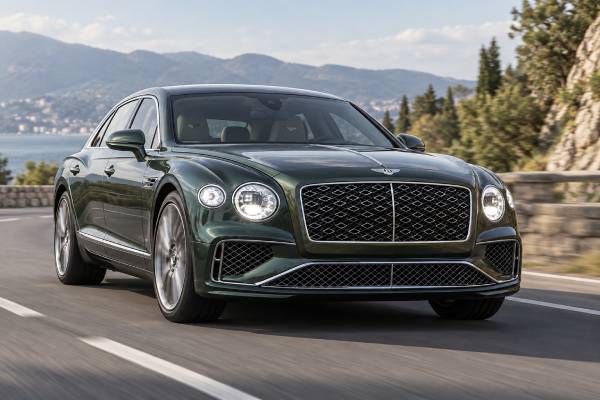
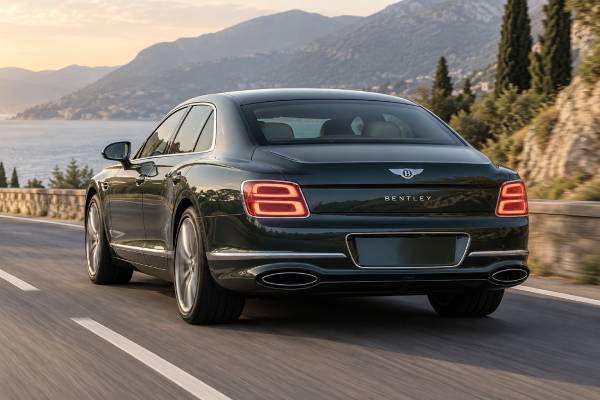
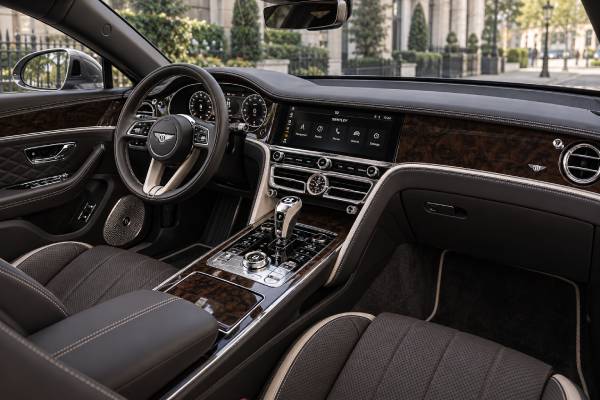
The 2025–present Bentley Flying Spur with the High Performance Hybrid is the range’s core model, but “core” does not mean modest. Its 4.0-liter twin-turbo V8 and electric motor produce 680 PS, or 671 bhp, and 930 Nm—more output than the previous W12 Speed. Bentley claims 0–60 mph in 3.8 seconds, up to 80 km of electric range, and a 270 km/h maximum speed. It also includes active anti-roll control, all-wheel steering, twin-valve damping, and the 25.9 kWh battery capacity used by the more powerful Speed.
The key buying question is not whether this Flying Spur is fast enough. It is whether the Ultra Performance Hybrid, Mulliner trim, or Azure wellness package adds features that match the owner’s priorities. The standard car may offer a strong balance of discreet design, performance, useful electric commuting, and freedom to choose only the options that matter. This guide explains the 680 PS powertrain, separates its hardware from the 782 PS system, assesses charging and real-world use, and provides a checklist for specification, servicing, and eventual used-car inspection.
Table of Contents
- Why the core Flying Spur is not basic
- High Performance Hybrid specifications
- Daily driving and electric use
- Chassis, comfort, and control
- Options that change the car
- Service, charging, and operating costs
- New-order and used-buying guide
Why the core Flying Spur is not basic
The standard Flying Spur is the most understated member of the 680 PS range, not a stripped model. It uses the same High Performance Hybrid as Azure and delivers stronger performance than any third-generation Flying Spur except the new Ultra Performance Hybrid cars.
Bentley expanded the fourth-generation family in 2025 after launching Speed and Mulliner with the 782 PS system. The second powertrain combines a 519 PS V8 with the same 190 PS electric-motor rating used elsewhere, calibrated for 680 PS and 930 Nm at system level. That leaves a meaningful gap to the Speed’s 1,000 Nm but still produces supercar-like acceleration.
The visual treatment is intentionally restrained. A matte-black matrix grille, chrome surround and center bar, bright exterior detailing, 21-inch wheels, and a conventional Flying Spur cabin make the car less overt than Speed, less jewel-like than Mulliner, and less comfort-themed than Azure. This can be an advantage for buyers who want the engineering without a strong trim identity.
Standard equipment is market dependent, but the current car can include City Specification assistance, rear touchscreen control, wireless smartphone integration, advanced filtration, and a choice of premium audio. Personalization remains extensive. The absence of a sub-brand badge does not prevent Mulliner paint, alternative veneers, larger wheels, different brake-caliper colors, or a four-seat rear arrangement.
The core model’s top speed of 270 km/h is lower than the S’s later 308 km/h and the Speed’s launch performance calibration, but it is irrelevant to normal road use. Its 3.9-second 0–100 km/h time and 930 Nm provide more than enough response. The real differences emerge in chassis calibration, eLSD availability, styling, standard comfort packages, and price.
This version suits an owner who values discretion and intends to choose options selectively. It is also the rational entry point for company, chauffeur, or long-distance use when the 782 PS claim has little practical value. Rational is relative, of course: this remains a hand-finished, high-output, 2.6-ton luxury PHEV.
High Performance Hybrid specifications
The High Performance Hybrid is a plug-in system combining a twin-turbo V8, one traction motor integrated with the eight-speed dual-clutch transmission, and a 25.9 kWh battery. Its component and system figures must be kept separate because maximum outputs are electronically coordinated.
| Specification | Value |
|---|---|
| Powertrain classification | Plug-in hybrid electric vehicle |
| Gasoline engine | 4.0-liter twin-turbocharged V8 |
| Displacement | 3,996 cc |
| Engine output | 519 PS (512 bhp; 382 kW) at 6,250 rpm |
| Engine torque | 770 Nm (568 lb-ft) at 2,300–4,500 rpm |
| Electric motor output | 190 PS (188 bhp) |
| Electric motor torque | 450 Nm (332 lb-ft) |
| Combined output | 680 PS (671 bhp) |
| Combined torque | 930 Nm (686 lb-ft) |
| Battery capacity | 25.9 kWh |
| Transmission | 8-speed dual-clutch automatic |
| Specification | Value | Condition |
|---|---|---|
| 0–60 mph | 3.8 seconds | Manufacturer figure |
| 0–100 km/h | 3.9 seconds | Manufacturer figure |
| Maximum speed | 270 km/h (168 mph) | Optional approved summer tire may be required |
| Electric range | Up to 80 km (50 miles) | Manufacturer/EU cycle statement |
| Maximum AC charging | 11 kW | Compatible supply |
| DC fast charging | Not supported | AC charging only |
| Fuel tank | 80 liters (21.1 US gal) | Published specification |
| Specification | Value |
|---|---|
| Overall length | 5,316 mm (209.3 in) |
| Width across mirrors | 2,220 mm (87.4 in) |
| Overall height | 1,474 mm (58.0 in) |
| Wheelbase | 3,194 mm (125.7 in) |
| Published unladen weight | about 2,646 kg (5,833 lb) |
| Boot capacity | 346 liters (12.2 cu ft) |
| Standard wheels | 21-inch ten twin-spoke design |
| Suspension | Air springs with twin-valve dampers |
| Chassis technology | All-wheel steering and Bentley Dynamic Ride |
Unladen weight varies by region and equipment. The 346-liter trunk is a more tangible limitation: it is notably smaller than the outgoing non-hybrid Flying Spur’s 420-liter luggage compartment.
Daily driving and electric use
The High Performance Hybrid is most economical and refined when charged regularly, yet it remains a true long-distance car after the initial electric range is used. That combination makes it easier to live with than a short-range PHEV that relies on a small fuel tank or weak engine.
In electric operation, the 190 PS motor is capable of normal urban and suburban traffic. The car starts quietly, responds immediately at low speed, and can complete many commutes without combustion if conditions permit. High accelerator demand, heating, defrosting, cold battery temperature, or control-system needs may start the V8 before the range display reaches zero.
The larger battery roughly doubles the official electric capability of the earlier 2.9-liter Flying Spur Hybrid. Its 11 kW AC acceptance also reduces full-charge time on a suitable three-phase source. There is no DC charging, so the intended routine is home, office, or destination charging while the car is parked for hours.
When the V8 joins, the transition should be smooth. The motor can fill torque as the engine starts and the dual clutches change ratio. Test a car in stop-start traffic, at medium throttle, and during a firm overtake. A thump, repeated hesitation, or warning is not a normal consequence of hybrid complexity.
After the displayed electric range reaches zero, the battery retains a protected buffer. The system continues to regenerate and support the engine. The car does not become stranded electrically, but repeated hard use can reduce temporary electric assistance as temperature and state of charge change.
The official weighted fuel figure assumes charging. Owners who never plug in will carry battery mass and use the V8 for nearly every trip. They should compare the car with their actual energy prices and route, not with a laboratory figure. Record wall electricity, gasoline, and total distance to calculate a meaningful cost.
For longer travel, use automatic hybrid mode and reserve charge only when a low-emission urban arrival or quiet destination makes it useful. The car cannot benefit from a brief rapid-charger stop, so plan overnight AC access rather than altering a highway route around public DC stations.
Chassis, comfort, and control
The core Flying Spur includes sophisticated chassis hardware because 680 PS and 2.6 tons demand more than soft springs. Its tuning aims for a broad comfort range rather than the S or Speed’s most aggressive dynamic identity.
Air suspension carries the vehicle and can adjust its behavior for load and drive mode. Twin-valve dampers control compression and rebound separately, creating more freedom to soften sharp impacts while restraining body motion. The car should feel settled after one body movement rather than continuing to float.
Bentley Dynamic Ride applies active anti-roll torque through a 48-volt network. On a straight road it can reduce the compromise of a stiff passive bar; in a corner it resists lean. The system should make drive modes feel distinct. Warnings, excess roll, or no perceptible change deserve a diagnostic scan of the 48-volt battery, control units, wiring, and actuators.
All-wheel steering improves both parking and stability. The rear wheels oppose the fronts at low speed and move with them at higher speed. This is especially useful with a 3,194 mm wheelbase. Alignment work must use correct ride-height and calibration procedures; ordinary tire-shop settings may not be enough.
Active all-wheel drive and brake-based torque vectoring distribute power. The core car does not rely on the Speed’s or S’s performance identity to provide secure traction. It should accelerate cleanly without steering corruption, provided all four tires match and have appropriate tread.
Standard 21-inch wheels are a meaningful advantage for comfort and replacement cost. The optional 22-inch designs sharpen appearance and may alter response, but their lower-profile tires are more vulnerable to potholes. Buyers should choose based on roads rather than assuming the largest wheel is automatically desirable.
The core car’s standard seats can be upgraded with front and rear comfort or wellness functions. Spend time in both front and rear during a showroom visit. Chassis technology cannot compensate for a seat shape or rear configuration that does not suit the user.
Options that change the car
The most important Flying Spur options affect how the car is used, serviced, and resold. Paint and stitching create appeal, but seating layout, wheels, brakes, assistance, audio, and rear equipment change daily life.
Four-seat configuration replaces the center rear position with a console, increasing privacy and storage for two passengers. Five seats preserve flexibility and often suit owner-driven cars better. The choice also affects long-item loading in a vehicle whose trunk is already reduced by hybrid packaging.
Comfort specifications can add extensive seat adjustment, massage, ventilation, and rear controls. Wellness features may include automatic postural movement and thermal management. Test every motor and program. A seat that appears visually perfect can hide a failed bolster or ventilation fan.
Driver-assistance packages can include predictive adaptive cruise, lane guidance, surround view, night vision, head-up display, intersection support, and urban parking functions. Their availability differs by market. Body or windscreen repairs require camera and radar calibration, so invoices are valuable.
Audio choices include the standard Bentley system, Bang & Olufsen, and Naim. Listen for failed channels and trim buzz rather than comparing wattage alone. The Rotating Display adds theater but also an electromechanical mechanism that must align smoothly in all three positions.
Twenty-two-inch wheels, colored calipers, and upgraded brake systems change appearance and costs. Carbon-based brakes can reduce unsprung mass and resist heat, but their replacement is far more expensive than iron. A buyer who will never approach their thermal capacity may prefer conventional discs.
Mulliner personalization can add rare paint, technical veneers, embroidery, laser etching, and special color combinations without turning the car into the Mulliner trim. A coherent core-model commission may be more attractive than a heavily specified car with conflicting themes.
Connected services and App Studio functions require accounts and market support. Verify which licenses transfer, how the previous user’s data is removed, and whether mobile-network changes affect older or later model years.
The core model’s strongest advantage is freedom to build around actual use. An owner-driver can prioritize all-wheel steering, audio, darker trim, and durable colors without paying for every rear-cabin feature. A chauffeured buyer can direct money toward comfort seating, privacy equipment, and rear controls while retaining the less assertive exterior. Before selecting options, write down the car’s five most common journeys and the people and luggage involved. That simple exercise exposes equipment that will be used weekly and separates it from features chosen mainly because they look impressive in a configurator.
Charging deserves the same practical planning. Measure the parking position, cable route, connector clearance, and available electrical capacity before the car arrives. An 11 kW wallbox can make full use of the onboard AC charger, but only when the property and local supply support it. A lower-power installation can still suit overnight charging; the important point is that it is professionally installed, weather-appropriate, and easy enough to use every day. Owners who must cross a public walkway, rely on an extension lead, or move another car before plugging in often charge less consistently than expected.
Operating costs should therefore be modeled in scenarios rather than from one official consumption number. Compare a charged urban week, an uncharged motorway week, winter heating, insurance, scheduled service, tires, parking, and home electricity. The PHEV can reduce gasoline use dramatically on repeat short trips, but it remains a heavy 671 hp luxury sedan with correspondingly expensive wear items. The sensible purchase case combines frequent charging with enough annual use to appreciate the refinement, space, and performance.
Service, charging, and operating costs
The new Flying Spur needs maintenance across 12-volt, 48-volt, and high-voltage systems, plus a high-output V8 and conventional wear components. Annual distance is only one input; time, charging pattern, storage, and performance use matter.
The V8 requires approved oil and filters at the schedule specified for the VIN. Electric commuting may keep engine mileage low, but repeated cold starts and short combustion cycles can age oil. Review spark-plug, brake-fluid, coolant, transmission, differential, and air-conditioning requirements with a Bentley-trained workshop.
High-voltage diagnostics should inspect charging records, fault memory, cell-balance indicators, isolation status, thermal management, and software. Battery state of health cannot be judged from one predicted-range display. Use a full charge, diagnostic data, and measured energy consumption.
A weak 12-volt battery can stop the car from entering ready mode even when the traction battery is full. The 48-volt system powers Dynamic Ride. Test both low-voltage systems and use an approved maintainer during storage. Avoid clearing faults before recording their voltage context.
Charging installation is a one-time cost that determines everyday convenience. An 11 kW wallbox needs suitable electrical supply; lower-power AC still works with a longer dwell. Use a qualified electrician and avoid household extension cables. Inspect the vehicle cable, pins, lock, flap, and schedule function.
Tires and brakes are major recurring costs. Check tire age, load rating, matching tread, and inner-edge wear. Regenerative braking can allow iron discs to rust, especially on gently driven cars. Measure both disc faces and use the friction brakes periodically where safe.
Air suspension, rear steering, and active anti-roll control should be inspected after impacts and during routine service. A small alignment or leak issue can destroy expensive tires or overwork a compressor. Software updates should follow diagnosis, not replace it.
Insurance and tax treatment vary widely. Some markets reward PHEV registration; others change rules frequently or base fees on list price and weight. Confirm current local treatment before ordering rather than assuming the hybrid badge reduces every cost.
New-order and used-buying guide
The core High Performance Hybrid is the strongest value when its standard character already matches the owner. Add options that solve a use case; avoid building an imitation Azure, S, Speed, or Mulliner at greater cost than the factory derivative.
For a new order, start with garage and charging access. Confirm the car fits, the doors can open, the cable reaches safely, and an electrician can provide the intended AC rate. Then choose rear-seat layout, wheel size, comfort specification, assistance packages, and audio. Colors should come after those decisions.
Compare derivatives carefully. Azure adds wellness and comfort equipment as a coherent package. Speed and Mulliner use the 782 PS powertrain and a more performance-led chassis specification. The 2026 S uses the 680 PS system but adds the Performance Active Chassis, eLSD, sports exhaust, and a stronger visual identity. The core car remains the discreet choice.
For a used example, obtain:
- VIN and factory build data;
- complete service and software history;
- charging cables and both keys;
- high-voltage warranty terms;
- recall and campaign status;
- wheel, tire, and brake measurements;
- details of paint, glass, or bumper repairs and calibrations;
- account-transfer and connected-service information.
View the car with meaningful battery charge and from cold. Conduct an AC charging session, EV drive, hybrid transition test, low-speed clutch maneuvers, rough-road test, highway balance check, and controlled braking. Run diagnostics before and after the drive to catch faults that appear only under temperature or load.
A specialist should assess battery data, all three voltage systems, coolant circuits, air suspension, Dynamic Ride, rear steering, wheel runout, alignment, brake condition, paint depth, water entry, climate operation, and every seat and display. A warning explained as “software” needs a documented repair and clean retest.
Do not overvalue low mileage. Regular charging, full-temperature engine use, annual service, and healthy tires are more convincing than a car that has sat for months. Conversely, high mileage is acceptable only with evidence that wear items and software have kept pace.
The purchase is successful when the car’s use is obvious: quiet local trips, fast and stable touring, enough luggage space, comfortable passengers, and a charging routine that actually happens. The High Performance Hybrid provides the hardware; thoughtful specification and maintenance turn it into the best-balanced Flying Spur for many owners.
References
- Bentley News 2025 : New High Performance Hybrid Continental GT, GTC and Flying Spur – the daily supercar family expands 2025 (Model Launch)
- Bentley News 2025 : Bentley Motors debuts new Continental GT and Flying Spur models at Auto Shanghai 2025 2025 (Range Overview)
- Flying Spur | Flying Spur Range | Bentley Motors 2026 (Technical Data)
- BENTLEY NEWSROOM : New Flying Spur 2026 (Engineering Overview)
- : Services: Flying Spur services 2026 (Connected Services)
- Check for Recalls: Vehicle, Car Seat, Tire, Equipment | NHTSA 2026 (Recall Database)
Disclaimer
This article is for informational purposes and is not a substitute for professional diagnosis, repair, high-voltage service, or a VIN-specific inspection. Specifications, torque values, charging rates, intervals, software, and equipment vary by market, model year, and factory configuration. Verify all work against official Bentley service documentation. Please share this guide on Facebook, X/Twitter, or another platform if it helped you.