
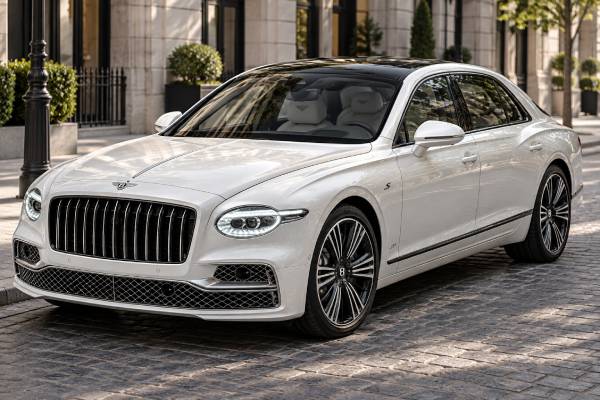
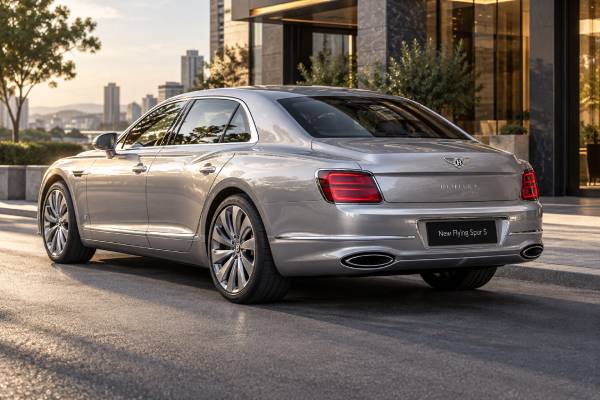
The 2026 Bentley Flying Spur S is the driver-focused version of Bentley’s four-door plug-in hybrid, but it is not simply a cosmetic package. Its 671 hp High Performance Hybrid system is paired with Bentley Performance Active Chassis, an electronic limited-slip differential, active all-wheel drive, all-wheel steering, Dynamic Ride anti-roll control, twin-valve dampers, and a sports exhaust. The result is a large luxury sedan that can travel quietly on electric power, then deliver genuine grand-touring pace and far more chassis control than its size suggests. It also introduces a sharper visual identity, with black exterior detailing, S-specific 22-inch wheels, focused-eye headlamps, and a cabin trimmed to feel more sporting than the standard Flying Spur or comfort-led Azure. This guide explains the exact 2026 specification, what the hardware changes on the road, how to charge and maintain the PHEV system, and what buyers should verify before ordering or taking delivery.
Table of Contents
- What Makes the 2026 Flying Spur S Different
- Technical Specifications and PHEV Packaging
- How the Performance Active Chassis Changes the Car
- Hybrid Performance, Electric Driving, and Charging
- Design, Cabin, Technology, and Daily Use
- Maintenance and Long-Term Care
- Buying, Ordering, and Delivery Checklist
What Makes the 2026 Flying Spur S Different
The 2026 S occupies a specific place in the Flying Spur range: it uses the 671 hp High Performance Hybrid powertrain rather than the 771 hp Ultra Performance Hybrid, yet receives the chassis hardware needed to make it the keenest driver’s choice at its power level. That combination matters more than a simple horsepower comparison.
Bentley’s core Flying Spur and Azure already offer strong acceleration, all-wheel steering, air suspension, and a broad spread of luxury equipment. The S adds a more complete performance system. Bentley Performance Active Chassis brings together active all-wheel drive, Bentley Dynamic Ride, an electronic limited-slip differential, torque-vectoring functions, all-wheel steering, and more decisive calibration. A sports exhaust gives the 4.0-liter V8 a stronger voice when the combustion engine is running. The S also carries a much higher published maximum speed than the regular High Performance Hybrid Flying Spur, subject to the correct original-equipment summer tire specification.
This makes the S less about isolated options and more about how the systems work as a group. The electronic differential can apportion drive more effectively at the rear axle. Dynamic Ride uses a high-voltage active anti-roll system to resist body lean without requiring permanently harsh springing. All-wheel steering makes the car easier to place in tight streets and steadier during fast direction changes. Twin-valve dampers allow rebound and compression control to be adjusted separately, increasing the difference between relaxed and sporting modes.
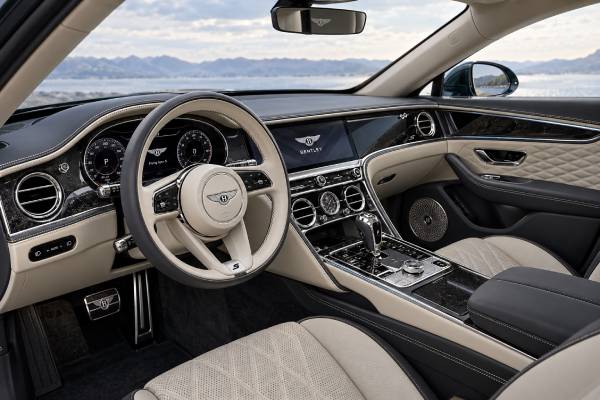
Inside, the S avoids trying to imitate a stripped track car. It remains a four-door Bentley with space, fine materials, rear-seat amenities, and extensive personalization. Its distinction comes from Dinamica surfaces, a Striking Sports color layout, fluted seats with embroidered S emblems, Piano Black veneer, model-specific display graphics, and touch points chosen to feel secure during fast driving. Buyers can still specify rear comfort features, premium audio, handcrafted veneers, and Mulliner details, so the car’s final character depends heavily on the order sheet.
choose the S because you want the High Performance Hybrid with the most advanced chassis and a darker sporting presentation. Choose the standard Flying Spur for a more traditional visual balance, Azure for a wellness-led rear-cabin experience, or Speed when the highest system output is the priority.
Technical Specifications and PHEV Packaging
The Flying Spur S is a PHEV: a 4.0-liter twin-turbocharged V8 works with an electric motor integrated into the eight-speed dual-clutch transmission, and a 25.9 kWh battery can be charged from an external AC supply. Power reaches all four wheels, while the battery and hybrid hardware reduce luggage capacity compared with a non-hybrid large sedan.
| Specification | Official value |
|---|---|
| Powertrain type | Plug-in hybrid gasoline-electric |
| Combustion engine | 4.0-liter twin-turbocharged V8, 3,996 cc |
| Engine output | 519 PS / 512 bhp / 382 kW |
| Engine torque | 770 Nm / 568 lb-ft |
| Electric-motor output | 190 PS / 188 bhp |
| Electric-motor torque | 450 Nm / 332 lb-ft |
| Combined system output | 680 PS / 671 bhp |
| Combined system torque | 930 Nm / 686 lb-ft |
| Transmission | 8-speed dual-clutch automatic with integrated electric motor |
| Drivetrain | Active all-wheel drive |
The combined output is an official system figure; it is not obtained by adding peak engine and motor outputs, because those peaks do not necessarily occur under identical conditions. The same principle applies to torque. What drivers feel is a broad delivery in which the electric motor supplies immediate response while the V8 sustains acceleration at higher speed.
| Measure | Value |
|---|---|
| 0–60 mph | 3.6 seconds |
| 0–100 km/h | 3.7 seconds |
| Maximum speed | 191 mph / 308 km/h |
| Maximum-speed condition | Optional summer tire fitted as original equipment |
Those numbers place the S well beyond normal luxury-sedan performance, even though it is not the 771 hp Speed. Its top-speed capability also means tire specification, condition, pressure, and speed rating are safety-critical rather than minor ownership details.
| Specification | Value |
|---|---|
| High-voltage battery capacity | 25.9 kWh |
| External charging | AC charging |
| Maximum AC charging rate | 11 kW |
| Indicative full-charge time at maximum AC rate | About 2 hours 45 minutes |
| DC rapid charging | Not provided |
Charging time depends on the supply, charging equipment, battery temperature, initial state of charge, and power available to the vehicle. A typical household outlet will be much slower than a correctly installed 11 kW wallbox. The S is therefore best treated as a car that charges routinely at home, work, or a destination rather than one that depends on highway rapid chargers.
| Specification | Value |
|---|---|
| Overall length | 5,316 mm / 209.29 in |
| Width across mirrors | 2,220 mm / 87.4 in |
| Overall height | 1,474 mm / 58.03 in |
| Wheelbase | 3,194 mm / 125.75 in |
| Published unladen weight | Approximately 2,641–2,646 kg, depending on regional definition |
| Boot volume | 346 liters / 12.2 cu ft |
| Fuel-tank capacity | 80 liters / 21.0 US gal |
The 346-liter boot is usable for business luggage or a carefully chosen set of cases, but it is modest for a sedan more than 5.3 meters long. Buyers who carry golf bags, bulky child equipment, or airport luggage should test their actual items before ordering. The charging cable also needs a clean, secure storage plan so it does not take over the available space.
| System | Purpose |
|---|---|
| Bentley Performance Active Chassis | Coordinates the S model’s performance-focused chassis systems |
| Bentley Dynamic Ride | High-voltage active anti-roll control |
| Electronic limited-slip differential | Improves rear-axle traction and corner-exit control |
| All-wheel steering | Improves low-speed maneuverability and high-speed stability |
| Twin-valve dampers | Separate control of compression and rebound damping |
| Standard S wheels | 22-inch ten swept-spoke design in black and machined finish |
| Brakes | Iron brakes standard; carbon-ceramic brakes available |
How the Performance Active Chassis Changes the Car
The S chassis is designed to make a heavy sedan respond predictably without destroying its luxury-car ride. Its value appears in traction and body control, not one acceleration statistic.
At parking speed, rear-wheel steering turns the rear wheels opposite the fronts. This reduces the effective turning circle and helps the car rotate into narrow entrances or multistory parking ramps. It does not make the Flying Spur small—its mirror-to-mirror width still demands care—but it reduces the amount of shuffling needed. At higher speed, the rear wheels turn in the same direction as the fronts, which can make lane changes feel more settled and reduce the sense of delay between steering input and body response.
Bentley Dynamic Ride addresses another problem created by the Flying Spur’s mass and height: body roll. Conventional anti-roll bars resist leaning by mechanically linking the suspension across an axle, which can compromise ride comfort when only one wheel encounters a bump. The active system can apply force when needed, supporting the body in a corner while allowing a more compliant response in gentler driving. The driver experiences this as flatter, cleaner cornering rather than as a harshly sprung ride.
The electronic limited-slip differential is especially relevant when accelerating out of a bend. An open differential can allow the lightly loaded inside tire to spin while the outside tire has more grip available. The electronically controlled unit manages rear-axle torque more effectively, helping the car deploy its 930 Nm without relying only on brake intervention. Active all-wheel drive and torque-vectoring functions then work with it to stabilize the car and shape its line.
Twin-valve dampers increase the calibration range. Compression damping controls how the suspension reacts as the wheel moves upward; rebound damping controls its return. Separate valves allow Bentley to tune these motions with greater independence, so Comfort and Bentley modes can remain composed while Sport mode tightens control.
Hybrid Performance, Electric Driving, and Charging
The High Performance Hybrid works best when it is charged frequently and allowed to use electric power for low-speed travel. Running it permanently with a depleted battery removes much of the refinement and efficiency benefit that justifies the PHEV system.
The electric motor is integrated within the transmission, so the power sources can operate separately or together. In urban traffic, the motor can move the car quietly and respond without waiting for turbo boost or a downshift. During stronger acceleration, it fills the response before the V8 reaches its most effective range. At cruising speed, the system can choose the most suitable combination according to drive mode, battery state, navigation context, temperature, and driver demand.
Bentley has published an electric range of up to roughly 50 miles for the related High Performance Hybrid Flying Spur configuration, but market certification for the 2026 S should be checked on the final order and vehicle documentation. Wheel and tire choice, ambient temperature, heating or air-conditioning use, speed, traffic, elevation, and battery condition all change real-world range. A cold high-speed trip can deliver far less electric distance than a mild-weather urban route.
For daily use, set a charging routine rather than waiting until the battery is empty. A wallbox that can supply the car’s maximum 11 kW AC rate gives the greatest flexibility, but the electrical installation must be assessed by a qualified professional. The circuit, protective devices, cable, connector, grounding, and local regulations all matter. Avoid relying on improvised extension leads or damaged outlets, especially with a vehicle that may draw substantial current for hours.
A useful routine is:
- Park with enough room to connect the cable without stretching or creating a trip hazard.
- Inspect the connector and cable for dirt, moisture, impact damage, or bent components.
- Connect according to the vehicle and charging-equipment instructions.
- Confirm on the car or app that charging has actually started and that no fault is shown.
- Use scheduled charging when it suits electricity pricing and the planned departure time.
- Disconnect by the approved sequence, replace protective caps, and store the cable dry.
The lack of DC rapid charging is not a defect; it reflects the battery size and intended use. On a long trip, stopping to AC-charge a PHEV may not be time-efficient. The normal strategy is to begin with a full battery, let the hybrid system manage energy while traveling, refuel normally, and use destination charging when convenient.
Regenerative braking recovers some energy during deceleration, but it cannot replace plug-in charging. It also changes brake use. Friction brakes may work less frequently in gentle driving, which can allow surface corrosion or uneven deposits in wet or salted climates. The control system blends regeneration and friction braking, so any pulsing, scraping, warning message, or inconsistent pedal feel deserves inspection. Periodic purposeful use of the brakes, where safe and consistent with the manual, can help keep the friction surfaces active.
Owners who leave the car parked for extended periods should follow Bentley’s guidance for both the high-voltage and 12-volt systems. The traction battery and the conventional low-voltage battery perform different jobs. A charged high-voltage battery does not guarantee that the 12-volt battery can wake control modules, release locks, or start the vehicle. Correct storage support, software status, and a healthy 12-volt battery are important in a highly connected luxury car.
Design, Cabin, Technology, and Daily Use
The S cabin remains a luxury environment, but its materials and graphics are chosen to give the driver more visual and tactile connection. It is a better fit for an owner-driver than for someone seeking the softest, most discreet rear-seat specification.
Dinamica appears on areas such as the seats, steering wheel, gear selector, and parts of the dashboard, providing a suede-like texture and added grip. The Striking Sports hide layout can be ordered in a single color or a more vivid duotone combination. Fluting and embroidered S emblems identify the model without relying on excessive badges. Piano Black veneer and S-specific instrument graphics reinforce the theme, while optional carbon-fiber or more traditional veneers can change the mood substantially.
The rear compartment is still a major strength. The 3,194 mm wheelbase provides generous legroom, and the 4+1 seating layout preserves occasional use of the center rear position. Buyers who regularly carry executives or family members should evaluate seat comfort, controls, privacy features, climate functions, and access with their normal passengers. A performance appearance does not automatically mean every comfort package is included, so the build specification matters.
Connectivity includes wired and wireless Apple CarPlay and Android Auto, a Wi-Fi hotspot, and access to My Bentley App Studio in supported markets. Driver-assistance features can help with lane centering, speed adaptation, parking, and surround-view visibility. These systems reduce workload but do not make the car autonomous. Cameras and sensors must be clean, correctly calibrated, and unobstructed; wheel alignment, glass replacement, collision repair, or bumper work may require calibration procedures.
The exterior requires practical thought. At 2,220 mm across the mirrors, the car can be challenging in old garages, narrow gates, and tightly marked parking spaces. Measure the actual opening and allow room for mirrors, body movement on ramps, doors, charging access, and walking space. A garage that matches the published width on paper may still be unusable once pillars or shelving are considered.
The S’s 22-inch wheels look proportionate, but they leave less tire sidewall to absorb sharp impacts. Confirm the tire’s exact size, load rating, speed rating, manufacturer marking, and season. Bentley notes that maximum speed depends on the appropriate original-equipment summer tire. Winter or all-season tires should be selected for climate and legal requirements, not for the top-speed number. Mixing tire models or fitting an incorrect load specification can affect noise, grip, and chassis-system behavior.
Maintenance and Long-Term Care
The Flying Spur S needs maintenance as both a high-output V8 car and a complex PHEV. The safest plan is VIN-specific servicing by technicians with the correct Bentley diagnostic access, high-voltage training, lifting information, and current repair procedures.
Do not substitute generic intervals for the schedule stored in the vehicle or official service documentation. Market, model year, usage, software, and equipment can change requirements. Short trips, dust, extreme temperatures, frequent high-load driving, long storage, and repeated urban use may justify additional inspections even when the mileage is low.
Key ownership areas include:
- Engine oil and filter: Use the exact approved specification. A powerful turbocharged V8 places heavy thermal demands on oil, especially after repeated acceleration or hot-weather driving.
- Cooling systems: The engine, hybrid hardware, battery, transmission, and cabin may use interconnected but distinct thermal circuits. Investigate coolant warnings, unusual fan operation, odor, visible residue, or repeated level loss.
- High-voltage system: Never open, probe, modify, or work near orange high-voltage components without the required qualification and isolation procedure. Collision damage, water entry, connector faults, or charging errors require specialist diagnosis.
- Transmission and driveline: Note hesitation, harsh engagement, vibration, leakage, or warning messages. The integrated motor and dual-clutch transmission make correct software and fluid procedures essential.
- Air suspension and active chassis: Check for overnight leaning, slow height changes, compressor noise, knocks, warning messages, or inconsistent mode behavior. Diagnose the cause rather than replacing parts by guesswork.
- Brakes: Inspect pad thickness, disc condition, corrosion, fluid age, hoses, and electronic parking-brake operation. Carbon-ceramic systems need correct measurement and handling methods.
- Tires and alignment: The car’s mass and torque can expose poor alignment quickly. Uneven inner-edge wear may be missed during a casual walk-around.
- 12-volt battery: Low voltage can trigger multiple unrelated-looking faults. Test battery condition and charging performance before assuming several control modules have failed.
- Software and recalls: Ask the retailer to confirm completed campaigns, control-unit updates, and any open actions against the VIN.
Because the 2026 S is newly introduced, early ownership should include careful observation rather than alarm. New models can receive software refinements, revised procedures, or service campaigns after launch. Keep My Bentley contact details current, read retailer notices, and save repair orders even when work is performed under warranty. A complete record is valuable for troubleshooting and resale.
Buying, Ordering, and Delivery Checklist
Buy the Flying Spur S only after confirming that its performance hardware, charging needs, and specification suit your real use. The model’s appeal is strongest when the owner will charge it, drive it, and value its chassis—not merely select it for the badge.
Start by comparing three neighboring versions. The standard High Performance Hybrid offers the same headline 671 hp system with a more traditional presentation. Azure focuses on wellness and rear-seat comfort. Speed adds the 771 hp Ultra Performance Hybrid and remains the maximum-output choice. The S answers a different question: how much driver-focused chassis capability and visual aggression can Bentley add around the 671 hp system?
During configuration, examine the following decisions together rather than in isolation:
- Brakes and wheels: Carbon-ceramic brakes bring capability and weight advantages but change replacement economics. Wheel finish and tire choice affect comfort, vulnerability, and seasonal use.
- Seat and cabin specification: Confirm ventilation, massage, rear controls, audio, veneer, Dinamica placement, and color combinations on the actual order.
- Driver-assistance packages: Check which functions are standard in your market and which require an option, data service, or subscription.
- Charging equipment: Confirm connector type, supplied cable, wallbox compatibility, installation lead time, and whether 11 kW AC service is available at the property.
- Exterior protection: Decide whether paint-protection film is suitable before delivery, especially around gloss-black lower body parts and wide rear arches.
- Seasonal tires: Plan storage and a second wheel set before winter if local conditions make summer tires unsuitable.
- Warranty and service coverage: Read exclusions, roadside-assistance terms, battery coverage, scheduled-maintenance products, and transfer rules rather than relying on a verbal summary.
At delivery, compare the car with the signed build sheet line by line. Check paint under varied lighting, wheel edges, tire dates and markings, glass, trim alignment, charge-port operation, both keys, charging cables, tools, documentation, and accessories. Test every seat function, window, blind, camera, audio source, phone connection, driver-assistance display, and rear control. Confirm that My Bentley is registered to the correct owner and that the vehicle appears with the correct services.
The first charging session should be demonstrated. Ask how to set a departure time, limit or schedule charging where supported, release a locked connector, interpret charge lights, and respond to a fault. Verify the wallbox can supply the expected power and that the car reports charging normally. A cable in the boot is not proof that the complete home-charging arrangement will work.
The strongest ownership case is for someone who wants one car to perform several roles: quiet local transport, fast long-distance touring, formal four-door travel, and involved driving on a good road. Owners who cannot charge, rarely drive themselves, or prioritize maximum luggage room may find another Flying Spur specification—or a different vehicle type—more rational. The S is compelling because its engineering has a clear purpose, not because every buyer needs every capability it offers.
References
- Flying Spur S | Flying Spur Range | Bentley Motors 2026
- Flying Spur | Flying Spur Range | Bentley Motors 2026
- Bentley News 2025 : New High Performance Hybrid Continental GT, GTC and Flying Spur – the daily supercar family expands 2025
- Bentley Motors Website: Set Up Guide: Flying Spur Set Up Guide 2026
- Check for Recalls: Vehicle, Car Seat, Tire, Equipment | NHTSA 2026 (Recall Database)
Disclaimer
This article is for informational purposes and is not a substitute for professional diagnosis, maintenance, or repair. Specifications, torque values, service intervals, charging instructions, and procedures can vary by VIN, market, software level, and equipment; verify all work against the vehicle’s official service documentation and current Bentley guidance. Please share this guide on Facebook, X/Twitter, or another platform if it helped you support informed vehicle ownership.