
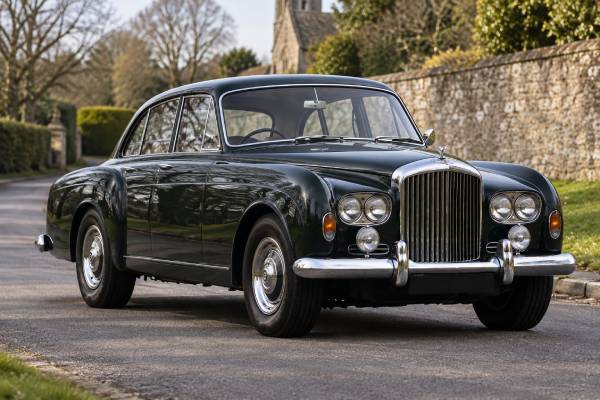
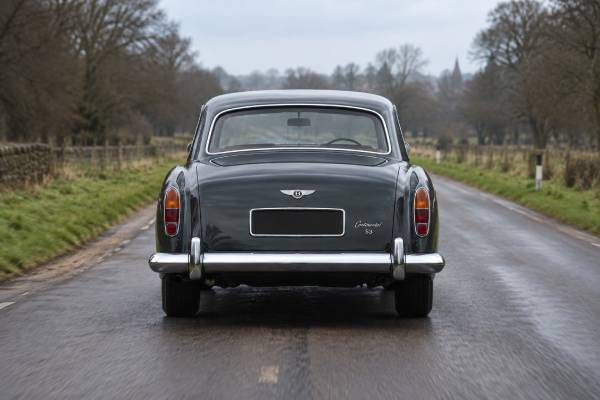
The S3 Continental Flying Spur was the final development of Bentley’s separate-chassis, coachbuilt Continental sedan. It combined the smooth 6.23-liter V8 introduced with the S2 with higher compression, revised breathing, stronger performance, four-headlamp styling, and small cabin improvements. An S3 that holds oil pressure, controls temperature, shifts cleanly, tracks straight, and has structurally sound coachwork will outperform a tired example regardless of the number in an advertisement. Buyers must also identify exactly what they are viewing: H.J. Mulliner, Mulliner Park Ward, and James Young produced related four-door bodies, and “Flying Spur” is sometimes applied too broadly. This guide focuses on the 1962–1965 four-door Continental Flying Spur concept with the 6.2-liter V8 and 215 hp.
Table of Contents
- The Final Coachbuilt S-Series Continental
- S3 Continental Flying Spur Specifications
- Performance, Braking, and Touring Balance
- How to Identify the Body and Its Authenticity
- Service Needs and Common Failure Points
- Restoration Quality and Cost Control
- Buying Verdict and Ownership Fit
The Final Coachbuilt S-Series Continental
The S3 was an evolution rather than a clean-sheet replacement. Bentley retained the S2’s V8, automatic transmission, separate frame, live rear axle, and drum brakes, then improved performance and updated the styling before the monocoque T-Series arrived.
The most visible change was the four-headlamp front. On standard S3 saloons the radiator shell became shorter, the lamps moved into paired units, and the front bodywork looked lower and wider. Coachbuilt Continentals received their own interpretations, so an S3 Flying Spur should not be authenticated by headlamps alone. Some S2 cars were later converted to an S3-style nose, sometimes by Bentley and sometimes elsewhere.
Mechanical changes were subtle but useful. Higher-octane fuel was more widely available, allowing a raised compression ratio and stronger output. Maximum output was approximately 215 bhp. Rear-passenger space and front-seat arrangements were improved, and the S3 preserved the quiet, torque-rich character that defined the S2.
The model also sits at an important historical boundary. The later Bentley T-Series used unitary construction, independent rear suspension, disc brakes, and hydraulic systems shared with the Rolls-Royce Silver Shadow. The S3 therefore represents the last opportunity to own a traditional Bentley with a separate chassis and bespoke coachwork while still benefiting from V8 power, automatic transmission, and power steering.
Rarity statements require care. Production counts can refer to all S3 Continentals, a particular body design, one coachbuilder, one steering position, or a specific wheelbase. A seller’s “one of only” claim should be tied to a recognized chassis register or factory document. The car’s body number and design should correspond to the build sheet, and any conversion should be disclosed.
S3 Continental Flying Spur Specifications
The S3 Continental Flying Spur is an ICE luxury sports saloon with front-mounted V8 power, rear-wheel drive, a four-speed automatic, and coachbuilt bodywork on a separate frame. Exact dimensions and weights can differ by coachbuilder and equipment, so the tables use representative values and clearly identified ranges.
| Specification | Value | Notes |
|---|---|---|
| Engine family | Bentley L-Series V8 | Early naturally aspirated aluminium version |
| Layout | 90-degree V8, overhead valves | Five-bearing crankshaft in period specification |
| Displacement | 6,230 cc (6.2 L) | Traditionally described as 6¼ liters |
| Fuel system | Twin SU carburettors | Correct needles and synchronization are essential |
| Maximum power | Approximately 215 bhp (160 kW) at 4,000 rpm | |
| Fuel | Petrol | Ignition and compression must suit available octane |
| Specification | Value |
|---|---|
| Transmission | Four-speed automatic |
| Driven wheels | Rear-wheel drive |
| Steering | Power-assisted cam-and-roller system |
| Service brakes | Four-wheel servo-assisted drums |
| Parking brake | Mechanical rear-wheel system |
| Specification | Value | Configuration |
|---|---|---|
| Frame | Steel box-section, cross-braced chassis | Body mounted separately |
| Front suspension | Independent wishbones and coil springs | Lever-arm dampers |
| Rear suspension | Live axle and semi-elliptic leaf springs | Period telescopic or lever-arm control by specification |
| Ride control | Electrically adjustable damping | Switch, wiring, and dampers must all function |
| Tires | 15-inch period-profile fitment | Use approved load and speed ratings |
| Specification | Typical value | Notes |
|---|---|---|
| Body style | Four-door Continental sports saloon | Coachbuilder and design number must be verified |
| Wheelbase | About 3,124 mm (123 in) | Standard Continental chassis |
| Length | Approximately 5,380 mm (212 in) | Body design affects exact value |
| Kerb weight | Roughly 2,000–2,100 kg (4,409–4,630 lb) | Equipment and body construction vary |
| Seating | Four or five | Rear console and bespoke cabinetry may alter capacity |
| Measure | Typical figure | Interpretation |
|---|---|---|
| Top speed | About 115–120 mph (185–193 km/h) | Coachwork, gearing, and condition affect results |
| 0–60 mph | Approximately 10–11 seconds | Period test methods and specifications differ |
| Best use | Fast, sustained touring | Not repeated maximum-effort acceleration or braking |
Performance, Braking, and Touring Balance
The S3’s performance advantage is felt in flexibility and cruising reserve, not in a modern sports-sedan launch. A healthy car gathers speed with little noise, settles into a long-legged gait, and carries four adults without feeling strained.
Throttle response depends on tune. Twin carburettors must open together, ignition advance must work through its range, and the cooling system must keep combustion temperatures stable. A flat spot, hesitation after a hot soak, or black exhaust under ordinary acceleration points to a service need. The engine should deliver torque without requiring full throttle.
The automatic transmission is central to the car’s character. Check engagement from cold and hot, part-throttle upshifts, kickdown, and behavior on a descending grade. Slipping, delayed reverse, contaminated fluid, or severe leaks can lead to a specialist rebuild. Because the unit is linked to the brake servo drive on these cars, noises or problems around the transmission area deserve knowledgeable diagnosis rather than assumption.
Power steering should be light at low speed and stable on the open road. Do not accept wandering as normal. Radial tires, incorrect pressures, worn kingpins or joints, wheel-bearing play, chassis alignment, and steering-box condition all influence directional control. The large wheel should move the car progressively without a loose band around center.
Braking is the limiting system when the car is driven hard. The drums are large and servo-assisted, but heat remains in the assembly and can change friction. The correct approach is to brake early, use the gearbox on long descents, and allow cooling between heavy applications. A properly adjusted car should stop straight from normal road speed; pulling, grabbing, vibration, or a sinking pedal requires immediate attention.
Ride quality should be calm rather than floaty. A single rise and settle after a bump is acceptable. Continuing oscillation indicates weak damping. If the electrical ride-control switch makes no difference, inspect the wiring and damper mechanism rather than leaving the system permanently in one position.
At night, the four-headlamp arrangement improves illumination potential, but old reflectors, corroded grounds, voltage drop, and aged wiring can erase that advantage. Upgraded bulbs should not exceed the capacity of the original switches and harness without relays and proper fusing.
How to Identify the Body and Its Authenticity
Body identification must begin with records and stamped numbers. The terms S3 Continental, Flying Spur, H.J. Mulliner, Mulliner Park Ward, and James Young describe related but not identical cars.
By the S3 era, Rolls-Royce had acquired H.J. Mulliner and combined it with Park Ward. Some four-door bodies continued earlier Flying Spur themes, while James Young offered a visually similar six-light saloon that auction catalogs may call a Flying Spur for convenience. A buyer should record the coachbuilder plate, body number, design number, chassis number, engine number, and original order details.
The four-headlamp nose is not conclusive. Period owners sometimes updated S2 cars, and damaged fronts were occasionally rebuilt in later style. Look for documentation, panel construction, wiring, lamp bowls, radiator-shell proportions, trim holes, and body numbers. A well-executed historic factory conversion can be interesting, but it should not be represented as an original S3 chassis.
Examine the body in bright, low-angle light. Aluminium corrosion often appears as pimples, raised seams, or paint lifting. Steel framework and fasteners can rust behind sound-looking panels. Typical inspection areas include:
- lower door skins and door frames;
- sill covers and body mounts;
- wheel-arch lips and rear quarters;
- windscreen, rear-window, and gutter seams;
- boot floor edges and spare-wheel area;
- bonnet edges, hinge points, and latch panels;
- lamp apertures and repaired front corners.
Door operation reveals structure. Each door should open without scraping and close without lifting. Compare gaps on level ground. A change after the chassis is jacked correctly may show body-mount or structural movement. Heavy doors can also wear hinges, but hinge repair should not be used to disguise a distorted opening.
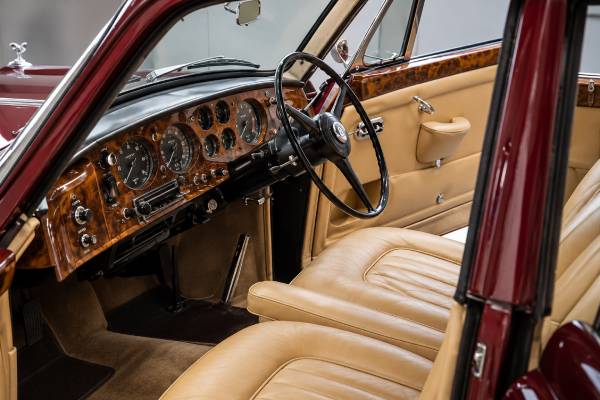
Inside, compare leather pattern, veneer, instruments, switches, picnic fittings, rear cabinets, radios, and air-conditioning parts with factory records. Bespoke bar compartments and refrigerated units appeared on some cars, but later additions should be disclosed. Missing original fittings can be costly to reproduce and may affect historic value.
Brightwork should fit the body rather than forcing panel alignment. Rechroming can soften detail or remove markings. Complete, restorable original trim is often preferable to highly polished reproduction pieces that do not match the contours.
Service Needs and Common Failure Points
Preventive cooling, lubrication, brake, and fuel-system work gives the greatest return. An S3 rarely becomes unreliable because it is inherently fragile; it becomes unreliable when long storage and partial repairs allow several small faults to overlap.
The aluminium V8 needs correct coolant chemistry. Plain water, mixed coolant types, and neglected changes promote internal corrosion. Pressure-test the system, verify thermostat operation, inspect the radiator core and pump, and confirm that heater and air-conditioning loads do not trigger overheating. Infrared temperature comparison across the radiator can reveal blocked sections, but it does not replace flow testing.
Hot oil pressure is a key health indicator. Verify the dashboard reading with a calibrated mechanical gauge. Low pressure can come from a sender or instrument fault, but also from bearing clearance, pump wear, an incorrect filter arrangement, excessive oil temperature, or unsuitable viscosity. Diagnose before choosing a thicker oil.
Fuel problems are common after storage. Tanks can shed debris, flexible lines can harden, carburettor floats can stick, and modern fuel can evaporate. Check for leakage with the pump running and again after heat soak. A fuel smell in the cabin or boot is never acceptable.
The braking system must be serviced as a complete assembly. Wheel cylinders, master cylinder, flexible hoses, hard lines, servo, drums, shoes, adjusters, bearings, and transmission-driven assistance interact. Fluid renewal alone cannot fix corroded bores or swollen hoses.
Electrical faults often come from grounds and added accessories. Inspect battery cables, regulator output, generator condition, fuse protection, bulkhead connections, lamp grounds, and any air-conditioning conversion. High-current fans and compressors should use relays and properly sized cables.
The chassis has many lubrication points. Missing one can accelerate wear in steering or suspension joints. Follow the period lubrication chart, not a modern “oil and filter only” service. Grease should appear at the intended outlet without damaging seals.
A practical annual routine includes a cold start, road test to full temperature, underbody inspection, brake heat comparison, fluid sampling, battery test, tire-age check, cooling pressure test, and operation of every electrical accessory. Record readings so gradual changes become visible.
Restoration Quality and Cost Control
A low purchase price does not make a restoration economical. The cost of metal shaping, woodwork, trim, chrome, and specialist mechanical labor can exceed the finished value unless the car has exceptional history or personal importance.
Separate cosmetic, mechanical, and structural needs. Faded paint on a sound body may be usable for years. Fresh paint over electrolytic corrosion may require immediate disassembly. Likewise, an engine that leaks lightly but holds pressure may be serviceable, while a quiet engine with low hot pressure can require major work.
Ask for detailed invoices. A proper engine rebuild record should show measurements, machining, bearings, pistons, valve work, pump inspection, cooling-passage cleaning, and balancing where performed. A transmission invoice should identify internal work, not merely seals and fluid. A body invoice should describe stripping, corrosion repair, metal isolation, fitting, priming, and finishing.
Avoid commissioning every improvement at once. First make the car safe, stable in temperature, and dependable. Then correct drivability and water leaks. Cosmetic work should follow after the structure and mechanical systems are proven. This order prevents a new interior from being damaged by leaking glass or a new paint finish from being disturbed during chassis work.
Storage conditions have financial consequences. A dry, ventilated building with battery management and pest control is cheaper than repairing mold, seized brakes, corroded contacts, and damaged upholstery. Do not place a cover over a damp car or park on a moisture-trapping surface.
Keep original parts removed during upgrades. Label them with the chassis number and the date. Reversible electronic ignition, hidden relays, improved cooling, and seat belts may improve use, but the next owner should understand exactly what changed.
Buying Verdict and Ownership Fit
An S3 Continental Flying Spur is for the buyer who wants the most developed traditional S-Series Bentley, including V8 torque, power steering, automatic transmission, and striking late-period styling. It is not automatically better than an S1 or S2; its appeal depends on taste and the individual car.
The four-headlamp face divides opinion. Some prefer the purity of the S1 and S2, while others value the improved lighting and more assertive appearance. That difference can influence market demand, but condition and provenance remain more important than styling preference.
Choose an S3 when you intend to tour and want easier traffic manners than a six-cylinder Bentley. Four doors and a spacious rear compartment make it useful for passengers, events, and hotel arrivals. Its performance is adequate for modern traffic as long as the driver respects drum brakes, tire technology, and the absence of contemporary crash protection.
Walk away from unclear identity, severe body corrosion, missing coachbuilt trim, chronic overheating, low verified oil pressure, slipping transmission, or a restoration that has no supporting records. These are not small bargaining points. They can change the entire economics of ownership.
A good car should come with a coherent file, a specialist report, stable mechanical readings, and evidence of recent use. It should start cold, idle cleanly, reach operating temperature without distress, restart hot, stop straight, and return from the road test without new leaks or odors.
Owned thoughtfully, the S3 provides an experience that ended with it: a fast, formal, hand-built Bentley on a separate chassis. That combination of old construction and mature V8 power is precisely what makes the model desirable—and what makes expert inspection non-negotiable.
Late-production details and the cost of visual correctness
S3 buyers often focus on the four-headlamp front, but late-production correctness extends through hundreds of smaller details. Grille treatment, sidelamps, wheel covers, bumpers, rear lamps, badges, dashboard hardware, steering wheel, switchgear, seat pleating, carpets, and ventilation outlets can differ by body style, market, and build period. Compare the individual car with its coachbuilder and chassis records rather than a restoration guide based on a single example.
The distinctive nose is expensive to correct after poor accident repair. Sight along the wings, measure symmetry around all four lamps, inspect mounting bowls and wiring, and compare grille-to-bonnet alignment. Chrome that appears acceptable in photographs may reveal thin plating, sanding waves, or pitting at close range. Reproduced pieces can solve availability problems but may have different profiles or mounting points, affecting panel fit.
Interior restoration has a similar compound effect. Replacing one damaged veneer section can require matching grain, color, and aged lacquer throughout the cabin. New leather must harmonize with retained door panels and headlining. An owner may choose full replacement for visual consistency, but that decision removes original material and should be documented. Price an S3 according to the cost of reaching the standard you actually want; small visual compromises are inexpensive only when you are willing to keep them.
Because the S3 was the final development before the Silver Shadow and T-series era, a mechanically and cosmetically coherent Flying Spur represents the endpoint of separate-chassis postwar Bentley design. That historical position rewards accurate preservation more than indiscriminate modernization.
Insurance valuation should list the exact coachwork and restoration standard, not merely “Bentley S3.” Agreed-value photographs should document the body number, special trim, engine bay, underside, tools, and major invoices. In a claim, that detail helps prevent a rare Flying Spur from being treated like a standard saloon with interchangeable panels and interior parts.
A prospective custodian should ask who can maintain the car after purchase. Identify a nearby specialist, machine shop, radiator service, trimmer, and chrome restorer before a failure. Rare-car ownership becomes far less disruptive when suppliers already understand the exact coachwork and mechanical specification. Keep copies of drawings, parts cross-references, and previous measurements with the car rather than in one restorer’s private files.
Coachbuilt geometry after restoration
Panel alignment should be judged with the car settled at normal ride height, doors fully latched, and the body free of temporary workshop supports. On a coachbuilt S3, attractive paint can conceal a shell that was repaired without preserving aperture geometry. Compare door gaps from hinge to latch, inspect how the window frames meet the seals, and watch for fresh stress marks where aluminum skins meet their supporting structure. Poor geometry can create wind noise, water entry, cracked finishes, and recurring latch adjustment.
References
- BENTLEY NEWSROOM : 1963 S3 176FGH 2026 (Heritage Collection)
- Photo credit: Jay Hirsch | Christie’s 2002
- 1963 Bentley S3 Continental Flying Spur | Gooding Christie’s 2026
- BENTLEY S3 CONTINENTAL 2003
- 1965 BENTLEY S3 CONTINENTAL FLYING SPUR 1995
- 1962 BENTLEY S3 CONTINENTAL DROPHEAD COUPE, COACHWORK BY H.J. MULLINER, PARK WARD | Christie’s 1998
Disclaimer
This article is for informational purposes and does not replace professional diagnosis, restoration, or repair. Specifications, torque values, intervals, fluids, and procedures differ by chassis, market, coachbuilder, and equipment; verify them against the individual car’s factory records and official service documentation.
Share this guide on Facebook, X/Twitter, or a Bentley owners’ group when it can help another enthusiast research an S3.