
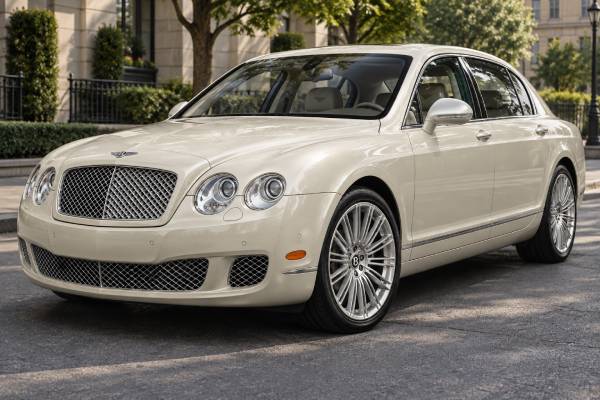
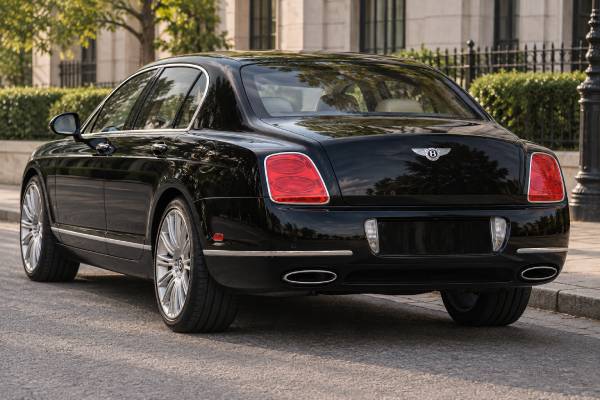
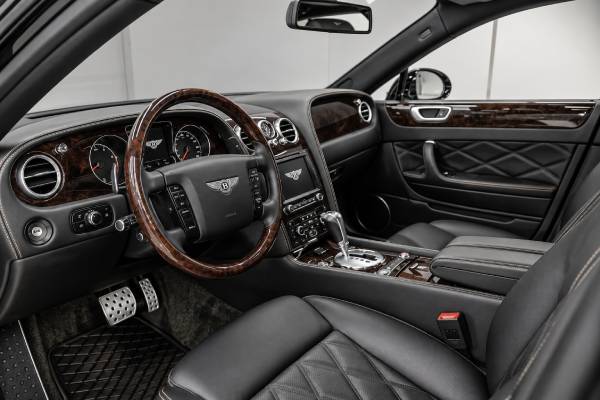
The 2008–2012 Continental Flying Spur Speed took Bentley’s already extraordinary four-door W12 and sharpened nearly every dynamic edge. Output rose to 600 hp, torque increased to 750 Nm, the claimed maximum speed reached 200 mph, and revised suspension, steering, exhaust, wheels, tires, and electronic calibration gave the large sedan a more urgent personality. Those changes also make the Speed more demanding as a used purchase. Its performance depends on every supporting system being healthy: boost control, cooling, ignition, transmission, all-wheel drive, air suspension, brakes, tires, and voltage supply. A neglected example can still look magnificent while accumulating repair needs worth a substantial portion of its purchase price. This guide explains what separates a genuine 3W2 Speed from the standard 552 hp Flying Spur, how the car should behave, which age-related problems deserve priority, and how to inspect one without mistaking badges, low mileage, or recent detailing for evidence of sound maintenance.
Table of Contents
- What Made the First Flying Spur Speed Different
- Specifications, Dimensions, and Performance Data
- How a Two-Ton Sedan Reached 200 mph
- Age-Sensitive W12 and Chassis Systems
- Maintenance Priorities for a Speed
- Authenticating and Inspecting a Used Car
- Ownership Costs, Suitability, and Final Decision
What Made the First Flying Spur Speed Different
The first-generation Flying Spur Speed was a factory performance derivative, not a cosmetic package. Bentley increased W12 output, recalibrated the transmission and chassis, lowered the ride height, fitted more assertive exhaust tuning, and gave the car model-specific visual details.
The most important distinction is mechanical. The standard Continental Flying Spur produced approximately 552 hp and 650 Nm, while the Speed was rated at 600 hp and 750 Nm. Bentley achieved the increase through engine-management and boost changes rather than a different basic engine family. The six-speed automatic and permanent all-wheel-drive system remained, but their calibrations had to manage a stronger midrange and more aggressive throttle response.
The suspension sat approximately 10 mm lower and used firmer settings. Steering response was made more direct, stability-control programming allowed a more sporting attitude, and 20-inch multi-spoke Speed wheels carried high-performance tires. Darkened grilles, larger exhaust outlets, discreet Speed badging, drilled alloy pedals, and diamond-quilted or otherwise performance-themed cabin details helped identify the model. Equipment varied by market and individual specification, so no single trim feature should be treated as conclusive proof.
A Speed is not automatically the better car for every owner. The standard Flying Spur rides more gently on imperfect roads, can be less sensitive to tire condition, and offers almost the same real-world pace at legal speeds. The Speed’s appeal is the improbable combination of rear-seat luxury and sustained high-speed ability. Buyers should pay for that character only when the car remains mechanically coherent.
Production-year boundaries can be confusing because registration dates, model years, and facelift timing do not always align. Verify the vehicle identification number, option codes, original sales documentation, and factory build data. A standard car with Speed wheels and badges is still a standard car, and an authentic Speed with missing original parts may deserve a lower value.
Specifications, Dimensions, and Performance Data
The 3W2 Speed is a gasoline-only internal-combustion vehicle. It combines a 5,998 cc twin-turbo W12, six-speed torque-converter automatic, permanent all-wheel drive, electronically controlled air suspension, and large ventilated brakes.
| Item | Specification | Buyer relevance |
|---|---|---|
| Engine | 5,998 cc twin-turbocharged W12 | Compact four-bank layout, 48 valves |
| Maximum power | 600 hp (about 610 PS / 449 kW) | Factory Speed calibration |
| Maximum torque | 750 Nm (553 lb-ft) | Strong low- and midrange load on driveline |
| Transmission | ZF six-speed automatic | Torque converter, manual selection available |
| Drive | Permanent all-wheel drive | Torsen-type center differential |
| Fuel | Premium unleaded gasoline | Use market-specified minimum octane |
| Measure | Published figure | Conditions |
|---|---|---|
| 0–60 mph | Approximately 4.5 seconds | Launch figure varies by market convention |
| 0–100 km/h | Approximately 4.8 seconds | Healthy drivetrain and suitable surface |
| Top speed | 322 km/h (200 mph) | Correct tires, closed course, proper conditions |
| Power increase over standard car | About 48 hp | Compared with common 552 hp rating |
| Torque increase over standard car | 100 Nm | Especially noticeable during overtaking |
| Item | Approximate specification |
|---|---|
| Body style | Four-door, four- or five-seat luxury sedan |
| Length | About 5,307 mm (208.9 in), depending on source and trim |
| Wheelbase | 3,065 mm (120.7 in) |
| Kerb weight | Approximately 2,475 kg (5,456 lb), equipment-dependent |
| Suspension | Double-wishbone front, multi-link rear, adaptive air springs |
| Speed ride height | Approximately 10 mm lower than standard |
| Area | Typical factory feature | Verification note |
|---|---|---|
| Exterior | Dark-tint matrix grilles and Speed badging | Easy to retrofit; do not rely on badges alone |
| Wheels | 20-inch multi-spoke Speed design | Check casting, size, finish, and damage |
| Exhaust | Larger oval outlets and sportier calibration | Aftermarket systems may imitate appearance |
| Cabin | Speed instruments, drilled pedals, model-specific trim | Exact combination varies by specification |
| Chassis | Lower, firmer suspension calibration | Confirm through build data and road behavior |
| Measurement | Why it matters |
|---|---|
| Tire brand, model, date, and tread depth at all four corners | Rolling-circumference mismatch can burden the AWD system |
| Cold and warm ride height at each wheel | Reveals leakage, calibration, or worn struts |
| Brake disc thickness and runout | Heavy cars can consume or distort brakes quickly |
| Battery voltage, load test, and sleep current | Low voltage creates cascading electronic faults |
| Cooling-system pressure retention | Small leaks become serious under sustained boost |
How a Two-Ton Sedan Reached 200 mph
The Speed’s headline was 200 mph, but the engineering achievement was its ability to remain composed while accelerating a very heavy, luxurious body through dense air. Power alone was insufficient; cooling, aerodynamics, tire capability, suspension control, and braking all had to work together.
The W12’s unusual architecture keeps twelve cylinders within a relatively short engine bay. Two turbochargers generate a wide torque plateau, so the car does not need frantic engine speed to gain speed. In normal driving the sensation is a continuous surge rather than a dramatic step in boost. A healthy car should pull cleanly from low rpm and intensify without hesitation. Surging, misfire, or a sharp loss of power is not characteristic.
The six-speed automatic uses its torque converter for smooth departures, then locks strategically to reduce slip and heat. At high load, transmission-fluid temperature and cooling matter. A gearbox that behaves well during a five-minute demonstration may develop harsh shifts or flare once fully warm. A proper evaluation therefore includes urban creep, moderate acceleration, kickdown, steady cruising, and repeated hot engagements of drive and reverse.
Permanent all-wheel drive gives the Speed excellent launch traction. It also ties the condition of all four tires to driveline health. A pair of new rear tires combined with worn fronts may look economical but can create a persistent circumference difference. The correct response is a matched set with similar wear, not electronic adaptation or repeated differential-fluid changes.
The lowered air suspension reduces body movement, but it does not transform the car into a lightweight sports sedan. The best examples flow through fast bends with stable, measured responses. A car that crashes over small ridges, wanders, or follows road grooves may have incorrect tires, excessive wheel size, poor alignment, tired control arms, worn dampers, or damaged wheels. “They all drive like that” is not an acceptable explanation.
Brake energy rises dramatically with speed and mass. Even when the car is never driven near its maximum, repeated motorway deceleration can expose worn discs, seized caliper hardware, old fluid, or poor-quality pads. The pedal should be firm and consistent. Steering-wheel shake, pulsing, pulling, or a soft pedal demands investigation.
The 200 mph rating should never be treated as an invitation to test an old car on public roads. It is useful as evidence of the original engineering envelope. A buyer should instead look for stable temperatures, clean full-load acceleration within legal limits, straight braking, balanced tires, and absence of vibration.
Age-Sensitive W12 and Chassis Systems
Age, heat, vehicle mass, and complexity create the main used-car risks. Mileage matters, but storage conditions, trip pattern, previous repairs, and battery health can matter just as much.
Vacuum, boost, ignition, and crankcase control
The W12 uses many hoses, valves, seals, sensors, and ignition components. Heat hardens rubber and plastic, while oil vapor contaminates some passages. Symptoms include rough idle, inconsistent boost, whistling, fuel-trim faults, misfire under load, smoke, or increased oil consumption. A scan should include misfire counters and fuel corrections, not only active warning lights.
Spark plugs and ignition coils are service items with high labor implications because access is crowded. Replacing one coil without evaluating plug age and the remaining bank can lead to repeated visits. Parts should be correct for the engine code, and repairs should be documented by cylinder position.
Cooling and heat management
A twin-turbo W12 generates substantial heat in a tightly packaged front end. Radiators, condensers, intercoolers, fans, pumps, hoses, pipe connections, and expansion tanks all deserve inspection. Debris trapped between heat exchangers can reduce airflow without being visible from the front grille. Coolant odor after a drive, dried residue, unexplained top-ups, or fans running excessively are warning signs.
An overheating history is more serious than a minor external leak. Ask why the coolant was changed, what parts were replaced, whether the system was pressure-tested, and whether the correct bleeding procedure was used. Mixed coolant or stop-leak products can create larger future problems.
Air suspension and front-axle wear
Air struts can leak internally or externally, valve blocks can stick, level sensors can fail, and compressors can wear from compensating for small leaks. Park the car on level ground, record each corner’s height, and recheck after several hours or overnight. A corner that falls is evidence, even if the system raises it immediately after start-up.
The front suspension carries significant mass. Control-arm bushes, ball joints, tie rods, mounts, and wheel bearings can produce knocks, steering shimmy, irregular wear, or vague tracking. Replacing isolated parts without a complete geometry check often leaves the car only partly improved.
Electrical networks and water ingress
The Flying Spur has numerous control modules, powered seats, rear convenience features, keyless entry, infotainment, navigation, telephones, climate zones, blinds, and parking systems. Low battery voltage creates implausible combinations of warnings. Both battery condition and parasitic draw must be measured after the vehicle has fully entered sleep mode.
Blocked drains, failed seals, or previous body repair can allow moisture into carpets, the trunk, connectors, or modules. Lift floor panels and inspect for staining, corrosion, musty odor, or recently replaced trim. Electronic faults that return after rain are particularly suspicious.
Maintenance Priorities for a Speed
A Speed should be maintained as a 200 mph-capable system even when it is driven gently. That means time-based fluid care, thorough inspections, correct tires, diagnostic records, and preventive attention to heat and voltage.
Start unknown ownership with a baseline rather than a superficial oil service. Record a complete module scan, engine operating data, battery tests, coolant pressure, air-conditioning performance, ride heights, brake measurements, wheel condition, tire ages, fluid leaks, and underside corrosion. Photograph the condition so later changes are obvious.
Use only the engine-oil specification approved for the exact model and market. Check the level according to Bentley’s procedure, because an incorrect reading can lead to overfill or underfill. Oil analysis can be useful when establishing a trend, but one sample cannot certify an engine.
Transmission and final-drive fluids should not be ignored simply because an early schedule used “lifetime” terminology. Inspection for leaks, correct fill level, adaptation behavior, and contamination is prudent. Any service must use the exact fluid, filter, seals, temperature window, and filling method. A generic power flush is not an appropriate substitute.
Cooling service includes more than draining the expansion tank. Confirm coolant compatibility, clean the heat-exchanger stack, inspect fans and auxiliary pumps, pressure-test the system, and verify stable temperature under load. Replace brittle hoses and seals on evidence, not by pouring sealant into the system.
Brake fluid should be renewed by time. Inspect disc thickness, pad wear sensors, caliper boots, hoses, hard lines, parking-brake operation, and wheel-bolt condition. Speed wheels are costly to replace; inspect inner barrels for cracks and previous welds, and use a road-force balance when vibration persists.
Tires should be premium products in the correct sizes, ratings, and Bentley-approved specification where applicable. Replace as a set when circumference mismatch would be significant. Old tires with deep tread are not suitable for the car’s speed and weight.
A quality battery maintainer is valuable during storage, but it is not a cure for weak batteries or excessive draw. Exercise the car fully: bring all fluids to operating temperature, use the climate system, move seats and blinds, cycle suspension modes, and apply the brakes enough to prevent corrosion. Repeated short starts in a garage are worse than leaving the car undisturbed.
Keep invoices that identify part numbers, software work, measured values, and technician findings. A binder showing progressive preventive maintenance is worth more than a stamp book with no detail.
Authenticating and Inspecting a Used Car
Authentication and mechanical inspection should occur together. A genuine Speed with poor history is not a good purchase, while a well-kept standard car wearing Speed accessories should be priced honestly as a standard car.
Obtain factory build information from the VIN and compare it with the engine output, instrument graphics, wheel specification, trim, badges, suspension coding, and original sales documents. Check for non-factory engine software. A tuned W12 may be faster, but it complicates diagnosis, emissions compliance, insurance, and evidence of how the drivetrain was used.
Inspect the body in strong diffuse light. Look for panel-edge masking, inconsistent metallic flake, overspray, disturbed fasteners, mismatched glass dates, and incorrect gaps. A large Bentley can be repaired well, but poor aluminium and steel refinishing is expensive to reverse. Verify operation of soft-close doors, windows, sunroof, trunk, hood release, and exterior lighting.
A specialist pre-purchase examination should include:
- a cold start after the car has sat long enough to reveal leakage and battery condition;
- a full factory-capable diagnostic scan before any codes are cleared;
- misfire, fuel-trim, boost, temperature, and transmission data under controlled load;
- cooling-system pressure and combustion-gas checks where symptoms justify them;
- ride-height retention and compressor-run assessment;
- inspection of control arms, wheel bearings, driveshafts, boots, and undertrays;
- brake thickness, tire circumference, wheel runout, and alignment evidence;
- operation of every seat, heater, ventilation fan, blind, display, camera, key, and audio channel;
- a VIN-specific recall and campaign check through an authorized source.
During the road test, do not begin with full throttle. Listen at low speed over alternating bumps, feel for driveline clunk during take-up, and confirm smooth steering assistance. When temperatures are stable, apply progressive load and watch for hesitation or warnings. Cruise at several speeds to expose wheel and propeller-shaft vibration. Brake firmly on a safe straight road and note pedal consistency.
Afterward, let the car heat-soak, restart it, smell for coolant or fuel, inspect for fresh leaks, and compare wheel temperatures without touching hot components. Repeat a scan. Intermittent faults may appear only after load or restart.
A seller who refuses a specialist inspection, presents recently cleared readiness monitors, cannot explain mixed tires, or dismisses repeated suspension warnings should be treated cautiously. The Speed is too complex for a purchase based on appearance alone.
Ownership Costs, Suitability, and Final Decision
The first Flying Spur Speed suits an owner who values rarity, discreet styling, immense all-weather pace, and a hand-finished cabin—and who maintains a substantial repair reserve. It is unsuitable for anyone shopping only by depreciation-adjusted purchase price.
Routine expenses are significant before faults occur. Premium fuel consumption is high, 20-inch performance tires are costly, brakes are large, insurance can reflect the performance rating, and specialist labor is required for many procedures. Storage, secure parking, battery care, and periodic long drives are part of ownership rather than optional extras.
Choose condition before mileage. A 70,000-mile example used regularly and serviced by knowledgeable specialists may be safer than a 20,000-mile car that sat on old tires, weak batteries, stale fluids, and leaking air struts. Look for evidence that expensive jobs were completed correctly, not merely a list of parts a seller claims are “common.”
Price immediate needs before negotiating. Four tires, front and rear brakes, control arms, batteries, suspension repairs, cooling work, and a major ignition service can combine rapidly. A purchase makes sense when the price plus documented near-term work remains acceptable, not when the buyer hopes every warning is a sensor.
Compared with the standard 552 hp car, the Speed offers stronger overtaking, a firmer chassis, distinct identity, and the symbolic 200 mph figure. It also gives up some ride suppleness and may have led a harder life. The right decision depends on whether those differences are central to the experience you want.
Walk away from overheating history without proof of correction, persistent misfires, gearbox flare, structural damage, water-soaked electronics, air suspension that cannot hold level, mismatched tires, extensive undocumented tuning, or a dashboard full of recently erased faults. There will be another car; there may not be another inexpensive repair.
A properly sorted Speed remains remarkable. Its performance is no longer shocking only in a straight line; what endures is the way it combines huge reserves with silence, four real seats, fine materials, and winter traction. Buy the maintenance record as carefully as the badge, and the car can still deliver the grand-touring authority its name promised.
References
- BENTLEY NEWSROOM : 2005 Flying Spur 2026 (Heritage Collection)
- BENTLEY NEWSROOM : Flying Spur 2026 (Manufacturer Archive)
- Vehicle Detail Search – 2008 Bentley Continental Flying Spur | NHTSA 2026 (Recall Database)
- May 15, 2008 2008 (Recall Acknowledgment)
- Technical product information 2016 (Manufacturer Communication)
- Search Safety Issues | NHTSA 2026 (VIN Recall Search)
Disclaimer
This guide is general information, not a diagnostic procedure or substitute for a Bentley-qualified technician. Specifications, service operations, fluids, software, recalls, and part compatibility can differ by VIN, market, equipment, and build date; confirm them in current official documentation before work or purchase.
Share this article on Facebook, X/Twitter, or a Bentley enthusiast forum when it can help another buyer evaluate a Flying Spur Speed realistically.