

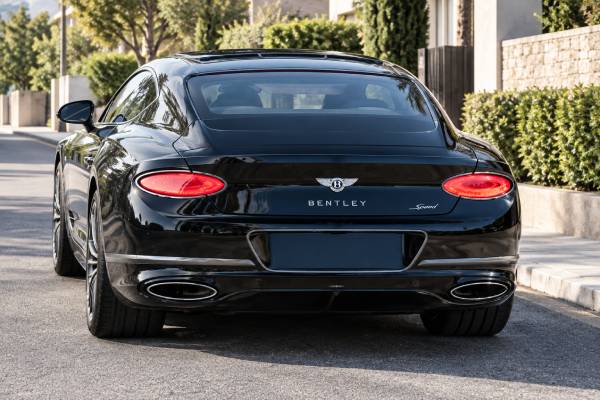
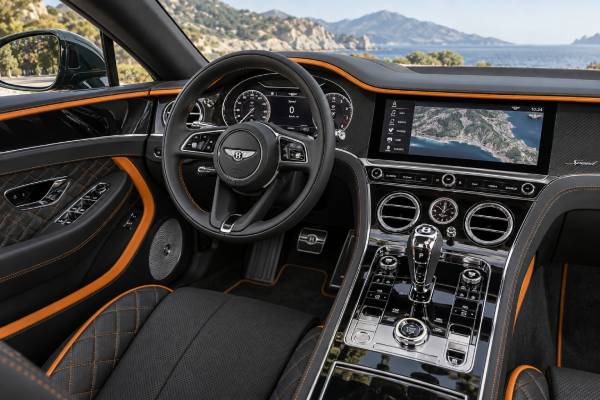
The 2021–2024 Bentley Continental GT Speed is the final series-production W12 coupé and the first Speed whose chassis changes matter more than its modest power increase. Output rises to 650 hp with 900 Nm, but all-wheel steering, an electronic rear differential, recalibrated active all-wheel drive and 48-volt Dynamic Ride make the 3S3 feel more agile and adjustable than the regular W12. It reaches 60 mph in 3.5 seconds and 208 mph, yet repeated launches tell little about condition. Rear-steer accuracy, eLSD behavior, 22-inch tire wear, optional carbon-ceramic brakes, software history and DCT response are the expensive questions. The strongest cars change direction cleanly without tramlining, brake without deposit vibration and deploy torque without rear-axle noise. Because the W12 is no longer produced, provenance will increasingly influence value, but documented use and correct service remain preferable to decorative rarity on a neglected car.
Table of Contents
- The Speed became more than an engine upgrade
- Specifications for the final-series W12 GT Speed
- All-wheel steering, eLSD and the change in cornering attitude
- Brakes, tires and the limits of a very heavy performance car
- Maintaining the last high-volume W12 flagship
- What to test during a serious pre-purchase drive
- The case for buying now—and the configurations to seek
The Speed became more than an engine upgrade
The 2021 GT Speed changed the meaning of the badge by adding chassis systems that alter how the car turns, not just how fast it accelerates. The W12 gained 24 PS over the standard third-generation car, but the decisive additions were all-wheel steering, an electronically controlled rear differential and new stability calibration. Together they give the driver more authority over a large, front-engined coupé.
At low speed, the rear wheels steer opposite the fronts, reducing the apparent wheelbase and helping the 3S3 maneuver. At higher speed, they steer in the same direction to improve stability. The transition should be invisible. A warning, steering offset or scrub during a tight turn suggests calibration, alignment or hardware trouble rather than an accepted characteristic.
The electronic limited-slip differential controls torque across the rear axle. Under power, it can support rotation and traction instead of relying only on brake intervention. Its contribution is most obvious when the driver accelerates out of a bend. The car should feel planted and progressive, with no grinding, binding or sudden intervention.
Active all-wheel drive remains part of the safety net, while 48-volt Bentley Dynamic Ride resists roll. The Speed can therefore feel more neutral than its mass suggests. It is still a 2.3-tonne grand tourer, so physics remains present in tire and brake load. The engineering reduces delay and excess motion; it does not create a lightweight sports car.
The final W12 status adds historical importance. Bentley ended W12 production in 2024, making these late Speeds the last regular coupés of their type. That fact may support long-term desirability, but it should not persuade a buyer to accept missing service, modified software or damaged 22-inch wheels.
The correct perspective is to buy the chassis, not the headline. A standard W12 can provide similar straight-line force and luxury. The Speed earns its premium when rear steering, eLSD, brakes, tires and active roll control are all healthy enough to deliver the sharper response Bentley intended.
Specifications for the final-series W12 GT Speed
The final-series W12 GT Speed is identified as much by rear steering and its electronic rear differential as by the 659 PS engine rating. The data below therefore places output beside the chassis systems, 22-inch forged wheels and fixed-roof dimensions. It excludes the earlier 633 hp 393 Speed and the later hybrid Z23. Model-year equipment can differ, so brake type and optional content need VIN-level confirmation.
| Item | Specification |
|---|---|
| Powertrain class | Gasoline internal-combustion engine (ICE) |
| Engine | 6.0L twin-turbo W12 TSI |
| Maximum output | 650 hp (659 PS; 485 kW) |
| Maximum torque | 900 Nm (664 lb-ft) |
| Transmission | 8-speed dual-clutch transmission with Speed calibration |
| Driven wheels | active all-wheel drive with electronic rear limited-slip differential |
| Fuel tank | 90 L (23.8 US gal) |
| Measure | Value | Context |
|---|---|---|
| 0–60 mph | 3.5 seconds | Manufacturer claim |
| 0–100 km/h | 3.6 seconds | Manufacturer claim |
| Maximum speed | 208 mph (335 km/h) | Factory limit or announced target |
| Combined fuel consumption | official fuel and CO₂ figures depend on market, wheel and model year | Period European or WLTP figure |
| CO₂ emissions | market-specific; verify the exact homologation record | Market and equipment can change result |
| Dimension or capacity | Value |
|---|---|
| Body style | two-door, four-seat performance coupé |
| Length | 4,850 mm (190.9 in) |
| Width | 1,954 mm (76.9 in), excluding mirrors |
| Height | about 1,405 mm (55.3 in) |
| Wheelbase | 2,851 mm (112.2 in) |
| Kerb weight | about 2,273 kg (5,011 lb) kerb, depending on equipment |
| Luggage capacity | 358 L (12.6 cu ft) |
| Component | Factory specification |
|---|---|
| Suspension and active systems | three-chamber air springs, adaptive damping, 48-volt Dynamic Ride, all-wheel steering and eLSD |
| Brake system | 420/380 mm iron brakes standard; 440 mm front carbon-ceramic system optional |
| Factory wheel context | 22-inch forged Speed wheels |
| Steering/stability distinction | all-wheel steering and Bentley’s first electronic rear differential transformed the Speed from a faster trim into the most agile W12 Continental GT |
| Area | Detail |
|---|---|
| Roof/body structure | fixed coupé body |
| Fuel capacity | 90 L (23.8 US gal) |
| Seating | Four seats |
| Primary buyer verification | Match wheel, brake, chassis and market equipment to the VIN build record |
Only a modest power increase separates this Speed from the regular W12 on paper; rear steering, eLSD and Speed calibration create the more meaningful distinction. Those systems make alignment history and four matching tires part of the technical specification, not merely maintenance details. Confirm brake choice and option content against the original factory build.
All-wheel steering, eLSD and the change in cornering attitude
All-wheel steering changes the first phase of a corner. The front axle responds while the rear helps rotate the body, reducing the moment when a conventional heavy GT seems to wait before taking a set. The driver should use that agility smoothly; a sudden steering input still transfers substantial load to the outer tires.
A straight-road check is essential. The steering wheel should sit centered, and the car should track consistently after the systems complete their start-up checks. Rear-steer alignment requires the correct equipment and procedure. A normal front-only alignment may leave the vehicle feeling nervous or create rapid tire wear.
The eLSD shapes corner exit. With the car balanced and throttle added progressively, torque should build without inside-wheel spin or abrupt stability intervention. A rear-axle hum, clunk during load reversal or fault message needs specialist diagnosis. Fluid history and software status should be reviewed before assuming mechanical failure.
Drive modes change the relationship among throttle, transmission, damping, active roll and stability control. Test the same bend or rough section in more than one mode. Sport should feel more immediate and allow greater rotation, but it should not introduce a new vibration or steering pull. A mode that produces no change may indicate a dormant system.
The dual-clutch gearbox supports the chassis by shifting faster in Sport and holding the W12 in its power band. It should still creep and reverse without repeated shudder. During the road test, include a hill start, gentle automatic shifts, manual paddle commands and a hot restart. Note any symptom with gear and temperature.
Tire condition determines whether the active systems feel sophisticated or confused. Four 22-inch tires must match in model, age and wear. Inner shoulders can disappear while the outer tread looks acceptable. Measure all four and inspect wheel barrels for cracks or flat spots.
A well-set Speed communicates a clear sequence: steering input, body set, rear-axle support and acceleration. When alignment, tires or electronic systems are wrong, that sequence becomes delayed or abrupt. The chassis technology is valuable precisely because its correct operation can be felt, not merely listed.
Brakes, tires and the limits of a very heavy performance car
The Speed’s performance envelope places extraordinary demand on consumables. Standard iron brakes use large 420 mm front and 380 mm rear discs, while the optional carbon-ceramic package increases front-disc diameter to 440 mm. Identify which system is fitted before estimating ownership cost; caliper color or an advertisement is not enough.
Iron discs should be measured for thickness, runout and pad deposits. A vibration may come from uneven transfer layers rather than a visibly warped disc. Carbon ceramics require inspection for chips, surface condition and wear by the approved method. Wheel removal history matters because careless contact can damage an expensive disc edge.
Pedal response should remain stable through several stops. Begin gently, then increase load after the tires and brakes are warm. The car should track straight, with no steering shake or change in travel. Brake fluid remains time-sensitive on both systems, and old fluid can undermine confidence even when discs and pads appear healthy.
The 22-inch forged Speed wheels reduce mass relative to some cast designs but provide little sidewall protection. View each inner barrel, check for welds and record runout. Repeated refinishing may make the face attractive while concealing structural repair. A road-speed vibration in a narrow band often points toward wheel or tire condition.
Tires should carry the correct load and speed ratings. Age is critical because a W12 Speed can overwhelm hardened rubber in wet conditions long before tread reaches the legal limit. Matching tread depth also protects active AWD and differential behavior. Replacing only one damaged tire may not be the economical solution if the other three are substantially worn.
Mass sets the ultimate limit. All-wheel steering and active roll control make the car agile, but every braking or cornering event still loads more than two tonnes. Repeated hard use raises tire and brake temperature quickly. A driver should allow cooling and monitor pressure rather than assuming advanced systems remove the need for mechanical sympathy.
Underbody and cooling condition support the same performance. Check ducts, liners and fasteners after any front-end repair. Missing airflow guides can affect brakes or heat exchangers. The Speed remains composed only when its consumables and airflow hardware are maintained to the same standard as the electronics.
Maintaining the last high-volume W12 flagship
Maintaining the final W12 Speed means preserving a discontinued engine without treating it as untouchable. Regular use, correct oil and early leak diagnosis are healthier than repeated short starts followed by storage. Build a detailed service timeline and retain invoices that identify fluids, parts, software updates and measured brake or tire condition.
The W12 uses dense twin-turbo packaging and several cooling paths. Inspect hose unions, pumps, reservoirs, radiators and undertrays for residue. Pressure-test any loss and clean heat exchangers carefully. A high-output engine can remain reliable, but its thermal margin depends on every connection and fan functioning correctly.
Oil level should be recorded between services using the handbook procedure. An unexplained trend may come from leakage, consumption or an incorrect previous fill. Do not overfill in the hope of increasing protection. Investigate persistent odor or smoke while evidence is fresh.
The DCT and eLSD require correct service information. Review adaptation and software history, then discuss fluids by VIN, age and use. Cars subjected to frequent launch control or track driving deserve closer examination. Generic flushing, additives or undocumented tuning introduce uncertainty.
Rear steering and 48-volt Dynamic Ride should be scanned as distinct systems. Measure alignment on all relevant axes, compare ride heights and check stored events. A weak 12-volt battery can disturb communication and create misleading warnings, so electrical supply testing belongs early in diagnosis.
Tire and brake records should be quantitative. Note tread at multiple points, production dates, wheel runout, disc measurements and pad thickness. The optional ceramic system needs specialist knowledge; the standard iron setup still requires careful cooling and fluid service.
A useful yearly program is:
- Engine oil and complete leak survey.
- Cooling pressure test and heat-exchanger inspection.
- Battery load test plus all-module scan.
- DCT, eLSD, rear-steer and 48-volt data review.
- Measured brakes, wheels, tires and alignment.
- Underbody, aero and active-system inspection.
- Full-temperature road test with the results saved.
As W12 parts and expertise become more valuable, continuity with an informed workshop will matter. A technician who can compare current data with last year’s report protects the car more effectively than a sequence of unrelated repairs.
What to test during a serious pre-purchase drive
A serious drive should last long enough to test parking behavior, chassis calibration, sustained temperature and high-torque response. Begin with the car genuinely cold. Observe start-up warnings, idle quality and how quickly the electrical systems settle. Do not let the seller precondition the car unless that condition is disclosed.
First use slow maneuvers. Reverse on level ground, turn at full lock and climb a mild incline. All-wheel steering should make the car easy to place without tire scrub or warning messages. The DCT may communicate clutch engagement, but it should not repeatedly judder or delay.
Next establish a steady cruise. Check steering center, road-speed vibration and cylinder-deactivation smoothness. Vary the surface and note whether a noise follows wheel speed, body movement or engine load. Test Comfort and Sport on the same road to confirm the dampers and active roll system alter behavior.
On a suitable bend, use measured steering and moderate throttle. The rear axle should support rotation cleanly. Do not attempt to provoke the eLSD on public roads; the objective is to detect noise, instability or inconsistent intervention. A specialist can interpret the system more safely with data.
Brake progressively from several speeds. The pedal should remain firm and the wheel should not shake. After stopping, compare heat at each corner without touching components. One unusually hot wheel can indicate drag or unequal work.
Only after full warm-up should the W12 be asked for strong legal acceleration. Power should arrive continuously, the DCT should choose ratios decisively and no warning should appear. Follow with a calm cruise, then a hot restart.
The inspection order should include:
- Before-and-after diagnostic scans with software status
- Rear-steer operation and four-wheel alignment evidence
- eLSD behavior, fluid history and rear-axle noise
- DCT creep, shift quality and launch-use history
- 48-volt Dynamic Ride and air-suspension function
- Exact brake system, disc/pad condition and fluid age
- Four matching 22-inch tires and undamaged wheels
- W12 cooling pressure, oil leakage and hot restart
A seller who restricts temperature, speed or diagnostic testing prevents the buyer from evaluating the systems that justify the Speed premium. Walk away rather than substituting optimism for evidence.
The case for buying now—and the configurations to seek
The case for buying now rests on the car’s position as the final regular W12 GT Speed. Production has ended, yet the model remains modern enough for daily use and benefits from the mature third-generation cabin. That combination may support desirability, but purchase timing should still follow the quality of the available example rather than fear of missing out.
Seek complete mechanical specification first. Rear steering, eLSD and 48-volt Dynamic Ride are inherent to the Speed story; confirm their function. Decide between iron and carbon-ceramic brakes according to intended use and budget. Ceramics offer exceptional capability and lower unsprung mass, while iron discs may be easier for a road-focused owner to plan around.
Color, Blackline details, Mulliner content and audio can distinguish two strong cars. They should not outrank tire age, wheel condition or software history. A rare configuration with mixed tires and recurring chassis warnings is not automatically collectible.
Mileage can be positive when it represents long journeys and annual care. Inspect wear for consistency and ask about periods of storage. A very low-mileage car may need tires, battery, fluids and brake recommissioning immediately. Price that work rather than treating the odometer as proof of perfection.
Consider alternatives. The regular W12 GT delivers similar refinement at lower cost but lacks the rear-steer/eLSD character. A fourth-generation hybrid Speed is much more powerful and can drive electrically, yet it is heavier and fundamentally different. The 2017 Supersports is rarer and more collectible, but older and more dependent on unique carbon hardware.
Hold a reserve after purchase for a four-tire set, alignment, battery, baseline fluids or small electronic correction. The Speed is an expensive car to neglect and a rewarding car to maintain. A buyer who uses the entire budget on acquisition may turn a minor issue into deferred deterioration.
The strongest configuration is ultimately the one that can be driven as intended. It should steer accurately, rotate progressively, brake repeatedly and deliver full W12 torque without drama. When those traits are documented, the 650 hp GT Speed is more than the last of an engine line—it is the most dynamically complete production W12 Continental coupé.
References
- Bentley News 2021 : THE MOST DYNAMIC BENTLEY ROAD CAR IN HISTORY: THE NEW CONTINENTAL GT SPEED 2021 (Official Model/Technical Source)
- Bentley News 2021 : CONTINENTAL GT SPEED CONVERTIBLE BREAKS COVER FOR SPRING 2021 (Official Model/Technical Source)
- Bentley News 2024 : End of an era as final Bentley W12 engine hand-built in Crewe 2024 (Official Model/Technical Source)
- The New Continental GT and Continental GT Convertible 2020 (Official Model/Technical Source)
- Technical Service Bulletin 2076639/2 2025 (Recall/Service Source)
- Check for Recalls: Vehicle, Car Seat, Tire, Equipment | NHTSA 2026 (Recall/Service Source)
Disclaimer
This article offers general information rather than professional diagnosis or repair guidance. Specifications, torque values, service intervals and procedures may vary by VIN, market and equipment; use official Bentley service documentation for the specific car before maintenance or parts decisions.
If the guide was useful, please share it on Facebook, X/Twitter or with another W12 enthusiast to support our work.