

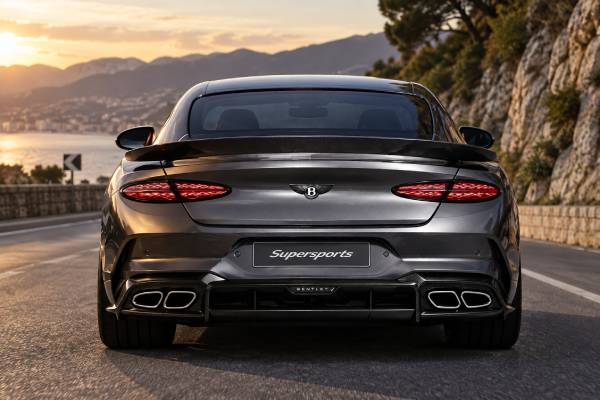
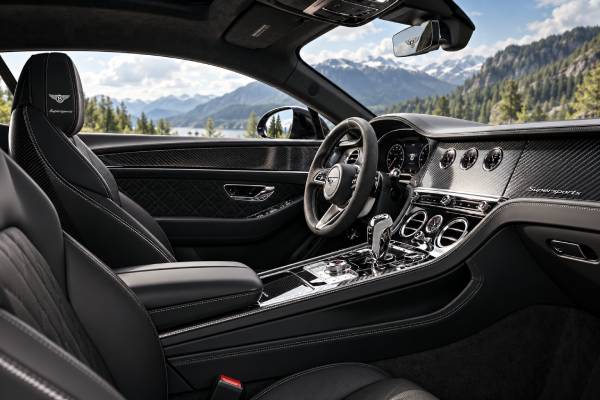
The 2026 Bentley Continental Supersports is a deliberate rejection of the heavier hybrid formula. Bentley announced a 657 hp non-hybrid 4.0-litre V8, rear-wheel drive, two seats, standard carbon-ceramic brakes, extensive carbon aero and a target weight below 2,000 kg. The company also quoted 0–100 km/h in 3.6 seconds, a 199 mph maximum and up to 1.3 g of lateral acceleration. Production is scheduled to begin in the fourth quarter of 2026, with first deliveries planned for early 2027, and all 500 numbered cars were reported sold out before customer production. That timing changes the buying guide. Final homologated figures, market eligibility, allocation authenticity, contract transfer and delivery condition matter more than used-car wear today. The car’s importance lies not in out-powering the hybrid Speed, but in removing mass and front-drive hardware to create the first rear-wheel-drive Continental GT of the modern era.
Table of Contents
- The most radical modern Continental is not a hybrid
- Confirmed Supersports data—and what remains provisional
- Rear-wheel drive, lower mass and the new V8
- Aerodynamics, carbon brakes and a 1.3 g target
- Limited production, allocation and real delivery timing
- Ownership planning before the first customer cars arrive
- Buying outlook for a sold-out 500-car series
The most radical modern Continental is not a hybrid
The fourth-generation Continental GT arrived as a plug-in hybrid, making the Supersports decision unusually bold. Instead of increasing the 771 hp Speed’s system output, Bentley removed the traction battery, electric motor, front-driven hardware and rear seats. The resulting concept targets less than two tonnes and sends all 657 hp to the rear wheels.
That output is lower than the hybrid flagship’s, yet power-to-weight response and steering behavior are different questions from peak horsepower. A lighter car asks less of its tires and brakes during every change of direction. Rear-wheel drive also separates propulsion from the front axle, allowing the steering to communicate without simultaneously managing driven torque.
Bentley describes the 4.0-litre twin-turbo V8 as non-hybrid and pairs it with an eight-speed dual-clutch transmission. Maximum torque is 800 Nm. The specification creates a simpler energy path than the Speed’s combined system, though the car remains electronically sophisticated through its eLSD, stability modes, adaptive chassis and active aero development.
The two-seat cabin is not a symbolic rear-seat delete. A carbon-fibre rear tub replaces the bench and includes storage suitable for helmets. New sports seats sit lower, and carbon veneer, leather and Dinamica reinforce the functional brief. Buyers expecting the usual occasional four-seat flexibility must accept that Supersports has chosen purpose over family use.
Exterior changes are similarly functional. A large front splitter, dive planes, revised side features, rear diffuser and fixed rear wing produce a much more assertive profile than the core GT. These parts contribute to aerodynamic balance rather than serving as a cosmetic package. Their ground clearance and replacement cost will influence how the car can be used.
The model revives a name with a century of performance history, but the modern significance is immediate: Bentley has never previously sold a rear-wheel-drive Continental GT from this era. That makes it more than a limited appearance edition. It is an experiment in what remains when the platform’s grand-touring mass and all-weather priorities are deliberately reduced.
Its radical nature should not be confused with simplicity. Carbon-ceramic brakes, bespoke forged wheels, model-specific tires, carbon body components and low-volume calibration create new ownership obligations. The Supersports removes one layer of hybrid complexity while concentrating cost in specialized performance hardware.
For collectors, the formula is easy to summarize. For drivers, its value will depend on execution: steering clarity, brake modulation, traction control, thermal consistency and the quality of final production calibration. Until customer cars are delivered, those elements should be described as announced engineering intent rather than established long-term experience.
Confirmed Supersports data—and what remains provisional
The Supersports figures below remain announced pre-production data as of July 25, 2026. They describe a 666 PS non-hybrid V8, rear-wheel drive, two seats and a sub-two-tonne target rather than a delivered customer-car measurement. Where Bentley has not published final production dimensions, fuel capacity or EU27 consumption, the tables say so instead of borrowing values from the hybrid GT. Final homologation documents should replace provisional entries once issued.
| Item | Specification |
|---|---|
| Powertrain class | Gasoline internal-combustion engine (ICE) |
| Engine | 4.0L twin-turbo V8 |
| Maximum output | 657 hp (666 PS; 490 kW) |
| Maximum torque | 800 Nm (590 lb-ft) |
| Transmission | 8-speed dual-clutch transmission |
| Driven wheels | rear-wheel drive with an electronic limited-slip differential |
| Fuel tank | production-market fuel capacity should be verified when final homologation data is issued |
| Measure | Value | Context |
|---|---|---|
| 0–60 mph | about 3.5 seconds under Bentley’s stated performance-tire condition | Manufacturer claim |
| 0–100 km/h | 3.6 seconds | Manufacturer claim |
| Maximum speed | 199 mph (320 km/h) | Factory limit or announced target |
| Dimension or capacity | Value |
|---|---|
| Body style | two-door, two-seat rear-wheel-drive performance coupé |
| Length | approximately 4,895 mm (192.7 in), based on the current Continental architecture |
| Width | approximately 1,966 mm (77.4 in), excluding mirrors |
| Height | model-specific production dimensions pending final market documentation |
| Wheelbase | 2,851 mm (112.2 in) platform wheelbase |
| Kerb weight | below 2,000 kg (4,409 lb) gross vehicle target as stated by Bentley |
| Luggage capacity | rear seats replaced by a carbon rear tub with helmet storage |
| Component | Factory specification |
|---|---|
| Suspension and active systems | rear-drive chassis with revised steering, eLSD, performance stability modes and extensive aerodynamic development |
| Brake system | carbon-ceramic brakes standard |
| Factory wheel context | 22-inch lightweight forged wheels developed with Manthey Racing |
| Steering/stability distinction | limited to 500 numbered cars, non-hybrid, two-seat, rear-wheel drive and capable of up to 1.3 g lateral acceleration; production starts Q4 2026 with first deliveries planned for early 2027 |
| Area | Detail |
|---|---|
| Roof/body structure | fixed coupé body with extensive carbon-fibre aero components |
| Fuel capacity | production-market fuel capacity should be verified when final homologation data is issued |
| Seating | Two seats |
| Primary buyer verification | Match wheel, brake, chassis and market equipment to the VIN build record |
The published package points toward agility rather than an output contest with the hybrid Speed. Rear drive, the carbon brake system and Manthey-developed forged wheels are central to that intent, while final production weight and homologation remain pending. Allocation buyers should rely on signed Bentley documentation until customer cars provide measured, repeatable evidence.
Rear-wheel drive, lower mass and the new V8
Rear-wheel drive changes the Continental’s fundamental torque path. Earlier modern GTs used all-wheel drive to deploy large outputs in poor weather and stabilize acceleration. The Supersports asks the rear axle to carry the full 800 Nm, managed by an electronic limited-slip differential and revised control software. That choice favors adjustability and driver involvement over maximum all-condition launch security.
Bentley’s announced 0–100 km/h time is 3.6 seconds, with approximately 3.5 seconds to 60 mph under the stated performance-tire condition. A hybrid Speed is quicker in a straight launch. The Supersports case begins after that comparison, where lower mass, steering purity and reduced inertia can influence braking and direction changes.
Removing hybrid hardware is only part of the weight program. The rear seats are deleted, lightweight sports seats are fitted, carbon components replace heavier pieces and 22-inch forged wheels were developed with Manthey Racing. Bentley states a weight below 2,000 kg, but final market documentation should be used before quoting an exact production kerb figure.
The V8’s 666 PS is calibrated for the rear-drive chassis. Output alone does not reveal throttle mapping, turbo response, cooling margin or exhaust character. Pre-production demonstrations can show intent, while customer testing across temperatures and fuels will establish repeatability. Buyers should avoid treating promotional drifting by the specially modified FULL SEND car as proof that every production control strategy is identical; that film car received changes for the shoot.
The eight-speed DCT must handle both calm road use and rapid track shifts. Final owners should assess low-speed clutch take-up as carefully as full-load changes. A performance calibration can feel direct without being harsh. Repeated judder, delayed reverse engagement or a fault after heat soak should be documented rather than labeled a normal consequence of the model.
The eLSD is central. It can distribute torque between the rear wheels, support rotation and control inside-wheel spin. Fluid, cooling and software requirements should be followed from the first service. Owners planning circuit use should record temperatures, tire condition and any intervention rather than repeatedly performing laps until a warning appears.
Rear drive also changes winter expectations. The model-specific performance tires and high torque may not suit cold or snowy conditions, and market-approved winter fitments may be limited initially. Buyers should obtain Bentley guidance before improvising another wheel or tire combination. The car’s absence of front drive is a defining feature, not a fault to be compensated for with unsuitable rubber.
Lower mass benefits every maneuver but does not turn the Supersports into a small sports car. It remains based on a substantial luxury coupé. The engineering achievement is relative: removing hundreds of kilograms and changing axle responsibility enough to give the Continental a new attitude without abandoning refinement entirely.
Aerodynamics, carbon brakes and a 1.3 g target
Bentley’s claim of up to 1.3 g lateral acceleration places the focus on cornering rather than top-speed supremacy. That figure depends on tire, surface, temperature, alignment and aerodynamic load. It is a controlled-test result, not a promise that every road or track session will reproduce the same number.
The body package is designed to manage front and rear lift as well as create downforce. The front splitter and dive planes influence the nose; side elements control flow around the body; the diffuser and fixed rear wing stabilize the tail. A damaged or incorrectly installed component can affect balance, so repair quality matters beyond appearance.
Carbon exterior pieces should be inspected under strong, angled light. Look for cracks at mounting points, clouding, edge chips and distortion around fasteners. A clear-coat blemish may be cosmetic, while a fracture through the laminate requires specialist assessment. Replacement supply for a 500-car series may be slow and expensive.
Ground clearance creates another risk. Photograph the splitter before delivery and after transport. Confirm loading procedures with the dealer and transporter. A car can acquire underside damage before its owner drives it, especially when ramps, wheel straps or lift points are used without model-specific care.
Standard carbon-ceramic brakes reduce unsprung mass and provide high thermal capability. They are not maintenance-free. Discs must be inspected using the approved criteria, including surface condition, edge damage and any required weight or wear assessment. Pads, fluid and cooling ducts remain consumable or service items.
Brake bedding should follow Bentley instructions. An owner should not copy a generic procedure from another carbon system. Incorrect high-temperature use early in life can compromise transfer layers or create vibration. Track users need a warm-up and cool-down routine that respects both brakes and tires.
The lightweight forged wheels are part of the lateral-performance package. Check inner barrels, mounting faces and runout after any impact. Refinishing must not remove identification or alter critical surfaces. Model-specific tire development means replacing a damaged tire with a visually similar generic product could change steering and balance.
Alignment becomes a performance and preservation tool. Record factory delivery settings, then measure after any curb strike or track event. Inner-shoulder wear can progress without being visible from outside. Pressure should be set for the actual use and corrected after tires cool, not judged only when hot.
The 199 mph maximum still demands aerodynamic stability, although it is below the hybrid Speed’s 208 mph. No public-road test is necessary to validate ownership. Proper panel fit, undamaged aero, correct tires and closed-course professional checks are the appropriate evidence.
The 1.3 g headline is therefore a systems claim. Aero, wheel mass, tire construction, suspension, eLSD, steering and brakes must remain in specification together. Owners who preserve only the visible carbon while neglecting geometry or tire age will retain the appearance of the package but not its intended performance.
Limited production, allocation and real delivery timing
Bentley limited the new Supersports to 500 individually numbered cars. By January 22, 2026, the company described the series as sold out and said all 500 units were reserved. Production is scheduled to begin in the fourth quarter of 2026, with first deliveries at the start of 2027. As of July 25, 2026, customer production therefore remains a future event.
That calendar matters because “2026 model” can be mistaken for “already delivered.” A legitimate allocation should be supported by dealer and Bentley documentation showing customer, market, specification stage, deposit, contract terms and expected sequence. A social-media post or claimed build number is not proof that a transferable car exists.
Market eligibility is restricted. Bentley listed the United Kingdom, EU27 plus Switzerland and Turkey, the United States, Canada, Australia, New Zealand, Malaysia, Japan, Oman, Bahrain, the United Arab Emirates, Qatar and Kuwait. Registration elsewhere may involve homologation obstacles, tax or the absence of warranty support.
Contract transfer deserves legal review. Some manufacturers or dealers restrict assignment, resale before delivery or export. The original customer may not possess an unrestricted right to sell the slot. A buyer paying a premium for an allocation should understand whether Bentley will recognize the change and whose name appears on the final order.
Specification timing creates another distinction. An early reservation may have a chosen number or preliminary configuration while paint, livery and Mulliner details remain open. Bentley announced a broad palette, multiple livery themes and extensive personalization. Confirm which choices are locked, which can still change and what additional cost is not included in the advertised premium.
Build number should not be confused with production order or delivery date. A requested plaque number may not determine when the car leaves Crewe. Transport, market preparation and local certification can create a gap between factory completion and customer handover.
Payment should follow verified milestones. Escrow, dealer acknowledgment and independent legal advice may be appropriate in a private allocation transaction. Avoid wiring funds based solely on screenshots. Confirm the selling entity, tax treatment and refund conditions if production timing changes.
The car’s public appearances also need context. Bentley’s FULL SEND demonstration vehicle was modified with a hydraulic handbrake and software changes for filming. Its Goodwood activity confirms dynamic development and visibility, not that customer production has begun. Press and prototype cars may differ in trim or calibration.
A realistic timeline protects expectations. During 2026, the key assets are an authenticated reservation and a finalized build. At the start of 2027, attention shifts to transport, pre-delivery inspection and title. Only after customer use will a conventional secondary market with mileage and service history begin to form.
Ownership planning before the first customer cars arrive
An allocated owner can make useful preparations before delivery without pretending to service a car that does not yet exist. The first step is to identify the authorized workshop that will support the vehicle. Low production means not every technician will have immediate familiarity with its carbon body parts, rear-drive calibration or model-specific tire requirements.
Insurance needs an agreed understanding of value and repair method. The policy should cover factory carbon parts, transport to an approved repairer, calibration and any bespoke paint or livery. An ordinary Continental replacement estimate may not reflect Supersports-specific components or waiting time.
Transport instructions should be written. Require appropriate enclosed equipment, soft straps where approved, correct tie-down points and photographs at collection and delivery. The aero and forged wheels are vulnerable during loading. Odometer, tire condition and protective film should be documented before movement.
At handover, do not let ceremony replace inspection. Examine paint under neutral light, carbon weave, splitter edges, wheel barrels, brake discs, glass and interior trim. Verify the individual number, options, accessories, keys, books and digital account. Compare the finished car with the signed specification.
Request the final homologation and technical documents rather than relying on 2025 announcement figures. Confirm tire pressures, fluid levels, software status and any delivery campaigns. Save the pre-delivery diagnostic report. A baseline is particularly valuable for a first-year limited model.
Running-in instructions should come from Bentley for the exact car. Engine, DCT, eLSD, brakes and tires may each have early-life considerations. Avoid a social-media launch session immediately after delivery. Progressive temperature cycles and correct brake bedding protect components whose replacement may be constrained.
Track use should be planned rather than improvised. Check event noise limits, insurance, recovery points, helmet storage and available tire support. Record cold pressures, ambient temperature and session duration. Allow cooling, inspect the car after each event and retain data for future maintenance.
Storage must preserve function, not only appearance. Control humidity, protect tires from long static loads, maintain the 12-volt system and exercise the car according to official guidance. Carbon ceramics can suffer surface issues if washed and parked wet. Fuel and fluids still age.
The owner should also establish a parts record. Photograph part numbers where accessible, keep removed original pieces and document any protective film. Reversible protection is different from undocumented modification. With only 500 cars, originality and repair traceability are likely to influence value strongly.
Buying outlook for a sold-out 500-car series
The immediate market is for contractual positions, not used cars. Premiums may reflect scarcity, but asking prices do not prove completed transactions. A buyer should value the allocation according to verified rights, final specification, taxes and delivery risk rather than comparing only the headline number.
Rarity is genuine: 500 cars, rear-wheel drive, two seats and a non-hybrid V8 create a clear identity. It arrives at a moment when Bentley’s mainstream Continental line is hybrid. Those facts support collector interest, but they do not guarantee that every specification or resale timing will be profitable.
The strongest allocations are transparent. They have a recognized dealer, signed order, clear payment history, confirmed market and documentation of any requested number. The weakest are second- or third-hand claims with no direct Bentley acknowledgment. A large discount cannot compensate for a slot that cannot legally transfer.
Specification may affect liquidity. Historic Bentley colors, restrained carbon presentation or a coherent livery can attract a broad audience. Highly personal combinations may be wonderful for the original owner and narrower on resale. Because Mulliner choice is part of the experience, financial optimization should not eliminate individuality for someone planning long-term ownership.
Future value will depend on use and documentation. A delivery-mile car may appeal to preservation collectors; a carefully tracked car with complete records may appeal to drivers. Damage to unique aero, missing original parts or an undocumented tune will likely carry a disproportionate penalty.
Buyers should also consider liquidity. A 500-car Bentley is rare, but the audience able to purchase and maintain one is small. Selling quickly may require a meaningful price concession. Financing and storage costs continue while waiting for the right buyer.
The best reason to acquire the Supersports is conviction about its engineering direction. It prioritizes rear-drive response, lower mass and a conventional V8 at a time when the rest of the range moves toward electrification. That is a strong historical narrative even if investment returns are uncertain.
As of July 25, 2026, patience remains part of the purchase. Production has not yet reached the announced fourth-quarter start, and first customer deliveries are planned for early 2027. Authenticate the allocation, wait for final production data and inspect the delivered car rigorously. The most expensive mistake would be paying collector money for a promise that the manufacturer or dealer does not recognize.
References
- Bentley News 2025 : Supersports: the most driver-focused Bentley ever 2025 (Official Model/Technical Source)
- Bentley Supersports 2026 (Official Model/Technical Source)
- Bentley News 2026 : Travis Pastrana and Bentley launch the most dynamic film in Bentley history – ‘Supersports: FULL SEND’ 2026 (Official Model/Technical Source)
- Bentley News 2026 : Fourteen Bentleys not to miss at the 2026 Goodwood Festival of Speed 2026 (Official Model/Technical Source)
- Bentley Continental | History and Heritage | Bentley Motors 2026 (Official Model/Technical Source)
- Check for Recalls: Vehicle, Car Seat, Tire, Equipment | NHTSA 2026 (Recall/Service Source)
Disclaimer
This article reflects publicly announced information available through July 25, 2026. Production specifications, homologation, timing, market availability and contract terms may change. It is not legal, investment or repair advice; verify any allocation directly with Bentley, the authorized dealer and qualified advisers before transferring funds.
Please share this guide on Facebook, X/Twitter or with another enthusiast following the new Supersports program.