
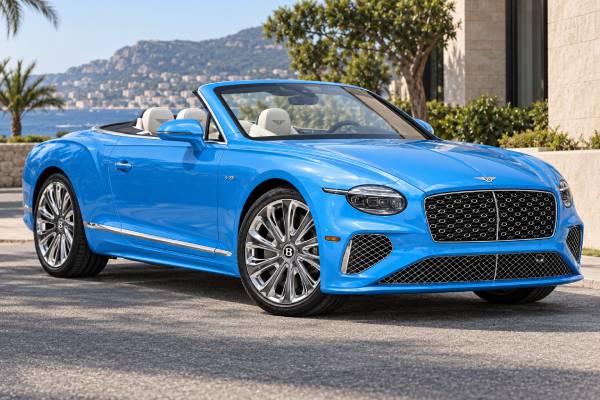
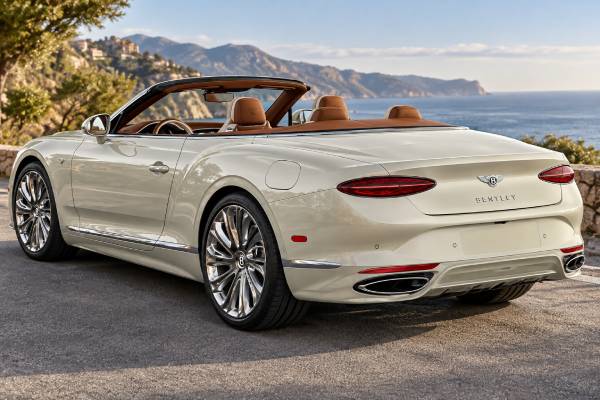
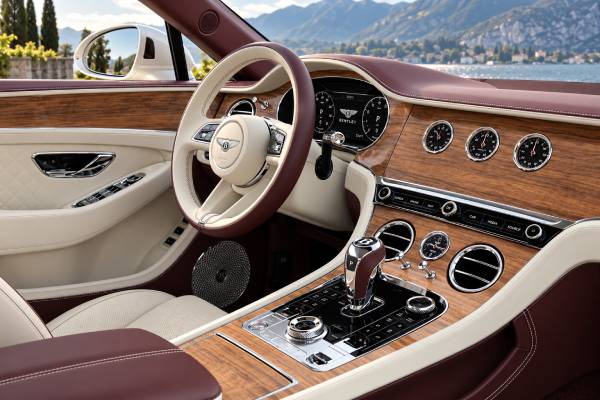
The 2025–present Bentley Continental GTC High Performance Hybrid is a luxury convertible that can leave home with its V8 silent. Its official 671 hp and 930 Nm still provide supercar-level acceleration, while Bentley announced up to 53 miles of electric range for the High Performance Hybrid family. The seven-bow roof opens in 19 seconds, so local electric driving can also be open-air driving. The compromise is packaging: battery, roof and four seats leave limited luggage room, and the car carries several electrical and thermal systems. Home charging, software status, battery warranty and roof adjustment are therefore fundamental ownership topics, not secondary technology. Core, Azure and Speed derivatives must be compared by actual equipment and chassis hardware. A well-chosen core GTC can be the most usable version for daily travel; a poorly specified or rarely charged example may deliver the cost and weight of a PHEV without its most persuasive benefit.
Table of Contents
- The new GTC as an electric-first daily convertible
- Specifications for the 671 hp High Performance Hybrid
- Using EV mode with the roof down
- Long trips, performance reserves and comfort-led tuning
- Charging, servicing and preserving battery usability
- How to compare core, Azure and Speed specifications
- Buying advice for a rapidly evolving luxury PHEV
The new GTC as an electric-first daily convertible
The core GTC is most coherent when the first miles of an ordinary day are electric. Leaving a garage quietly, lowering the roof after the neighborhood and arriving without a cold V8 cycle gives the convertible a use case no previous Continental offered. The petrol engine then becomes a reserve for distance and performance rather than the compulsory beginning of every trip.
That pattern depends on dependable charging where the car is parked. The owner who connects most evenings can use a large share of the announced 53-mile electric capability. The owner relying on occasional public AC posts may see the battery empty often enough that the V8 performs almost every journey. Both cars still move, but only one is being used according to the product’s central idea.
The core derivative is deliberately less aggressive than the GTC Speed. It produces 671 hp rather than 771 hp, reaches 60 mph in 3.8 seconds and is limited to 168 mph. Those figures remain extraordinary for a comfort-oriented four-seat convertible. On public roads, ride quality, roof refinement and predictable brake response will usually matter more than the extra tenth-level acceleration of the flagship.
Standard 21-inch wheels support that daily role. Their additional sidewall can improve compliance and reduce the chance that one pothole bends a costly rim. Larger factory designs may suit the visual brief, but a buyer should experience them on familiar rough roads rather than assuming the most expensive wheel is automatically superior.
Electric running also changes what can be heard. With the V8 stopped, suspension movement, wheel resonance, roof seals and trim noises become more apparent. That quiet is useful during an inspection because it exposes issues combustion sound might mask. It also raises the standard for cabin fit expected from a new luxury car.
The roof remains a major machine within the machine. It must fold into a rear body already occupied by hybrid hardware, while preserving two rear seats and some luggage capacity. The result is only about 134 litres of boot space, so this GTC is better suited to soft bags and planned packing than spontaneous bulky loads.
As a daily convertible, its strengths are situational: secure parking, a wallbox, moderate local mileage and frequent opportunities to lower the roof. When those conditions exist, the car combines near-silent routine travel with effortless long-range ability. Without them, the owner may be better served by a conventional late V8 GTC or the fixed-roof hybrid GT.
Specifications for the 671 hp High Performance Hybrid
This is the technical baseline for the core Z24 GTC High Performance Hybrid. Its 680 PS output, 25.9 kWh battery and 11 kW AC capability sit beside the roof, 134-litre approximate boot and roughly 2.6-tonne body. The combination is more informative than quoting power alone. Azure, Mulliner and regional option packs may change wheels, cabin hardware or assistance features, so use the build record to finish the comparison.
| Item | Specification |
|---|---|
| Powertrain class | Plug-in hybrid (PHEV) |
| Engine | 4.0L twin-turbo V8 plus transmission-mounted electric motor |
| Maximum output | 671 hp (680 PS; 500 kW) |
| Maximum torque | 930 Nm (686 lb-ft) |
| Transmission | 8-speed dual-clutch transmission with integrated electric motor |
| Driven wheels | active all-wheel drive |
| Fuel tank | 80 L (21.1 US gal) |
| Measure | Value | Context |
|---|---|---|
| 0–60 mph | 3.8 seconds | Manufacturer claim |
| 0–100 km/h | 3.9 seconds | Manufacturer claim |
| Maximum speed | 168 mph (270 km/h) | Factory limit or announced target |
| Traction battery | 25.9 kWh gross traction battery | Published gross capacity |
| Official electric range | up to 53 miles (about 85 km) announced for the High Performance Hybrid family | WLTP launch or family figure |
| AC charging | 11 kW AC charging for home and destination use | Supply and temperature affect time |
| Dimension or capacity | Value |
|---|---|
| Body style | two-door, four-seat plug-in-hybrid convertible |
| Length | 4,895 mm (192.7 in) |
| Width | about 1,966 mm (77.4 in), excluding mirrors |
| Height | about 1,392 mm (54.8 in) |
| Wheelbase | 2,851 mm (112.2 in) |
| Kerb weight | roughly 2.6 tonnes, depending on equipment |
| Luggage capacity | about 134 L (4.7 cu ft), market measurement dependent |
| Component | Factory specification |
|---|---|
| Suspension and active systems | two-chamber air springs and dual-valve dampers; active chassis features vary by trim |
| Brake system | high-capacity ventilated iron discs |
| Factory wheel context | 21-inch standard on the core GTC, with multiple larger designs optional |
| Steering/stability distinction | the standard GTC pairs 680 PS with a comfort-led specification and the ability to drive many local journeys with the V8 off |
| Area | Detail |
|---|---|
| Roof/body structure | seven-bow fabric roof, opening or closing in 19 seconds at up to 30 mph (48 km/h) |
| Battery and charging | 25.9 kWh gross traction battery; 11 kW AC charging for home and destination use |
| Seating | Four seats |
| Primary buyer verification | Match wheel, brake, chassis and market equipment to the VIN build record |
This GTC gives up the Speed’s final 100 hp but retains enough performance to make roof integrity, battery usability and tire condition the practical priorities. Its compact boot and considerable mass should be tested against the owner’s real travel needs. Market-specific range, trim content and warranty coverage must be confirmed on the individual paperwork.
Using EV mode with the roof down
Roof-down electric driving is a distinctive experience, but it changes energy use. An open cabin creates more aerodynamic disturbance than the closed body, especially as speed rises. Climate demand can also increase because conditioned air escapes. The displayed range may fall faster than on a roof-up route even when the distance and traffic are similar.
A useful owner test is to compare the same local circuit in three conditions: roof raised with climate control, roof lowered with moderate climate use, and roof lowered with heating or neck warmers active in cool weather. Record energy consumption rather than relying on the starting estimate. The result will show how the car fits the buyer’s actual habits.
The electric motor is integrated with the eight-speed dual-clutch transmission. The GTC therefore changes gears in EV operation instead of using the single-speed behavior familiar from many battery-electric cars. Shifts should be unobtrusive at light load. A repeated flare, thump or delay should be logged with selected mode, gear and battery charge so a technician can reproduce it.
The roof can operate in 19 seconds at speeds up to approximately 30 mph under the stated conditions. For inspection, begin stationary. Watch the header latch, frame movement, rear deck and quarter windows. Both sides should remain synchronized, and the instrument display should confirm completion without requiring a second cycle.
Lowering the roof reveals the wind-management equipment. Check the deflector, neck-level warm air, seat heating, ventilation and microphone performance. A comfort function that works only with the engine running may indicate a fault or an energy-management setting; establish which before purchase.
Electric silence should not be confused with absolute silence. Tire pattern, road surface and airflow remain audible. Listen for a single-corner rumble that changes with speed, a knock over diagonal bumps or a whistle that appears only with the roof raised. Repeat observations in both roof positions to isolate the source.
Regenerative braking can feel different as battery temperature and charge change. On a nearly full battery, the system may have less room to accept recovered energy, so friction braking may contribute sooner. The pedal should still feel consistent. Test gentle stops, firmer stops and the final transition to stationary without traffic pressure.
Avoid using electric mode solely to preserve low engine mileage. The V8 needs proper heat cycles and fresh fuel. Allow it to reach operating temperature on suitable journeys and follow time-based servicing. A PHEV is healthiest when both halves are exercised, not when one is treated as emergency equipment.
Roof-down EV travel works best at local and suburban speeds where the absence of engine vibration can be appreciated. It is not a strategy for maximizing laboratory range. The value lies in the quality of the journey—quiet departure, open air and no need to start the engine for a modest trip.
Long trips, performance reserves and comfort-led tuning
Once the electric portion is used, the GTC continues as a petrol-hybrid grand tourer. The 80-litre fuel tank and twin-turbo V8 remove the need to organize motorway travel around rapid charging. An owner can begin with a full battery, let the control system blend energy and recharge during an overnight stop or an extended destination visit.
The motor remains useful beyond EV range because the system protects a working reserve and can recover energy during deceleration. However, maximum assistance is influenced by battery state and temperature. A fully charged start may feel different from repeated acceleration late in a demanding journey. That is normal within limits; warning messages or severe inconsistency are not.
The 930 Nm system output provides effortless overtaking. Request power progressively after the V8 has warmed. The engine start, clutch engagement and torque blend should form one continuous response. A pause followed by a sharp hit suggests a need to examine software, transmission adaptation or hybrid control rather than accepting it as character.
The core chassis is intended to emphasize comfort. Two-chamber air springs and dual-valve dampers manage body movement without the Speed’s full performance emphasis. On a motorway, the car should settle into long vertical motions rather than float. On a broken secondary road, individual impacts should be rounded rather than transmitted as sharp knocks.
The 168 mph maximum is a calibrated limit for this derivative, not an invitation to modify it. The GTC Speed is faster at the top end and more overtly dynamic. Buyers who care about high-speed track or autobahn performance should select the correct model rather than alter the core car’s software.
Long-trip comfort depends on specification. Test seat support for at least an hour if possible. Ventilation, massage, neck heating, wind deflection, adaptive cruise and premium audio can contribute more to real touring than exterior carbon pieces. Confirm actual option codes because package names and standard equipment vary by market.
Luggage requires discipline. The compact boot must also respect the roof separator. Use soft bags, confirm that the partition is correctly positioned and never defeat an interlock to squeeze in an object. If two people plan extended travel, conduct a packing trial before choosing the convertible over the coupé.
The car’s reserve is broader than its performance figures suggest: it can cruise after the battery display reaches zero, add electrical torque when available and remain comfortable over distance. Its defining success is not a maximum-speed number but arriving after several hours without fatigue, warning messages or the sense that the roof and hybrid systems compromised one another.
Charging, servicing and preserving battery usability
An 11 kW AC wallbox is the most suitable charging partner where the local supply supports it. Lower-power AC still works, but the session length increases. Before installation, a qualified electrician should assess circuit capacity, protection, earthing and cable placement. A luxury car does not make an unsuitable household outlet safe.
At handover, test the supplied cable on a known charger. Confirm that the plug locks, charging begins, the displayed power is plausible and scheduled charging follows the chosen settings. Examine the inlet for damaged seals or pins. Retain session records if the car intermittently stops, because the time and fault code help distinguish vehicle, cable and infrastructure problems.
Battery usability is not represented by the range display alone. The estimate changes with recent consumption and temperature. A specialist assessment should consider diagnostic data permitted by Bentley, charging behavior, thermal-system performance and any stored isolation or cell-related events. Written warranty terms for the VIN are essential, including duration, mileage, transfer and capacity provisions.
The 12-volt battery deserves equal attention. It wakes control modules and enables high-voltage contactors. A weak conventional battery can leave a healthy traction pack inaccessible or create multiple unrelated messages. Load-test it and maintain it according to storage guidance.
Cooling circuits serve the engine, charge air, electric hardware and traction battery. They may use different operating temperatures and procedures. Check each reservoir and connection for residue; do not assume one coolant specification fits all. A warning during charging, reduced power or an unusually long fan run should be diagnosed with live data.
Annual service remains broader than an oil change. The V8 needs oil, filters, ignition and leak inspection even if it runs fewer miles. Brake fluid ages with time, roof drains require inspection, air conditioning must cool effectively, and tires bear substantial mass regardless of propulsion mode.
To preserve useful operation:
- Charge regularly enough that electric mode is used, not merely carried.
- Follow Bentley’s guidance for long-term state of charge and storage.
- Keep the 12-volt supply healthy during inactive periods.
- Run the V8 fully warm at sensible intervals and avoid stale fuel.
- Maintain correct tire pressure to control energy use and wear.
- Keep roof drains, seals and the charging inlet clean and intact.
- Save software, campaign, diagnostic and charging records.
- Investigate repeated derating instead of resetting warnings.
No owner can prevent normal battery aging, and a single range figure should not cause panic. The objective is to preserve charging access, thermal control and balanced use so the available capacity remains useful. Documentation will also matter when later buyers compare early examples.
How to compare core, Azure and Speed specifications
The range uses one body shape to serve different priorities. The core High Performance Hybrid is the reference point: 680 PS, comfort-led chassis tuning and standard 21-inch wheels. Azure adds a well-being and touring emphasis, while the Speed uses the 782 PS Ultra Performance Hybrid system and a more performance-focused active chassis. Market equipment and option packages can alter the details.
Begin comparison with the powertrain label and output, not exterior cues. A core or Azure car should not be advertised as a Speed because it has black trim or large wheels. Obtain the build sheet and check the VIN against official model information. Replacement badges are inexpensive; chassis hardware is not.
Next compare the equipment that affects every journey. Seat design, Touring Specification, audio, wind deflector, neck warmers, driver assistance and wheel size may matter more in a GTC than maximum output. Azure can be attractive when its comfort features match the intended use, but do not assume every Azure has every available assistance option.
The Speed should be chosen for its additional power and dynamic systems, not because it is the highest-priced line. Its 177 mph limit, eLSD, rear steering and performance calibration create a different driving character. It may also bring higher tire and brake exposure. A driver using the car mainly for calm coastal routes may prefer the core model’s balance.
Brake specification must be verified directly. Carbon-ceramic systems can be desirable for repeated high-load use and reduced unsprung mass, yet replacement cost is substantial. Iron discs are fully appropriate for road touring. Inspect whichever system is fitted using the correct method.
Wheel and trim packages are easy to see; software and market content are not. Confirm adaptive systems, connected services and app functionality during the inspection. Some services require subscriptions or depend on network availability. Determine what transfers with the car and what expires.
For used examples, compare like with like. A heavily optioned core GTC may cost more than a lightly configured Azure, while a discounted Speed may need tires or software work. Normalize the comparison by adding immediate maintenance, charging equipment and missing accessories to the purchase price.
The right derivative is the one whose standard philosophy matches the owner. Core emphasizes value within an extravagant category, Azure prioritizes comfort presentation, and Speed prioritizes dynamic authority. Options can refine those roles but should not be used to pretend one model is another.
Buying advice for a rapidly evolving luxury PHEV
A rapidly changing model cycle creates both opportunity and uncertainty. New software, additional trims and revised standard equipment can make an early car depreciate quickly, while that same depreciation may produce an attractive purchase. The buyer needs to separate normal market movement from a discount caused by an unresolved technical issue.
Inspect identity and history before condition. Record the VIN, build date, first-registration date and exact derivative. Request the original order, campaign record and software invoices. Ask whether the car served as a demonstrator, press vehicle or executive loan car, and how frequently it was charged.
Arrange the inspection with a full traction battery and a cold engine. Connect to AC, verify input power and then drive electrically. Operate the roof twice, test all quarter windows and search for moisture. Only after those checks should the V8 be brought into the evaluation and warmed for stronger acceleration.
Scan all control modules before and after the road test. Intermittent faults may not illuminate a lamp during a short drive. Review high-voltage, charging, transmission, roof, driver-assistance and 12-volt records. A recently cleared system with no supporting invoice is a reason for further investigation.
Check the underbody for impact at shields, aero panels and lifting points. Inspect every wheel barrel and all tire shoulders. The car’s weight makes correct load rating, matching construction and pressure important. A low-mileage demonstrator can still consume tires through repeated acceleration and tight display maneuvers.
Budget for the home side of ownership. Add a wallbox, electrical work, cable storage and tariff choice to the acquisition calculation. Include a reserve for tires, roof adjustment and diagnostic labor even on a nearly new car. Luxury warranty coverage does not eliminate inconvenience or consumables.
Alternatives help test the decision. A late V8 GTC avoids high-voltage complexity; a hybrid GT offers more luggage and a fixed roof; the GTC Speed supplies greater performance; the Azure may bundle comfort features. Drive the closest two alternatives on the same day.
The best early core GTC has been charged, updated, exercised and kept dry. Its seller can demonstrate the complete car rather than only the V8. Buy when the daily charging plan is obvious, the derivative is verified and the roof–hybrid packaging fits the journeys. Those conditions are more important than timing the lowest point of depreciation.
References
- Bentley News 2025 : New High Performance Hybrid Continental GT, GTC and Flying Spur – the daily supercar family expands 2025 (Official Model/Technical Source)
- Continental GT Range 2025 (Official Model/Technical Source)
- Bentley Continental GT | Luxury Hybrid Coupé | Bentley Motors 2026 (Official Model/Technical Source)
- Bentley News 2024 : The new Continental GT Speed: redefining the definitive Grand Tourer 2024 (Official Model/Technical Source)
- Check for Recalls: Vehicle, Car Seat, Tire, Equipment | NHTSA 2026 (Recall/Service Source)
- Technical Service Bulletin 2076639/2 2025 (Recall/Service Source)
Disclaimer
This article is a general ownership and purchase guide, not a substitute for Bentley’s VIN-specific technical information. High-voltage diagnosis and repair require trained personnel and approved safety procedures. Verify equipment, performance, charging, warranty and service requirements for the exact market vehicle.
Share this guide on Facebook, X/Twitter or with someone considering a daily-use hybrid luxury convertible.