
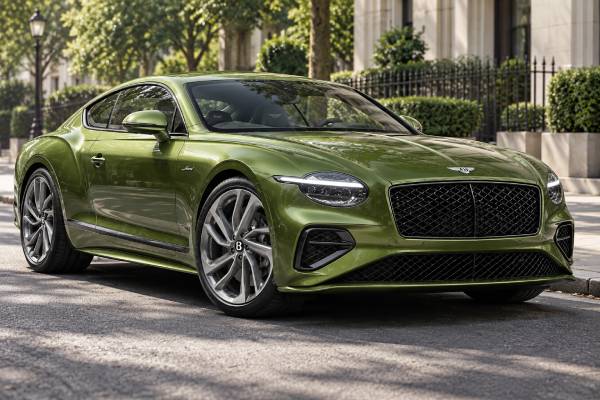
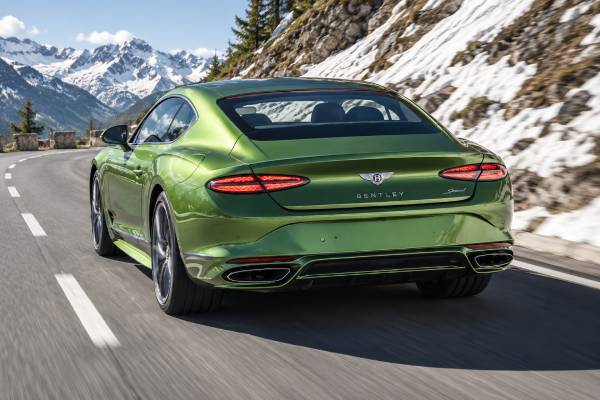

The 2024–present Bentley Continental GT Speed replaces twelve-cylinder tradition with Bentley’s Ultra Performance Hybrid system. A 4.0-litre V8, a traction motor integrated with the eight-speed dual-clutch transmission and a 25.9 kWh battery deliver an official 771 hp and 1,000 Nm. The coupé reaches 60 mph in 3.1 seconds, retains a 208 mph maximum and can cover up to 50 WLTP miles electrically under launch-cycle conditions. This is not an engine-and-motor sum; the combined figure is the manufacturer’s integrated system output. Ownership changes accordingly. Home AC charging, high-voltage warranty, hybrid cooling, software campaigns and 12-volt health now sit beside tires, brakes and engine oil. The car makes its strongest case when it is plugged in frequently, driven electrically for local trips and used as a petrol-hybrid GT for distance. Without a charging routine, the owner carries complexity while missing one of the model’s central benefits.
Table of Contents
- The Speed formula after the W12
- Ultra Performance Hybrid specifications and dimensions
- How the V8, motor and battery divide the work
- Charging, electric range and long-distance strategy
- The rear-biased active chassis and 208 mph capability
- Maintenance and diagnostics for a multi-voltage Bentley
- Buying the right specification in a fast-changing model cycle
The Speed formula after the W12
Bentley ended W12 production in 2024, but it did not design the fourth-generation GT Speed as a softer replacement. The Ultra Performance Hybrid system produces more power and torque than the outgoing twelve-cylinder model while allowing electric travel. The character changes from uninterrupted large-engine thrust to tightly coordinated combustion and electric delivery.
The electric motor sits within the driveline rather than powering a separate axle. That arrangement lets it launch the car, fill torque while the V8 and turbochargers build output, recover energy and assist gear changes. The eight-speed dual-clutch transmission remains central to the experience. A driver may feel the car move silently, wake the V8 under demand and blend both sources without a clear step when everything is functioning correctly.
The 771 hp rating is a system figure. The 600 PS V8 and 190 PS electric motor reach their individual peaks under different conditions, so adding their headline numbers would misrepresent the official combined output. The same caution applies to torque. Bentley’s calibrated total of 1,000 Nm describes what the complete powertrain can deliver, not an arithmetic exercise.
The Speed identity now extends further into chassis calibration. Two-chamber air springs, dual-valve dampers, 48-volt Bentley Dynamic Ride, all-wheel steering and an electronic rear differential are coordinated with a rear-biased active all-wheel-drive strategy. The goal is to make the car rotate and settle more naturally despite the mass of the traction battery.
The result is not simply a faster W12 successor. It is a different proposition: electric commuting, V8 grand touring and active-chassis performance. Buyers who expect the old engine’s sound and delivery may prefer the final 2021–2024 Speed. Buyers able to charge and interested in the broader operating range gain a car that can leave home silently yet match the previous model’s 208 mph maximum.
Understand this Speed is by energy flow. Its distinction lies in how quickly and smoothly the car moves among stored electrical energy, regenerative braking and petrol power while preserving the responses expected of the badge.
Ultra Performance Hybrid specifications and dimensions
The Z23 Speed specification must be read as an integrated plug-in system. Bentley’s 782 PS and 1,000 Nm totals are calibrated combined outputs; they are not obtained by adding every independent peak. The tables connect that powertrain with the 25.9 kWh battery, 11 kW AC charging, coupé dimensions and active chassis. Range and CO₂ figures remain homologation-dependent, particularly as software and market documentation evolve.
| Item | Specification |
|---|---|
| Powertrain class | Plug-in hybrid (PHEV) |
| Engine | 4.0L twin-turbo V8 plus transmission-mounted electric motor |
| Maximum output | 771 hp (782 PS; 575 kW) |
| Maximum torque | 1000 Nm (738 lb-ft) |
| Transmission | 8-speed dual-clutch transmission with integrated 190 PS electric motor |
| Driven wheels | active all-wheel drive with electronic limited-slip differential |
| Fuel tank | 80 L (21.1 US gal) |
| Measure | Value | Context |
|---|---|---|
| 0–60 mph | 3.1 seconds | Manufacturer claim |
| 0–100 km/h | 3.2 seconds | Manufacturer claim |
| Maximum speed | 208 mph (335 km/h) | Factory limit or announced target |
| Traction battery | 25.9 kWh gross traction battery | Published gross capacity |
| Official electric range | 81 km (50 miles) WLTP electric range | WLTP launch or family figure |
| AC charging | 11 kW AC charging; a full charge takes roughly 2 hours 45 minutes under the stated ideal supply condition | Supply and temperature affect time |
| Dimension or capacity | Value |
|---|---|
| Body style | two-door, four-seat plug-in-hybrid performance coupé |
| Length | 4,895 mm (192.7 in) |
| Width | about 1,966 mm (77.4 in), excluding mirrors |
| Height | about 1,397 mm (55.0 in) |
| Wheelbase | 2,851 mm (112.2 in) |
| Kerb weight | about 2,459 kg (5,421 lb) kerb, configuration dependent |
| Luggage capacity | 260 L (9.2 cu ft), reduced by hybrid packaging |
| Component | Factory specification |
|---|---|
| Suspension and active systems | two-chamber air springs, dual-valve dampers, 48-volt Dynamic Ride, rear steering and eLSD |
| Brake system | large iron brakes standard with carbon-ceramic brakes available |
| Factory wheel context | 22-inch Speed wheels |
| Steering/stability distinction | the Ultra Performance Hybrid combines a 600 PS V8, 190 PS motor and 25.9 kWh battery for 782 PS system output without adding engine and motor peaks arithmetically |
| Area | Detail |
|---|---|
| Roof/body structure | fixed coupé body |
| Battery and charging | 25.9 kWh gross traction battery; 11 kW AC charging; a full charge takes roughly 2 hours 45 minutes under the stated ideal supply condition |
| Seating | Four seats |
| Primary buyer verification | Match wheel, brake, chassis and market equipment to the VIN build record |
The hybrid figures should be interpreted through use: a charged battery enables the advertised electric capability and supports the strongest combined response, while the V8 sustains long-distance travel. Kerb mass and 22-inch tires keep consumable costs high despite regeneration. Software version, battery coverage and market homologation belong beside the traditional build-sheet checks.
How the V8, motor and battery divide the work
The hybrid system has three operating resources: fuel in the 80-litre tank, energy in the 25.9 kWh battery and the ability to recover some motion during deceleration. Their roles change continuously. At low demand, the motor can propel the car alone. Under stronger acceleration, it supplies immediate torque while the twin-turbo V8 joins. At high sustained speed, the engine carries most of the continuous load because liquid fuel stores far more usable journey energy than the battery.
The motor’s location within the transmission allows electric drive through the gearbox. That supports several ratios rather than a single fixed electric reduction. It also means shift quality and hybrid control cannot be evaluated separately. A hesitation may involve clutch adaptation, engine start coordination, battery state or software rather than one obvious mechanical fault.
Battery state of charge influences the repeatability of maximum performance. The car reserves energy for hybrid operation, but a nearly depleted battery cannot support every demand in the same way as a charged one. A proper test should include pure-electric travel, blended acceleration and operation after the displayed range has fallen. The transitions should remain composed in all three conditions.
Regeneration turns the motor into a generator during suitable deceleration. The friction brakes then join as more stopping force is requested or as battery and temperature limits change. Pedal response should feel consistent even though the source of braking is changing beneath the surface. A step, surge or unpredictable final stop may reflect calibration or service needs.
Thermal management links the battery, power electronics, motor, engine and cabin. Different circuits may operate at different temperatures, and pumps can continue after shutdown. Buyers should not assume every fan or pump noise is abnormal, but repeated warnings, coolant loss or disabled charging must be investigated with model-specific data. General V8 experience is not enough for the high-voltage side.
Electric driving also changes engine use. A car may travel many short journeys without starting the V8, then ask it for full power on a motorway merge. The control system manages warm-up, but an owner can help by avoiding immediate extreme demand after a cold engine start. Annual oil service remains important even when petrol mileage is low, because time, moisture and repeated brief operation still affect lubricant.
For diagnosis, record the condition in which a symptom occurs: charge level, selected mode, outside temperature, engine running or stopped, gear and recent charging source. “Hybrid warning appeared once” is not enough. Precise context allows a technician to separate charging, high-voltage, transmission and combustion causes without replacing parts by guesswork.
Charging, electric range and long-distance strategy
Bentley equips the GT Speed for AC charging at up to 11 kW. Under the stated ideal supply condition, a full charge takes roughly two hours and 45 minutes. Real time depends on the building supply, wallbox, cable, battery temperature and any charging limit set in the car or app. The vehicle does not need rapid DC charging to fulfil its intended role because most replenishment should happen while parked at home or a destination.
Before purchase, confirm where the car will charge. A dedicated three-phase installation may deliver the full rate in suitable markets; a lower-power domestic supply will take longer. The electrical installation should be assessed by a qualified professional. Extension leads, overheated outlets and improvised adapters are inappropriate for repeated high-load charging.
The launch WLTP electric figure is 81 km, or 50 miles. It is a laboratory-cycle result, not a promise for every journey. Speed, cabin heating or cooling, gradient, tire pressure, weather and wheel choice alter consumption. A useful test is to begin with a verified full charge, reset the trip data and drive a route similar to the buyer’s routine. Compare energy used rather than judging the car solely by the initial range estimate.
A practical daily strategy is simple: plug in after the final trip, schedule charging around tariffs when appropriate and leave with the cabin preconditioned while connected. Preconditioning can improve comfort without consuming as much of the battery immediately after departure. Owners should still drive the car on petrol regularly enough to exercise the engine and use fuel before it ages.
For a long motorway journey, there is little value in stopping every few miles solely to seek an AC point. Begin charged, let the hybrid system deploy energy where it benefits performance or efficiency, and charge at an overnight or extended destination. The V8 and fuel tank make the car a genuine long-distance GT after the electric range is used.
Charging inspection should include the flap, socket, cable, locking pin, seals and status lights. Test the car on a known-good supply and verify that it reaches the expected power without repeated interruptions. Review charging history or app records where available. A failed session can originate in the building, cable or car, so testing more than one known supply is valuable.
Battery warranty terms differ by market and registration date. Obtain the written coverage for the exact VIN, including duration, mileage, capacity provisions, exclusions and transfer rules. Do not rely on a seller’s paraphrase. The value of early hybrid cars will be influenced by remaining cover and documented software campaigns.
This Speed rewards routine rather than range anxiety. Its electric capability is most useful for repeated local miles, while its petrol-hybrid system removes the need to plan intercity travel around fast chargers. A buyer without dependable overnight charging should calculate whether the limited opportunities to plug in justify the added mass and complexity.
The rear-biased active chassis and 208 mph capability
The fourth-generation Speed carries more hybrid hardware than the outgoing car, yet Bentley sought a more natural balance by revising the active chassis around it. The all-wheel-drive system can vary torque distribution, while the eLSD controls the rear axle. All-wheel steering changes agility and stability according to speed. Dynamic Ride counters roll through its 48-volt actuators, and the dual-valve dampers can manage compression and rebound more independently than a simpler adaptive unit.
A road test should reveal cooperation rather than individual effects. In a slow junction, the car should turn tightly without tire hop. On a fast sweep, steering effort should build cleanly, the body should take a set once and the rear axle should accept power without an abrupt correction. Over a broken surface, the wheels should move without the body becoming floaty.
The Speed’s 208 mph maximum is not a speed to explore on public roads. It indicates the validation burden placed on cooling, aerodynamics, tires, brakes and stability. Any owner planning closed-course high-speed use should confirm tire specification, pressure, age, load, track rules and Bentley guidance for the exact car. Cosmetic wheel damage or an uncertain tire repair is incompatible with that capability.
Standard iron brakes are substantial, and carbon ceramics are available. Regeneration can reduce friction-brake use in normal driving, which creates a different concern: discs may corrode or develop uneven deposits if the car is driven gently in wet conditions and parked. Periodic appropriate friction braking, within safe conditions, helps keep surfaces active. A specialist should diagnose vibration rather than automatically replacing discs.
The battery’s location and mass also affect tire load. Check all four inner shoulders and compare tread depth precisely. A mismatched tire can disrupt steering and torque management. Wheel alignment should be performed with the correct ride-height and rear-steer procedures, not treated as a quick toe adjustment.
Drive modes alter powertrain, damping, roll control, steering and stability behavior. Test at least two modes on the same road. The car should become more immediate without introducing a new pull, vibration or impact. A setting that produces no discernible change may indicate a fault or simply a subtle parameter; live data can distinguish the two.
The chassis succeeds when it hides the complexity without erasing feedback. The driver should feel one coherent grand tourer, not a battery pack being corrected by electronics. A noisy eLSD, rear-steer warning or persistent brake-blend issue is central to the car’s value, not a minor comfort defect.
Maintenance and diagnostics for a multi-voltage Bentley
This model contains conventional 12-volt equipment, a 48-volt active-chassis system and a high-voltage traction network. Each voltage domain has different safety procedures. Orange cables, battery connections and power electronics should be handled only by trained personnel using approved isolation and verification methods. Disconnecting the 12-volt battery does not make the traction system safe.
The 12-volt battery remains a common starting point in diagnosis because it wakes control units, closes contactors and supports communication. A weak battery can generate a cascade of misleading messages. Test state of health and charging behavior before interpreting a long fault list. After replacement, any required registration or adaptation should be completed.
High-voltage evaluation should include stored events, insulation monitoring, cell or module balance data available through approved tools, charging performance and thermal-system operation. A simple dashboard range reading cannot establish battery health. Compare data with Bentley criteria and the written warranty rather than applying generic thresholds from another PHEV.
Cooling deserves separate attention. Inspect all relevant reservoirs and circuits for level, concentration, residue and pump operation. The engine, charge-air system, battery and electronics may not share the same temperature requirements. Mixing fluids or opening a circuit without the correct procedure can introduce contamination or air locks.
The V8 still needs conventional care: correct oil, filters, spark and ignition assessment, leak checks and unobstructed heat exchangers. Low petrol mileage should not be used to extend time-based service indefinitely. Fuel age also matters if the car spends months in electric mode; owners should follow manufacturer guidance and avoid keeping the tank perpetually full of old fuel.
Transmission behavior should be tested in EV and hybrid operation. Record creep quality, engine-start events, manual shifts and any difference with charge level. Software calibration may be as important as hardware condition, so campaign history and update invoices belong in the file.
A disciplined annual review can cover:
- VIN-specific recall, campaign and software-status check.
- 12-volt battery load test and complete diagnostic scan.
- Verified AC charging session with recorded input power.
- High-voltage warranty and battery-data review.
- Hybrid, engine and charge-air cooling inspections.
- V8 oil service and combustion-system checks.
- DCT, eLSD, rear-steer, 48-volt roll control and air-suspension data.
- Tire age, tread, wheel runout, brake surfaces and fluid.
- Charging cable, inlet seals and emergency-release operation.
Save reports rather than accepting a reset warning as a repair. Because several systems can reduce performance protectively, the absence of a permanent warning after restart does not prove that the cause has disappeared. Trend data gives an owner and future buyer the strongest evidence of health.
Buying the right specification in a fast-changing model cycle
Early fourth-generation cars entered a range that expanded quickly. Speed, Mulliner and later High Performance Hybrid derivatives can look similar in advertisements while carrying different outputs, chassis calibrations and standard equipment. The first buying task is to decode the VIN and obtain the factory build record. Do not infer a Speed from wheels, black trim or a seller’s wording.
The 771 hp Speed should have the Ultra Performance Hybrid specification, active chassis content and model-specific details documented by Bentley. Verify the brake system, wheel design, audio, seat configuration, touring technology and exterior packages individually. Expensive options can add enjoyment, but they can also increase repair exposure after minor damage.
Build date matters for software. Ask which campaigns and control-unit updates have been completed and whether any features changed afterward. Test both keys, the vehicle app, remote charging functions and all driver-assistance equipment. Connectivity services may depend on market subscriptions and network support, so distinguish permanent vehicle capability from an expiring service.
A demonstration car deserves specific questions about charging, launch use, press events and tire changes. Very low mileage does not remove the need for battery records; it may indicate long periods at an unsuitable state of charge. Conversely, a regularly charged car with documented daily use can provide useful evidence that the complete system operates consistently.
Compare the Speed with the 671 hp core GT honestly. The standard High Performance Hybrid is already extremely fast and may offer a more comfort-focused specification. The Speed justifies its premium for buyers who value the additional output, rear-biased chassis calibration and flagship presentation. A final W12 Speed offers a different form of rarity and sound but cannot provide electric local travel.
Purchase economics should include a home wallbox, insurance, tires, wheel repair, brake replacement, scheduled service and a reserve for electronic diagnosis. Confirm whether the charging cable and accessories included at delivery remain with the car. Missing proprietary items can be expensive and inconvenient to replace.
For an inspection, require a full charge and enough time to reduce it meaningfully. Test charging, EV propulsion, engine start, blended performance, regeneration, friction braking and a hot restart. A ten-minute drive with the battery already depleted does not evaluate the product being sold.
The strongest early example is not necessarily the one with the highest option count. It is the car whose build specification is clear, software history is complete, charging works at the expected rate and behavior remains consistent across electrical and combustion modes. In a fast-evolving range, documentary precision protects the buyer from paying flagship money for the wrong derivative or an incompletely updated car.
References
- Bentley News 2024 : The new Continental GT Speed: redefining the definitive Grand Tourer 2024 (Official Model/Technical Source)
- Continental GT Range 2025 (Official Model/Technical Source)
- Bentley Continental GT | Luxury Hybrid Coupé | Bentley Motors 2026 (Official Model/Technical Source)
- Bentley News 2025 : New High Performance Hybrid Continental GT, GTC and Flying Spur – the daily supercar family expands 2025 (Official Model/Technical Source)
- Check for Recalls: Vehicle, Car Seat, Tire, Equipment | NHTSA 2026 (Recall/Service Source)
- Technical Service Bulletin 2076639/2 2025 (Recall/Service Source)
Disclaimer
This material is for general education and is not high-voltage repair instruction. Hybrid isolation, testing and service must be performed by properly trained personnel using the official procedures for the VIN and market. Specifications, charging results, warranty terms and software applicability can change by configuration.
Share this guide on Facebook, X/Twitter or with a prospective fourth-generation Continental buyer if it clarifies the new Speed’s technology.