


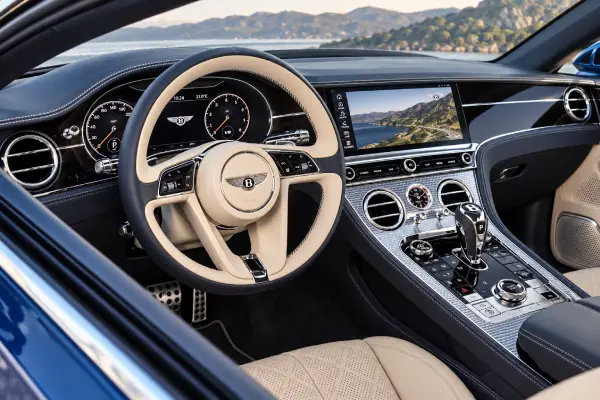
The 2019–2024 Bentley Continental GT V8 is often the most convincing third-generation Continental for regular use. Its 4.0-litre hot-V engine produces 542 hp and 770 Nm, reaches 60 mph in 3.9 seconds and runs to 198 mph, so the performance gap to the W12 is smaller than the badge hierarchy suggests. The lighter engine reduces front-axle inertia, the cross-plane exhaust note is more present, and cylinder deactivation can reduce fuel demand during a steady cruise. It is still a complex, heavy luxury car. Turbocharger heat, oil and coolant sealing, DCT calibration, 48-volt options, wheel damage and mismatched tires can turn a superficially attractive example into a poor purchase. The right car should respond cleanly from idle, coast and re-engage without drama, and hold alignment on worn roads. For a buyer expecting to add mileage, condition and maintenance discipline matter more than choosing twelve cylinders by default.
Table of Contents
- Why the V8 can be the smarter Continental GT
- Exact specifications for the 542 hp coupé
- The hot-V engine, cylinder deactivation and response
- Daily driving, touring range and chassis balance
- Maintenance decisions that protect a modern Bentley V8
- Known trouble areas and a disciplined inspection route
- Buying by condition, options and intended use
Why the V8 can be the smarter Continental GT
The V8 can be the smarter third-generation Continental because it preserves nearly all of the car’s real-world speed while reducing mass at the front and fuel demand at a cruise. Its 542 hp output is 84 hp below the early W12, yet the 3.9-second 0–60 mph claim is only a few tenths slower. On ordinary roads, throttle response, steering balance and exhaust character often matter more than the final margin above 190 mph.
The 4.0-litre engine changes the personality without turning the GT into a lesser luxury car. It retains the same basic cabin, active all-wheel drive, eight-speed dual-clutch transmission and air-suspension architecture. The V8’s cross-plane pulse is more obvious, especially in Sport, while the W12 remains smoother and more effortless. Preference is legitimate; superiority is not automatic.
Lower engine mass improves the sense of front-end response. The car still weighs well over two tonnes, but it can feel more willing to rotate and less reluctant to change direction. That advantage is easily lost when a car wears old, mismatched or oversized tires. Chassis condition matters more than the marketing distinction.
The long 2019–2024 production span includes equipment and market changes. Verify build date, software campaigns, emissions equipment, wheel package and 48-volt options by VIN. Later advertisements may use “final edition” language loosely, and cars from different regions can have different standard equipment.
For frequent use, the V8’s benefits compound. It warms readily, offers strong 770 Nm mid-range torque and can deactivate four cylinders during light-load cruising. Cylinder deactivation should be nearly imperceptible. A vibration, exhaust drone or warning during transition requires investigation rather than acceptance as normal V8 behavior.
The smartest purchase is therefore not simply the cheapest engine choice. It is a V8 whose service history, tires, cooling system and DCT support regular use. When those fundamentals are right, the car provides the Continental experience with a more communicative front end and fewer reasons to reserve it for special occasions.
Exact specifications for the 542 hp coupé
The 542 hp V8 coupé is not merely a W12 with four cylinders removed. Its hot-V engine, lower nose mass, 90-litre fuel system and launch wheel choices create a distinct technical package. The following data applies to the 3S3 V8 across its 2019–2024 run, while emissions and standard equipment can move with model year and country. Compare a candidate car’s option codes before assigning it brake or chassis hardware from another Continental derivative.
| Item | Specification |
|---|---|
| Powertrain class | Gasoline internal-combustion engine (ICE) |
| Engine | 4.0L twin-turbo V8 |
| Maximum output | 542 hp (550 PS; 404 kW) |
| Maximum torque | 770 Nm (568 lb-ft) |
| Transmission | 8-speed dual-clutch transmission |
| Driven wheels | active all-wheel drive with rear-biased operation |
| Fuel tank | 90 L (23.8 US gal) |
| Measure | Value | Context |
|---|---|---|
| 0–60 mph | 3.9 seconds | Manufacturer claim |
| 0–100 km/h | 4.0 seconds | Manufacturer claim |
| Maximum speed | 198 mph (318 km/h) | Factory limit or announced target |
| Combined fuel consumption | 12.1–12.7 L/100 km WLTP combined for later European-market cars | Period European or WLTP figure |
| CO₂ emissions | 275–288 g/km WLTP for later European-market cars | Market and equipment can change result |
| Dimension or capacity | Value |
|---|---|
| Body style | two-door, four-seat coupé |
| Length | 4,850 mm (190.9 in) |
| Width | 1,954 mm (76.9 in), excluding mirrors |
| Height | 1,405 mm (55.3 in) |
| Wheelbase | 2,851 mm (112.2 in) |
| Kerb weight | about 2,165 kg (4,773 lb) kerb |
| Luggage capacity | 358 L (12.6 cu ft) |
| Component | Factory specification |
|---|---|
| Suspension and active systems | three-chamber air suspension with adaptive damping; 48-volt active anti-roll system optional on many cars |
| Brake system | 420 mm front and 380 mm rear ventilated iron discs |
| Factory wheel context | 20-inch launch wheel; 21- and 22-inch choices common |
| Steering/stability distinction | the hot-V V8 brought 770 Nm, cylinder deactivation and lower nose mass while preserving near-200-mph performance |
| Area | Detail |
|---|---|
| Roof/body structure | fixed coupé body |
| Fuel capacity | 90 L (23.8 US gal) |
| Seating | Four seats |
| Primary buyer verification | Match wheel, brake, chassis and market equipment to the VIN build record |
The V8’s smaller output gap on the road is explained partly by its lower mass and different front-axle feel. Wheel size, tire construction and iron-disc condition can change that advantage more than a brochure comparison suggests. Before buying consumables or coding modules, confirm the car’s model year and option list through Bentley’s VIN data.
The hot-V engine, cylinder deactivation and response
The hot-V layout places the turbochargers inside the cylinder banks, shortening the path between exhaust ports and turbines. That arrangement improves response and packaging, but it concentrates heat near oil lines, coolant connections, wiring and seals. Inspection should therefore focus on temperature history as much as on the published 542 hp.
From cold, the engine should settle quickly into an even idle. Brief condensation is normal in suitable weather; persistent blue smoke, a strong oil smell or uneven combustion is not. Listen with the bonnet open and then from the exhaust, because a heat shield or valve noise can be mistaken for internal engine trouble.
Under light throttle, power should arrive smoothly before the transmission needs a large downshift. Under full load, the V8 should continue pulling without hesitation, misfire or boost flutter. A one-time acceleration from a seller is not enough. Repeat the request only after temperatures are stable and watch for warnings that appear when the turbochargers are working hardest.
Cylinder deactivation shuts down four cylinders during suitable low-load conditions. The change should be subtle, often noticed more through an economy display than through the seat. A shudder at steady speed may instead come from tire imbalance, engine mounts, driveline load or an ignition issue. Diagnosis should compare engine speed, road speed and the exact operating mode.
The eight-speed DCT gives the V8 a direct, eager feel. Test low-speed creep, reverse, a hill start, normal upshifts and manual commands. Some clutch sensation is inherent, but repeated judder or a long delay is not a personality trait. Software level, adaptations, mounts and mechanical wear all need consideration.
Oil and coolant traces deserve prompt investigation because hot-V packaging can spread fluid over several surfaces. Check undertrays after a drive, not only a freshly cleaned engine bay. Record oil level over distance and pressure-test any coolant loss. Repeated topping up removes useful evidence.
A healthy V8 combines quick response with refinement. It can sound purposeful without vibrating through the cabin and can deliver strong torque without making the DCT feel abrupt. That clean coordination is the benchmark for both road testing and future maintenance.
Daily driving, touring range and chassis balance
The V8 GT works well daily because its performance is accessible at normal engine speeds. Urban driving still requires awareness of width, wheel size and low-speed clutch behavior, but the car does not need high revs to move briskly. Cameras and parking sensors should operate consistently; intermittent assistance faults make a large coupé harder to place than it should be.
At a cruise, cylinder deactivation and the V8’s lower demand can improve range compared with the W12, although actual consumption remains strongly influenced by speed, traffic and wheel choice. The 90-litre tank supports long stages, and the 358-litre luggage bay takes practical soft bags. Plan cargo around the shallow opening rather than relying only on the volume figure.
Three-chamber air suspension should deliver a distinct range of behavior. Comfort allows wheel travel and softens sharp edges; Sport reduces roll and pitch. The change must be controlled rather than theatrical. A car that becomes brittle in every mode may be running excessive pressure, damaged wheels or old tires rather than a genuinely sporting setup.
The optional 48-volt active anti-roll system can keep the body flatter without using extremely stiff springs. Its benefit is most obvious in a sequence of bends, where the car settles quickly but remains compliant over surface changes. Stored faults, wiring problems or low voltage can reduce that benefit, so scan the chassis modules and compare actual mode response.
Steering balance is a V8 strength. On correct tires and alignment, the front axle should turn in without a delayed secondary movement from the body. Tramlining often comes from broad worn tires or repaired wheels. Measure inner tread and inspect barrels before authorizing steering parts.
The 420 mm front and 380 mm rear iron brakes are powerful but can develop deposits or storage corrosion. Use several progressive stops to judge the pedal. A long motorway journey followed by gentle cooling can feel different from repeated short urban use; history helps explain the condition of the discs.
Daily suitability ultimately depends on consistency. Climate control, seats, connectivity, rotating display and driver assistance need to work every morning, not only during a demonstration. The V8 is the rational Continental only when its convenience systems are as dependable as its engine.
Maintenance decisions that protect a modern Bentley V8
Protecting the V8 begins with regular oil service and a record of the exact product used. The turbochargers rely on clean oil and correct flow after hot operation. Avoid switching off immediately after extreme load, and investigate a level trend rather than masking it with frequent top-ups. An itemized invoice is more useful than a generic service stamp.
Cooling maintenance should include the engine circuit, charge-air cooling and front heat exchangers. Remove debris carefully, inspect fins and ducts, and pressure-test unexplained loss. The hot-V location means heat can age nearby seals and electrical connectors, so look for brittle insulation or staining during annual inspection.
Spark plugs and ignition components operate under high cylinder pressure. A misfire that appears only under boost may not show during idle. Save fault data and reproduce the load condition before replacing parts. Repeated full-throttle tests with an unresolved misfire can damage catalysts.
DCT service requires correct fluid, temperature and diagnostic procedure. Review Bentley guidance for the VIN and discuss use history with a specialist. City creeping, repeated launches and track use create different demands. A software adaptation is not a cure for worn hardware, but it should be checked before major work.
The 12-volt battery powers a broad electronic network. Test capacity and charging output, especially after storage. Low voltage can cause warnings from the suspension, display, assistance or transmission. Stabilize the supply and retain the original scan before deciding that multiple control units have failed.
Tires should be replaced as a coordinated set when age or circumference spread becomes significant. Record cold pressure, tread across the full width and wheel runout. Follow with an alignment suited to the factory wheel package. Wide tires can wear their inner shoulders while appearing healthy from outside.
A useful ownership baseline is:
- Full diagnostic report and software/campaign check.
- Engine-oil service with hot-V leak inspection.
- Cooling-system pressure and heat-exchanger examination.
- DCT behavior review and fluid-history confirmation.
- Battery load test and charging-system measurement.
- Brake, wheel, tire and alignment report.
- Retest under the same road conditions after correction.
These decisions protect response and refinement. Waiting for a warning often turns an affordable seal, battery or tire issue into a wider diagnostic problem.
Known trouble areas and a disciplined inspection route
A disciplined inspection follows the heat and load path of the car. Start with a cold engine and stable battery, move through urban operation, reach full temperature on the road, then inspect the underside and scan the modules again. This sequence exposes faults that a polished, pre-warmed car can conceal.
Check body history first. The 3S3 uses superformed aluminium exterior panels and advanced assistance sensors, so repair quality and calibration matter. Compare paint depth, glass dates, panel fasteners and radar/camera operation. A windscreen replacement should be accompanied by correct calibration where required.
At the engine, inspect the hot-V area, turbocharger oil and coolant connections, expansion tank and lower covers. Look for fresh residue after the drive. Observe hot restart and idle stability. Ask whether any oil or cooling repair was performed and whether follow-up checks confirmed the result.
During low-speed driving, test the DCT through reverse, incline creep and repeated stop-starts. At a cruise, note cylinder-deactivation smoothness. Under controlled acceleration, listen for boost leaks or misfire and watch for messages. Record whether a vibration follows road speed or engine load.
Switch suspension modes over the same rough surface. Check ride height after the car has stood and monitor compressor activity. Inspect control arms, joints and undertrays on the lift. A knock that appears only under braking may come from different hardware than one produced by a pothole.
Require written findings for:
- V8 oil leakage, coolant loss and turbocharger-area heat damage
- Ignition behavior under boost and cylinder-deactivation transition
- DCT engagement, clutch shudder and software status
- 12-volt battery health and complete module scans
- Air suspension and optional 48-volt active-roll operation
- Wheel repairs, tire matching, dates and inner-edge wear
- Iron-disc condition, pad life and brake-fluid age
- Body repair, sensor calibration and underbody damage
Known trouble areas are not a prediction that every car will fail. They are a method for directing inspection money toward systems with meaningful consequences. A seller who permits a full cold-to-hot examination provides more confidence than one who offers a long list of options but restricts testing.
Buying by condition, options and intended use
Buy the V8 for the way it will be used. A daily or touring owner benefits from its response, slightly lower fuel demand and lighter front end. A collector focused on the last twelve-cylinder era may still prefer a W12 or Speed. The correct decision follows purpose rather than an assumption that the most cylinders always create the best car.
Condition should be ranked above decorative specification. Continuous service, a dry engine, stable DCT, fresh matching tires and clean diagnostics provide value every mile. Carbon trim, contrast stitching and a rare paint can enhance a strong car, but they do not offset four damaged wheels or a weak battery network.
Wheel choice is practical. Twenty-inch wheels offer the most sidewall, 21s balance appearance and ride, and 22s sharpen the visual stance while increasing tire cost and pothole risk. Inspect what is fitted, not what the advertisement claims. A factory design that has been repeatedly welded is not a premium option.
Mileage needs a narrative. A car used for long trips with annual care may be preferable to one that completed only short urban journeys. Compare odometer readings with seat, pedal, steering, tire and brake wear. Ask how the car was stored and whether the battery was supported.
Review options that affect daily comfort: seat ventilation or massage, touring assistance, upgraded audio and the rotating display. Demonstrate them long enough to reveal intermittent operation. Price any failure before agreeing on value; replacement trim and modules can be costly.
Maintain a post-purchase reserve for baseline work. Four tires, alignment, fluids, battery or a minor cooling repair can appear even after a competent inspection. The reserve prevents the owner from delaying the very maintenance that makes the V8 the sensible choice.
The best 542 hp GT V8 feels lighter than its mass, stronger than its output suggests and calm in ordinary use. When engine, gearbox, chassis and electronics agree, it is not the budget Continental. It is the version whose performance and ownership character are most naturally suited to being driven.
References
- Bentley News 2019: NEW CONTINENTAL GT V8 AND GT V8 CONVERTIBLE 2019 (Official Model/Technical Source)
- Bentley News 2024 : Continental GT V8, GTC V8, and Flying Spur V8 leave the UK, European, and MEAI markets 2024 (Official Model/Technical Source)
- The New Continental GT and Continental GT Convertible 2020 (Official Model/Technical Source)
- Bentley Continental | History and Heritage | Bentley Motors 2026 (Official Model/Technical Source)
- Technical Service Bulletin 2076639/2 2025 (Recall/Service Source)
- Check for Recalls: Vehicle, Car Seat, Tire, Equipment | NHTSA 2026 (Recall/Service Source)
Disclaimer
This article supplies general information and should not be used in place of professional inspection, diagnosis or repair. Specifications, torque settings, service intervals and procedures may differ by VIN, market and installed options; confirm them in official Bentley service documentation for the exact car.
If you found the guide useful, please share it on Facebook, X/Twitter or with another Continental researcher to support our work.