

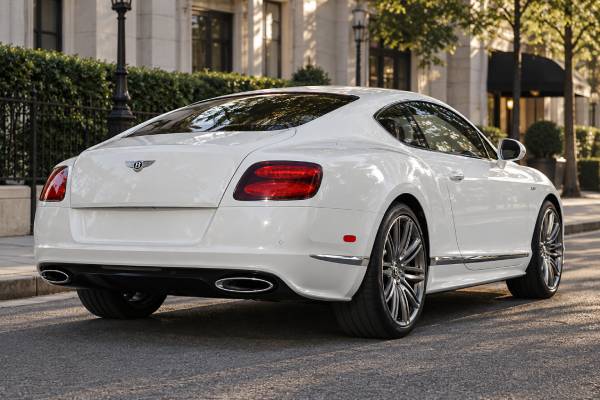
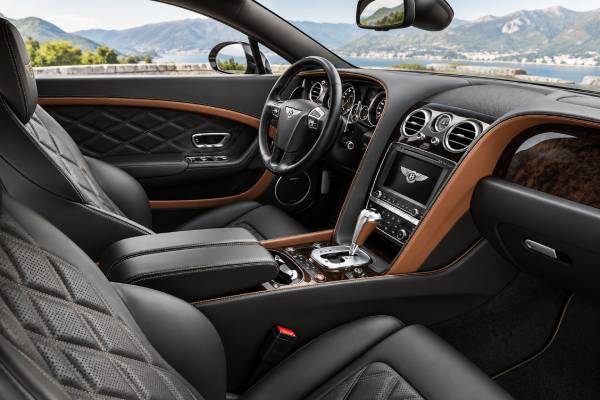
The 567 bhp Continental GT W12 introduced the second-generation coupe without abandoning the qualities that made the original successful. Its 6.0-liter twin-turbo W12 delivered 700 Nm (516 lb-ft), the permanent all-wheel-drive system adopted a 40:60 rear-biased split, and a redesigned body and cabin improved refinement. Bentley claimed 0–100 km/h in 4.6 seconds and 318 km/h (198 mph) for the early six-speed version.
This 2011–2015 range needs careful definition. The 567 bhp engine remained, but transmission and certification details changed during production: launch cars used a six-speed Quickshift automatic, while later examples gained an eight-speed ZF unit. The 582 bhp facelift is not the same specification even when registered during 2015. For buyers, build date and VIN therefore matter more than a broad year label. Condition matters even more. A smooth W12 can hide old tires, cooling residue, low-voltage faults, leaking air springs, overdue fluids, or damaged optional carbon brakes. The best car is one whose exact configuration is documented and whose maintenance shows regular diagnosis rather than last-minute cosmetic preparation.
Table of Contents
- Understanding the 567 hp Production Run
- Continental GT W12 Specifications
- Six-Speed Versus Eight-Speed Cars
- W12 Strengths and Aging Points
- Chassis, Brakes, Tires, and Electronics
- Building a Complete Purchase File
- Making the W12 Work as a Grand Tourer
Understanding the 567 hp Production Run
The 567 bhp W12 was the original flagship powertrain for the second-generation 393 Continental GT. It is neither the 616 bhp Speed nor the later 582 bhp facelift, and identifying the correct version prevents inaccurate specifications and wrong parts assumptions.
Bentley retained the compact 5,998 cc W12 arrangement, with four banks of three cylinders packaged more closely than a conventional V12. Twin low-inertia turbochargers, variable cam timing, and revised management produced 567 bhp at 6,000 rpm and 700 Nm from 1,700 rpm. Early marketing also described FlexFuel capability in approved markets, allowing gasoline, bioethanol, or a mixture. Fuel suitability must be checked against the exact car’s handbook and market equipment rather than assumed from a generic brochure.
The second-generation body kept the four-seat fastback form but sharpened its surfaces and used aluminum in several exterior panels. A steel monocoque supplied the primary structure. The cabin gained an 8-inch touchscreen, hard-drive navigation, improved audio architecture, more sculpted seats, and a cleaner dashboard while retaining traditional hide, metal, and veneer.
Rear-biased AWD changed the driving character. The nominal 40:60 front/rear distribution gives more influence to the rear axle under normal conditions, while the Torsen center differential can react mechanically to changes in grip. The coupe still carries much of its engine mass ahead of the cabin, so it remains a grand tourer rather than a lightweight sports car.
The hidden production change is the gearbox. Launch specifications list a ZF six-speed automatic with Quickshift and double-downshift capability. Later 567 bhp W12 cars use an eight-speed ZF automatic, bringing closer intermediate ratios and lower cruising speed. Listings sometimes apply the later specification to every year. Buyers should verify the gearbox through build data, control-unit identification, selector behavior, and VIN-specific parts information.
Exterior appearance alone is unreliable. Wheels, grilles, exhaust outlets, badges, and Mulliner details are easily changed. The 567 bhp car normally lacks the dark Speed treatment and lowered Speed chassis, but extensive personalization creates exceptions. The factory build sheet remains the reference.
The 2015 boundary is especially important. Depending on market, calendar registration and model-year naming can overlap with the facelifted 582 bhp W12. This article follows the assignment’s 567 bhp engine scope. A car with variable cylinder displacement and 582 bhp belongs to the later specification even if some other hardware looks familiar.
Continental GT W12 Specifications
This model is an internal-combustion 2+2 coupe with a front-mounted twin-turbo W12, automatic transmission, permanent AWD, self-leveling air suspension, and an automatically deploying rear aerofoil. Year-specific gearbox and consumption figures should be verified before service or comparison.
| Item | Factory data |
|---|---|
| Engine | 5,998 cc twin-turbocharged W12 |
| Orientation | Front, longitudinal |
| Construction | Aluminum-alloy block and heads |
| Bore × stroke | 84.0 × 90.2 mm (3.31 × 3.55 in) |
| Compression ratio | 9.0:1 |
| Valve gear | DOHC, 48 valves, variable cam timing |
| Maximum power | 567 bhp / 575 PS / 423 kW at 6,000 rpm |
| Maximum torque | 700 Nm (516 lb-ft) from 1,700 rpm |
| Production phase | Transmission | Drive layout |
|---|---|---|
| Launch specification | ZF six-speed automatic with Quickshift and paddles | Permanent AWD, nominal 40:60 front/rear split |
| Later 567 bhp specification | ZF eight-speed automatic with paddles | Permanent AWD, nominal 40:60 front/rear split |
| Control modes | Automatic Sport and manual selection, depending on market interface | Torsen center differential |
| System | Specification |
|---|---|
| Front suspension | Four-link double wishbones, air springs, anti-roll bar |
| Rear suspension | Trapezoidal multi-link, air springs, anti-roll bar |
| Damping | Computer-controlled continuous damping |
| Steering | Speed-sensitive Servotronic rack and pinion, about 2.6 turns lock to lock |
| Standard front brakes | 405 mm ventilated iron discs |
| Standard rear brakes | 335 mm ventilated iron discs |
| Optional brake system | 420 mm front / 356 mm rear carbon-silicon-carbide ceramic discs |
| Measurement | Metric | Imperial |
|---|---|---|
| Wheelbase | 2,746 mm | 108.1 in |
| Length | 4,806 mm | 189.2 in |
| Body width | 1,944 mm | 76.5 in |
| Width including mirrors | 2,227 mm | 87.7 in |
| Height | 1,404 mm | 55.3 in |
| EU curb weight | 2,320 kg | 5,115 lb |
| Fuel tank | 90 L | about 23.8 US gal |
| Trunk volume | 358 L | 12.6 cu ft |
| Measure | Published figure |
|---|---|
| 0–60 mph | 4.4 seconds |
| 0–100 km/h | 4.6 seconds |
| 0–100 mph / 0–160 km/h | 10.2 seconds |
| Maximum speed | 318 km/h (198 mph) |
| Early European combined cycle | 16.5 L/100 km (17.1 mpg imperial) |
| Early U.S. cycle | 12 mpg city / 19 highway / 14 combined |
Later eight-speed certification can show improved consumption and slightly different acceleration. Factory options alter weight. Always use the handbook and official service data matched to the VIN.
Six-Speed Versus Eight-Speed Cars
The gearbox change affects how the car drives and how it should be assessed, but it does not make one production phase automatically superior. The six-speed feels more deliberate; the eight-speed offers closer ratios and more relaxed high-speed cruising.
The six-speed Quickshift transmission can perform double downshifts and was claimed to cut change time substantially compared with the previous generation. Its first gear is not as short as the later eight-speed’s, but the W12’s 700 Nm masks the wider ratio gaps. Under light throttle it should change almost imperceptibly. Under stronger load it should respond firmly without a flare or impact.
The eight-speed gives the control unit more choices. It can keep the engine near the broad torque band, use a lower launch ratio, and settle into seventh or eighth on an open road. More shifts do not mean constant busyness when calibration is healthy. Hunting between ratios can indicate load, terrain, adaptation, a sensor problem, or a developing transmission issue.
For either version, test engagement cold and hot. Select Reverse and Drive while holding the brake and note the time before load is felt. A slight pause is normal; a repeated long delay, heavy clunk, or engine flare is not. Use manual selection to confirm that requests are recognized, then allow automatic mode to handle mixed-speed driving.
Fluid-service advice must follow the exact transmission and Bentley procedure. A generic “sealed for life” statement should not end the discussion on a mature car, but neither should a high-pressure flush be authorized casually. Review history, identify the gearbox, inspect for leaks, assess shift quality and fault data, and have a specialist choose the correct service method and fluid.
The transmission also interacts with engine and mounts. A clunk on throttle reversal may come from driveline joints, differentials, mounts, or control adaptation rather than the gearbox itself. Diagnosis should consider the complete torque path from crankshaft to four tires.
When comparing two cars, prioritize condition and records before the number of ratios. An early six-speed car with clean shifts, regular inspection, correct tires, and a healthy cooling system is a stronger purchase than a neglected eight-speed example. Choose the later gearbox for refinement, not as a substitute for maintenance.
W12 Strengths and Aging Points
The W12’s great strength is effortless output from low engine speed. Its ownership challenge is dense packaging: small leaks, ignition faults, and cooling problems can require substantial labor to access and should be addressed before they spread.
A cold start should be decisive. Idle may begin slightly elevated, then settle evenly without persistent vibration. Check the exhaust for blue or dense white smoke, listen for abnormal chain or accessory noise, and smell for raw fuel or coolant. The instrument cluster should complete its warning-lamp check rather than display messages that have been dismissed as “battery related.”
Misfire diagnosis must use data. Spark plugs and coils are possible causes, but so are injectors, fuel pressure, vacuum leaks, wiring, compression, and sensors. Replacing one visible component without comparing cylinder counters and fuel trims can waste money. Repeated misfire under boost can damage catalysts and should not be ignored because the engine still produces impressive power.
Cooling deserves a pressure test when there is residue, odor, unexplained top-up, or fan concern. Inspect the radiator stack through the front openings, not just the expansion tank. Debris between heat exchangers reduces airflow. Check electric fans, hose joints, auxiliary circuits, undertrays, and signs that previous coolant has dried on hidden surfaces.
Oil leaks can collect above aerodynamic panels before reaching the floor. Inspect with the undertrays removed where the specialist considers it appropriate. Record oil level and consumption rather than relying on a one-time reading. The correct oil specification and service interval depend on market and operating pattern.
Fuel choice should follow the handbook. Early FlexFuel-capable cars were designed to adapt to approved bioethanol mixtures, but fuel quality, regional labeling, seasonal composition, storage, and later parts changes complicate a blanket recommendation. If a car has spent long periods on high-ethanol fuel or in storage, ask the specialist to inspect fuel-system behavior rather than assuming the badge guarantees trouble-free use.
Engine mounts and driveline mounts influence refinement. Excess movement can create thumps, vibration, exhaust contact, and misleading transmission symptoms. A loaded inspection and road-test observation are more useful than a visual glance alone.
Regular full-temperature journeys are better than repeated short starts. Warm the engine gently, avoid heavy load until fluids stabilize, and allow the cooling system to complete normal cycles. A battery maintainer preserves voltage during storage but does not replace actual driving.
Chassis, Brakes, Tires, and Electronics
A W12 Continental can feel luxurious even when its chassis is deteriorating, because power, sound insulation, and thick upholstery mask gradual changes. Compare all four corners and demand even behavior.
Air suspension should hold the car level after resting. Observe initial compressor activity, changes between ride settings, and warning messages. Frequent running suggests leakage or pressure loss. A failed air spring can overwork the compressor; a weak compressor can create slow height changes; a sensor or wiring fault can command the wrong response. Scan data helps separate them.
Continuous damping control should change body response across modes. The softest setting allows more movement but should not float for several cycles after a crest. The firmest should control roll without sharp impacts from every seam. Old tires, bent wheels, incorrect pressure, and nonstandard lowering can mimic damper trouble.
Tires are part of the AWD system. Record brand, model, size, load index, speed rating, date, tread depth at inner/middle/outer positions, repairs, and sidewall condition. Four matching tires with close wear are preferred. A large circumference difference can stress the driveline and confuse handling.
Standard iron brakes are large and expensive but straightforward to measure. Check disc thickness and variation, pad depth, caliper condition, hose age, fluid history, and vibration. Optional carbon ceramics reduce unsprung mass and resist fade, but their condition requires the approved assessment. Chips, edge damage, wrong pads, or unknown refinishing can change the purchase economics.
The automatically deploying rear spoiler should be tested through diagnostic output or its permitted control sequence. Inspect hinges, wiring, water paths, and panel alignment. A spoiler warning may seem minor, but it can indicate a failed mechanism or communication fault.
Electronic checks should cover every seat movement and memory, steering-column adjustment, windows, mirrors, keyless access, trunk power operation, parking sensors, camera, climate zones, audio, navigation, telephone connection, adaptive cruise where fitted, tire-pressure display, and all exterior lights. Low voltage can create multiple codes, but the correct response is battery testing and a full scan—not erasing faults.
Water entry is less common than in the convertible, yet drains, windshield bonding, door membranes, trunk seals, and body repairs still matter. Feel carpets and inspect the trunk’s low points and electronic compartments. Corrosion at a connector can create intermittent behavior that is difficult to reproduce.
Building a Complete Purchase File
A strong purchase file lets the buyer connect claims to evidence. It should contain factory identity, service chronology, diagnostic results, inspection photographs, and priced next steps.
Request the VIN before traveling. Obtain a build record and verify engine output, transmission phase, market, paint, interior, brakes, wheels, and major options. Compare that with the physical car. A seller may be unaware that wheels or trim were changed, but the buyer still needs to know.
Read invoices in date order. Look for repeated complaints, unresolved leaks, multiple battery replacements, recurring suspension warnings, or frequent tire damage. Gaps do not prove neglect, but they require inspection and a conservative budget. A stamped book without invoices cannot show what was actually found.
Commission a cold-start inspection that includes:
- battery and charging-system test;
- all-module diagnostic scan before codes are cleared;
- engine data, misfire history, fuel trims, and readiness review;
- cooling-system examination and hot behavior;
- transmission engagement and adaptation assessment;
- road test across suspension modes and speeds;
- brake, wheel, tire, and alignment inspection;
- lift examination after the driveline is warm;
- verification of spoiler, comfort, and infotainment functions;
- written estimates divided into urgent, near-term, and optional work.
Title, accident, import, finance, and recall checks should be completed through the appropriate authorities for the car’s country. NHTSA information is useful for U.S. vehicles but does not replace VIN-specific dealer or manufacturer checks elsewhere.
A clean scan is one piece of evidence. Mechanical wear may not set a fault, and recently cleared codes may not have returned. Compare the scan with readiness status, battery voltage, physical condition, and records. Consistency is the goal.
Walk away when identity cannot be resolved, the engine overheats, active misfires persist, structural repair is hidden, water has reached modules, transmission engagement is seriously abnormal, or the seller refuses independent inspection. Other defects can be negotiated if they are understood and priced.
Making the W12 Work as a Grand Tourer
The 567 bhp W12 is the right version for an owner who values silent reserve and traditional Bentley character more than the sharper attitude of a Speed. It remains extremely fast, but its standard suspension and wheel choices can deliver a more forgiving long-distance ride.
The V8 alternative is lighter at the nose, more economical, and sonically distinctive. The W12 provides smoother low-rev thrust and the symbolic appeal of twelve cylinders. Neither is objectively better; the ownership plan, local fuel cost, specialist access, and intended mileage should decide.
Choose wheel and brake specification with actual roads in mind. The standard 20-inch setup offers more sidewall than 21-inch alternatives. Iron brakes suit many touring owners, while healthy carbon ceramics reduce unsprung mass and offer exceptional heat capacity. Condition is more important than prestige.
Once purchased, create a baseline if documentation is incomplete. Address tires, brakes, leaks, battery, cooling, fluids, suspension, and fault codes before cosmetic work. Keep old parts and record part numbers. Photograph underbody and brake condition so future changes are visible.
A dedicated reserve fund prevents deferred maintenance. It should sit outside routine service and insurance budgets. Exact needs vary, but the principle applies at every purchase price: a discounted W12 can consume the saving quickly if it arrives with four old tires, a weak battery, coolant residue, and an air leak.
Use the coupe as intended. Long drives bring systems to temperature, charge the battery, exercise the spoiler and suspension, and reveal emerging issues before storage. Check pressures and fluids before a tour, carry the correct recovery information, and know where the nearest qualified workshop is.
The second-generation 567 bhp GT has matured into an unusually capable used grand tourer. It is modern enough to feel refined, old enough that condition varies widely, and technically distinctive enough to reward careful ownership. The right car is not defined by six or eight gears, low mileage, or an exotic color alone. It is defined by a verified specification and a maintenance record that respects the whole machine. That evidence also makes future diagnosis faster, resale clearer, and long-distance use more confident.
References
- continental gt 2011 (Manufacturer Brochure)
- Bentley Motors UK Press – TECHNICAL SPECIFICATION 2011 (Technical Specification)
- continental gt features book 2012 (Manufacturer Brochure)
- Used 2013 Bentley Continental GT Specs & Features | Edmunds 2013 (Vehicle Data)
- Vehicle Detail Search – 2014 BENTLEY CONTINENTAL GT | NHTSA 2014 (Recall Database)
Disclaimer
This article provides general information, not professional diagnosis, repair, or a substitute for a model-specific inspection. Specifications, torque settings, service intervals, and procedures vary with VIN, market, build date, transmission, and equipment; confirm them in official Bentley documentation. Please share the guide on Facebook, X/Twitter, or another platform if it helps support informed ownership.