

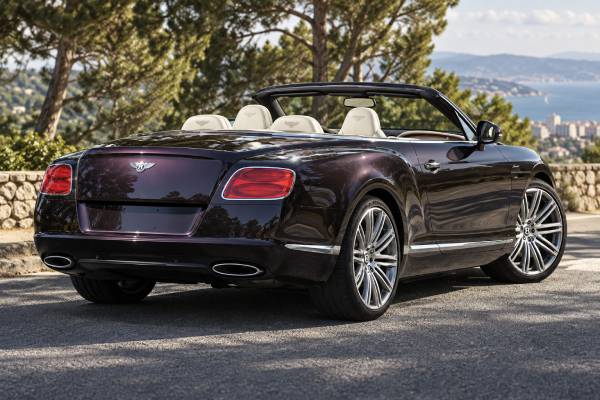
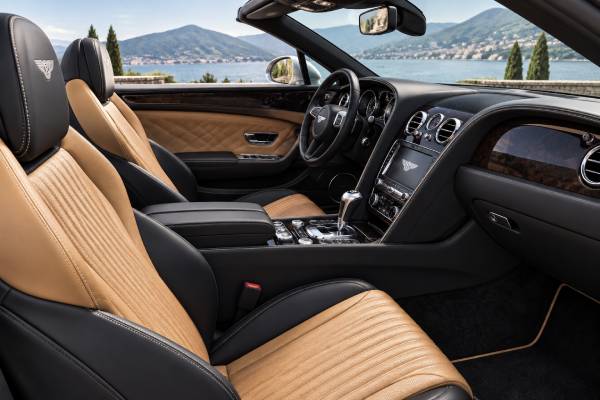
The 626 bhp Continental GTC Speed sits at an unusual intersection: it is a 327 km/h (203 mph) convertible with four seats, permanent all-wheel drive, a four-layer powered roof, and the materials of a hand-finished luxury cabin. Its 6.0-liter twin-turbo W12 produces 820 Nm (605 lb-ft), while an eight-speed automatic and 40:60 front-to-rear torque split turn that output into smooth, all-weather acceleration.
This version is easy to misidentify because the earlier GTC Speed made 616 bhp and later registrations can overlap with facelift changes. The exact car covered here is the 626 bhp/635 PS specification assigned to 2014–2016. A build sheet, VIN, and engine data are more reliable than badges or advertisement wording. Condition also needs convertible-specific scrutiny. A functioning roof must seal, drain, index its windows, communicate with multiple controllers, and remain stable at highway speed. Add W12 cooling, air suspension, large tires, optional carbon-ceramic brakes, and aging electronics, and a quick walk-around becomes inadequate. The right purchase is dry, documented, diagnostically clean, and coordinated after a warm test—not merely polished and low-mileage.
Table of Contents
- A Faster Open Continental, Not Just a Facelift
- 626 hp Convertible Specifications
- Roof Up, Roof Down, and Water Control
- How to Judge the Speed Chassis
- Keeping the W12 and Eight-Speed Healthy
- The Pre-Purchase Day
- Buying for Touring, Not for a Number
A Faster Open Continental, Not Just a Facelift
The 626 bhp GTC Speed is the higher-output development of the second-generation 394 Speed convertible. Bentley increased torque to 820 Nm and maximum speed to 203 mph while retaining the eight-speed gearbox, rear-biased AWD, and lowered adaptive air chassis.
The W12’s output is broad rather than peaky. Maximum power arrives at 6,000 rpm, but the important figure in daily driving is the torque available from about 1,700 rpm. It lets the car accelerate hard from a cruise without waiting for several downshifts. The engine’s compact W layout also helps package twelve cylinders and AWD hardware ahead of the cabin, though the resulting nose remains heavy.
The ZF eight-speed automatic provides a short first gear, closely spaced middle ratios, and tall cruising gears. A torque converter gives smooth launch behavior, while fixed steering-column paddles allow manual requests. The gearbox should feel refined in town and immediate in Sport; a harsh shift should not be excused as a Speed characteristic.
Permanent AWD normally divides torque 40 percent to the front and 60 percent to the rear. That setting gives the driver more rear-axle influence than early first-generation cars while preserving traction. The system’s mechanical effectiveness depends on four compatible tires with close circumference. The correct tire set is part of the driveline, not an optional luxury.
The Speed chassis sits about 10 mm lower than a standard GTC. Damping, steering, air-spring control, and electronic stability programming are tuned for greater body control. Twenty-one-inch wheels, dark grilles, black-background winged badges, larger rifled exhaust outlets, and Speed interior detailing distinguish the model. Paint, veneers, hides, and option packages vary widely.
The roof uses four layers to improve sound and temperature insulation. It folds beneath a hard cover in roughly 25 seconds and can operate at low speed where the handbook allows. Optional All Seasons features, including neck warmers, a heated steering wheel, and wind deflector, broaden the car’s climate range. Each option adds components that need testing.
The production scope should be checked carefully. A 2014 car may be an earlier 616 bhp version depending on market build and registration conventions. A 2016 registration can reflect inventory timing. Verify 626 bhp/635 PS and 820 Nm in factory data. Do not infer the specification from exterior styling alone.
626 hp Convertible Specifications
Viewed as hardware, this is a heavy four-seat open body surrounding a front-mounted twin-turbo W12, ZF eight-speed, Torsen driveline, self-leveling air springs, adaptive dampers, and an electrically operated fabric hood. None of those systems can be judged in isolation because each helps manage roughly 2.5 tonnes.
| Item | Specification |
|---|---|
| Engine | 5,998 cc twin-turbocharged W12 |
| Position | Front, longitudinal |
| Construction | Aluminum-alloy block and heads, 48 valves |
| Maximum power | 626 bhp / 635 PS / 467 kW at 6,000 rpm |
| Maximum torque | 820 Nm (605 lb-ft) from about 1,700 rpm |
| Induction | Twin turbochargers with charge-air cooling |
| Fuel | Premium gasoline to the approved market specification |
| System | Factory layout |
|---|---|
| Transmission | Eight-speed ZF automatic with column-mounted paddles |
| Driveline | Permanent all-wheel drive |
| Nominal torque split | 40 percent front / 60 percent rear |
| Front suspension | Four-link double wishbones with air springs and anti-roll bar |
| Rear suspension | Trapezoidal multi-link with air springs and anti-roll bar |
| Damping | Continuous electronic damping control |
| Speed ride height | Approximately 10 mm lower than standard GTC |
| Measure | Metric | Imperial |
|---|---|---|
| Wheelbase | 2,746 mm | 108.1 in |
| Overall length | 4,806 mm | 189.2 in |
| Body width | 1,943 mm | 76.5 in |
| Width including mirrors | 2,227 mm | 87.7 in |
| Height, roof raised | about 1,394 mm | 54.9 in |
| EU curb weight | about 2,495 kg | 5,501 lb |
| Fuel tank | 90 L | about 23.8 US gal |
| Trunk capacity | 260 L | 9.2 cu ft |
| Measure | Factory claim |
|---|---|
| 0–60 mph | 4.1 seconds |
| 0–100 km/h | 4.4 seconds |
| Maximum speed | 327 km/h (203 mph) |
| Roof cycle | Approximately 25 seconds |
| Seating | Four in a 2+2 arrangement |
| Area | Typical equipment |
|---|---|
| Wheels | 21-inch Speed-design alloys |
| Tires | Bentley-approved high-performance fitment; verify size and ratings by VIN |
| Standard brakes | Large ventilated iron discs |
| Optional brakes | Carbon-silicon-carbide ceramic discs on applicable examples |
| Control systems | ABS, ESP, traction control, tire-pressure monitoring |
Figures and equipment vary with market, options, and production revision. Use official VIN-specific documents for pressures, torque values, fluid specifications, and repair procedures.
Roof Up, Roof Down, and Water Control
The roof’s condition determines whether the GTC Speed remains a refined grand tourer or becomes an electrical and trim project. Inspection must cover motion, sealing, drainage, structure, and evidence of previous repair.
Start with the roof fully raised. Check fabric tension, color consistency, seams, fold points, rear-glass bond, edge piping, and the relationship between the frame and body. Abrasion often appears where fabric repeatedly folds against itself. A patch, altered stitching, or uneven tension should have an invoice and explanation.
Open and close the roof with a tested battery. Observe each stage rather than merely timing it. Side windows should lower, the header should release, the rear section and storage cover should move without contact, and the system should confirm the final locked position. No one should have to push a bow or cycle the switch several times.
Repeat the operation after a long drive. Warm components can reveal leakage, weak pumps, sticking joints, or sensors that drift with temperature. If operation is limited to stationary use by local coding or handbook instruction, follow that requirement. Do not force a cycle in low temperature or high wind.
Window indexing is part of sealing. Open each door repeatedly and watch the glass lower and return into the seal. Check the small rear side windows too. Misalignment produces a concentrated whistle and can direct water inside. Regulator, latch, and door-module faults may also interrupt roof commands.
Drain paths carry water away from the roof well and body cavities. Inspect them with controlled water and appropriate access. Search beneath mats, in footwells, under reachable rear carpet, in the trunk, around the battery, and near modules. Mineral residue, green corrosion, tide marks, swollen trim, musty odor, or recently replaced insulation can show past entry.
The cabin should be evaluated with the roof up at highway speed. A broad background sound is realistic; loud air at one corner, fabric flutter, glass movement, or a roof-frame knock is not. Drive over a diagonal entrance slowly and listen for structural or latch noise.
Keep the roof raised, clean, and dry during storage. Do not fold wet fabric for long periods. Clear drains, clean seals with approved products, and exercise the mechanism under suitable conditions. A battery maintainer prevents low-voltage interruption, but it does not fix worn roof hardware.
How to Judge the Speed Chassis
A healthy GTC Speed feels controlled without pretending to be light. Its mass should appear as solidity and momentum, not as wandering, repeated bouncing, brake shake, or delayed steering.
Check ride height before the car starts. All corners should be consistent after an overnight rest. When the system wakes, note compressor duration and whether one corner rises later. Frequent compressor activity suggests leakage or pressure loss. A sensor fault can also command incorrect height.
Drive the same road in every damping setting. The soft mode should absorb coarse surfaces while maintaining control; firmer modes should reduce pitch and roll. If all settings feel identical, scan the dampers and control unit. If every mode is harsh, investigate tire pressure, tire age, wheel damage, nonstandard suspension coding, and worn components.
The 21-inch wheels are exposed to pothole damage. Inspect inner barrels for bends and cracks, not just visible faces. Road-force testing can separate wheel or tire variation from bearing and driveline vibration. A repair should be structurally appropriate and documented; repeated welding is a warning.
Tires should form a matching set. Record date codes, load index, speed rating, tread across the full width, sidewall repairs, and evidence of flat spotting. Inner shoulders can wear rapidly when alignment or bushings are wrong. Do not align the car until joints, ride height, wheels, and pressures are correct.
Brake feel should be firm and repeatable. Iron discs require measurement of thickness, variation, pad depth, and caliper condition. Optional carbon ceramics require an approved specialist evaluation for chips, edge damage, surface state, and remaining life. Their high replacement cost belongs in the purchase calculation.
The convertible body should remain composed. Over rough or diagonal surfaces, listen for suspension clunks separately from roof-frame noises. A worn control arm, top mount, or anti-roll-bar link can be masked by interior sound insulation. A lift inspection after the drive is essential.
Steering should be light during parking and stable at speed. Excessive tramlining can come from tires and road surface, but severe pull or constant correction points to alignment, damaged wheels, brake drag, or structural repair. The car was designed for high-speed confidence; persistent nervousness is a fault.
Keeping the W12 and Eight-Speed Healthy
Preventive attention to cooling, ignition, lubrication, voltage, and transmission behavior is more valuable than trying to predict one universal failure mileage. These cars age according to heat cycles, storage, service quality, and use.
The W12 should be assessed cold. It should crank strongly, settle to an even idle, and show no persistent smoke or raw-fuel smell. Save diagnostic data before clearing any codes. Misfires can arise from plugs, coils, injectors, air leaks, sensors, fuel pressure, wiring, or mechanical condition; parts should follow diagnosis.
Cooling capacity relies on clean heat exchangers, working fans, sound hoses, correct coolant, and intact underbody airflow. Inspect the radiator pack for debris and impact, pressure-test when residue or odor appears, and monitor temperature during traffic and after a heat-soaked restart. Unexplained coolant loss requires a cause.
Use the approved oil and filter, record level and consumption, and inspect above undertrays for leakage. A spotless garage floor does not prove a dry engine because panels can catch fluid. Time-based oil service remains sensible for low-mileage cars.
The eight-speed automatic should engage Drive and Reverse without a heavy delay, change cleanly under light load, and downshift promptly when requested. Test it both cold and fully warm. Fluid-service decisions must match the exact gearbox and Bentley procedure; a generic flush can be inappropriate.
AWD health begins with tires, then extends to mounts, shafts, differentials, seals, and the center drive. Clunks on throttle reversal or vibration at a narrow speed band should be traced through the full driveline. Replacing a transmission based on symptoms alone is poor diagnosis.
Stable voltage underpins every controller. Test battery capacity and alternator performance, inspect grounds, and investigate parasitic draw when storage life is short. Use a suitable maintainer, but do not dismiss repeated faults as low voltage without proving the battery was the cause.
A practical annual service should include a complete scan, road test, lift inspection, brake measurements, tire report, roof and drain check, fluid review, cooling examination, suspension-level data, and test of every comfort feature. Written findings create the baseline needed to catch gradual change.
The Pre-Purchase Day
A serious inspection is a full-day decision process, not a test drive squeezed between sales appointments. It should begin with identity and finish with priced repair priorities.
Before seeing the car, obtain the VIN, factory specification, service invoices, ownership history, recall status, title information, and photographs of the roof and underside. Confirm the 626 bhp output and brake equipment. Ask that the car remain cold.
At the car, work in this order:
- Match VINs, labels, documents, keys, and build equipment.
- Inspect paint, panel gaps, roof fabric, glass, seals, drains, trunk, and cabin low points.
- Read tire and wheel details and identify brake type.
- Test battery capacity, charging, and every electrical function.
- Scan all modules before clearing faults.
- Start cold and record noise, idle, smoke, odors, and data.
- Complete the first roof cycle.
- Drive until engine, gearbox, brakes, and cabin systems are fully warm.
- Complete the second roof cycle and hot restart.
- Lift the car and inspect fluid traces, suspension, underbody, driveline, and repairs.
The road route should include parking maneuvers, rough low-speed surfaces, a steady highway section, moderate acceleration, several brake applications, and each damper setting. Maximum acceleration is unnecessary and unsafe when tire condition is unknown.
Ask the inspector to divide findings into safety-critical, overdue, expected within a year, and cosmetic. Obtain estimates from the workshop that would actually perform the work. Add a contingency because some roof, cooling, or electronic repairs reveal more after trim or undertrays are removed.
Major reasons to pause include damp modules, incomplete roof operation, active overheating, persistent misfires, serious transmission delay, structural uncertainty, mismatched or damaged tires, unknown ceramic-disc condition, and a seller who will not permit independent diagnostics.
A clean appearance and empty fault list do not prove health. A reset can leave the modules temporarily quiet, while worn mechanical parts may remain electronically invisible. Compare scan data with readiness status, battery voltage, physical evidence, and invoices.
Buying for Touring, Not for a Number
The GTC Speed should be purchased for the experience of open, long-distance travel with immense reserve—not because 203 mph is a usable road target. Its real talents appear in effortless overtaking, quiet roof-up cruising, and the ability to extend the convertible season.
Compare it honestly with alternatives. A standard GTC W12 is softer and nearly as dramatic. The V8 convertible is lighter, more efficient, and has a distinct exhaust character. The coupe is quieter, more rigid, and has a larger trunk. The 626 bhp GTC Speed is right when the sharper chassis, W12 output, and open body all matter to the buyer.
Select options according to use. Neck warmers and wind deflector can be more valuable on a cool tour than exotic trim. Iron brakes may suit road mileage and predictable replacement budgets; sound carbon ceramics offer lower unsprung mass and exceptional heat capacity. Condition decides the better choice.
Plan ownership before purchase. Identify a Bentley specialist, secure dry storage, price insurance, understand flatbed recovery, and reserve money outside routine service. A single roof, wheel, brake, cooling, or air-suspension event can arrive independently of recent maintenance.
After purchase, establish a baseline and correct water, tire, brake, cooling, and voltage issues first. Keep documents for every roof adjustment, battery, tire, alignment, scan, and fluid. Preserve original wheels and trim when making reversible changes.
Drive the car enough to keep systems active. Warm it gently, use the roof regularly in suitable conditions, operate climate and seat functions, and avoid storing wet fabric. Long journeys are preferable to frequent brief starts.
A maintained GTC Speed feels like one machine rather than a collection of expensive systems. The roof closes cleanly, the cabin stays dry, the W12 pulls smoothly, the transmission disappears into the background, and the chassis controls its mass. That integrated behavior—not the top-speed figure—is the standard a buyer should demand.
References
- CONTINENTAL GT AND SPEED CONVERTIBLE 2014 (Manufacturer Brochure)
- Vehicle Detail Search – 2015 BENTLEY CONTINENTAL GTC | NHTSA 2015 (Recall Database)
- 2015 Bentley Continental GTC Speed 2015 (EPA Fuel Economy)
- 2015 Bentley Continental GT Speed Convertible 2015 (Vehicle Data)
- 2015 Bentley Continental GTC Buyer’s Guide 2015 (Model Overview)
Disclaimer
This guide is informational and is not a substitute for professional diagnosis, repair, or a specialist pre-purchase inspection. Specifications, torque values, maintenance intervals, and procedures vary by VIN, market, production date, and equipment; verify all work in official Bentley service documentation. Please share the article on Facebook, X/Twitter, or another platform if it helps promote careful ownership.