

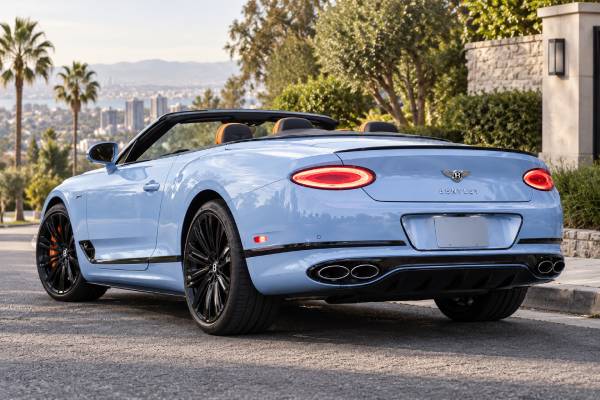
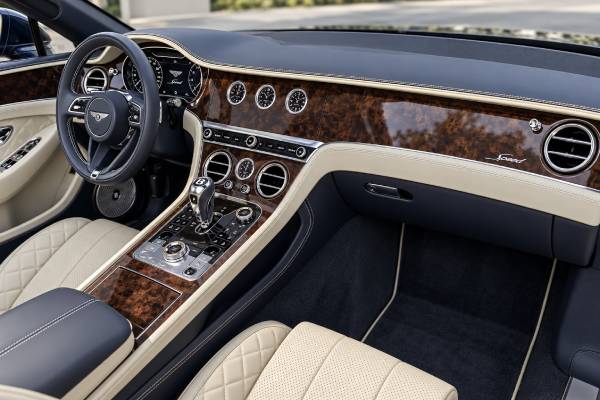
The 2021–2024 Bentley Continental GTC Speed is defined by active chassis technology as much as by its 650 hp W12. Rear-wheel steering, an electronic limited-slip differential, 48-volt anti-roll control and revised stability logic allow a heavy open car to match the coupé’s 208 mph maximum while retaining a 19-second fabric roof. That breadth is extraordinary, but every additional system creates an inspection point. Roof synchronization, rear-quarter glass, active-roll faults, rear-steer alignment, eLSD operation, tire circumference and optional ceramic brakes must all agree before the car feels right. A good example remains composed over diagonal bumps, turns tightly without scrubbing or warning messages and delivers full torque without drivetrain shock. The model is best for an owner who will use both halves of its character: quiet roof-up distance and roof-down performance. Buyers interested only in the Speed badge can find simpler and cheaper Continental alternatives.
Table of Contents
- Why the GTC Speed is a chassis story
- Complete technical picture of the 650 hp convertible
- How active systems contain weight with the roof down
- The fabric roof, cabin climate and high-speed refinement
- Maintenance priorities for Speed-specific hardware
- Road-test and inspection clues buyers should not miss
- Who benefits from the GTC Speed’s extreme breadth
Why the GTC Speed is a chassis story
The GTC Speed did not become the flagship convertible merely because Bentley raised W12 output to 650 hp. Its more important distinction is the way several controlled systems cooperate to make a 2,436 kg open car change direction with unusual precision. All-wheel steering shortens the apparent wheelbase in tight maneuvers and adds stability at speed. An electronic rear limited-slip differential manages torque across the axle. Bentley Dynamic Ride uses a 48-volt system to oppose roll, while the air springs and adaptive dampers preserve the long-travel comfort expected of a Continental.
That combination changes the buying question. A conventional power upgrade can often be assessed with compression, boost, cooling and service records. The GTC Speed also demands evidence that its rear steering, differential, active anti-roll hardware, suspension and stability software are synchronized. A car can start, idle and accelerate impressively while still failing to deliver the chassis behavior for which the Speed premium was paid.
The convertible body makes that integration more difficult. Removing a fixed roof requires structural reinforcement, and the folding mechanism adds mass high in the body. Bentley nevertheless quoted the same 208 mph maximum as the coupé. Achieving that figure required more than power: roof aerodynamics, underbody control, tire capability, cooling, brake stability and body sealing all had to work at an extreme speed.
On ordinary roads, the benefit appears at far lower velocity. The car should turn into a roundabout without the long pause associated with older heavy GTs, settle rapidly after a diagonal bump and accept throttle without pushing wide. In Comfort mode, the systems should recede into the background. In Sport, the body should feel tied down rather than brittle.
This is why cosmetic inspection alone is inadequate. A perfect hood, bright 22-inch wheels and unmarked leather do not prove that the rear-steer alignment is correct or that the eLSD behaves properly when hot. The most convincing car is one whose service history names the active systems, whose tires match, whose diagnostic scan is clean and whose road manners remain consistent through different modes and temperatures.
The W12 still matters. Its smooth 900 Nm delivery gives the GTC effortless pace with the roof raised or lowered. Yet the engine is only one part of the model’s identity. A buyer choosing between a regular GTC W12 and a GTC Speed should pay for the Speed only when the complete chassis package can be demonstrated, not simply because the grille, badges and specification sheet look more dramatic.
Complete technical picture of the 650 hp convertible
For the 3S4 GTC Speed, the crucial numbers combine 659 PS with the convertible’s 2,436 kg approximate mass, 235-litre boot and 19-second roof. The car matches the coupé’s quoted 208 mph top speed but reaches it through a different body package. These tables also record the rear-steer, eLSD and 48-volt chassis systems that justify the Speed designation. Verify optional carbon ceramics and market equipment from the build sheet.
| Item | Specification |
|---|---|
| Powertrain class | Gasoline internal-combustion engine (ICE) |
| Engine | 6.0L twin-turbo W12 TSI |
| Maximum output | 650 hp (659 PS; 485 kW) |
| Maximum torque | 900 Nm (664 lb-ft) |
| Transmission | 8-speed dual-clutch transmission with Speed software |
| Driven wheels | active all-wheel drive with an electronic rear limited-slip differential |
| Fuel tank | 90 L (23.8 US gal) |
| Measure | Value | Context |
|---|---|---|
| 0–60 mph | 3.6 seconds | Manufacturer claim |
| 0–100 km/h | 3.7 seconds | Manufacturer claim |
| Maximum speed | 208 mph (335 km/h) | Factory limit or announced target |
| Combined fuel consumption | official figures vary with market and configuration | Period European or WLTP figure |
| CO₂ emissions | market-specific and dependent on homologated equipment | Market and equipment can change result |
| Dimension or capacity | Value |
|---|---|
| Body style | two-door, four-seat high-performance convertible |
| Length | 4,850 mm (190.9 in) |
| Width | 1,964 mm (77.3 in), excluding mirrors |
| Height | about 1,399 mm (55.1 in) |
| Wheelbase | 2,849 mm (112.2 in) |
| Kerb weight | about 2,436 kg (5,370 lb) kerb, depending on specification |
| Luggage capacity | 235 L (8.3 cu ft) |
| Component | Factory specification |
|---|---|
| Suspension and active systems | air suspension, 48-volt Dynamic Ride, all-wheel steering, eLSD and Speed-specific stability calibration |
| Brake system | large iron brakes standard; 440 mm front carbon-ceramic package optional |
| Factory wheel context | 22-inch forged Speed wheels |
| Steering/stability distinction | it matched the coupé’s 208 mph maximum while adding a 19-second roof and all-season neck-warming comfort |
| Area | Detail |
|---|---|
| Roof/body structure | seven-bow fabric roof, operable in 19 seconds at up to 30 mph (50 km/h) |
| Fuel capacity | 90 L (23.8 US gal) |
| Seating | Four seats |
| Primary buyer verification | Match wheel, brake, chassis and market equipment to the VIN build record |
Matching the coupé’s 208 mph claim does not make the open Speed mechanically identical. Roof structure, reinforcement and the smaller boot add their own loads and service points. The safest interpretation combines the stated dimensions with measured tire, wheel, brake and alignment condition, then checks every optional item by VIN.
How active systems contain weight with the roof down
Containing mass is not the same as removing it. The GTC Speed remains a very heavy car, and its tires, wheel bearings and brakes still carry the loads created by that weight. Bentley’s active systems instead control when and how the mass moves. Their success can be judged by the sequence of responses during a corner: initial steering, body set, rear-axle support and clean acceleration away.
At parking speed, the rear wheels steer opposite the fronts. The effect should be a noticeably manageable turning circle without hopping or scuffing. At higher speed, they steer in phase to support lane changes and stability. The transition is electronically managed and should never call attention to itself. A crooked steering wheel, unusual rear-tire wear or a sensation that the car is steering from two places requires a proper four-wheel alignment procedure and a diagnostic review, not a quick front-axle adjustment.
The eLSD becomes important as torque rises. It can direct drive across the rear axle and help the car rotate under power. On a dry, open bend, moderate acceleration should produce a progressive tightening of line rather than wheelspin followed by abrupt brake intervention. Binding during slow turns, a rear-axle groan or repeated stability warnings deserves specialist investigation. Fluid condition, control software and tire circumference should be considered before condemning hardware.
Dynamic Ride uses electric actuators on the anti-roll system. In a bend it can resist lean; over a single-wheel bump it can allow more independence. Test it on roads that include smooth corners and uneven surfaces. Sport mode should reduce excess motion, while Comfort should permit more isolation. If both modes feel identical, or one corner reacts sharply, stored faults and live data may reveal an inactive actuator or communication issue.
The fabric roof changes the acoustic clues available to the driver. With it lowered, wind can hide wheel-bearing hum, driveline resonance and suspension knocks. Conduct the chassis test roof-up first, then repeat selected maneuvers roof-down. Listen during throttle lift, low-speed lock and gentle braking.
Tires are the mechanical foundation beneath all this control. Four matching 22-inch tires should have compatible production dates, similar tread depth and correct load and speed ratings. Inspect inner shoulders and wheel barrels. A single mismatched replacement can alter rolling circumference enough to confuse torque distribution and can make the car feel nervous despite healthy electronics.
A correctly functioning GTC Speed does not feel small, but it feels coherent. The steering, body and rear axle act as one system. That coherence is the real proof that the active technology is containing the convertible’s mass as intended.
The fabric roof, cabin climate and high-speed refinement
The seven-bow roof is both a weather barrier and a structural component of the ownership experience. Bentley states that it opens or closes in 19 seconds and can operate at up to 30 mph. A pre-purchase test should include several complete cycles on level ground, preferably from cold and again after the cabin has warmed. Movement should be even, latches should engage without a second attempt and both rear-quarter windows should index correctly.
Do not judge the roof only while standing beside the car. Sit inside during closure and listen for motor strain, hydraulic or mechanical hesitation, and changes in speed as the frame passes its highest load points. After closure, inspect the header seal, side-glass contact and rear-deck fit. The fabric should be evenly tensioned without polished rub marks, pinched edges or a pronounced difference between sides.
Water management deserves a deliberate inspection. Examine drains, carpet edges, the luggage compartment, trim behind the seats and electronic-module areas for staining or odor. A dry car on the day of sale is not proof of long-term sealing; moisture meters and evidence beneath removable trim can be more useful. Never clear a drain aggressively without understanding its routing, because disconnected tubes can move water into hidden cavities.
Roof-up refinement should approach coupé standards for conversation and long-distance travel. Whistling at one speed often points to glass or seal adjustment. A booming noise can arise from tire wear or a loose underbody panel rather than the roof itself. Test at several legal speeds and with the climate fan both on and off.
Roof-down comfort depends on more than ambient temperature. The wind deflector, seat heating, neck-level warm-air system and climate control should be checked independently. Confirm that air output is balanced between seats and that the climate system maintains temperature at idle as well as while moving. Weak cooling may indicate refrigerant, condenser or airflow issues that also matter to the tightly packaged W12.
The GTC’s 235-litre luggage area is modest. Operate the roof while carrying no luggage, then examine the partition and warning logic that protect the mechanism from an obstructed load space. Damaged dividers or bypassed switches create a risk of contact between luggage and the folded roof.
High-speed capability makes small fit faults more significant. Loose seals, missing undertrays, repaired wheel-arch liners or incorrect glass adjustment may be tolerable around town but become noisy and aerodynamically disruptive on a fast motorway. A refined car should remain calm with the roof raised, stable with it lowered and free of warnings in either state. The roof is not an accessory to inspect after the drivetrain; it is one of the model’s most complex and expensive systems.
Maintenance priorities for Speed-specific hardware
A sensible maintenance plan separates routine W12 care from the components unique to the Speed chassis. Both categories matter, but they require different evidence. Oil services, cooling-system pressure checks and ignition health protect the engine. Diagnostic scans, alignment records and measured brake condition protect the systems that distinguish this derivative.
The twin-turbo W12 operates in a crowded engine bay. Inspect coolant reservoirs, hose connections, pumps, radiators and undertrays for dried residue. Clean heat exchangers without damaging fins and investigate any repeated top-up. Oil level should be tracked using the handbook method; adding oil without a confirmed reading can be as harmful as allowing it to run low. A hot restart and a full-temperature road test reveal more than prolonged idling in a showroom.
The eight-speed dual-clutch transmission should be evaluated in slow creep, reverse, gentle automatic shifts and firm acceleration. Ask a Bentley specialist to check software level and adaptations. A shudder may result from clutch control, mount movement or driveline issues, so generic additives and indiscriminate flushing are poor substitutes for diagnosis.
For the eLSD and rear steering, obtain a complete scan rather than relying on the absence of dashboard warnings. Review stored and intermittent events, then check alignment with equipment capable of handling the rear-steer system. Record tire dimensions and tread depths at the same visit. A future technician should be able to compare measurements rather than interpret vague invoice language such as “tracking checked.”
Dynamic Ride introduces a 48-volt circuit alongside the conventional 12-volt network. Both supplies must be healthy. A weak 12-volt battery can create communication faults across unrelated modules, while 48-volt hardware requires trained handling and correct isolation procedures. Owners should not probe orange or high-current wiring as a home diagnostic exercise.
Brakes can be standard iron or optional carbon ceramic. Identify the system by part data and inspection. Iron discs need thickness and runout measurements; ceramics need the manufacturer-approved condition assessment, including edge damage and wear criteria. Brake fluid remains time-dependent in either case.
A useful annual technical review includes:
- W12 oil service, leak survey and cooling-pressure test.
- Battery load tests and a saved all-module diagnostic report.
- Rear-steer calibration and four-wheel alignment measurements.
- eLSD operation, fluid history and rear-axle noise assessment.
- Dynamic Ride, air-spring and damper function in multiple modes.
- Wheel runout, tire age and inner-shoulder tread readings.
- Roof cycles, drains, seals, quarter glass and luggage-partition logic.
- Brake disc, pad and fluid condition using the correct method.
Maintaining this car is less about reacting to warning lights than creating a trend record. Annual data can expose a weakening battery, shifting alignment or small coolant loss before those issues become expensive failures.
Road-test and inspection clues buyers should not miss
The most revealing test begins before the engine starts. Ask that the car be left cold and parked where the ground beneath it can be examined. Check battery voltage, fluid levels, tire pressures and stored warnings before anyone clears fault memory. Record the VIN and verify the build specification, especially brake type and optional equipment.
Start with the roof raised. The W12 should fire cleanly and settle without prolonged mechanical noise. Watch every warning lamp complete its check. While stationary, operate seat functions, neck warmers, climate zones, cameras and infotainment. Then cycle the roof while listening from inside and outside.
Use the first miles for low-speed systems. Reverse up a slight incline, creep in traffic and make full-lock turns in both directions. The DCT should engage predictably. Rear steering should reduce effort without tire scrub. A clunk that appears only as drive reverses may involve mounts, axle components or differential control and should be documented.
At a steady cruise, assess wheel balance and alignment. Release steering pressure briefly on a safe, level road; the car should not dart or require constant correction. Vibration at one speed often identifies a wheel or tire problem. Repeat the same section in Comfort and Sport to establish that damping and roll control change character.
Brake testing should progress from gentle to firm. The pedal should remain consistent, the car should track straight and the steering wheel should stay calm. Afterward, compare heat among corners without touching the discs. An unusually hot wheel may reveal drag.
Once temperatures are stable, request strong but legal acceleration. The W12 should deliver continuous thrust, and the gearbox should shift decisively without a flare or shock. Lift the throttle and listen for rear-axle or prop-shaft resonance. Stop, allow a short heat soak and perform a hot restart.
Lower the roof only after the roof-up acoustic assessment. Repeat a cruise and a moderate bend. This separates wind noise from mechanical sounds and confirms that the body remains composed when open.
The workshop inspection should then target:
- Complete scan reports before and after the drive
- Service-campaign and recall status by VIN
- Roof-frame alignment, drains and moisture traces
- Four-wheel geometry including rear-steer calibration
- eLSD data, DCT adaptations and driveline mounts
- 12-volt and 48-volt supply health
- W12 cooling integrity and evidence of leakage
- Brake specification, measured wear and wheel condition
- Four matching tires with acceptable age and load rating
Any seller can demonstrate acceleration. The valuable seller is the one who permits cold, hot, roof, chassis and diagnostic testing. Restrictions around those areas remove the evidence needed to justify the purchase.
Who benefits from the GTC Speed’s extreme breadth
The GTC Speed suits a buyer who wants one car to perform several contradictory jobs. It can cross countries in roof-up quiet, provide open-air touring in cool weather and deliver unusually sharp responses on a demanding road.
A regular GTC W12 may be the better answer for someone focused on comfort, design and effortless torque. It lacks the eLSD and rear-steer emphasis but can offer the same essential twelve-cylinder occasion at a lower entry price. A V8 GTC is lighter at the nose and usually less costly to fuel and service. The Speed earns its place for a driver who notices chassis timing, uses Sport mode and values the last W12 generation.
Specification should follow intended use. Carbon-ceramic brakes provide formidable heat capacity and reduced unsprung mass, but their replacement exposure may be difficult to justify on a gentle touring car. Standard iron brakes are not a weak option; their condition is easier to measure and budget. Mulliner trim, premium audio and Blackline details can influence enjoyment, yet none should outrank roof integrity, matching tires and clean active-system data.
Low mileage is not automatically an advantage. A stored car can have aged tires, discharged batteries, sticky roof seals, stale fluids and corrosion on iron brakes. A regularly exercised example with annual documentation may be the more dependable purchase. Compare condition, chronology and use rather than treating the odometer as a quality score.
Budget beyond the transaction. A baseline service, battery, four tires, precise alignment and correction of minor roof or wheel issues can consume a meaningful sum. The reserve should be available immediately; postponing alignment or cooling work undermines the systems that make the Speed special.
The strongest purchase has a coherent history. Invoices should identify the workshop, mileage, parts and measurements. Diagnostic reports should agree with the dashboard. The road test should confirm that the car behaves the same way its documents suggest.
For the right owner, this GTC is one of the most complete open grand tourers Bentley produced: 208 mph capability, four seats, all-weather traction and a roof that disappears in seconds. For an owner who wants only a rare badge or occasional boulevard use, it may be unnecessary complexity. The decision becomes clear when the buyer asks whether rear steering, active roll control and the W12 will be experienced regularly enough to merit their care.
References
- Bentley News 2021 : CONTINENTAL GT SPEED CONVERTIBLE BREAKS COVER FOR SPRING 2021 (Official Model/Technical Source)
- Bentley News 2021 : THE MOST DYNAMIC BENTLEY ROAD CAR IN HISTORY: THE NEW CONTINENTAL GT SPEED 2021 (Official Model/Technical Source)
- Bentley News 2024 : End of an era as final Bentley W12 engine hand-built in Crewe 2024 (Official Model/Technical Source)
- The New Continental GT and Continental GT Convertible 2020 (Official Model/Technical Source)
- Technical Service Bulletin 2076639/2 2025 (Recall/Service Source)
- Check for Recalls: Vehicle, Car Seat, Tire, Equipment | NHTSA 2026 (Recall/Service Source)
Disclaimer
This guide is general educational information, not a substitute for inspection by a Bentley-qualified technician. Procedures, fluid requirements, service campaigns and specifications can vary by VIN, market and equipment; consult the official workshop information for the individual vehicle before work or purchase.
Please share this article on Facebook, X/Twitter or with another Continental owner if it helps them evaluate a GTC Speed carefully.