

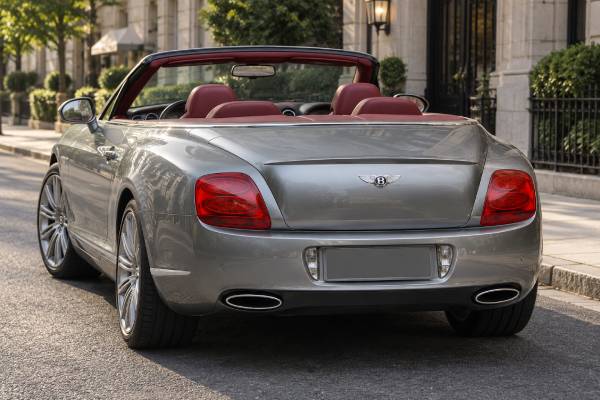
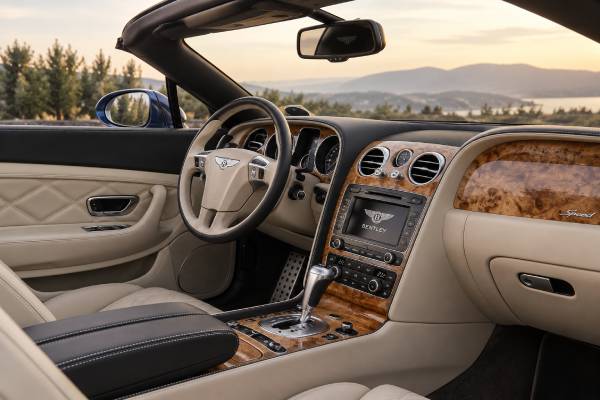
The first Continental GTC Speed turned Bentley’s already rapid convertible into a genuine 200 mph grand tourer. Its 6.0-liter twin-turbo W12 produced 600 bhp and 750 Nm (553 lb-ft), while a lower suspension, 20-inch wheels, sharper steering calibration, and a discreet rear spoiler made the extra speed usable rather than merely impressive on paper. Bentley claimed 322 km/h (200 mph) with the roof raised and 312 km/h (195 mph) with it lowered.
That combination makes the 2009–2011 GTC Speed unusually compelling today. It is a four-seat luxury convertible with immense all-weather traction, hand-finished materials, and performance that still feels serious. It is also a complex, heavy car whose roof, air suspension, cooling system, brakes, electronics, and W12 powertrain can turn neglect into a costly ownership problem. The smartest purchase is not the cheapest example or the one with the lowest odometer reading. It is the car with the clearest identity, strongest maintenance history, healthiest roof and chassis systems, and fewest signs of deferred work.
Table of Contents
- A 200 mph Convertible With a Specific Purpose
- GTC Speed Specifications and Factory Data
- How the W12, Chassis, and Roof Work Together
- What Age Does to the Driving Experience
- Maintenance Priorities and Cost Control
- Inspection Route for a Serious Candidate
- Choosing the Right Car and Owning It Well
A 200 mph Convertible With a Specific Purpose
The GTC Speed was not simply a standard GTC with a higher engine output. Bentley gave it a defined role: preserve the comfort and craftsmanship of the convertible while adding the response, stability, and visual restraint expected of a Speed model.
The foundation remained the 3W4-generation Continental GTC, a steel-bodied 2+2 with a powered three-layer fabric roof. The roof folds beneath a flush cover in about 25 seconds, and reinforced hoops behind the rear head restraints form part of the rollover protection system. This packaging gives the car genuine rear seats and an elegant roof-down profile, but it also adds mass and mechanical complexity. At 2,485 kg (5,478 lb) in Bentley’s published data, the GTC Speed is much heavier than a conventional sports car.
Bentley compensated with torque. The 5,998 cc W12 uses two turbochargers, four camshafts, 48 valves, and continuously variable cam timing. In Speed form it gained lower-friction components, revised management, and greater airflow. Output rose nine percent over the contemporary 552 bhp GTC, while torque increased by 15 percent. More important, the full 750 Nm was available over a broad band from roughly 1,750 to 5,600 rpm. The car therefore feels forceful without needing repeated high-rev downshifts.
The Speed chassis sits 10 mm lower at the front and 15 mm lower at the rear. Springs, anti-roll bars, dampers, rear-axle bushes, steering assistance, and stability-control programming were revised. The standard 20-inch multi-spoke wheels carry 275/35 ZR20 tires. A small boot-lid spoiler improves high-speed aerodynamic balance, and the dark matrix grilles, black lower valance, rifled exhaust outlets, and Speed treadplates provide identifiers without changing the basic shape.
This model’s headline top speed should be understood in context. Roof position changes aerodynamic drag and airflow around the cabin, which is why Bentley published separate roof-up and roof-down figures. Those numbers are engineering claims achieved under controlled conditions, not targets for public roads. For an owner, the useful benefit is the stability, cooling capacity, tire specification, and reserve performance required to support them.
The 2009–2011 scope is important when shopping. Registration year, build date, market model year, and first-use date can differ, especially for cars imported between countries. Verify the VIN, factory build record, equipment list, and market specification rather than relying on an advertisement’s year alone. A standard GTC with Speed-style wheels and badges is not equivalent to a factory GTC Speed.
GTC Speed Specifications and Factory Data
The GTC Speed is an internal-combustion grand tourer with a front-longitudinal W12, six-speed torque-converter automatic, and permanent all-wheel drive. Its defining technical combination is 600 bhp, a very wide torque plateau, a lowered air-sprung chassis, and convertible bodywork engineered for exceptional rigidity.
| Item | Factory specification |
|---|---|
| Engine | 5,998 cc twin-turbocharged W12, gasoline |
| Installation | Front, longitudinal |
| Block and heads | Aluminum alloy |
| Bore × stroke | 84.0 × 90.2 mm (3.31 × 3.55 in) |
| Compression ratio | 9.0:1 |
| Valve gear | Chain-driven DOHC, four valves per cylinder, variable cam phasing |
| Maximum power | 600 bhp / 610 PS / 449 kW at 6,000 rpm |
| Maximum torque | 750 Nm (553 lb-ft) from about 1,750–5,600 rpm |
| Recommended fuel | 98 RON; market documentation permits 95 RON where specified |
| System | Specification |
|---|---|
| Transmission | ZF six-speed automatic with Drive, Sport, manual gate, and steering-column paddles |
| Driveline | Permanent all-wheel drive with Torsen center differential |
| Front suspension | Four-link double-wishbone layout, self-leveling air springs, anti-roll bar |
| Rear suspension | Trapezoidal multi-link layout, self-leveling air springs, anti-roll bar |
| Damping | Electronically controlled continuous damping with four driver-selectable settings |
| Steering | Speed-sensitive power-assisted rack and pinion, 2.7 turns lock to lock |
| Turning circle | 11.4 m (37.4 ft), curb to curb |
| Item | Specification |
|---|---|
| Standard front brakes | 405 mm ventilated discs |
| Standard rear brakes | 335 mm ventilated discs |
| Optional carbon-ceramic brakes | 420 mm front and 356 mm rear cross-drilled discs; eight-piston front calipers |
| Standard wheels | 9.5J × 20-inch multi-spoke alloys |
| Factory tire size | 275/35 ZR20 |
| Driver aids | ABS, electronic brake-force distribution, ESP 8.1 Dynamic mode, tire-pressure monitoring |
| Measurement | Metric | Imperial |
|---|---|---|
| Length | 4,804 mm | 189.1 in |
| Width including mirrors | 2,194 mm | 86.4 in |
| Height, roof raised | 1,388 mm | 54.6 in |
| Wheelbase | 2,745 mm | 108.1 in |
| Curb weight | 2,485 kg | 5,478 lb |
| Luggage capacity | 235 L | 8.3 cu ft |
| Fuel tank | 90 L | about 23.8 US gal |
| Measure | Published figure |
|---|---|
| 0–100 km/h | 4.8 seconds |
| 0–60 mph | 4.5 seconds |
| 0–160 km/h | 10.5 seconds |
| 0–100 mph | 10.6 seconds |
| Top speed, roof raised | 322 km/h (200 mph) |
| Top speed, roof lowered | 312 km/h (195 mph) |
| EPA rating for the 2009 GTC family | 10 mpg city / 17 mpg highway / 12 mpg combined |
| European combined cycle | 16.6 L/100 km (about 17.0 mpg imperial) |
How the W12, Chassis, and Roof Work Together
The GTC Speed’s character comes from coordination rather than one dramatic component. The engine supplies effortless thrust, the driveline distributes it without wheelspin, the air suspension controls a very heavy body, and the roof structure allows open-air use without making the shell feel loose.
At low speed, the W12 should be smooth and quiet. The closely spaced cylinder arrangement makes the engine shorter than a conventional 12-cylinder design, helping it fit ahead of the cabin with the all-wheel-drive hardware. Two low-inertia turbochargers build boost progressively. A healthy car should move away cleanly, pull without hesitation, and settle to a steady idle. Surging, misfire warnings, smoke, or a strong raw-fuel smell deserve diagnosis rather than an explanation that “they all do that.”
The six-speed automatic is less quick than later eight-speed units, yet it suits the broad torque curve. In Drive it should upshift unobtrusively. Sport holds gears longer and responds more readily. Manual selection through the paddles gives the driver more control on descents and winding roads. A pause while the control system chooses a ratio is normal; harsh engagement, repeated flaring between gears, or delayed selection of Drive or Reverse is not.
The Torsen center differential is mechanical and reacts to grip differences without waiting for wheelspin to become severe. This gives the car dependable wet-weather traction, but it cannot overcome poor tires. Four matching tires of the correct size, load index, speed rating, and broadly similar tread depth are essential. Mixing constructions or running a large circumference difference can upset handling and place unnecessary stress on the driveline.
Continuous damping control adjusts the shock absorbers while the air springs maintain ride height. The driver can choose among four settings, but even the firmest mode should feel controlled rather than brittle. The lowered Speed calibration reduces pitch and roll, and stiffer rear-axle bushes improve turn-in. A car that floats, crashes over small ridges, sits unevenly, or produces suspension warnings needs inspection for air leaks, tired dampers, sensors, wiring, or control faults.
The roof is part of the driving system, not merely a convenience feature. Its multiple fabric layers help reduce wind noise and temperature transfer when raised. Latches, hydraulic or electro-mechanical actuation, position sensors, tensioning components, seals, drains, and the storage cover must complete a synchronized cycle. A weak battery can create misleading roof faults, but repeated hesitation or an incomplete sequence should never be dismissed. Water entry can damage trim and electronic modules far beyond the visible leak.
What Age Does to the Driving Experience
Start with the steering and tire response. The car should track securely without constant correction. Tramlining can come from wide tires, but severe wandering may indicate incorrect pressure, mismatched tires, alignment error, worn suspension joints, bent wheels, or previous impact damage. Inspect the inner shoulders because the outer tread can look healthy while the inside is worn through.
Brake feel depends on equipment. Standard iron discs should provide a firm, progressive pedal without steering shake or grinding. Optional carbon-ceramic brakes save roughly 20 kg of unsprung mass and resist fade, but replacement costs are high. Surface appearance alone does not establish remaining life. A specialist should measure and assess the discs using the approved procedure, check for edge damage and impact marks, and confirm that the fitted wheels provide the required clearance.
Listen to the body over diagonal bumps with the roof both raised and lowered. Some trim movement is realistic in an older convertible, but repeated knocks, sharp scuttle movement, water sloshing, or a roof-frame rattle that changes when pressure is applied can identify work ahead. Check all sealing surfaces for compression marks, splits, repairs, and displaced trim. Dampness under carpets or behind rear trim is more important than a recently cleaned cabin.
Heat management also shapes the experience. The W12, turbochargers, automatic transmission, air-conditioning system, and tightly packaged front end create substantial thermal load. Cooling fans should operate correctly, temperature should remain stable, and there should be no coolant odor after a drive. A car that behaves normally during a five-minute loop may reveal problems only after a long idle, repeated acceleration, or heat soak followed by a restart.
Electronics should be tested methodically. Seat motors and memories, steering-column adjustment, windows, mirrors, keyless entry, parking sensors, navigation, audio, climate control, adaptive cruise if fitted, tire-pressure monitoring, and every warning lamp matter. One low-voltage event can create several stored faults, but that is a reason to test the battery and scan the car—not a reason to ignore the messages.
Maintenance Priorities and Cost Control
Preventive maintenance is the least expensive way to own a GTC Speed, even when individual services are not cheap. The car responds badly to extended inactivity, weak batteries, old tires, incomplete fluid history, and repairs postponed until several systems fail together.
A service record should show more than stamps. Look for dated invoices, mileage, part numbers, fluid descriptions, diagnostic work, and the reason each repair was performed. Verify the official schedule for the exact VIN and market. Time-based items remain due when mileage is low, and an annual pattern of inspection is valuable because seals, batteries, brake fluid, tires, and roof drains age while the car is parked.
Key priorities include:
- Engine oil and filter: correct oil quality and sensible time intervals matter more than stretching service because annual mileage is low.
- Ignition and mixture control: spark plugs, coils, vacuum integrity, oxygen sensors, and fuel trim should be investigated when misfires or warning lights appear.
- Cooling system: inspect hoses, joints, radiators, fans, reservoir, cap, and signs of dried coolant; pressure-test where appropriate.
- Transmission and driveline: confirm fluid-service history against approved procedures, then inspect for leaks, harsh shifts, differential noise, and damaged mounts.
- Air suspension: address slow leaks promptly so the compressor is not forced to run excessively.
- Brake fluid and hardware: old fluid absorbs moisture, while a heavy, fast car places large demands on discs, pads, hoses, and calipers.
- Roof care: keep drains clear, seals clean and conditioned with approved products, and the battery supported during long storage.
- Battery management: use a suitable maintainer and register or configure replacement batteries as required by the service procedure.
Tires deserve their own budget. Date codes, sidewall cracking, flat spotting, repairs, load rating, and speed rating are all relevant even when tread depth is legal. The factory tire-pressure system also needs to function. Correct pressures vary with load, operating conditions, tire specification, and market guidance, so use the label and handbook rather than a generic internet number.
Inspection Route for a Serious Candidate
A credible pre-purchase inspection must begin with the car cold and include a full diagnostic scan, roof operation, lift examination, and extended road test. A visual walk-around at a general used-car lot is not enough for this model.
Use this sequence:
- Confirm identity before condition. Decode the VIN, compare it with every label and document, obtain the factory equipment record, and verify Speed-specific hardware and trim. Check title status, ownership trail, import history, and open recall information for the VIN.
- Inspect the body dry and wet. Measure paint where appropriate, look for overspray and uneven panel gaps, then test for water entry around the roof, glass, trunk, and drains. Examine the underbody and jacking points for careless lifting or corrosion.
- Test the roof through complete cycles. Start with a healthy battery. Observe unlatching, folding, cover movement, final locking, window drop and rise, warning messages, noises, and timing. Repeat the cycle after the road test when the car is warm.
- Examine wheels, tires, and brakes. Record tire make, model, size, load and speed ratings, date codes, tread depth across each width, wheel runout symptoms, disc condition, and pad life. Identify iron or carbon-ceramic brakes accurately.
- Scan every control unit. Read current, pending, intermittent, and historical faults with Bentley-capable equipment. Save the report. Clearing codes before inspection removes useful evidence and should be treated cautiously.
- Road-test in stages. Check cold idle, low-speed shifting, full steering lock, moderate acceleration, steady highway running, braking from different speeds, all suspension settings, and a hot restart. Keep the test lawful and mechanically sympathetic.
- Lift the car after the drive. Fresh fluid traces become easier to locate. Inspect cooling pipes, undertrays, suspension arms, air springs, dampers, boots, exhaust, brake hoses, driveline seals, and evidence of impact.
- Build a priced defect list. Separate immediate safety work, near-term maintenance, cosmetic issues, and optional improvements. Obtain specialist estimates before negotiating.
Certain findings should pause the purchase: unexplained overheating, persistent misfires, incomplete roof movement, wet electronic areas, severe tire mismatch, structural repair without documentation, missing carbon-brake evidence, repeated suspension faults, or a seller who refuses a specialist scan. None automatically makes the car impossible to repair, but each changes the price and risk sharply.
A clean diagnostic report is not proof of perfection. Some mechanical wear does not set a code, and recently cleared faults may not have returned. Compare readiness information, battery voltage, service records, physical condition, and the owner’s explanation. Consistency across those sources is more valuable than any single inspection result.
Choosing the Right Car and Owning It Well
The best GTC Speed is the one whose specification matches the intended use and whose history supports continued care. Color, veneer, audio, adaptive cruise, seat options, and carbon-ceramic brakes can change desirability, but condition and documentation should rank first.
Low mileage is similarly ambiguous. A lightly used example may have a preserved interior and body, but it may also carry old tires, weak batteries, sticky mechanisms, stale fluids, and seals that have spent years static. A higher-mileage car with regular long journeys and detailed specialist maintenance can be the stronger candidate. Evaluate use pattern, not the odometer in isolation.
Once purchased, establish a baseline unless the records are exceptionally clear. That may include fluids, filters, battery testing, tire assessment, alignment, brake measurement, roof-drain inspection, diagnostic scan, cooling-system examination, and correction of every warning. Photograph the car, retain scan reports and invoices, and record tire and battery dates. Good documentation helps the next technician and preserves resale credibility.
Use the car regularly enough to bring the engine, transmission, brakes, roof mechanisms, and climate system through normal operating cycles. Avoid repeated short starts merely to move it a few feet. Warm it gently, monitor pressures and temperatures, keep the roof clean and dry before long storage, and connect an appropriate maintainer when parked.
The GTC Speed’s lasting attraction is not that it behaves like a lightweight roadster. It does not. Its achievement is delivering open-air travel, four driven wheels, a richly finished 2+2 cabin, and immense W12 performance in one coherent machine. A well-kept example still feels special because few convertibles combine those qualities. The purchase makes sense for an owner who values that breadth and is prepared to maintain the engineering that makes it possible.
References
- The new GTC Speed builds on the success of Continental GTC 2009 (Bentley Motors Media)
- 2009 Bentley Continental GTC 2009 (EPA Fuel Economy)
- Vehicle Detail Search – 2009 BENTLEY CONTINENTAL GTC | NHTSA 2009 (Recall Database)
- Track Tested: 2009 Bentley Continental GTC Speed 2009 (Instrumented Test)
- CONTINENTAL GTC 2011 (Manufacturer Brochure)
Disclaimer
This article is for informational purposes and is not a substitute for professional diagnosis, repair, or a model-specific pre-purchase inspection. Specifications, torque values, maintenance intervals, and procedures vary by VIN, market, build date, and equipment; verify all work against official Bentley service documentation. Please share this guide on Facebook, X/Twitter, or another platform if it helped you support careful, informed ownership.