
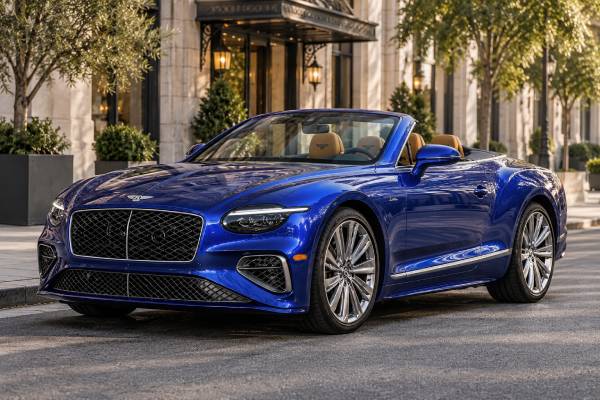
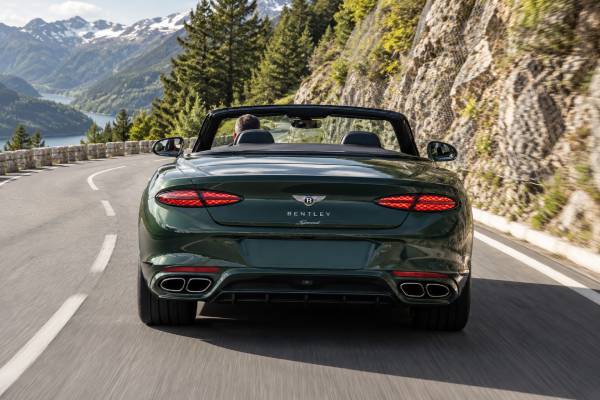
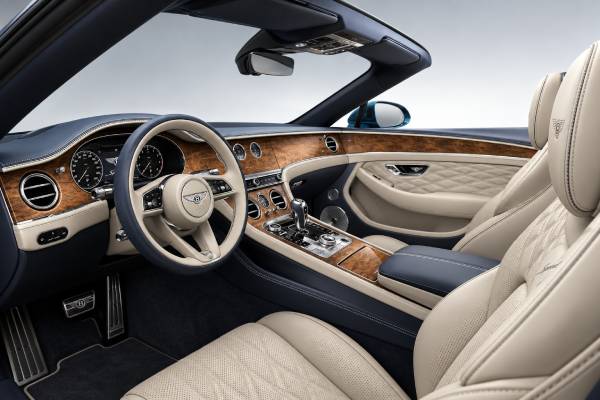
The 2024–present Bentley Continental GTC Speed places the 771 hp Ultra Performance Hybrid system beneath a four-seat fabric-roof body. It accelerates to 60 mph in 3.2 seconds, offers up to 50 WLTP electric miles and uses the same 25.9 kWh battery as the coupé, but its maximum speed is electronically limited to 177 mph. The lower figure reflects open-body, roof and tire priorities rather than a shortage of power. The engineering challenge is packaging: battery, roof stowage, rear seats, cooling circuits and luggage all compete for space and mass. A buyer should test the car in pure EV mode, through a complete AC charge and with the roof operating from cold and warm conditions. Software, rear-quarter glass, climate performance, brake blending and water management matter as much as acceleration. This GTC makes sense when silent roof-down local travel is a real habit, not just a brochure possibility.
Table of Contents
- Two personalities in one open-top Bentley
- GTC Speed hybrid specifications and packaging
- Roof engineering meets a 25.9 kWh battery
- Electric running, V8 performance and the 177 mph limit
- Charging habits and maintenance across three electrical systems
- Inspection priorities for an early fourth-generation GTC
- The buyer profile that makes this expensive complexity worthwhile
Two personalities in one open-top Bentley
The GTC Speed can begin a journey as a quiet electric convertible and finish it as a twin-turbo V8 grand tourer. Those two identities are not selectable decorations; they depend on one integrated drivetrain, a charged battery and a roof system sharing limited space in the rear of the car. The model’s appeal comes from the contrast, but its inspection must examine the points where those functions meet.
In electric operation, the transmission-mounted motor moves the car through the eight-speed dual-clutch gearbox. The cabin remains calm enough for roof, trim and suspension noises to become obvious. When the V8 starts, the transition should feel deliberate but smooth. A jolt, prolonged hesitation or warning may relate to engine start control, clutch adaptation, battery state or software. It should not be dismissed as normal merely because the system is complex.
With the roof lowered, the Speed becomes an unusually powerful open car. Its 1,000 Nm system output can arrive at low road speed, so tire condition and throttle calibration are critical. The active all-wheel-drive system, electronic rear differential, rear steering and stability logic help manage that force, but they cannot restore grip to aged or mismatched tires.
Roof-up, the GTC is intended to function as a serious long-distance GT. The multi-layer fabric top, glass adjustment and body sealing should create a stable acoustic environment. Wind noise from one corner, pressure flutter or damp trim indicates a fit or drainage issue, not an unavoidable consequence of choosing a convertible.
The 177 mph maximum is lower than the coupé’s 208 mph figure. That difference should be read as an engineering limit for the complete open-body package, including roof, aero and tires. It does not make the GTC slow; its 3.2-second 0–60 mph claim is only a tenth behind the fixed-roof Speed.
A buyer needs to decide which personality will be used most. Frequent local journeys, access to overnight charging and a climate suitable for open driving make the hybrid convertible coherent. A car kept away from a plug and driven mainly roof-up duplicates much of the coupé’s use while accepting less luggage space and additional roof complexity.
The strongest example demonstrates both sides in one inspection: it charges normally, drives electrically without warnings, blends the V8 cleanly, completes roof cycles without hesitation and remains dry and quiet when closed. A defect in either personality diminishes the reason to choose the GTC Speed over a simpler Continental.
GTC Speed hybrid specifications and packaging
These data belong to the Z24 GTC Speed, where the Ultra Performance Hybrid powertrain is packaged with a folding roof and a much smaller luggage bay. Its 177 mph limit is specific to the convertible even though system output matches the coupé. Battery capacity, charge rate, roof operation and open-body mass are presented together because all four shape real use. Check the individual car’s market certificate for final range and emissions values.
| Item | Specification |
|---|---|
| Powertrain class | Plug-in hybrid (PHEV) |
| Engine | 4.0L twin-turbo V8 plus transmission-mounted electric motor |
| Maximum output | 771 hp (782 PS; 575 kW) |
| Maximum torque | 1000 Nm (738 lb-ft) |
| Transmission | 8-speed dual-clutch transmission with integrated electric motor |
| Driven wheels | active all-wheel drive with eLSD and torque vectoring |
| Fuel tank | 80 L (21.1 US gal) |
| Measure | Value | Context |
|---|---|---|
| 0–60 mph | 3.2 seconds | Manufacturer claim |
| 0–100 km/h | 3.4 seconds | Manufacturer claim |
| Maximum speed | 177 mph (285 km/h), electronically limited | Factory limit or announced target |
| Traction battery | 25.9 kWh gross traction battery | Published gross capacity |
| Official electric range | 81 km (50 miles) WLTP electric range for the launch family | WLTP launch or family figure |
| AC charging | 11 kW AC charging, with no routine need for DC fast charging in this PHEV use case | Supply and temperature affect time |
| Dimension or capacity | Value |
|---|---|
| Body style | two-door, four-seat plug-in-hybrid convertible |
| Length | 4,895 mm (192.7 in) |
| Width | about 1,966 mm (77.4 in), excluding mirrors |
| Height | about 1,392 mm (54.8 in) |
| Wheelbase | 2,851 mm (112.2 in) |
| Kerb weight | about 2,636 kg (5,811 lb) kerb, configuration dependent |
| Luggage capacity | about 134 L (4.7 cu ft), depending on published market measurement |
| Component | Factory specification |
|---|---|
| Suspension and active systems | two-chamber air springs, dual-valve dampers, rear steering, 48-volt active anti-roll control and eLSD |
| Brake system | high-capacity iron brakes with carbon-ceramic option |
| Factory wheel context | 22-inch Speed wheels |
| Steering/stability distinction | the GTC launched alongside the coupé for the first time, using the same 782 PS system but an electronically limited 177 mph maximum |
| Area | Detail |
|---|---|
| Roof/body structure | seven-bow fabric roof, operable in 19 seconds at up to 30 mph (48 km/h) |
| Battery and charging | 25.9 kWh gross traction battery; 11 kW AC charging, with no routine need for DC fast charging in this PHEV use case |
| Seating | Four seats |
| Primary buyer verification | Match wheel, brake, chassis and market equipment to the VIN build record |
The GTC Speed carries the same 1,000 Nm system rating as the coupé, yet roof packaging raises mass, cuts boot space and produces a lower maximum speed. Those differences are deliberate engineering boundaries. Verify charge performance, roof operation and the exact brake system together, because no single headline number establishes the condition of this Z24.
Roof engineering meets a 25.9 kWh battery
A folding roof normally occupies the same rear-body volume that a plug-in hybrid would like to use for battery, cooling and high-voltage hardware. Bentley’s packaging preserves four seats, but it reduces luggage capacity and creates tight relationships among the roof stack, partition, rear trim and electrical components. Owners should treat the load-space rules as part of the mechanical specification.
The seven-bow fabric roof opens or closes in 19 seconds and can operate at up to 30 mph under the stated conditions. Test it first while stationary on level ground. Watch the front latch, frame joints, tonneau movement and rear-quarter glass. The two sides should move at the same rate, and the final seal should not require an extra command.
Repeat the test after a drive. Temperature changes can expose marginal sensors, stiff seals or a weak mechanism that behaves well only when cold. Listen for a motor that slows at one point or continues after the roof appears seated. Diagnostic data can show synchronization faults even when the cycle eventually completes.
The luggage separator protects the folded roof. Confirm that the car recognizes its position and refuses an unsafe command when appropriate. Do not bypass the switch to gain space. The battery already reduces the boot to about 134 litres, so the temptation to overpack is understandable, but contact with roof components can cause damage far beyond the value of an extra bag.
Water management is equally important. Inspect roof drains, header seals, door apertures, rear deck, boot floor and trim behind the seats. Look for mineral trails, tide marks, corrosion on fasteners and a sweet or musty smell. A recently detailed interior can hide visible evidence, so examine beneath accessible panels and use a moisture meter where appropriate.
High-voltage components must remain isolated from water ingress. Do not dismantle protected areas during a casual inspection. If dampness is found near electrical hardware, stop and obtain a qualified assessment. Drying the carpet does not address the source or confirm insulation integrity.
The roof also affects cabin thermal load. In strong sun or cold weather, the climate system may consume more battery energy than in the coupé. Test heating, cooling, seat ventilation, neck-level warm air and demisting in EV mode. The car should not need to start the engine merely because a climate function is malfunctioning.
A successful package feels ordinary in use: luggage rules are clear, the roof moves once, the glass seals and the battery supports the journey. That apparent simplicity is produced by many sensors and mechanisms. Buyers should value a dry, accurately adjusted car more highly than one whose unusual color combination distracts from roof or moisture evidence.
Electric running, V8 performance and the 177 mph limit
Electric driving is the most distinctive everyday feature of the fourth-generation GTC. A full battery can cover many local journeys without combustion, subject to weather, speed and cabin demand. Roof-down use may increase aerodynamic drag, while heating or cooling changes consumption. The displayed estimate should therefore be treated as a forecast based on recent use, not a measured capacity figure.
Begin an evaluation with a confirmed full charge. Select the electric operating mode, drive through town, climb a gradient and request moderate acceleration. The motor should move the car smoothly, and the gearbox should select ratios without a flare or thump. Note energy consumption over a known distance rather than comparing only the first and last displayed range numbers.
Next request enough power to start the V8. The engine should join without a severe shock. Because the car may have completed several miles electrically, combustion components can be cold while the rest of the vehicle is warm. Avoid immediate maximum demand and observe oil-temperature information where available.
The hybrid system’s combined 771 hp is not obtained by simply adding the V8 and motor peak ratings. Their maximum outputs occur under different conditions, and Bentley calibrates the integrated result. Performance can also vary with battery charge and temperature. A low-charge car should remain usable and fast, but repeated full-output events may not feel identical to those with substantial electrical reserve.
Regenerative braking recovers energy before or alongside the friction system. Test stops at several pedal pressures. The transition should not produce a surge, dead zone or inconsistent final creep. With the roof lowered, wind can disguise brake and tire noise, so repeat the assessment roof-up.
The 177 mph limit is specific to the convertible Speed. It protects the complete open-top configuration and should not be interpreted as a software restriction to remove. Aftermarket attempts to alter speed or power calibration can affect warranty, emissions compliance, thermal protection and driveline durability. A modified control unit reduces confidence in a new, highly integrated model.
At ordinary speeds, the active chassis should make the GTC feel stable rather than artificially stiff. Rear steering helps parking and turn-in, the eLSD supports corner exit, and Dynamic Ride controls roll. Test these functions on an uneven road as well as a smooth one. A performance car that works only on fresh asphalt has lost much of its grand-touring purpose.
The practical performance question is not whether the car can approach its limit. It is whether it can switch among silent motion, blended acceleration and sustained motorway travel without warnings or awkward transitions. That breadth is what the buyer pays for, and it can be evaluated safely without attempting extreme speed.
Charging habits and maintenance across three electrical systems
The GTC Speed combines a high-voltage propulsion network, a 48-volt active-roll system and a conventional 12-volt supply. These systems interact through control modules but require different tools and safety procedures. High-voltage service belongs to trained technicians. Orange cabling and battery enclosures should never be opened or probed during a home inspection.
The car accepts up to 11 kW AC charging and Bentley quoted roughly two hours and 45 minutes for a full charge under an appropriate supply. Verify the actual installation before expecting that rate. A single-phase outlet or lower-rated wallbox will extend the session. Test the supplied cable, inlet lock, status indicators and scheduled-charging functions.
The 12-volt battery remains crucial because it powers wake-up and communication. A weak unit can create messages involving systems that are mechanically healthy. Load-test it, confirm charging support and save the diagnostic scan before clearing anything. Replacement may require registration or adaptation.
For the traction battery, written warranty terms matter more than reassurance. Obtain market-specific documents showing duration, mileage, transfer conditions and any capacity provisions. Ask for campaign and software records. A successful charge proves basic operation but not the absence of stored insulation, thermal or cell-balance concerns.
Cooling circuits should be inspected without assuming they all use the same fluid or service method. The V8, charge-air system, motor, electronics and battery have different thermal needs. Residue around a reservoir or pump must be identified by circuit. Unexplained loss, charging derating or a fan that runs excessively requires data-led diagnosis.
The V8 needs annual attention even when electric miles dominate. Time-based oil service, filters, ignition inspection and fuel quality remain relevant. Exercise the engine fully warm and avoid storing old fuel indefinitely. At the same time, do not run the engine unnecessarily merely to “use it”; follow Bentley’s operating guidance.
Roof and electrical maintenance overlap. Keep drains clear using the approved method, inspect seals and investigate moisture immediately. Do not direct high-pressure water at the charging inlet or force connectors. Check that the flap and cap close securely before washing.
A balanced service visit should document:
- Charge rate on a known 11 kW-capable source where available.
- High-voltage scan, software level and warranty status.
- 12-volt battery state and 48-volt chassis fault history.
- V8 oil, filters, ignition and all cooling circuits.
- Roof cycles, glass indexing, drains and moisture readings.
- DCT operation in electric and hybrid modes.
- Brake blending, disc surfaces and fluid condition.
- Tire age, tread depth, wheel damage and rear-steer alignment.
The best maintenance record connects symptoms with conditions. It notes charge level, temperature, mode and roof position, allowing the next technician to reproduce a concern instead of searching blindly through a very complex car.
Inspection priorities for an early fourth-generation GTC
An early example should be inspected as both a new-generation electronic product and a convertible. Start with identity: decode the VIN, obtain the build sheet and confirm that the advertised car is the 771 hp Speed rather than the 671 hp High Performance Hybrid with cosmetic options. Verify market, model year, brake system, wheels and driver-assistance equipment.
Request that the battery be charged before arrival and that the car remain cold. Photograph the displayed charge and estimated range, then connect to a known supply to confirm communication and input power. Check both charging keys or cards, cables and any app access being transferred.
Perform two roof cycles before driving. Inspect alignment and sealing, then search the boot and cabin for water evidence. The reduced luggage area and roof separator should be complete and undamaged. Missing trim or a forced partition may indicate previous overloading.
Drive the first section electrically with the roof raised. Silence makes it easier to hear suspension knocks, wheel-bearing hum, seal whistle and trim movement. Test steering center, rear-steer maneuverability and brake blending. Then lower the roof and repeat a short route to distinguish wind effects from mechanical sounds.
Bring in the V8 gradually and test several transmission loads. The start event should not cause a violent shunt. After full warm-up, use strong legal acceleration, then return to gentle driving. Watch for reduced-performance messages, coolant warnings or changes in brake feel as the battery state shifts.
The workshop portion should include a complete module scan, software and campaign review, battery and charging data, cooling-system inspection and underbody examination. Look for damage to aero panels, battery shielding and jacking points. High kerbs can harm more than the visible front splitter.
Check the 22-inch wheels inside and out. A repaired face may conceal a distorted barrel. Measure all four tires and confirm matching specification. The vehicle’s torque, weight and active driveline make mixed or aged tires an immediate concern.
Confirm every luxury function because option replacement can be expensive: rotating display where fitted, audio, cameras, seat motors, ventilation, neck warmers, climate zones and powered access. Connectivity services should be demonstrated rather than promised.
A useful early-car file contains the original order, delivery inspection, all software visits, charging accessories and repeatable diagnostic reports. Sparse mileage with no charging or update evidence is not automatically reassuring. The buyer needs proof that the car has been operated through its complete range, not simply stored as a new object.
The buyer profile that makes this expensive complexity worthwhile
This GTC is most persuasive for an owner with secure home charging, regular short journeys and a genuine preference for open motoring. Such a driver can use electric mode in residential areas, lower the roof for local trips and rely on the V8 for distance. The powertrain then serves daily life rather than existing solely as an impressive specification.
A buyer who parks on the street without dependable charging should pause. Destination charging can help, but a large PHEV is less convenient when every refill requires a special trip. The V8 prevents range anxiety, yet carrying a battery that is rarely charged weakens the efficiency and refinement argument.
The coupé Speed is the alternative for maximum speed, luggage and roof-up rigidity. It reaches 208 mph and has a larger boot. The core GTC High Performance Hybrid provides 671 hp and a more comfort-oriented position, which may be sufficient for road use. A late W12 GTC Speed offers twelve-cylinder sound and historical finality but cannot provide silent electric travel.
Specification priorities should be personal. Touring and comfort options may add more value to a convertible than the most aggressive appearance package. Carbon-ceramic brakes suit repeated high-load use but introduce substantial replacement exposure. Standard iron brakes remain capable and may fit a road-touring budget better.
This is not the rational choice for someone seeking simple open-air transport. It is a compelling choice for a driver who will exploit the contrast between silent roof-down movement and full V8 performance, while accepting that roof, charging and active chassis systems all need evidence-based care.
The deciding test is a week’s routine translated into energy and weather: where the car sleeps, how often it can charge, how many miles are local, how often the roof will lower and where specialist support exists. When those answers align, the GTC Speed’s complexity produces capabilities no previous Continental convertible combined. When they do not, a less elaborate GTC may deliver more satisfaction at lower risk.
References
- Bentley News 2024 : The new Continental GT Speed: redefining the definitive Grand Tourer 2024 (Official Model/Technical Source)
- Continental GT Range 2025 (Official Model/Technical Source)
- Bentley Continental GT | Luxury Hybrid Coupé | Bentley Motors 2026 (Official Model/Technical Source)
- Bentley News 2025 : New High Performance Hybrid Continental GT, GTC and Flying Spur – the daily supercar family expands 2025 (Official Model/Technical Source)
- Check for Recalls: Vehicle, Car Seat, Tire, Equipment | NHTSA 2026 (Recall/Service Source)
- Technical Service Bulletin 2076639/2 2025 (Recall/Service Source)
Disclaimer
This article provides general buying and ownership information. It is not a repair procedure, and high-voltage components must be inspected or serviced only by personnel trained for the specific Bentley system. Always verify specifications, charging capability, campaigns and warranty terms against the vehicle’s VIN and market documents.
If this guide helps, share it on Facebook, X/Twitter or with someone comparing hybrid Continental convertibles.