

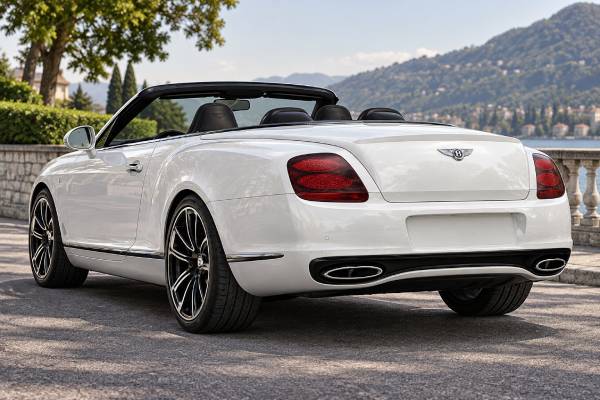
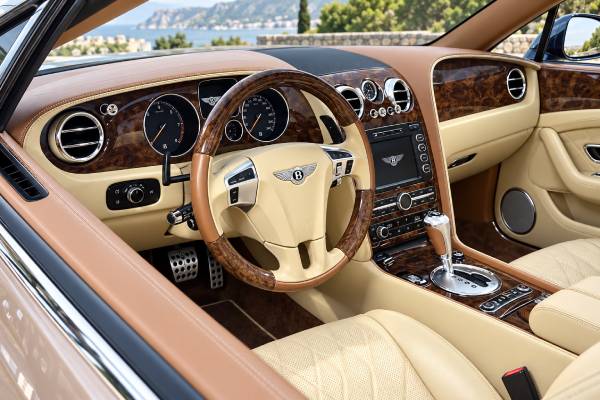
The second-generation Continental GTC W12 is a rare kind of convertible: a four-seat, all-wheel-drive grand tourer capable of 314 km/h (195 mph) while carrying a powered fabric roof and nearly 2.5 tonnes of structure, leather, and machinery. Its 6.0-liter twin-turbo W12 produces 567 bhp and 700 Nm (516 lb-ft), giving the car effortless pace rather than the sharp, high-rev character of a conventional sports car.
The specification range is more complicated than the badge suggests. Early cars use a six-speed Quickshift automatic; later 567 bhp examples can have an eight-speed unit. Registrations near 2015 may overlap with the later 582 bhp facelift, outside this engine scope. Roof condition, water management, battery health, tires, cooling, air suspension, and brake equipment can matter more than mileage. Identify the exact build first, then inspect the convertible systems and W12 powertrain together. A beautiful cabin is valuable, but dry carpets, clean diagnostics, and a complete service trail make the car usable.
Table of Contents
- The Open W12 Grand Tourer Explained
- 567 hp GTC Data and Dimensions
- Roof, Water, and Body Integrity
- Powertrain Choices Within the Same Badge
- Maintenance by System, Not by Appearance
- A Convertible-Specific Buying Audit
- Living With the GTC W12
The Open W12 Grand Tourer Explained
The 567 bhp GTC is the standard W12 convertible of the second-generation Continental family. It emphasizes refinement and broad performance, with a softer chassis tune and quieter appearance than the GTC Speed.
The body is a steel monocoque strengthened for roofless operation, with aluminum and composite panels used in selected areas. A four-layer insulated fabric roof closes over a four-seat 2+2 cabin and folds beneath a flush cover in roughly 25 seconds. Rollover protection is integrated behind the rear occupants. The structural reinforcement and roof mechanisms contribute to an EU curb weight of about 2,495 kg (5,501 lb).
The engine is Bentley’s 5,998 cc W12, mounted longitudinally ahead of the cabin. Twin turbochargers and charge-air cooling help produce 567 bhp at 6,000 rpm. Peak torque arrives at only 1,700 rpm, so the car accelerates strongly without frequent downshifts. Early model literature also describes FlexFuel ability in certain markets. Owners should use only the octane and ethanol blend approved for the specific VIN and region.
The center differential gives the rear axle the larger nominal share—60 percent—while retaining 40 percent at the front. This gives the second-generation GTC a more rear-led balance than its predecessor while maintaining secure traction. The Torsen center differential reacts mechanically to grip variation, but it depends on four compatible tires. Different rolling circumferences or unsuitable ratings can compromise both driveline and handling.
The suspension uses air springs and continuously controlled dampers at all four corners. The car can maintain ride height despite passengers and luggage, and it adjusts damping to road and driver selection. The standard W12 calibration favors compliance. A healthy example should absorb rough surfaces without excessive float, sharp impact, or repeated body movement.
Launch cars use a six-speed automatic with Quickshift, steering-column paddles, and double-downshift capability. Later 567 bhp cars gained an eight-speed automatic in many markets. This change improves ratio spacing and cruising efficiency but does not alter the fundamental W12 character. Because registration year is an imperfect guide, the gearbox should be confirmed through the build sheet and vehicle data.
The standard W12 can be mistaken for or cosmetically converted toward a Speed. Wheels, grilles, and exhaust tips are not decisive. Confirm engine output, suspension specification, brake option, factory trim, and original market. The correct model record protects against both mispricing and ordering the wrong parts.
567 hp GTC Data and Dimensions
The 394 GTC W12 is an internal-combustion convertible with a front-longitudinal twin-turbo engine, automatic transmission, permanent AWD, air suspension, and four-seat packaging. The early technical data below provides the clearest common baseline; later gearbox and certification details can differ.
| Item | Specification |
|---|---|
| Engine type | 5,998 cc twin-turbocharged W12 |
| Position | Front, longitudinal |
| Construction | Aluminum-alloy block and heads, 48 valves |
| Bore × stroke | 84.0 × 90.2 mm (3.31 × 3.55 in) |
| Maximum power | 567 bhp / 575 PS / 423 kW at 6,000 rpm |
| Maximum torque | 700 Nm (516 lb-ft) from 1,700 rpm |
| Fuel | Premium gasoline; approved FlexFuel capability on applicable market cars |
| System | Specification |
|---|---|
| Early transmission | ZF six-speed automatic with Quickshift and paddles |
| Later transmission | ZF eight-speed automatic on later 567 bhp examples |
| Driveline | Permanent AWD, nominal 40:60 front/rear torque split |
| Front suspension | Four-link double wishbones with self-leveling air springs |
| Rear suspension | Trapezoidal multi-link with self-leveling air springs |
| Damping | Continuous electronic damping control |
| Steering | Speed-sensitive Servotronic rack, about 2.6 turns lock to lock |
| Item | Early factory specification |
|---|---|
| Front iron brakes | 405 mm ventilated discs |
| Rear iron brakes | 335 mm ventilated discs |
| Optional carbon ceramics | 420 mm front / 356 mm rear cross-drilled CSiC discs |
| Standard wheels | 9.5J × 20-inch |
| Standard tire size | 275/40 ZR20 |
| Optional size | 9.5J × 21-inch with 275/35 ZR21 tires |
| Measure | Metric | Imperial |
|---|---|---|
| Wheelbase | 2,746 mm | 108.1 in |
| Overall length | 4,806 mm | 189.2 in |
| Body width | 1,943 mm | 76.5 in |
| Width including mirrors | 2,227 mm | 87.7 in |
| Height, roof raised | 1,403 mm | 55.2 in |
| EU curb weight | 2,495 kg | 5,501 lb |
| Fuel tank | 90 L | about 23.8 US gal |
| Trunk volume | 260 L | 9.2 cu ft |
| Measure | Published figure |
|---|---|
| 0–60 mph | 4.5 seconds |
| 0–100 km/h | 4.8 seconds |
| 0–100 mph / 0–160 km/h | 10.9 seconds |
| Maximum speed | 314 km/h (195 mph) |
| European combined cycle | 16.5 L/100 km (17.1 mpg imperial) |
| Early U.S. cycle | 11 mpg city / 19 highway / 14 combined |
Later eight-speed cars may have different certified economy and acceleration. Equipment changes mass. VIN-specific official data must control service procedures, tire pressures, fluids, capacities, and torque values.
Roof, Water, and Body Integrity
The roof and drainage system should be treated as a primary mechanical assembly. Water entry can damage trim, wiring, audio components, control modules, and connectors before the driver sees a visible puddle.
Begin with the fabric. Inspect it dry and clean, under daylight, from front header to rear glass. Look for scuffs at fold points, pulled stitching, shrinkage, uneven color, repaired punctures, loose rear-window bonding, and areas that remain damp. A recently treated roof may repel water beautifully while still hiding a sealing or drain problem.
Operate a full cycle with the battery in a known healthy state. The windows should index down, the header should unlatch, the storage cover should move, the frame should fold without striking trim, and the system should confirm completion. On closing, the roof must tension evenly and every window must reseal. Grinding, pauses, repeated warnings, or manual assistance requires diagnosis.
Repeat the test after the road drive. Hydraulic fluids, pumps, motors, sensors, and linkages can behave differently when warm. Low voltage can also produce incomplete cycles, but a battery explanation should be proven with capacity and charging tests rather than accepted casually.
Water-management inspection needs access to low points. Check beneath mats, around front footwells, under accessible rear carpet edges, in the trunk, near the battery, and behind side trim where the technician can inspect without damage. Look for tide marks, mineral residue, corrosion, green connector deposits, musty odor, fresh sound insulation, and inconsistent carpet color.
Door and side-glass alignment matters. The glass lowers slightly when a door is opened and rises into the roof seal when closed. Slow regulators, door-module faults, or incorrect adjustment can cause wind noise and leaks. Test both doors repeatedly, including with the roof down.
The steel structure should feel rigid over diagonal bumps. Some trim noise is possible with age, but sharp cowl shake, a clunk from the roof frame, or a door aperture that visibly moves calls for closer body and suspension inspection. Previous collision repair can disturb roof geometry even when paintwork looks excellent.
Check the underside for damaged jacking points, missing aerodynamic panels, bent braces, and corrosion in trapped areas. The GTC is low and wide; careless lifting can damage covers and pinch seams. Front cooling openings should be clear, and the radiator stack should not be packed with debris.
A leak test should be controlled, not a pressure-washer assault. The goal is to trace normal rainfall paths, confirm drains flow, and observe seals. High-pressure water can force entry into a healthy convertible and create misleading results.
Powertrain Choices Within the Same Badge
The six-speed and eight-speed 567 bhp cars share the same core engine character, but they feel different enough that buyers should drive both when possible. Choice should follow use and condition rather than internet claims about one being universally better.
The six-speed Quickshift unit has wider gaps and a distinct, muscular response. Its software can request a direct double downshift, helping the engine access its torque quickly. In normal operation it should be smooth, with prompt Drive and Reverse engagement and no flare between gears.
The eight-speed offers a shorter first ratio and closer spacing, so it can keep the W12 in a more precise operating range. Seventh and eighth reduce cruising revs. It may shift more often, but healthy programming makes those changes unobtrusive. Hunting, shudder, harsh engagement, or delayed response needs diagnosis.
Both gearboxes depend on engine torque management, mounts, control adaptation, fluid condition, and a sound AWD system. A thump can originate in a mount, prop shaft, differential, or control strategy. A transmission specialist familiar with Bentley applications should evaluate the complete system before parts are condemned.
The W12 itself should start cleanly, idle evenly, and deliver boost without hesitation. Misfire counters and fuel trims are more useful than a short impression from the driver’s seat. Plugs and coils are common diagnostic paths, but injectors, pressure, air leaks, sensors, wiring, and mechanical condition must be considered.
Cooling load is substantial. Inspect radiators, fans, hoses, reservoirs, charge-air circuits, and any dried residue above the undertrays. A car should maintain stable temperature during traffic, moderate acceleration, and heat soak. Coolant odor after shutdown or repeated top-up is not normal.
Approved fuel varies. Do not assume every 567 bhp GTC should be run on E85 because launch marketing mentioned FlexFuel. Confirm the market handbook, fuel-system equipment, and current manufacturer guidance. If the car has been stored with high-ethanol fuel, ask for fuel-quality and running-condition assessment.
The correct powertrain is the one documented and maintained. A clean early six-speed car can be more satisfying than a neglected later example. Conversely, an eight-speed car may suit owners who spend more time on highways. History should break the tie.
Maintenance by System, Not by Appearance
The most economical ownership plan is organized around systems and failure consequences. Cosmetic freshness cannot compensate for old tires, wet modules, weak batteries, or an unresolved cooling leak.
Use a written schedule that includes both official intervals and annual condition checks. Low annual mileage does not stop brake fluid, coolant, rubber, roof seals, batteries, or tires from aging. Service stamps should be supported by invoices describing what was inspected and replaced.
Maintain the car in priority order:
- Water exclusion: clear roof and body drains, correct seal or glass alignment, dry affected areas properly, and diagnose any corroded connector.
- Battery and charging: test capacity, check charging voltage and parasitic draw where appropriate, and use a compatible maintainer during storage.
- Tires: fit four matching tires with correct size, load index, speed rating, and similar tread depth; inspect inner shoulders and date codes.
- Brakes: measure iron discs and pads; assess carbon ceramics under approved criteria; renew fluid at the specified time.
- Cooling: clean heat exchangers, test fans, pressure-test when indicated, and investigate every coolant odor or residue.
- Engine: use approved oil, record consumption, monitor misfires and fuel trims, and address warning lights before catalyst damage.
- Transmission and AWD: identify the exact gearbox, follow the correct fluid procedure, and inspect differential and driveline seals.
- Air suspension: repair leaks before compressor duty rises, verify level sensors, and evaluate dampers in every mode.
- Roof mechanism: lubricate only where official instructions permit, maintain alignment, and exercise the roof under suitable conditions.
Electronics deserve a complete function check at each annual visit. Seat motors, memories, neck warmers if fitted, steering column, windows, mirrors, climate control, infotainment, audio, telephone, parking sensors, camera, adaptive cruise, tire-pressure monitoring, lights, trunk, and both keys should be tested. A list prevents convenient features from being forgotten until sale time.
Storage is an active process. Park with the roof raised, clean, and dry. Support the battery. Keep pressures correct and avoid prolonged weight on underinflated tires. Do not run the engine for a few minutes as a substitute for driving. Either store it properly or complete a journey long enough to heat the whole driveline.
A Convertible-Specific Buying Audit
A proper inspection should take several hours and should begin with the car cold. It must include two roof cycles, all-module diagnostics, a road test, a hot restart, and examination on a lift.
Ask for the VIN, build record, service invoices, title history, recall status, and two keys before the appointment. Confirm 567 bhp engine scope, transmission type, brake option, original market, paint, interior, and major packages. A 2015 registration should be checked carefully to exclude the 582 bhp facelift when exact specification matters.
The technician should document:
| Area | Minimum evidence |
|---|---|
| Roof | Cold and warm cycles, seal inspection, sensor faults, dry low points, working window indexing |
| Engine | Cold start, misfire data, fuel trims, smoke check, stable hot idle, leak inspection |
| Cooling | Fan operation, residue check, pressure test when indicated, stable temperature after heat soak |
| Transmission | Positive identification, cold/hot engagement, shift behavior, fault and adaptation review |
| Suspension | Overnight ride height, compressor behavior, damper response, joints and alignment wear |
| Brakes and tires | Measurements, ceramic assessment if fitted, matching tire set, dates, inner-edge condition |
| Electrical | Battery test, full-module scan, every comfort function, no unexplained cleared history |
On the road, avoid full throttle until fluids are warm and tire condition is known. Check tracking, vibration, shift quality, boost consistency, damping modes, braking, wind noise, and roof-frame sounds. Continue long enough for the cooling system and transmission to reach operating temperature.
Afterward, lift the car. Look above and around undertrays for oil or coolant residue, inspect air springs and dampers, check bushings and boots, examine wheel repairs, and locate any fresh fluid. Photograph defects and obtain specialist estimates.
Reject or pause a purchase with unresolved water damage, overheating, active misfires, structural uncertainty, incomplete roof operation, severe tire mismatch, damaged carbon brakes, or a seller who refuses diagnosis. Smaller faults can be negotiated when their cost is known.
The final report should separate safety work, overdue maintenance, likely one-year repairs, and cosmetics. This prevents a worn seat bolster from receiving the same weight as a leaking roof or unsafe tire.
Living With the GTC W12
The GTC W12 rewards owners who use it for meaningful journeys and maintain it before faults become emergencies. It is less suited to someone seeking a simple seasonal toy that can be parked unattended for most of the year.
Its practical strengths are real. The roof makes fair-weather travel special, AWD broadens the season, the rear seats can carry children or bags, and the cabin remains quiet with the roof raised. The 260-liter trunk is modest, so long-distance travelers should pack deliberately and keep the roof-storage area clear.
Choose 20- or 21-inch wheels according to road quality and appearance preferences. The 20-inch setup provides more sidewall, while 21s offer a sharper look and response. Correct, fresh tires matter more than wheel diameter. Avoid buying a car merely because it has expensive carbon brakes; buy them only when condition and future budget are understood.
Before the first tour, establish a baseline. Verify pressures, fluids, battery, roof drains, spare key, recovery arrangements, and scan status. Carry the correct handbook and know how to use the electronic parking brake and towing provisions. A low car with AWD requires appropriate recovery equipment.
Keep every invoice and diagnostic report. Note roof work, drain cleaning, tire dates, brake measurements, alignment, battery replacement, fluid specifications, and software changes. Detailed records preserve value and make intermittent faults easier to trace.
The standard 567 bhp GTC is often overshadowed by Speed models, but that can be its advantage. It delivers nearly all the drama of a W12 convertible with a more compliant setup and subtler appearance. The right example should feel calm at low speed, powerful without effort, dry inside, and mechanically consistent after a long drive.
Its appeal depends on completeness. The roof, glass, W12, automatic, AWD, suspension, brakes, and electronics must all contribute to the same refined experience. Buy the car whose evidence shows that they do; then maintain that standard rather than waiting for the dashboard to demand attention.
References
- Bentley Motors UK Press – TECHNICAL SPECIFICATION 2011 (Technical Specification)
- CONTINENTAL GT AND GTC 2012 (Manufacturer Brochure)
- Vehicle Detail Search – 2012 Bentley Continental GTC | NHTSA 2012 (Recall Database)
- 2012 Bentley Continental GTC 2012 (EPA Fuel Economy)
- Tested: 2013 Bentley Continental GTC V8 2013 (Body and Chassis Context)
Disclaimer
This guide is for informational purposes and cannot replace professional diagnosis, repair, or an independent specialist inspection. Specifications, torque values, service intervals, and procedures vary by VIN, market, transmission, build date, and equipment; verify every job against official Bentley documentation. Please share the article on Facebook, X/Twitter, or another platform if it supports careful ownership.