

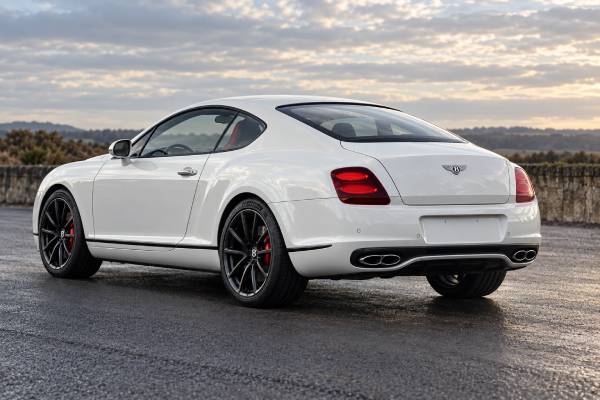
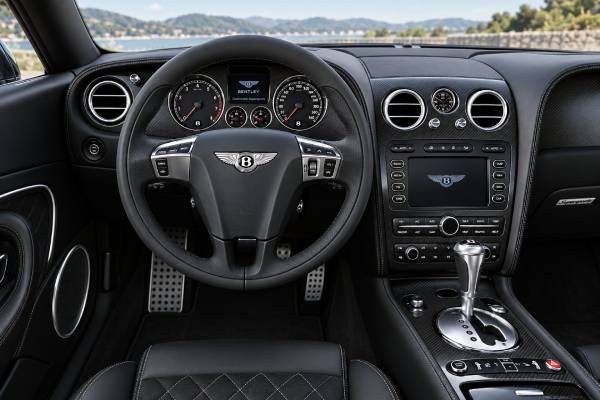
The first Continental Supersports was a deliberate attempt to remove mass and add focus to Bentley’s already formidable W12 coupe. Power increased to 621 bhp, torque reached 800 Nm (590 lb-ft), the normal driveline balance sent 60 percent of torque rearward, carbon-ceramic brakes became central to the package, and the cabin could be configured with two lightweight carbon-fiber seats. Bentley claimed 0–100 km/h in 3.9 seconds and 329 km/h (204 mph), making it the fastest production Bentley of its time.
Its appeal today is broader than the numbers. The Supersports was also Bentley’s first production FlexFuel car, capable of adapting to gasoline, E85 bioethanol, or a mixture where approved fuel was available. It combined that unusual environmental statement with weight reduction, wider rear track, revised bodywork, and a more aggressive chassis. Used examples must be assessed as rare, high-load performance cars. The brake system, original wheels, carbon trim, seat specification, cooling health, tire fitment, service records, and model authenticity all matter materially to value.
Table of Contents
- From Continental to Supersports
- Supersports Factory Data
- FlexFuel W12 and Quickshift
- Brakes, Tires, and Weight Reduction
- Preserving a Rare Performance Bentley
- Authenticity and Condition Audit
- Buying for Use or Collection
From Continental to Supersports
The Supersports was engineered as a distinct top model rather than a cosmetic Speed edition. Bentley combined a more powerful FlexFuel W12 with rear-biased all-wheel drive, weight savings of roughly 110 kg, a wider rear track, revised aerodynamics, and enormous carbon-ceramic brakes.
The engine remained a 5,998 cc, twin-turbocharged W12, but airflow increased and calibration changed to produce 621 bhp, or 630 PS, at 6,000 rpm. Torque rose to 800 Nm and remained available across a broad 1,700–5,600 rpm range. The wider plateau matters more in daily driving than the peak number: the car can accelerate hard in almost any gear without waiting for a narrow rev window.
Bentley retained the six-speed automatic but introduced a faster Quickshift strategy. It could perform double downshifts and cut shift time compared with the regular GT. The hardware still behaves like a refined torque-converter transmission, so buyers should not expect the instant response of a later dual-clutch gearbox. It should, however, engage cleanly and respond consistently in manual and automatic modes.
The all-wheel-drive calibration normally sends 40 percent of torque to the front axle and 60 percent to the rear, unlike the more neutral distribution associated with earlier GTs. That rear bias helps the car rotate and makes throttle adjustment more useful through a bend. Stability control remains available, and the chassis is designed to make 621 bhp manageable rather than theatrical.
Weight reduction came from several areas. Lightweight 20-inch forged wheels saved rotating and unsprung mass. Aluminum suspension components reduced weight at the corners. Carbon-fiber sports seats were about half the weight of the standard seat assemblies. The rear seat was deleted in the strict two-seat configuration, though some markets and later customer choices complicate equipment descriptions. Even carpets and trim were reconsidered. Bentley quoted a curb weight around 2,240 kg (4,938 lb), still substantial but meaningfully below a standard GT.
The body also changed. Twin bonnet vents improve engine-bay airflow, the front openings are larger, the rear track is wider, the rear spoiler is more prominent, and smoked-steel exterior detailing replaces much of the bright chrome. These features are part of the car’s engineering identity. Missing or imitation parts should affect both purchase confidence and valuation.
Supersports Factory Data
The following specifications apply to the 621 hp first-generation Supersports coupe. They must not be confused with the 2017 second-generation Supersports, the 600 hp GT Speed, or the 621 hp convertible’s different weight and body measurements.
| Specification | Value | Important distinction |
|---|---|---|
| Engine | Twin-turbocharged 48-valve W12 | Gasoline/FlexFuel internal-combustion engine |
| Displacement | 5,998 cc (6.0 L) | 84.0 mm bore × 90.2 mm stroke |
| Maximum power | 621 bhp / 630 PS / 463 kW at 6,000 rpm | Factory rating |
| Maximum torque | 800 Nm (590 lb-ft) at 1,700–5,600 rpm | Broad torque plateau |
| Compression ratio | 9.0:1 | Supersports specification |
| Fuel capability | Gasoline, E85 bioethanol, or a compatible mixture | Fuel availability and ethanol content vary by market |
| Fuel-tank capacity | 90 L (23.8 US gal) | Single tank with fuel-composition sensing |
| System | Supersports configuration |
|---|---|
| Transmission | Six-speed automatic with Quickshift programming and paddles |
| Drive type | Permanent all-wheel drive |
| Normal torque split | 40 percent front / 60 percent rear |
| Shift function | Faster changes and double downshift capability |
| Stability system | Electronic stability program with performance-oriented calibration |
| Rear track | Wider than the standard GT |
| Measure | Value | Test basis |
|---|---|---|
| 0–60 mph | 3.7 seconds | Bentley claim |
| 0–100 km/h | 3.9 seconds | Bentley claim |
| 0–160 km/h | Less than 9 seconds | Factory statement |
| Maximum speed | 329 km/h (204 mph) | Bentley claim |
| 2010 U.S. EPA economy | 12 mpg city / 19 mpg highway / 14 mpg combined | Premium gasoline test listing |
| EPA estimated tank range | 333 miles | Displayed U.S. combined-cycle estimate |
| Component | Factory specification |
|---|---|
| Suspension | Independent air suspension with electronic damping and Supersports tuning |
| Wheels | 20-inch lightweight 10-spoke alloy wheels |
| Front tires | 275/35 ZR20 in common factory fitment |
| Rear tires | 275/35 ZR20 in common factory fitment |
| Front brake discs | 420 mm carbon-ceramic |
| Rear brake discs | 356 mm carbon-ceramic |
| Brake purpose | High thermal capacity with reduced unsprung mass |
| Measurement | Value |
|---|---|
| Body style | Two-door coupe |
| Seating | Two in the lightweight factory concept; equipment can vary by car and market |
| Length | 4,804 mm (189.1 in) |
| Width | 1,945 mm (76.6 in), excluding mirrors in commonly published data |
| Height | 1,380 mm (54.3 in) |
| Wheelbase | 2,745 mm (108.1 in) |
| Kerb weight | Approximately 2,240 kg (4,938 lb) |
| Weight reduction | Approximately 110 kg versus the contemporary GT Speed |
FlexFuel W12 and Quickshift
The Supersports’ fuel system automatically identifies the gasoline-to-ethanol blend and adjusts engine management accordingly. That capability is technically significant, but owners should not assume that any ethanol-rich fuel is appropriate in every country, storage pattern, or season.
A sensor in the fuel circuit measures the blend and sends information to the engine control system. The calibration then changes fueling and ignition to maintain performance. E85 contains less energy per unit volume than gasoline, so consumption normally increases even when octane resistance supports strong performance. Availability, labeling, seasonal composition, and legal standards differ by region.
Long-term storage deserves special care. Ethanol blends can absorb moisture, and fuel quality can deteriorate. A collector car that sits for months should follow Bentley and local fuel guidance rather than generic internet advice. Do not add unapproved stabilizers or alternate fuels without confirming compatibility. If a car has been stored with old fuel, inspect and diagnose before demanding full boost.
The engine should deliver smooth torque regardless of an approved fuel mixture. Hard starting, unstable idle, fuel-trim faults, misfire, or hesitation should not be dismissed as “the E85 setting.” Verify actual fuel content, pressure, sensor operation, ignition condition, injectors, and stored adaptation data.
Quickshift gives the automatic a more urgent character. In hard braking it can select two lower ratios, helping place the engine in the torque band before corner exit. During normal driving it should retain Bentley smoothness. A transmission that slams into gear, flares, shudders, or delays reverse engagement needs investigation.
The rear-biased torque split also changes how the car feels. The Supersports is more willing to rotate under power than a standard early GT, yet it remains AWD and front-engined. On wet or cold roads, correct tire temperature and tread condition remain decisive. Stability-control intervention should be treated as a safety net, not a substitute for suitable tires.
Brakes, Tires, and Weight Reduction
The carbon-ceramic brakes are among the car’s defining parts and among the most expensive items to evaluate incorrectly. Their condition can affect the purchase price by a substantial amount, so inspection should be performed by someone familiar with Bentley’s measurement and damage criteria.
The 420 mm front discs were exceptionally large for a production car. They provide high thermal resistance and reduce unsprung mass relative to equivalent iron hardware. That helps steering response and repeated high-speed braking. Their long potential life depends on avoiding impact damage, incorrect wheel handling, incompatible pads, contamination, and extreme wear.
A visual check should look for edge chips, cracks, abnormal surface changes, impact marks, missing material, and evidence that a wheel has been dropped against a disc. The specialist should identify the disc part numbers, examine wear indicators or measurement data where applicable, inspect pads and calipers, and check service records. Surface appearance varies, so casual judgments are unreliable.
Brake feel may be different when cold or wet, but the pedal should remain firm and the car should stop straight. Persistent grinding, vibration, warning lights, or a large left-to-right temperature difference requires diagnosis. Parking-brake operation is separate and must also be tested.
The lightweight wheels are valuable original components. Inspect inner barrels for bends and cracks, confirm correct dimensions and offsets, and look for poor refurbishment that obscures damage. Replacement wheels should match the engineering requirements, not merely fit over the hubs.
Tires connect every chassis change to the road. They should be a matched set with suitable load and speed ratings, similar tread depth, and recent date codes. The 40:60 driveline still depends on closely matched rolling circumference. Uneven inner wear can reveal alignment, bush, damper, or ride-height problems.
Weight-reduction parts also require authenticity checks. Carbon-fiber seats, rear-seat deletion components, carbon trim, lightweight carpets, and specific hardware can be costly to restore. A car converted to standard seats may be more comfortable but less original. Determine whether the change was factory, dealer, or owner performed and whether all removed parts remain with the car.
Preserving a Rare Performance Bentley
Maintenance should protect originality as well as function. A Supersports is rare enough that undocumented substitutions, generic brake parts, cut wiring, or irreversible tuning can reduce both reliability and collector appeal.
Begin with a baseline inspection even when records appear complete. Scan every control module, test both batteries, pressure-check the cooling system, inspect air suspension, measure brakes, document tire condition, and examine the underbody. Photograph original labels and part numbers before components are replaced.
The W12 needs correct oil, filter, level procedure, and leak inspection. Its engine bay is crowded, so apparently minor coolant, vacuum, or ignition work can require major disassembly. Use a workshop that plans the job properly and replaces disturbed seals, one-time fasteners, and aged adjacent hoses where the official procedure requires them.
Cooling performance is especially important on a 621 bhp car. Radiators and condensers can collect debris, fans can age, plastic fittings can become brittle, and small leaks can evaporate before reaching the floor. Monitor pressure, temperature behavior, coolant odor, and fan operation rather than relying on the dashboard gauge alone.
Air suspension must hold the intended ride height. A leak can overwork the compressor; worn bushes can alter alignment; failed dampers can overload tires and brakes. Because the car is lower and wider than a standard GT, incorrect setup is easier to feel and more consequential.
Battery voltage is the foundation of trustworthy diagnostics. A weak supply can generate unrelated-looking faults across transmission, suspension, steering lock, parking brake, and comfort systems. Test the system before clearing codes. A tender is appropriate for storage, but it does not prove battery capacity or absence of parasitic draw.
Recommended preservation records include:
- Fuel type and date added, especially before storage.
- Oil specification, quantity, filter number, and sample observations.
- Brake-disc condition reports and photographs.
- Wheel measurements, refinishing history, and tire date codes.
- Suspension heights and alignment printouts.
- Full module scans before and after repairs.
- Original parts retained after reversible changes.
- Recall and campaign completion documents tied to the VIN.
Authenticity and Condition Audit
A credible Supersports purchase starts by proving what the car is. VIN decoding, build documentation, original invoice, option list, and service history should agree with its body, interior, wheels, brakes, and seating configuration.
Examine exterior details methodically. The bonnet vents, front bumper openings, smoked-steel trim, mirrors, rear spoiler, wider rear stance, rear valance, tailpipes, lamps, badges, and wheels should be correct. Inconsistent paint texture, missing fasteners, poor panel alignment, or nonstandard trim may indicate accident repair or imitation conversion.
The interior should contain the expected mixture of hide, Alcantara, carbon fiber, and model-specific details. Carbon seats are expensive and can suffer bolster wear, shell damage, loose mounting, or altered wiring. Verify seat-belt and airbag systems after any seat change. Check that warning lamps illuminate during the normal self-test and then extinguish.
Inspect water-management areas. Plenum drains, seals, luggage wells, rear lamp areas, and module locations should be dry and free from corrosion. Rare model status does not protect the car from the same blocked-drain and low-voltage risks as other 3W cars.
A cold mechanical assessment should include oil and coolant condition, leak inspection, compression or further engine testing when symptoms justify it, boost behavior, fuel-trim balance, misfire counters, transmission adaptations, suspension heights, brake data, and drivetrain noise. Run the scan before and after the road test.
The road test should build gradually. Check low-speed steering and parking-brake release, then rough-road body control, steady-throttle transmission behavior, moderate acceleration, and full-load performance only after warm-up. Braking should be progressive and straight. Any vibration must be isolated to wheel, tire, brake, hub, suspension, or driveline rather than blamed on “big ceramic brakes.”
Modification history deserves extra scrutiny. ECU tuning, exhaust changes, lowering links, wheel spacers, nonfactory wheels, or altered intake parts can affect heat, emissions, calibration, and value. Ask who performed the work, what testing supported it, and whether the original parts and software are available.
Buying for Use or Collection
The best car for frequent touring may not be the best static collection piece. Decide whether comfort, originality, mileage, specification, color, or driving condition is the priority before comparing listings.
For regular use, a fully serviced car with recent tires, documented brake health, functioning air suspension, and a clean diagnostic report is more important than extremely low mileage. A car that has exercised all systems and received time-based maintenance can be more dependable than one stored without proper climate, fuel, or battery management.
For collection, matching original equipment and documentation carry greater weight. Rare paint, two-seat configuration, carbon seats, complete accessories, factory wheels, books, keys, and early ownership records improve historical coherence. Reversible changes should be documented, with original parts retained.
Neither buyer should ignore operating costs. Carbon-ceramic replacement, W12 labor, tires, batteries, suspension parts, specialty trim, and insurance remain tied to the car’s original status. Market value may fluctuate, but repair complexity does not.
The Supersports rewards that commitment with a distinctive combination. It has the hand-built materials and long-distance composure of a Bentley, the acceleration and braking expected of a supercar, unusual FlexFuel engineering, and a chassis that feels more rear-driven than the first GT Speed. It is not merely a more powerful Continental. It represents the point at which Bentley tested how far the original 3W platform could move toward performance without abandoning luxury.
Buy only after the car proves its identity, brake condition, fuel-system health, and maintenance history. Preserve the parts that make it specific. When those requirements are met, the 621 hp Supersports can be both a usable high-speed grand tourer and an important modern Bentley collectible.
A further point is parts planning. Some Supersports-specific components were produced in far smaller numbers than standard Continental parts. Before buying a car with damaged trim, missing underbody panels, incorrect wheels, or cracked carbon pieces, confirm availability and price using the VIN. A repair that appears cosmetic may require a used part, specialist restoration, or a long search. Preserve removed hardware and labels because apparently minor original items can become important when returning the car to factory condition.
Driving frequency should be intentional. The car benefits from being brought fully to temperature, but repeated short trips load the batteries, create condensation, and never allow the oil or exhaust to stabilize. On a longer drive, watch coolant temperature, transmission behavior, tire pressure, and brake feel. Afterward, inspect for fresh seepage and allow hot brakes to cool without holding the parking brake unnecessarily if the official procedure advises otherwise.
Supersports ownership also demands restraint around performance claims. The 204 mph figure was achieved with a new, correctly prepared car under controlled conditions. An older example should never be assumed ready for maximum speed because it has recent engine service. Wheel integrity, tire manufacturing date, aerodynamic panels, ride height, alignment, brake condition, cooling airflow, and every relevant fastener are equally important. The safest way to enjoy the car is to treat factory capability as evidence of engineering depth, not as a maintenance test.
References
- CONTINENTAL SUPERSPORTS THE EXTREME BENTLEY 2010 (Manufacturer Brochure)
- 2010 Bentley Continental Supersports 2010 (Official Fuel Economy)
- Vehicle Detail Search – 2010 BENTLEY CONTINENTAL | NHTSA 2026 (Recall Database)
- 2009 – 2010 Bentley Continental Supersports Specifications 2009 (Technical Specifications)
- First Drive: Bentley Continental Supersports 2010 (Road Test)
- Continental Supersports 2009 (Manufacturer Brochure)
Disclaimer
This article is for informational purposes and is not a substitute for professional inspection, diagnosis, maintenance, or repair. Fuel compatibility, specifications, brake criteria, fluids, torque values, procedures, intervals, and campaign applicability vary by VIN, market, equipment, and production date. Verify every technical decision against the official Bentley service documentation for the exact car.
Please share this guide on Facebook, X/Twitter, or another platform if it was helpful. Sharing supports more independent technical and buyer resources.