

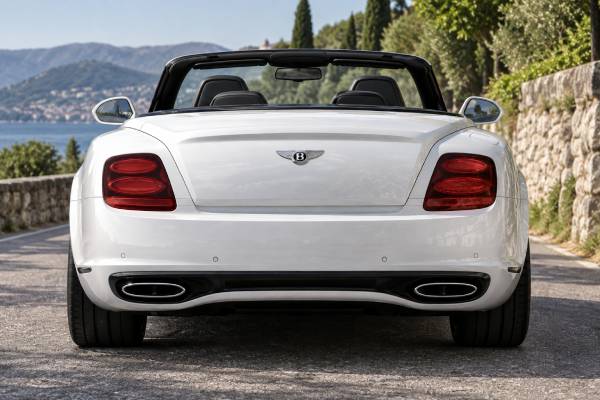
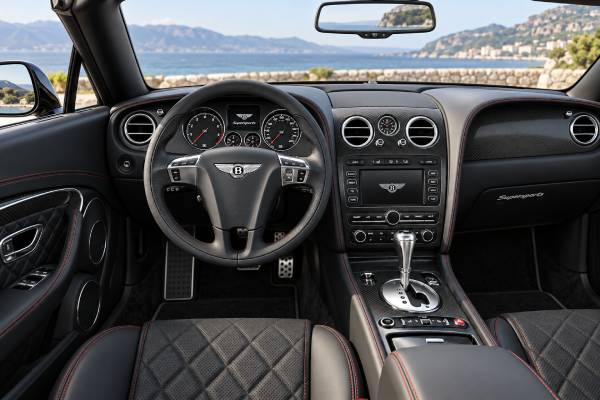
The Continental Supersports Convertible is the rarest and most uncompromising open first-generation Continental. Bentley paired a 621 bhp FlexFuel W12 with rear-biased all-wheel drive, a faster Quickshift transmission, standard carbon-ceramic brakes, wider rear track, forged wheels, and a body capable of more than 200 mph. Yet it retained the powered fabric roof and the quiet, lavish cabin expected of a Bentley convertible.
Only 583 convertibles were produced, according to Bentley’s heritage material, so authenticity and completeness matter as much as mechanical condition. These cars are now old enough for neglected cooling systems, tired air suspension, roof faults, damaged carbon brakes, and incorrect tires to outweigh any saving in purchase price. The strongest example is one whose VIN, equipment, service history, and specialist inspection tell the same story. Buyers should also understand the FlexFuel system, because the ability to run approved E85 blends does not make every modern ethanol fuel suitable in every market. What follows focuses on the 2010–2011 3W4 Supersports Convertible rather than the coupe or later Supersports generations.
Table of Contents
- Why This Convertible Is a Separate Model
- Technical Profile of the Open Supersports
- FlexFuel, Quickshift, and Rear-Biased Drive
- Carbon Brakes, Wide Track, and Aero
- Roof, Body, and Cabin Condition
- Service Strategy for a Rare Bentley
- Purchase Decision and Preservation
Why This Convertible Is a Separate Model
The Supersports Convertible is more than a GTC Speed with an engine tune. Bentley changed the driveline balance, transmission programming, brakes, wheels, rear track, airflow, exterior details, and cabin treatment to create an open counterpart to the focused Supersports coupe.
Its 5,998 cc W12 produces 621 bhp at 6,000 rpm and 800 Nm (590 lb-ft) across approximately 1,700–5,600 rpm. The additional output came from improved charge airflow and revised engine management. Bentley also calibrated the engine to recognize mixtures of gasoline and bioethanol within the approved FlexFuel range. Unlike a conversion added later, the fuel sensors, seals, control logic, and cold-start strategy were designed as a system.
The six-speed ZF automatic gained Quickshift programming. It can execute faster changes and double downshifts, giving the heavy car more immediate response without sacrificing torque-converter smoothness. In normal running, the mechanical center differential favors the rear axle with 60 percent of the nominal split and leaves 40 percent forward. That rearward balance makes the car feel more willing to turn under power than earlier 50:50 Continental calibrations, while permanent all-wheel drive preserves traction.
The body tells knowledgeable buyers what to look for. Supersports-specific front openings improve cooling, bonnet vents draw hot air from the engine bay, smoked-steel brightwork replaces much of the normal chrome, and flared rear arches cover a track widened by 50 mm. The convertible uses a fixed rear spoiler rather than the coupe’s deploying arrangement. Larger oval exhaust outlets, dark rear lamp housings, and lightweight 20-inch forged wheels complete the package.
The interior is not identical to the two-seat coupe. The convertible retains a 2+2 layout, but it uses sporting materials and details such as carbon-fiber trim, Alcantara, quilted leather, and Supersports branding according to specification. Because Bentley offered extensive personalization, no single color combination proves authenticity. Factory build data and VIN-linked documentation are more reliable than appearance.
Rarity raises the importance of originality without making every replaced component undesirable. Tires, batteries, seals, dampers, and friction materials are consumables. Correct, documented replacement is good stewardship. Poorly repaired forged wheels, generic brake parts, imitation trim, nonstandard suspension modules, or an undocumented engine calibration are different: they can reduce both reliability and collector confidence.
Technical Profile of the Open Supersports
This is a gasoline/E85-capable internal-combustion convertible with a front-mounted twin-turbo W12, six-speed automatic, permanent all-wheel drive, air suspension, and standard carbon-ceramic brakes. The most useful figures are not just its 621 bhp output, but the 800 Nm torque plateau, 2,395 kg curb weight, and brake and tire specifications that must control that performance.
| Item | Factory data |
|---|---|
| Engine type | 5,998 cc twin-turbocharged W12 |
| Layout | Front, longitudinal; aluminum-alloy block and heads |
| Bore × stroke | 84.0 × 90.2 mm (3.31 × 3.55 in) |
| Compression ratio | 9.0:1 |
| Valve gear | Four overhead camshafts, 48 valves, variable timing |
| Power | 621 bhp / 630 PS / 463 kW at 6,000 rpm |
| Torque | 800 Nm (590 lb-ft) from about 1,700–5,600 rpm |
| Approved fuel capability | Premium gasoline through E85 FlexFuel, subject to market documentation |
| Component | Specification |
|---|---|
| Gearbox | ZF 6HP26A six-speed Quickshift automatic with paddles |
| Drive | Permanent AWD, Torsen T-3 center differential |
| Nominal torque split | 40:60 front to rear |
| Front suspension | Four-link double wishbones, air springs, anti-roll bar |
| Rear suspension | Trapezoidal multi-link, air springs, anti-roll bar; 50 mm wider track than regular GTC |
| Damping | Continuous electronic damping control |
| Steering | Speed-sensitive Servotronic rack and pinion |
| Item | Specification |
|---|---|
| Front brakes | 420 mm carbon-fiber-reinforced silicon-carbide ceramic discs |
| Rear brakes | 356 mm carbon-ceramic discs |
| Front calipers | Eight-piston, Bentley-branded |
| Wheels | Lightweight 20-inch forged 10-spoke alloys |
| Tires | 275/35 ZR20 performance tires; verify exact approved fitment by market |
| Electronic support | ABS, brake-force distribution, tuned ESP, tire-pressure monitoring |
| Measure | Metric | Imperial |
|---|---|---|
| Length | 4,804 mm | 189.1 in |
| Width including mirrors | 2,194 mm | 86.4 in |
| Height, roof raised | about 1,388 mm | 54.6 in |
| Wheelbase | 2,745 mm | 108.1 in |
| Curb weight | about 2,395 kg | 5,280 lb |
| Fuel tank | 90 L | 23.8 US gal |
| Seating | 2+2 | Four positions |
| Measure | Figure |
|---|---|
| 0–100 km/h | about 4.2 seconds |
| 0–60 mph | about 4.0 seconds |
| 0–160 km/h | about 9.5 seconds |
| Top speed | 325 km/h (202 mph) |
| 2011 EPA premium gasoline | 12 mpg city / 19 highway / 14 combined |
| 2011 EPA E85 | 8 mpg city / 14 highway / 10 combined |
FlexFuel, Quickshift, and Rear-Biased Drive
The three systems that most distinguish the Supersports in use are its adaptive fuel calibration, faster six-speed transmission logic, and rear-biased all-wheel drive. All three must be healthy for the car to feel coherent.
FlexFuel allows the engine-control system to adapt fueling and ignition to the ethanol content detected in the tank. E85 contains less energy per gallon than gasoline, which explains the lower EPA mileage even though peak power is retained. Ethanol can also absorb moisture and its actual seasonal blend varies. Owners should use only fuel permitted by the handbook for their market, buy from a reliable high-turnover station, and avoid leaving a questionable high-ethanol mixture in long-term storage.
Switching fuel type is not a performance shortcut that excuses poor maintenance. The engine still relies on accurate fuel pressure, injectors, oxygen sensors, ignition components, airflow measurement, and leak-free intake plumbing. Hard starting, rough running, abnormal fuel trim, or a warning lamp after refueling requires diagnosis. Do not repeatedly dilute the tank and hope an electrical or mechanical fault disappears.
Quickshift shortens the sense of interruption during hard acceleration. The control strategy can request a double downshift, coordinate engine torque, and re-engage more quickly than the regular GTC calibration. It remains a conventional automatic, so fluid condition, valve-body operation, mounts, and control adaptation matter. A healthy gearbox should select Drive and Reverse promptly, pull away without a thump, and change ratios consistently when hot.
Rear-biased drive does not make the car rear-wheel drive. The front axle remains powered, and the Torsen differential varies distribution as grip changes. On a dry road, the 40:60 default helps the car feel less nose-led. On wet or cold pavement, the system uses all four tires to manage the torque. Its effectiveness depends on four compatible tires with close rolling circumference. A single replacement tire on a worn set may be false economy.
Electronic stability control was recalibrated to permit more driver involvement before intervening, while restoring torque promptly after an intervention. That does not repeal physics. The car carries more than 2.3 metric tons, and its energy rises sharply with speed. Smooth inputs, correct pressures, adequate temperature in the tires, and generous braking distance are still essential.
During a test drive, use light and moderate throttle first. Confirm smooth boost, linear steering, and clean shifts before asking for more. Full-power acceleration on old, unknown, cold, or mismatched tires is not a valid inspection technique. Diagnostic data and physical examination reveal more with less risk.
Carbon Brakes, Wide Track, and Aero
The standard carbon-ceramic system is both a major engineering feature and one of the largest financial risks in a used Supersports Convertible. It should be inspected by someone who knows the material, not judged only by pedal feel or a glance through the wheel.
Carbon-fiber-reinforced silicon-carbide discs are much lighter than comparable iron components and tolerate repeated high heat with little fade. Bentley paired 420 mm front discs with 356 mm rears, reducing unsprung mass and helping the suspension keep the tires in contact with the road. The forged wheels save additional mass and their spoke shape encourages brake cooling.
These discs do not wear or fail like ordinary iron rotors. Impact chips, edge damage, surface oxidation, overheating, contamination, incorrect pad material, and prior refinishing all matter. Thickness alone may not determine life. The approved inspection method can include visual criteria and weight or other measurements specific to the disc. Request records for any replacement and verify part identity; the cost of four discs and related hardware can dominate an otherwise attractive purchase.
The wider rear track supports more stable cornering and creates the pronounced rear arches. It also means body and wheel repairs must preserve unusual geometry. Check each forged wheel for cracks, bends, welds, excessive machining, and paint hiding previous damage. A cosmetically perfect wheel is not necessarily structurally original. Verify that offsets, tire size, and fasteners are correct.
The roof-up top-speed claim depends on the roof skin, tensioning, seals, glass alignment, and body being in proper condition. No used-car inspection should attempt to verify maximum speed. Instead, drive at normal highway speed and listen for local wind roar, flapping material, vibration, or a seal that lifts. These signs expose roof adjustment or repair needs without dangerous testing.
A professional alignment is worthwhile after purchase, but only after worn joints, air-suspension faults, damaged wheels, and tire problems are corrected. Aligning around defects can create acceptable numbers on the rack while leaving the car unstable on the road.
Roof, Body, and Cabin Condition
The convertible roof and its water-management paths deserve the same scrutiny as the engine. A small leak can reach expensive modules, stain rare trim, and create intermittent electrical behavior long before water is obvious to the driver.
Operate the roof from fully closed to fully stowed and back again with the battery at correct voltage. Watch the windows lower and reseal, the front bow release and latch, the storage cover move, and the system confirm completion. The motion should be coordinated, with no grinding, sudden stop, repeated warning, or manual assistance. Test it again after the car is warm because some hydraulic and sensor faults change with temperature.
Inspect the fabric from several angles. Look for abrasion at folds, shrinkage, loose stitching, discolored repair material, uneven tension, and evidence of pressure washing. Examine the rear glass bond and all rubber seals. Pouring large amounts of water onto an unknown car is unwise, but a controlled leak test and drain inspection are reasonable with the seller’s consent.
Inside, lift mats and feel low points in the carpets. Check the trunk, rear quarters, under-seat areas accessible without damage, and the compartment around the battery and electronics. A musty smell, fogged lamps, corrosion on connectors, water marks, or a recently replaced carpet without explanation calls for deeper investigation.
Supersports trim can be difficult to replace correctly. Carbon-fiber veneer should have consistent finish and secure edges. Alcantara can wear smooth, leather bolsters can crack, and embroidered or quilted panels can be poorly retrimmed. Compare both sides and ask for photographs from before any restoration. Original wear is often easier to evaluate than a hurried cosmetic refurbishment.
Body inspection should include paint measurement where the substrate permits, close examination of the flared rear quarters, and a view beneath the car. The model’s low nose and wide wheels are vulnerable to scrapes and impacts. Check cooling openings for debris and bent fins. Look at jacking points, sill covers, suspension mounting areas, and undertrays for lifting damage.
Because production was limited, build records can add value. Confirm original paint, interior color, options, brake specification, wheel finish, and market. A rare color is desirable only if the finish is sound and the history credible. The model’s worth comes from the whole car, not a single unusual option.
Service Strategy for a Rare Bentley
A Supersports Convertible should be maintained as a high-load performance car that happens to cover modest annual mileage. Time, heat cycles, storage conditions, and component age matter alongside the odometer.
Begin with a Bentley-capable diagnostic scan and a line-by-line review of invoices. A stamp book cannot show which coolant leak was repaired, whether the roof fault returned, what pads were fitted to the ceramic discs, or whether repeated misfires affected the same cylinders. Records should identify mileage, dates, labor, parts, and findings.
A sensible maintenance baseline covers:
- correct engine oil and filter, with leak inspection;
- ignition health, fuel trims, and pressure under load;
- cooling-system pressure, fans, radiators, hoses, and dried residue;
- transmission behavior and approved fluid-service history;
- front and rear differential and transfer-system leak checks;
- air-spring leakage, compressor run time, damper condition, and level sensors;
- carbon-disc and pad assessment by the proper method;
- tire dates, matching specification, tread pattern, and alignment;
- brake fluid, coolant, filters, and other time-dependent items;
- roof drains, seals, hydraulic components, latches, and position sensors;
- battery capacity, charging voltage, and parasitic-draw testing where needed.
Storage should keep the car clean, dry, ventilated, and electrically supported with a suitable maintainer. Do not store it with damp roof fabric folded. Avoid long periods on underinflated tires; use correct pressure and move or support the car appropriately. Exercise the roof and climate control under suitable conditions rather than leaving every mechanism untouched for a year.
The W12 should be warmed through by driving gently, not idling for a long time and then being revved. Regular trips that reach stable operating temperature help the battery, exhaust, fluids, and seals. Repeated very short journeys increase condensation and may never bring the large driveline fully warm.
Modifications need extra caution on a limited-production model. An ECU tune may conceal the factory FlexFuel strategy or increase turbo and transmission load. Lowering software can damage geometry and ride. Aftermarket wheels may not clear the ceramic brakes safely. A loud exhaust can introduce drone or remove important thermal shielding. Documentation and reversibility should be part of the value calculation.
Set aside a repair reserve before purchase. The car may need no major work for a period, but one roof, brake, cooling, or suspension event can be substantial. A reserve protects the car from becoming a deferred-maintenance project when the first unexpected invoice arrives.
Purchase Decision and Preservation
Buy this model for its unusual combination of rarity, open-air character, and first-generation Supersports engineering—not simply because it is the least expensive route to 621 bhp. A standard GTC or GTC Speed may be a better fit for an owner who values softer manners, simpler brake economics, or a larger choice of cars.
Commission the inspection before agreeing that a deposit is nonrefundable. The technician should verify the VIN and factory specification, read all control modules, assess the roof, examine the car on a lift, measure or evaluate the carbon brakes correctly, test the cooling system, and conduct a long enough drive to include full warm-up and restart. A compression or leak-down test is not automatically necessary on every smooth-running car, but abnormal misfire data, smoke, or cylinder imbalance may justify deeper engine testing.
Price the findings as four groups: safety-critical, immediately overdue, likely within a year, and cosmetic or optional. Tires, brakes, fluid leaks, and roof water entry belong near the top. A worn seat bolster belongs lower unless originality is central to the purchase. This prevents dramatic cosmetics from distracting from mechanical risk.
Walk away or pause when identity is uncertain, faults have just been cleared, the roof is disabled, carbon discs are chipped or undocumented, the engine overheats, multiple tires are mismatched, or structural repairs lack evidence. A specialist can estimate repairs, but uncertainty itself deserves a financial allowance.
After acquisition, preserve removed original parts when practical, photograph condition, and keep digital and paper records. Record every tire date, brake measurement, battery replacement, fluid used, scan report, and roof repair. Future buyers of a 583-unit convertible will value a continuous technical story.
Driving the car is also preservation when done thoughtfully. Use it often enough to keep systems active, but avoid exposing a cold driveline to heavy load. Check pressures before fast touring, inspect the roof and drains seasonally, and investigate new noises or warnings while the issue is small.
The Supersports Convertible represents a brief period when Bentley used a twelve-cylinder FlexFuel engine, carbon-ceramic brakes, rear-biased mechanical AWD, and a traditional fabric roof to build an open 200 mph grand tourer. No later maintenance shortcut can recreate the way those systems work together. A carefully selected, correctly serviced car remains both an extraordinary road machine and a significant Bentley variant.
References
- BENTLEY NEWSROOM : 2011 Continental Supersports DK12FZM 2011 (Bentley Heritage Collection)
- CONTINENTAL SUPERSPORTS THE EXTREME BENTLEY 2010 (Manufacturer Brochure)
- 2011 Bentley Continental Supersports Convertible 2011 (EPA Fuel Economy)
- Gas Mileage of 2011 Bentley Continental Supersports 2011 (EPA Model Data)
- Vehicle Detail Search – 2011 BENTLEY CONTINENTAL SUPERSPORTS | NHTSA 2011 (Recall Database)
Disclaimer
This guide provides general information and cannot replace professional diagnosis, repair, or inspection. Specifications, torque values, service intervals, and procedures differ by VIN, market, build date, and equipment, so confirm every technical decision in official Bentley service documentation. Please share the article on Facebook, X/Twitter, or another network if it supports informed care of these cars.