
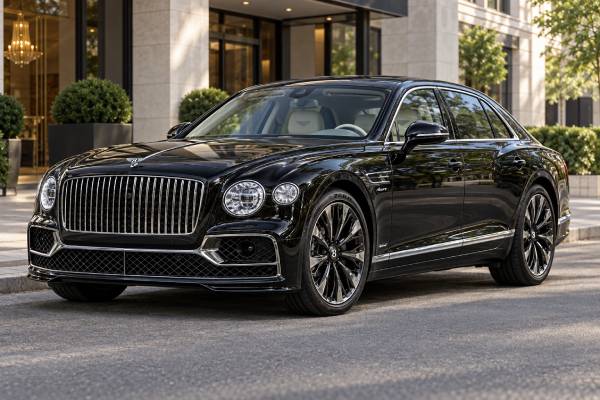
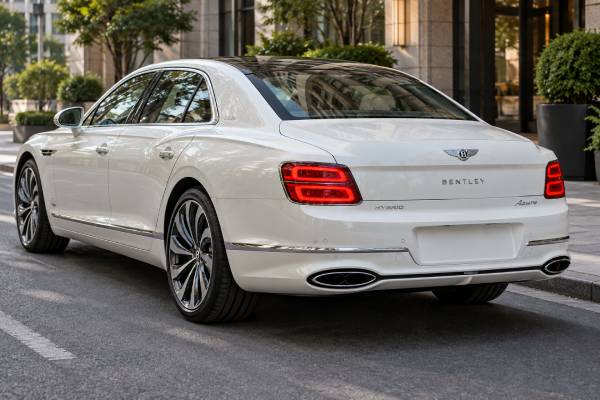
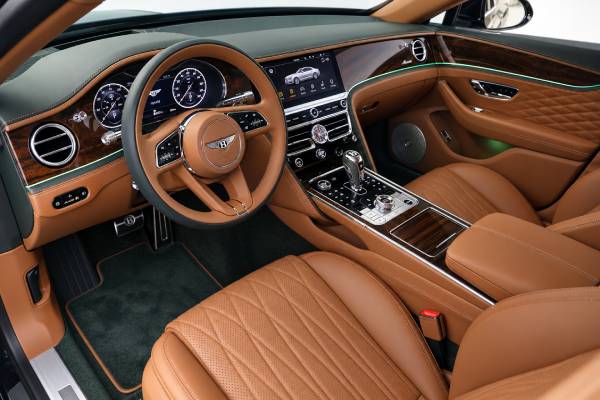
The 2022–2024 Bentley Flying Spur Azure Hybrid is the comfort-led version of Bentley’s first plug-in-hybrid Flying Spur. It pairs a 2.9-liter twin-turbo V6 with an electric motor integrated into the eight-speed transmission, producing 536 bhp and 750 Nm while offering up to 41 km of WLTP electric driving. Azure specification changes the emphasis from visual aggression to reduced fatigue: air suspension, driver-assistance equipment, quieter detailing, supportive seating, and a cabin designed around long-distance wellbeing.
The important ownership question is not whether the Hybrid is “green” in the abstract. It is whether the car can be charged regularly and used in a pattern that suits a PHEV. With a charged battery, it can handle quiet urban segments, assist the engine strongly, and reduce fuel use on short routines. With an empty battery and no charging habit, it carries extra mass and complexity without gaining the full benefit. This guide explains the hardware, charging routine, comfort features, maintenance needs, and used-car checks that determine whether an Azure Hybrid is a smart luxury sedan or the wrong tool for the journey.
Table of Contents
- The Azure Hybrid’s purpose
- Plug-in-hybrid specifications
- Electric driving and charging
- Comfort, chassis, and wellbeing
- Everyday efficiency and trip planning
- Hybrid maintenance and diagnostics
- Used Azure Hybrid buying checks
The Azure Hybrid’s purpose
The Azure Hybrid is designed for owners who prioritize calm progress and passenger comfort but still want substantial performance. It is not the sportiest Flying Spur and it is not a battery-electric limousine; it is a high-output PHEV that can make the first or last part of a trip quieter and smoother.
Azure became Bentley’s wellbeing-focused specification across several model lines. On the Flying Spur, that meant a curated combination of comfort seats, cabin materials, driver-assistance features, bright exterior detailing, and a ride setup intended to reduce stress. Exact standard equipment varied by market and model year, so a factory build sheet remains essential. The name describes the car’s character, not an identical global option list.
The Hybrid powertrain supports that brief unusually well. An electric motor can move the car without waiting for the engine to start, fill torque during gear changes, and assist the V6 when the driver asks for rapid acceleration. In urban traffic, the absence of engine vibration can make the car feel even more refined than a gasoline version. On a motorway, the engine becomes the main energy source and the system uses the battery strategically rather than attempting to drive electrically at all times.
This distinction matters because official weighted fuel-consumption figures assume a defined test cycle that begins with a charged battery. Real use can be much better or much worse depending on charging frequency and trip length. A driver covering 20 km each way with workplace charging may use little gasoline during the week. A driver doing 500 km journeys without plugging in will experience the car mainly as a heavy, fast V6 sedan.
The Azure Hybrid therefore rewards routine. A suitable parking space, reliable AC charging, and an owner willing to connect the cable are more important than theoretical range. It also suits urban access rules in some markets, but tax, registration, and low-emission-zone treatment should be checked locally rather than assumed from the PHEV badge.
Plug-in-hybrid specifications
This model is a plug-in hybrid with a twin-turbo V6, one traction motor inside the transmission, an externally chargeable high-voltage battery, and active all-wheel drive. The system output is an official combined figure; it should not be recreated by simply adding the engine and motor peaks because they do not necessarily occur at the same speed.
| Specification | Value |
|---|---|
| Powertrain classification | Plug-in hybrid (PHEV) |
| Combustion engine | 2.9-liter twin-turbocharged V6 gasoline engine |
| Engine displacement | 2,894 cc |
| Electric motor | Permanent-magnet motor integrated with transmission |
| Combined system power | 544 PS (536 bhp; 400 kW) |
| Combined system torque | 750 Nm (553 lb-ft) |
| Battery capacity | 18.0 kWh gross |
| Transmission | 8-speed dual-clutch automatic with integrated motor |
| Drivetrain | Active all-wheel drive |
| Specification | Value | Standard or condition |
|---|---|---|
| 0–60 mph | 4.1 seconds | Manufacturer figure |
| 0–100 km/h | 4.3 seconds | Manufacturer figure |
| Maximum speed | 285 km/h (177 mph) | Manufacturer figure |
| Electric range | Up to 41 km (26 miles) | WLTP |
| Combined driving range | Up to 805 km (500 miles) | WLTP-based manufacturer statement |
| AC charging | Up to 7.2 kW | Market and supply dependent |
| Typical full AC charge | About 2.5 hours | At maximum supported AC rate under suitable conditions |
| DC fast charging | Not supported | AC charging only |
| Specification | Value |
|---|---|
| Body type | Four-door luxury sedan |
| Overall length | 5,316 mm (209.3 in) |
| Width across mirrors | 2,220 mm (87.4 in) |
| Wheelbase | 3,194 mm (125.7 in) |
| Fuel tank | 80 liters (21.1 US gal) |
| Boot volume | 351 liters (12.4 cu ft) |
| Suspension | Adaptive three-chamber air suspension |
| Typical Azure wheel | 22-inch ten-spoke design |
The PHEV’s luggage compartment is smaller than the 420-liter gasoline car because hybrid components occupy space beneath and around the rear floor. That packaging difference is easy to overlook in online listings and can matter more than the nominal electric range for owners carrying large cases.
Electric driving and charging
The Azure Hybrid works best when it begins local trips with a charged battery and uses its engine for longer, faster travel. Charging is AC-only, so the practical strategy is overnight or destination charging rather than brief public rapid-charge stops.
The charge port is on the left rear quarter, opposite the fuel filler. Connection and status should be tested with the car’s original cable or a known-good charger. Confirm that the flap opens, the connector locks, charging begins without repeated interruptions, and the car reports a sensible completion time. A seller saying the car “has never needed charging” is not a benefit; it means a major system may not have been exercised.
The 18.0 kWh figure is gross battery capacity. The car protects part of the pack and does not allow the driver to access every kilowatt-hour. Do not estimate usable capacity from range or dashboard percentages, because battery buffers and software strategies are not simple linear relationships. Likewise, dividing capacity by charger power does not produce an exact charge time: conversion losses, temperature, tapering, cell balancing, and supply limits all matter.
Driving modes govern how the two power sources are used. EV Drive favors electric operation when battery charge, temperature, speed, and power demand permit. Hybrid mode manages both sources automatically. Hold mode preserves a chosen level of charge for later urban use. Charge mode can use the engine to add energy, but doing so is usually less efficient than plugging into the grid; its value is situational rather than routine.
The engine may start even when electric range is displayed. Strong acceleration, high speed, low temperature, windshield defrosting, heating demand, battery protection, or system diagnostics can require combustion operation. This is normal PHEV behavior and should not be described as a guaranteed engine-off range. What matters is whether the system transitions smoothly and whether the displayed range is plausible for the weather and recent use.
In winter, cabin heating and battery temperature reduce range. At high speed, aerodynamic demand rises sharply. Large wheels and performance tires also affect consumption. A 41 km WLTP rating is a standardized result, not a promise for every journey. For used-car evaluation, compare the displayed estimate after a full charge with ambient conditions and trip history, then verify actual energy use over a meaningful route.
Home charging should be installed and checked by a qualified electrician. A dedicated circuit and compatible wallbox improve convenience and reduce dependence on a household outlet. Charging schedules can use lower-cost electricity where available, but the car should still complete periodic full charges to allow normal balancing. Avoid leaving the cable stretched across a public walkway or using unapproved adapters.
Comfort, chassis, and wellbeing
Azure’s central promise is lower fatigue, achieved through seating, ride control, noise management, and assistance systems rather than one headline feature. The Hybrid’s quiet low-speed operation reinforces that goal, but the hardware must be configured and functioning correctly.
Front Seat Comfort Specification and rear comfort features can include multi-way adjustment, heating, ventilation, massage, adjustable bolsters, and memory. Bentley’s wellbeing approach emphasized posture and thermal comfort because small, continuous adjustments can reduce fatigue on long journeys. Test each seat function independently. A seat that moves in one direction but not another may have a switch, module, motor, or mechanical issue.
The air suspension isolates sharp impacts while maintaining body control. Azure models generally favor a composed, flowing response rather than the firmer personality of S or Speed. Wheels still matter: 22-inch designs look appropriate but leave less tire sidewall to absorb potholes. Inspect inner rims for cracks or bends, and verify that all four tires are approved, matched, and correctly loaded.
All-wheel steering may be fitted depending on exact specification and market package. It is valuable in a car with a 3,194 mm wheelbase, making tight turns easier and stabilizing fast lane changes. Bentley Dynamic Ride, where present, uses 48-volt active anti-roll control to resist cornering forces. The result is not a flat, harsh ride; the system can relax on a straight and act strongly in a bend.
Touring Specification features may include adaptive cruise, lane assistance, head-up display, night vision, and additional collision support. City-oriented systems can include surround cameras, traffic warnings, and parking assistance. Their names and availability differ by market. Check the build sheet, then test cameras for clear images, radar functions on a suitable road, and the head-up display through its full adjustment range.
Cabin serenity depends on details. Acoustic glass, powered blinds, soft-close doors, climate zones, the Naim or Bang & Olufsen audio options, and the rotating center display can all contribute. A single trim rattle or fan noise is more noticeable in electric driving, so perform part of the test with the engine off and audio muted.
The four-seat rear configuration creates two individual chairs and a continuous console; the five-seat layout retains occasional center-seat use. The PHEV’s smaller boot makes this choice more consequential for airport or family duties. Bring representative luggage to the viewing rather than relying on liters alone.
Everyday efficiency and trip planning
A PHEV’s efficiency is a behavior-dependent outcome. The Azure Hybrid can be exceptionally fuel-efficient on repeat short trips with charging, yet consume like a large luxury sedan when the battery is depleted and the route is fast.
Think in three journey types. For local trips shorter than the realistic electric range, charge before departure and use EV Drive where conditions allow. For mixed regional trips, let Hybrid mode blend the engine and motor; it can reserve electric assistance for low-speed sections and use the V6 efficiently at cruise. For a long highway day, accept that gasoline will supply most energy and preserve some charge only if the destination has an urban low-emission segment.
Official weighted fuel figures are useful for homologation but poor predictors unless your charging pattern resembles the test. A more honest ownership log separates electricity consumed, gasoline purchased, and distance traveled. Record seasonal changes. Electricity drawn from the wall includes charging losses, so it will be higher than the energy stored in the battery.
The 80-liter fuel tank supports long touring, and Bentley quoted a combined range of up to 805 km. Actual range depends on speed, weather, terrain, battery state, and wheel choice. The car is at its least efficient during repeated cold starts and short engine runs, where the V6 warms itself but does not remain on long enough to operate at steady temperature. Charging and pre-conditioning can reduce that pattern.
Route planning does not require chasing rapid chargers because the car cannot use DC charging. Select hotels, workplaces, or home facilities where it can remain connected for several hours. A 7.2 kW AC point can replenish the small pack relatively quickly; a lower-power supply still works when the car is parked overnight.
Do not carry the charging cable loose in the trunk. Use its bag and secure it so it cannot damage the carefully trimmed luggage compartment. Check cable condition, connector pins, and seals regularly. In rain, normal approved charging is designed to be safe, but damaged equipment or improvised extensions are unacceptable.
Hybrid maintenance and diagnostics
Maintenance must cover three systems: the combustion engine, the high-voltage hybrid equipment, and the conventional chassis and electronics. A car with little engine mileage still needs time-based service, while a car that rarely charges still needs the battery and charging hardware tested.
For the V6, verify annual oil service with the correct Bentley-approved specification. Review spark-plug, filter, brake-fluid, coolant, belt, transmission, and differential requirements against the VIN-specific schedule. PHEVs can run the engine intermittently, so oil may age from time, condensation, and repeated warm-up cycles even when total distance is low.
The high-voltage system should be left to trained technicians. Inspection can include diagnostic state-of-health data, isolation monitoring, coolant-circuit checks, charging logs, fault memory, and software campaigns. Do not open the battery, probe orange cables, or attempt depowering procedures without the official equipment and training.
Battery condition cannot be judged from one dashboard range estimate. Recent driving, climate use, and temperature influence that number. A proper assessment uses a full charge, diagnostic data, energy-throughput observation, and a road test. Ask about remaining high-voltage warranty terms, which vary by market and first-registration date.
The 12-volt battery remains critical because it wakes control modules and closes the high-voltage contactors. A weak auxiliary battery can prevent the car from becoming ready even when the traction battery is charged. Test it, maintain it during storage, and use the specified replacement and coding process.
Brake maintenance has a PHEV-specific wrinkle. Regeneration can reduce use of the friction brakes, allowing discs to corrode, especially on cars driven gently in wet climates. Inspect both faces of every disc and perform safe periodic braking that uses the friction system. Any pulsing, grinding, or uneven surface needs measurement.
Air suspension, rear steering, active anti-roll hardware, tires, alignment, climate control, and drainage points require the same care as gasoline Flying Spurs. The extra mass makes correct load-rated tires and healthy dampers especially important. A comprehensive service should not focus on the battery while overlooking conventional wear.
Used Azure Hybrid buying checks
The right used Azure Hybrid has a demonstrable charging history, complete service record, healthy battery systems, functioning comfort equipment, and a specification that matches your real travel. A low price without those fundamentals is not value.
Begin by confirming the exact car. Obtain the VIN and factory build sheet. Verify Azure features, powertrain, seating layout, wheel design, driver-assistance packages, audio, rotating display, rear entertainment, and charging equipment. Advertisements often confuse Mulliner options with Mulliner trim or list optional features as standard.
Inspect in this order:
- Cold ride height and start-up: Look for corner sag, warning messages, unusual pump operation, and a rough engine start.
- Full charge session: Connect to AC power, confirm lock and communication, watch the rate and estimated time, and check for interruptions.
- Electric road test: Drive with the engine off where conditions permit, listening for wheel, bearing, brake, and trim noise.
- Hybrid transition: Request moderate and strong acceleration, verifying a smooth engine start and consistent power.
- Low-speed transmission test: Reverse, creep, park on an incline, and repeat when warm; persistent shudder or delay needs diagnosis.
- Comfort and technology test: Operate every seat, blind, table, screen, camera, climate zone, audio channel, and assistance feature.
- Diagnostic and physical inspection: Scan all modules, test both batteries, measure brakes, inspect tires and wheels, and look for leaks or water entry.
Check recall status by VIN and obtain proof of completed campaigns. Some 2021–2023 Flying Spurs were included in a recall concerning retention brackets for certain rear entertainment screens, while other campaigns affected narrower production groups. Equipment and build date determine applicability.
Price the car against its immediate needs. Four matching 22-inch tires, brakes, annual service, a 12-volt battery, wheel repairs, and a missing charging cable can erase an apparent bargain. High-voltage faults require specialist diagnosis and should not be accepted on the promise that a warning will clear after charging.
The Azure Hybrid is preferable to the V8 Azure when local electric use, quiet departure, and frequent charging are valuable. The V8 may suit owners without charging access or those who prioritize a lighter, simpler gasoline configuration. The S Hybrid uses the same broad powertrain idea but adopts darker styling and a more driver-focused brief. Choose by use, not by headline output.
A final test is logistical: confirm that the car fits your garage, the charge cable reaches safely, the trunk holds your luggage, and the rear layout works for your passengers. When those practical details align with a clean inspection, the Azure Hybrid delivers a rare combination of limousine calm, strong performance, and genuinely useful electric operation.
References
- BENTLEY NEWSROOM : Flying Spur Azure 2022 (Model Overview)
- Bentley News 2022 : FLYING SPUR HYBRID CERTIFIED AS MOST EFFICIENT BENTLEY YET 2022 (WLTP Data)
- Bentley News 2021 : THE WORLD’S BEST LUXURY SEDAN MADE GREENER: INTRODUCING THE NEW FLYING SPUR HYBRID 2021 (Hybrid Engineering)
- BENTLEY NEWSROOM : wellbeing behind the wheel 2022 (Azure Design)
- : Set Up Guide: Flying Spur Set Up Guide 2026 (Charging and Connected Features)
- Check for Recalls: Vehicle, Car Seat, Tire, Equipment | NHTSA 2026 (Recall Database)
Disclaimer
This article is for informational purposes, not a replacement for professional diagnosis, high-voltage service, repair, or a VIN-specific inspection. Specifications, torque values, intervals, charging equipment, software, and procedures differ by VIN, market, model year, and options. Confirm all work with official Bentley service documentation and use qualified high-voltage technicians. Please share this article on Facebook, X/Twitter, or another platform if it helped you.