
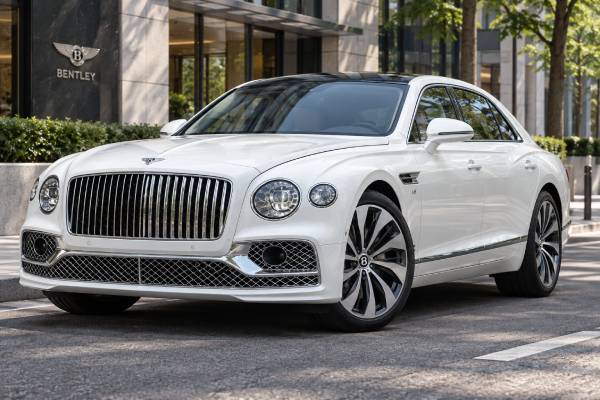
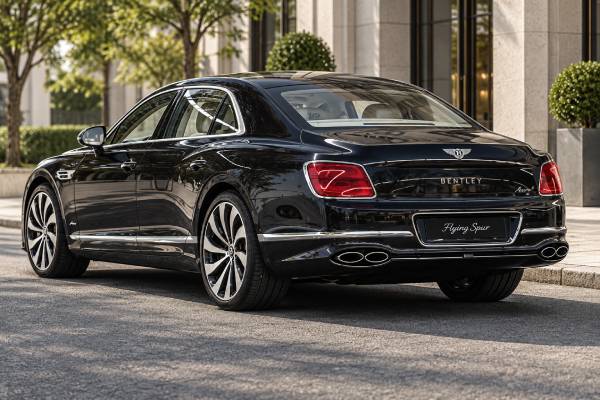
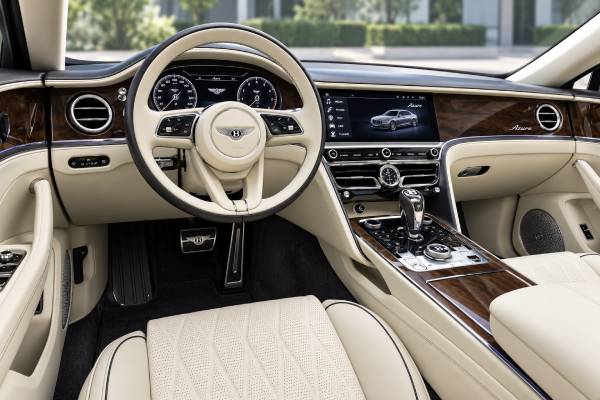
The 2022–2024 Bentley Flying Spur Azure V8 is the version to choose when comfort matters more than visual aggression, but you still want the response and range of a conventional gasoline powertrain. Azure specification adds a set of seating, assistance, chassis, and design features intended to reduce fatigue. The 542 hp twin-turbo V8 then gives the car a lighter front end than the W12, a 198 mph maximum speed, and enough torque to move from limousine duty to rapid cross-country travel without changing personality.
That balance makes the Azure V8 easy to understand and easy to buy badly. A soft-looking color scheme can hide worn 22-inch tires, tired air suspension, neglected brakes, weak batteries, or malfunctioning comfort equipment. Conversely, a well-maintained car can cover distances with less powertrain complexity than the plug-in hybrid and less mass than the W12. This guide focuses on the details that matter in use: which Azure features change the experience, how the V8 and active chassis work, what servicing should look like, and how to inspect a used example beyond its paint and leather.
Table of Contents
- Azure V8 character and model scope
- Core technical data
- Comfort engineering that matters
- V8 performance and efficiency
- Cabin technology and practicality
- Service strategy and wear items
- Used-car selection and final checks
Azure V8 character and model scope
The Azure V8 is a comfort-focused Flying Spur with a full-strength performance engine, not a detuned chauffeur special. It keeps the same 550 PS output as other V8 versions but combines it with Azure’s bright exterior treatment, wellness-oriented seating, and a specification built around relaxed travel.
Bentley used the Azure name across its range to separate comfort-led models from the darker, more driver-centered S and the fastest Speed. The distinction is clearest in presentation. Azure cars generally use bright chrome lower grilles, prominent brightwork, model-specific badging, and a 22-inch ten-spoke wheel design. Inside, lofted or wellness-themed quilting, open-pore wood, illuminated treadplates, contrast stitching, and comfort equipment create a softer visual environment.
The exact standard list changed by market. Touring Specification, Front Seat Comfort Specification, rear comfort features, mood lighting, and driver-assistance packages may be included or optional depending on country and year. A used listing that says “full options” is meaningless without the build sheet. Determine what the car actually has and whether those systems operate.
The V8 suits buyers who cannot charge at home, travel long distances frequently, or prefer a conventional powertrain. It is about 100 kg lighter than the comparable W12 Flying Spur and avoids the smaller trunk of the PHEV. The engine’s 770 Nm torque peak arrives low enough that the car rarely needs high revs. The result is effortless rather than frantic.
Azure does not remove the driver from the experience. The same rear-biased active all-wheel drive, adaptive air suspension, and available advanced chassis systems remain. On a winding road, the V8’s lower nose mass makes it more willing to change direction than the W12, while the cabin remains quiet enough for rear passengers. That duality is the reason to choose this version over a conventional long-wheelbase limousine.
Core technical data
The Azure V8 is an internal-combustion luxury sedan with a 4.0-liter hot-V twin-turbo engine, an eight-speed dual-clutch transmission, and active all-wheel drive. Data should be matched to the individual market because emissions certification, tires, optional equipment, and weight measurement vary.
| Specification | Value |
|---|---|
| Engine type | 4.0-liter twin-turbocharged V8 gasoline engine |
| Displacement | 3,996 cc |
| Maximum power | 550 PS (542 bhp; 404 kW) |
| Maximum torque | 770 Nm (568 lb-ft) |
| Turbo layout | Twin-scroll turbochargers mounted inside the V |
| Cylinder deactivation | Four cylinders can shut down under suitable light load |
| Transmission | 8-speed dual-clutch automatic |
| Drive | Active all-wheel drive |
| Specification | Value | Notes |
|---|---|---|
| 0–60 mph | 4.0 seconds | Manufacturer claim |
| 0–100 km/h | 4.1 seconds | Manufacturer claim |
| Top speed | 318 km/h (198 mph) | Appropriate tires and conditions required |
| Fuel tank capacity | 90 liters (23.8 US gal) | Regional specification may differ |
| Boot volume | 420 liters (14.8 cu ft) | Gasoline model |
| Seating arrangement | Five seats or optional four-seat configuration | Build dependent |
| Specification | Value |
|---|---|
| Overall length | 5,316 mm (209.3 in) |
| Width over mirrors | 2,220 mm (87.4 in) |
| Overall height | approximately 1,483 mm (58.4 in) |
| Wheelbase | 3,194 mm (125.7 in) |
| Suspension | Adaptive three-chamber air suspension |
| Anti-roll technology | 48-volt Bentley Dynamic Ride where specified |
| Steering assistance | Electronic all-wheel steering where specified |
| Typical Azure wheels | 22-inch ten-spoke alloy wheels |
A published weight must be read with its definition. Bentley documents may list unladen mass under different regional conventions, and options can add meaningful weight. For purchase decisions, tire condition, brake load, and the 100 kg V8-versus-W12 difference are more useful than comparing two figures measured by unlike standards.
Comfort engineering that matters
Azure’s comfort advantage comes from coordinated systems, not merely softer seats. Air suspension, body control, rear steering, cabin temperature management, assistance features, and low noise all reduce the number of corrections occupants must make during a journey.
The three-chamber air springs can vary effective stiffness. On a broken road, the system allows more compliance; during acceleration, braking, or cornering, it can support the body more firmly. Adaptive dampers manage wheel movement continuously. The car should float over long undulations without continuing to bounce, and it should absorb sharp edges without knocking.
Bentley Dynamic Ride, if fitted, uses a 48-volt electrical architecture to power active anti-roll actuators. Traditional anti-roll bars link left and right wheels mechanically, which controls roll but can transmit a one-sided bump. The active system can reduce that compromise by relaxing on a straight and applying counter-torque in a bend. A malfunction can leave the car drivable but alter its character, so chassis warnings require proper diagnosis.
All-wheel steering is particularly valuable for an Azure owner who uses city centers, hotels, and parking garages. At low speed, the rear wheels steer opposite the fronts, shortening the effective wheelbase. At speed, they turn in the same direction to stabilize lane changes. Check operation indirectly through maneuverability, diagnostic data, alignment, and tire wear; the rear-wheel angle is small enough that visual observation is unreliable.
Seat design is the human side of the system. Multi-way adjustment should allow the hips, thighs, back, and shoulders to be supported without pressure points. Heating, ventilation, and massage help maintain comfort across temperature changes and long periods of sitting. Set the driving position from zero rather than accepting the seller’s memory setting, then spend at least 30 minutes in it. A seat can have every feature and still not suit a particular body shape.
Azure’s Touring Specification can reduce workload through adaptive cruise control, lane guidance, head-up display, night vision, and other assistance, depending on market. These are support systems, not autonomous driving. Dirty sensors, damaged windscreens, poor calibration, or faded lane markings can limit them. During inspection, verify that the car recognizes the environment without unexplained warnings.
Wheel choice creates the largest mechanical compromise. The standard Azure appearance is tied to 22-inch wheels, but low-profile tires transmit more impact and are vulnerable to pothole damage. A correctly balanced, round wheel with fresh approved tires is more comfortable than a cosmetically perfect wheel that has been badly straightened.
Comfort should be assessed with the passengers who will actually use the car. A brief solo test can miss seat pressure points, head-restraint position, rear climate noise, blind operation, or vibration transmitted through a large wheel-and-tire package. Sit in each principal seat for at least 15 minutes, run the massage and ventilation functions, and try the rear controls while the car is moving. Listen for trim movement over diagonal bumps and confirm that doors, tables, screens, and blinds remain quiet. Azure equipment is valuable when it reduces fatigue over a real journey; it is less persuasive when complex features are selected but rarely used. A careful passenger-led evaluation separates a genuinely relaxing specification from one that merely photographs well.
V8 performance and efficiency
The V8 gives the Azure immediate, quiet thrust while preserving a more responsive front end than the W12. It is powerful enough that the transmission can prioritize smoothness in normal driving and still provide decisive acceleration when needed.
The hot-V arrangement places the turbochargers between the cylinder banks. Short exhaust passages improve turbine response, while twin-scroll housings keep exhaust pulses separated. Maximum torque is available from roughly 2,000 rpm through the middle of the rev range. In practical terms, the car can accelerate strongly in a high gear without announcing every downshift to the cabin.
Cylinder deactivation works when torque demand and engine speed are low enough. The engine temporarily operates on four cylinders, then restores all eight rapidly when the driver requests more power. The system should not create a detectable shudder. If a car vibrates at steady speed, investigate tires, wheels, engine mounts, ignition, and driveline operation rather than accepting the behavior as economy mode.
The dual-clutch transmission is quicker than a conventional automatic but may feel different at walking pace. It uses clutches to pull away and reverse, so careful modulation is normal. Persistent judder, a delay selecting drive, heavy clunks, or overheating messages are not. Test on level ground, an incline, and after the drivetrain is warm.
Active all-wheel drive normally keeps the car rear-led and sends more torque forward when required. This supports clean steering and strong wet-weather traction. Brake-based torque vectoring can slow an inside wheel to help the car rotate. Neither system replaces proper tires. Four mismatched or old tires undermine the calibration and can create vibration or stability-control intervention.
Fuel consumption varies dramatically. A steady long journey can produce a useful range from the 90-liter tank, while dense traffic and repeated acceleration make the V8 thirsty. Compare costs with the Hybrid based on actual charging access. A PHEV used without plugging in may not beat the V8 meaningfully, while a regularly charged Hybrid can use far less gasoline on short trips.
The V8 is also the more practical luggage choice. Its 420-liter trunk is larger than the Hybrid’s reduced space. Owners who carry airport luggage or golf bags should test both in person; the shape of the opening and underfloor packaging matter as much as the published volume.
Cabin technology and practicality
The Azure cabin should be evaluated as an interconnected set of comfort, entertainment, and control systems. A fault-free basic car is preferable to an option-heavy example with several dead features.
The central touchscreen manages navigation, media, vehicle settings, climate functions, and cameras. The optional Bentley Rotating Display can replace it visually with three analog gauges or a veneer panel. Operate the mechanism multiple times from cold and warm conditions. It should move quietly and stop exactly flush; uneven gaps or grinding noise indicate trouble.
Rear passengers may have a touchscreen remote, powered blinds, picnic tables, seat controls, climate zones, and entertainment screens. Some 2021–2023 Flying Spurs with specific rear screens were included in a safety recall concerning the retention brackets, which is why VIN confirmation matters. Check that screens lock securely and that campaign documentation is present where applicable.
Audio systems range from the standard setup to Bang & Olufsen and Naim. High output alone does not guarantee a healthy installation. Play speech, bass-heavy music, and a left-right channel test. Listen for buzzing grilles, failed tweeters, amplifier shutdown, or distortion as volume rises. Verify all USB ports, wireless charging, Bluetooth, Apple CarPlay, and navigation data.
Climate performance is vital. Test cooling at idle and on the road, heat output, rear-zone control, defrosting, fan speeds, and seat ventilation. A quiet car makes fan bearing noise and vent actuator clicks obvious. Musty odor can point to a dirty evaporator, blocked drains, or a car stored damp.
Body practicality is mixed. Rear legroom is generous and the doors open wide, but the car’s overall width makes narrow spaces difficult. Surround cameras are valuable, yet lenses can be scratched or misaligned after repairs. Inspect the lower bumper, wheel rims, door edges, and sill panels for parking damage.
The four-seat rear arrangement feels more exclusive but eliminates the center position. It can also complicate carrying long items because the rear console occupies the middle. The five-seat car is more flexible and often easier to resell. Decide based on use rather than rarity.
Service strategy and wear items
A good Azure V8 service history shows consistent annual care, not just low mileage and occasional dealer stamps. The car’s electronics, air systems, fluids, and rubber age even when the odometer moves slowly.
Request detailed invoices and compare them with the official schedule for the VIN. Engine oil and filter should use the approved specification. Ask about spark plugs, filters, brake fluid, coolant work, transmission and differential fluids, drive belts, air-conditioning service, and software updates. Do not assume “lifetime” fluid means the unit benefits from never being inspected.
The 12-volt battery is a central maintenance item. When voltage drops, dozens of modules can log faults or shut down convenience functions. A stored car should use an approved maintainer. At purchase, conduct a load or conductance test and review battery age. A recent jump-start can temporarily hide weakness.
Tires must have the correct load and speed ratings, ideally the approved Bentley marking for the application. Record date codes, tread depth across each tire, and any inner-edge wear. Cars with all-wheel steering require precise alignment. Uneven wear after a recent tire replacement can reveal unresolved geometry or suspension damage.
Brake inspection should include both sides of every disc and measured remaining thickness. Heavy cars can wear front brakes quickly when driven in traffic, while lightly used cars can corrode discs during storage. Carbon-ceramic brakes, if fitted, require a specialist assessment for chips, impact damage, and remaining life.
Air suspension should maintain level height overnight. Excessive compressor activity, a low corner, or slow mode changes needs leak testing and diagnostic review. Dynamic Ride and rear steering add separate checks. Avoid shops that replace major assemblies before confirming power, wiring, software, sensor, and hydraulic conditions.
The V8’s cooling system and turbo area should be inspected for residue, odor, seepage, and heat-damaged lines. Remove or lower undertrays as appropriate during a proper inspection; a clean engine bay from above does not prove the underside is dry.
Cosmetic maintenance has financial consequences. Open-pore veneer can be damaged by aggressive cleaners, polished wheel faces can be ruined by poor refinishing, and soft leather can lose its texture through heavy coatings. Use products suitable for the specific material and preserve documentation of professional repairs.
Used-car selection and final checks
Choose an Azure V8 by condition, configuration, and evidence of care. A rare paint color or low odometer is secondary to healthy chassis systems, matching tires, complete service records, and working cabin technology.
Before viewing, obtain the VIN and factory build sheet. Identify whether the car has Dynamic Ride, all-wheel steering, Touring Specification, rear entertainment, four-seat configuration, rotating display, panoramic roof, premium audio, carbon-ceramic brakes, and Blackline or bright chrome trim. Then create a checklist for that exact equipment.
At the car, begin before start-up. Compare ride height at all four corners, inspect the ground for fluid, check tire pressures and dates, and look through the grille for damaged cooling surfaces. Start cold. Warning lamps should illuminate for self-test and then extinguish. Listen for uneven idle, belt noise, fan roar, or an air-suspension compressor that runs for too long.
The road test should not be a short demonstration. Use slow parking maneuvers, gentle throttle, full operating temperature, all drive modes, firm acceleration, highway cruise, and controlled braking. The steering wheel should remain centered, the car should track straight, and no vibration should appear at a particular speed. Try rough surfaces to expose wheel, bush, damper, and trim noise.
A specialist inspection should include:
- full diagnostic scan with a saved report;
- battery state-of-health test;
- brake and tire measurements;
- underbody and cooling-system inspection;
- paint-depth readings and accident-repair review;
- alignment or tire-wear interpretation;
- recall and service-campaign verification;
- confirmation that every comfort and assistance feature operates.
Estimate the first year honestly. Add overdue service, four tires if matching replacement is needed, brake work, wheel refinishing, battery, alignment, cosmetic repairs, taxes, insurance, and a reserve for unexpected faults. A cheaper car can be the expensive one by the time it reaches the standard a Bentley deserves.
Compare alternatives by lifestyle. The Azure Hybrid is superior for regular charging and short electric routines but sacrifices trunk space and adds high-voltage systems. The S V8 is more visually and dynamically assertive. The Mulliner V8 adds greater bespoke detail. The Azure V8 remains the straightforward long-distance choice: conventional fueling, full trunk capacity, a responsive engine, and a cabin focused on calm.
A properly selected example should feel resolved rather than merely luxurious. Controls work without excuses, the chassis changes character cleanly between modes, the V8 is smooth at every load, and the records make the car’s past understandable. That combination is worth paying for.
References
- BENTLEY NEWSROOM : Flying Spur Azure 2022 (Model Overview)
- Flying Spur Now Available with Renowned V8 Powertrain | Bentley Media 2020 (V8 Engineering)
- BENTLEY NEWSROOM : wellbeing behind the wheel 2022 (Azure Design)
- Bentley News 2023 : BRINGING HARMONY TO AZURE, S AND SPEED 2023 (Model Changes)
- Bentley Motors Website: FAQs: Flying Spur FAQs 2026 (Connected Services)
- Check for Recalls: Vehicle, Car Seat, Tire, Equipment | NHTSA 2026 (Recall Database)
Disclaimer
This article is provided for informational purposes and is not a substitute for professional diagnosis, repair, or an inspection of the individual car. Specifications, torque values, maintenance intervals, procedures, and equipment vary by VIN, market, model year, and factory build. Verify all requirements in official Bentley service documentation. If this guide was useful, please share it on Facebook, X/Twitter, or another platform to support our work.