

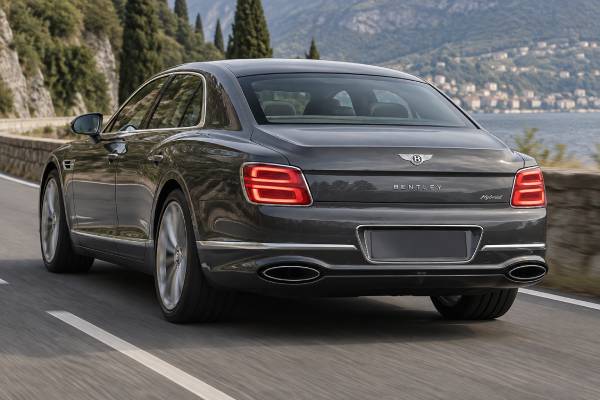
The 2021–2024 Flying Spur Hybrid is a plug-in hybrid, not a conventional hybrid and not an electric Bentley with a backup engine. It combines a 2.9-liter twin-turbo V6, an electric motor integrated with the eight-speed transmission, and an 18.0 kWh usable traction battery for 536 hp, 750 Nm, and a certified electric range of about 26 miles on the WLTP cycle. Bentley claimed 0–60 mph in 4.1 seconds and 177 mph, so electrification did not turn the Flying Spur into an economy special. Its real value depends on use: regular charging can make local trips quiet and gasoline-free, while the engine preserves long-distance flexibility. A used hybrid must therefore be inspected in two operating worlds. The V6, cooling, transmission, air suspension, brakes, and tires need conventional scrutiny; the charge port, onboard charger, battery, isolation system, power electronics, thermal management, and software need high-voltage expertise. This guide explains the PHEV architecture, realistic electric operation, maintenance responsibilities, and the tests required before buying.
Table of Contents
- What PHEV Means in a Flying Spur
- Hybrid Specifications, Battery, and Performance
- Electric Driving, Charging, and Real-World Range
- Blended Performance and Chassis Behavior
- Two Maintenance Plans in One Car
- Battery Health and the Hybrid Buying Test
- The Right Use Case and Ownership Verdict
What PHEV Means in a Flying Spur
A plug-in hybrid electric vehicle can charge its traction battery from an external power source and drive for a meaningful distance using its electric motor. The Flying Spur Hybrid also starts its gasoline engine whenever power demand, battery state, temperature, or system strategy requires it.
Bentley paired a 2,894 cc twin-turbocharged V6 with an electric motor mounted between the engine and eight-speed automatic transmission. Both can drive through the transmission and active all-wheel-drive system. Combined output is 536 hp in the assignment’s rating, corresponding to 544 PS, with 750 Nm.
The 18.0 kWh usable lithium-ion battery is positioned to preserve cabin function while affecting mass distribution and luggage packaging. The official European electric range is approximately 26 miles or 41 km. Temperature, speed, climate use, hills, tire pressure, traffic, and battery age can reduce or occasionally improve the distance achieved.
Three main powertrain strategies govern use. EV Drive prioritizes electric operation while conditions allow. Hybrid mode blends or selects sources automatically. Hold mode preserves battery charge for a later urban or restricted zone. Exact labels and behavior can vary with software and market, so confirm operation in the vehicle’s own display and handbook.
Regenerative braking converts some deceleration energy back into electricity. It cannot recover all energy and does not eliminate friction-brake use. A hybrid that spends long periods braking gently can develop corrosion on steel discs because the pads are used less heavily; inspection remains essential.
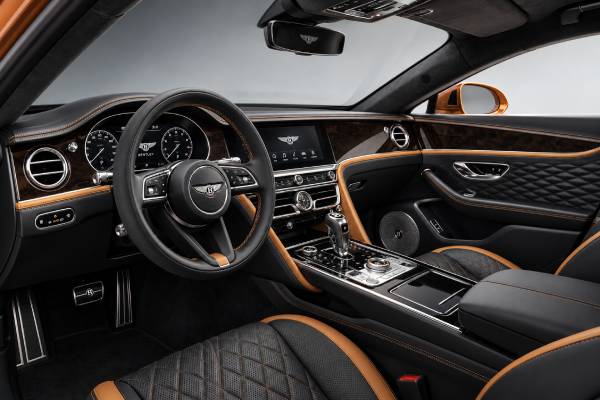
The Hybrid shares the ZG2’s long wheelbase, rear-wheel steering, air suspension, active AWD, and extensive digital luxury equipment. Some chassis options differ by trim or model year. Do not assume a Hybrid has every system fitted simply because another road test describes it.
The assignment ends at 2024, before Bentley’s later high-performance hybrid generation becomes the relevant specification. Buyers should distinguish the 536 hp V6 PHEV from newer powertrains with different batteries, motors, outputs, and charging capability.
Hybrid Specifications, Battery, and Performance
The Flying Spur Hybrid is a gasoline plug-in hybrid electric vehicle. It combines a twin-turbo V6, one traction motor, a lithium-ion battery, an eight-speed automatic transmission, and active all-wheel drive.
| Specification | Value | Notes |
|---|---|---|
| Gasoline engine | 2,894 cc twin-turbo V6 | Direct-injection ICE component |
| Electric motor | Approximately 134 hp / 136 PS and 400 Nm | Integrated with transmission |
| Combined system power | 536 hp (544 PS / 400 kW) | Outputs do not add arithmetically at all speeds |
| Combined torque | 750 Nm (553 lb-ft) | Electric torque supports immediate response |
| Transmission | Eight-speed automatic | Motor positioned within driveline |
| Drive | Active all-wheel drive | Rear-led with front drive as needed |
| Item | Manufacturer data | Buyer check |
|---|---|---|
| Battery type | Lithium-ion traction battery | No impact damage, isolation or thermal faults |
| Usable capacity | 18.0 kWh | Confirm reported capacity and state-of-health data |
| Official EV range | About 26 miles / 41 km WLTP | Compare with temperature-adjusted real test |
| Typical full-charge time | About 2.5 hours on suitable AC supply | Verify cable, wall supply, onboard charger |
| Charging type | AC plug-in charging | Market connector and cable must match |
| Total touring range | About 500 miles / 805 km in Bentley certification | Highly dependent on use and fuel level |
| Measure | Factory claim | Operating condition |
|---|---|---|
| 0–60 mph | 4.1 seconds | Engine and motor delivering system output |
| 0–100 km/h | 4.3 seconds | Battery state and temperature can matter |
| Top speed | 285 km/h (177 mph) | Combined-power operation |
| Certified CO2 | As low as 75 g/km WLTP | Cycle depends heavily on starting charged |
| Powertrain classification | PHEV | External charging is central to efficiency |
| Item | Approximate specification |
|---|---|
| Length | 5,316 mm (209.3 in) |
| Wheelbase | 3,194 mm (125.7 in) |
| Width across body | 1,978 mm (77.9 in) |
| Kerb weight | Approximately 2,505 kg (5,522 lb), equipment-dependent |
| Suspension | Adaptive air suspension with rear-wheel steering |
| Brakes | Regenerative blending plus large friction brakes |
| Data or record | Question it answers |
|---|---|
| Traction-battery fault and health report | Has the high-voltage system stored deterioration or isolation events? |
| Charging session from low state to full | Do port, cable, locks, timers, and onboard charger work? |
| Energy use during measured EV drive | Is displayed range plausible for conditions? |
| Hybrid cooling and pump diagnostics | Can battery and electronics control temperature? |
| Warranty and campaign history | What high-voltage work has already been performed? |
Electric Driving, Charging, and Real-World Range
The Hybrid delivers its greatest benefit when it is charged frequently. Without external charging, it carries the mass and complexity of a plug-in system while relying heavily on gasoline.
EV Drive can move the car quietly through residential streets, city centers, or short commutes. The electric motor’s immediate torque suits gentle departures despite the car’s weight. A firm accelerator input, high speed, low battery, cold conditions, or a need for cabin heat may start the V6. That behavior can be normal; repeated unexpected starts with adequate charge require data and temperature context.
The official 26-mile range is a test-cycle result, not a promise for every journey. Winter heating, summer cooling, high speed, hills, standing water, tire pressure, and short trips reduce efficiency. A healthy vehicle can show a different range estimate after each use because the algorithm learns recent consumption.
Assess range scientifically. Begin with a full charge, note ambient temperature, reset a trip meter, select EV operation, use moderate climate settings, and drive a representative route. Record electricity consumed, distance, gasoline-engine starts, remaining state of charge, and warnings. One cold five-mile drive is not a battery capacity test.
Charging should be tested with the vehicle’s supplied cable and a known-good compatible AC source. Inspect the inlet for damage, moisture, overheated pins, debris, and a loose door. Confirm the cable locks, charging begins, power is accepted steadily, the timer responds, and the session terminates without fault.
A failure to charge may originate from the supply, portable cable, wall unit, inlet, locking mechanism, onboard charger, battery temperature, software, or isolation monitoring. Test with more than one known-good source before blaming the vehicle, but do not repeatedly reset a system that reports a high-voltage safety fault.
The approximate 2.5-hour full charge assumes an appropriate AC supply and a battery starting near empty. Household voltage and current differ by country. Use a professionally installed, correctly protected circuit. Extension leads and improvised adapters are not suitable for sustained high-current charging.
Charging records can reveal use pattern. A car that was rarely plugged in may have low electric mileage but not necessarily a poor battery. A car charged constantly to full and stored hot may have a different aging profile. Battery-management data and an actual capacity assessment are more useful than assumptions about odometer mileage.
Blended Performance and Chassis Behavior
When engine and motor cooperate, the Hybrid is only slightly slower to 60 mph than the V8. Its character is quieter at low speed and more layered during acceleration, with electric torque filling before the V6 and turbochargers deliver full output.
The transition between sources should be smooth. A slight change in sound and pedal response is normal as the engine starts. A jolt, repeated flare, warning, or hesitation can involve engine start control, transmission clutches, mounts, battery power limits, software, or combustion quality.
Regenerative and friction braking are blended electronically. Pedal response may differ subtly from a pure ICE Flying Spur, but stopping should remain progressive and predictable. A step in deceleration, pulling, vibration, or inconsistent pedal travel requires diagnosis of both regenerative control and mechanical brakes.
Steel brake discs can corrode when regeneration handles much of gentle slowing. Inspect inner and outer faces, because rust may be worse where it is difficult to see. Periodic appropriate friction-brake use helps keep surfaces clean, but cannot repair deeply pitted discs.
The traction battery adds mass. Rear-wheel steering and air suspension help the car remain agile, yet tire load and brake energy are still substantial. Four matched tires with correct load and speed ratings are mandatory. Uneven wear can indicate alignment, rear-steering reference, suspension, or pressure problems.
Drive modes coordinate throttle, transmission, steering, damping, and power-source strategy. Test them separately. Comfort should isolate without repeated heave; Bentley mode should provide a balanced default; Sport should make the powertrain more immediate. A chassis warning can force fallback behavior that a casual test driver mistakes for normal heaviness.
The V6 must also be tested when the battery is at a lower state of charge. Some faults appear only when the engine carries more load. Log fuel pressure, boost, ignition, misfire, temperatures, and hybrid power limits during a specialist drive.
Noise in EV mode can reveal wheel bearings, tires, trim rattles, pumps, or driveline sounds normally masked by an engine. Listen carefully rather than assuming every electrical whir is a fault. Compare with documented system operation and scan data.
Two Maintenance Plans in One Car
The Hybrid needs conventional engine and chassis maintenance plus high-voltage inspection. Servicing only the gasoline side leaves half the powertrain unmanaged; relying on electric use does not protect oil, fuel, or friction brakes from aging.
The V6 oil should be changed by time and mileage with the exact approval. A plug-in may run its engine briefly and intermittently, creating condensation and fuel dilution. Regular longer engine operation helps reach stable temperature, but does not replace oil analysis or scheduled service.
Fuel can age when most local trips are electric. Use fresh premium gasoline, avoid leaving a nearly empty tank for long periods, and follow Bentley guidance on storage. The engine should be brought to operating temperature periodically under appropriate conditions.
Cooling is divided among the engine, turbochargers, battery, electric motor, power electronics, and cabin systems. Pumps, valves, radiators, chillers, hoses, sensors, and refrigerant interaction may be involved. Use factory diagnostics to command components and verify temperatures; topping up one visible reservoir does not test the network.
High-voltage components must be handled only by trained technicians using isolation, protective equipment, and manufacturer procedures. Never probe orange cables, open the battery, or assume the system is safe because the car is switched off. The battery can retain lethal voltage.
The eight-speed transmission integrates the motor and clutches. Fluid work requires the correct hybrid-specific process, temperature, and parts. Evaluate launch, engine-start transitions, shifts, reverse engagement, and behavior after heat soak.
Brake fluid remains time-sensitive. Measure discs and pads despite regenerative braking, inspect caliper movement, and ensure the electronic parking brake releases. Tires, wheel damage, suspension arms, air struts, rear steering, and alignment need the same attention as other ZG2s.
The 12-volt battery is crucial because it wakes control modules and closes high-voltage contactors. A healthy traction battery cannot compensate for a weak 12-volt supply. Test battery state, charging, parasitic draw, and sleep behavior.
Software updates can alter charging, energy management, displays, and diagnostics. Programming should use approved stable power support and be documented. An update is not a substitute for investigating a hardware fault, but outdated software can create known symptoms.
Battery Health and the Hybrid Buying Test
A complete pre-purchase inspection must include a charge-discharge evaluation and high-voltage diagnostic report. A normal dashboard and a short electric demonstration do not establish battery health.
Request the VIN, build sheet, service history, charging cable set, warranty terms, campaign records, and any high-voltage repairs before viewing. Confirm connector type and cable compatibility with the buyer’s country and home supply.
Inspect the underside for impact or incorrect lifting near battery protection. Look for damaged panels, missing fasteners, scrape marks, corrosion, and signs of collision repair. High-voltage battery enclosures should never be accepted with unexplained deformation.
Scan all modules before clearing codes. Review battery cell or module data where the diagnostic system permits, temperature spread, isolation faults, contactor events, charger errors, cooling-pump history, and state-of-health indicators. Interpretation requires model-specific expertise; a single displayed percentage may not tell the whole story.
Perform a full charging session or observe enough of one to confirm stable power acceptance. Test scheduled charging, port lock, indicator lights, cable release, and app or in-car status where supported. A seller who cannot provide a charge source should allow inspection at a qualified facility.
Drive first in EV mode on a measured route. Note range consumption and unexpected engine starts. Then operate in blended mode under progressively higher load, test regeneration and friction braking, use all chassis modes, and assess transmission behavior. Repeat after heat soak.
Inspect conventional systems: coolant and oil leaks, V6 misfire, turbo boost, air suspension, rear steering, tires, wheels, brakes, cameras, driver assistance, rotating display, rear seats, and water ingress. Hybrid health does not offset ordinary Bentley faults.
After the drive, scan again and inspect temperatures, pumps, fan operation, smells, and leaks. A thermal or isolation fault may appear only after charging or sustained power flow.
Price uncertainty explicitly. If battery health cannot be documented, do not assume the best case. Obtain a written diagnostic result and check remaining warranty coverage by VIN and registration market before agreeing value.
The Right Use Case and Ownership Verdict
The Flying Spur Hybrid is best for an owner who can charge at home or work, drives many trips within its electric range, and still needs effortless long-distance travel. Without regular charging, the PHEV’s strongest advantage is left unused.
Urban electric operation is exceptionally refined. It removes engine noise from parking garages and neighborhoods, provides immediate low-speed torque, and can reduce local fuel consumption. On longer trips, the V6 prevents charging stops from controlling the journey.
The Hybrid is not automatically the least expensive Flying Spur to own. Fuel savings depend on electricity price, charging frequency, route, climate, and gasoline cost. Maintenance still includes luxury-sedan tires, brakes, air suspension, rear steering, digital systems, and a combustion engine, plus high-voltage expertise.
Compared with the V8, the Hybrid is heavier and slower at the top end but quieter around town and potentially far more efficient on charged short trips. Compared with the W12, it lacks twelve-cylinder drama but offers a fundamentally different ownership pattern. The correct choice follows daily use, not prestige hierarchy.
Choose a car with transparent charging history, complete cables, clean battery diagnostics, stable cooling, smooth source transitions, matching tires, healthy brakes, and every option working. A later model year or low odometer cannot compensate for an untested charging system.
Walk away from battery isolation warnings, damaged underbody protection, repeated charging faults, unexplained loss of range, coolant contamination, rough engine starts, transmission judder, brake corrosion, rear-steering faults, water ingress, or missing high-voltage service records after major repairs.
Budget for a home charging installation if needed, annual specialist service, battery and cooling diagnostics, tire and brake care, and a repair reserve. Confirm warranty coverage and exclusions in writing rather than relying on general statements about hybrid batteries.
When matched to the right routine, the 2021–2024 Flying Spur Hybrid is more than a compliance model. It can perform daily luxury transport in near silence, then cover hundreds of miles without changing plans. Its success as a used car depends on proof that both halves of the powertrain—and the sophisticated ZG2 chassis around them—remain healthy.
Planning home charging before purchase
Evaluate the charging location before bringing the Hybrid home. Confirm parking access, cable reach without creating a trip hazard, electrical capacity, weather protection, connector type, and permission from a landlord or building association where relevant. A qualified electrician should design the circuit, protective devices, earthing, and load management for local regulations.
The practical routine should be simple enough to use daily. Store the cable clean and dry, avoid tight bends, inspect plugs for heat or damage, and set charge schedules through the car or wall unit only after confirming clock and tariff settings. A PHEV that is awkward to plug in will gradually be used as a gasoline car.
Include installation cost and electricity tariff in the purchase decision. The Hybrid’s strongest ownership case comes from frequent, reliable charging—not from the badge alone.
References
- Bentley News 2021 : THE WORLD’S BEST LUXURY SEDAN MADE GREENER: INTRODUCING THE NEW FLYING SPUR HYBRID 2021 (Manufacturer Launch Release)
- Flying Spur Hybrid Certified as Most Efficient Bentley Yet | Bentley Media 2022 (Certified Range and Emissions)
- BENTLEY NEWSROOM : Flying Spur 2026 (Manufacturer Model Archive)
- BENTLEY NEWSROOM : Technical Specifications 2026 (Manufacturer Technical Archive)
- Search Safety Issues | NHTSA 2026 (VIN Recall Search)
Disclaimer
This article is educational and does not replace a high-voltage-qualified inspection or current Bentley repair information. Confirm specifications, charging equipment, battery warranty, software, fluids, recall status, isolation procedures, and part compatibility for the exact VIN and market.
Please share this guide on Facebook, X/Twitter, or an electric and Bentley owners’ forum if it can help another PHEV buyer test more than the displayed range.