
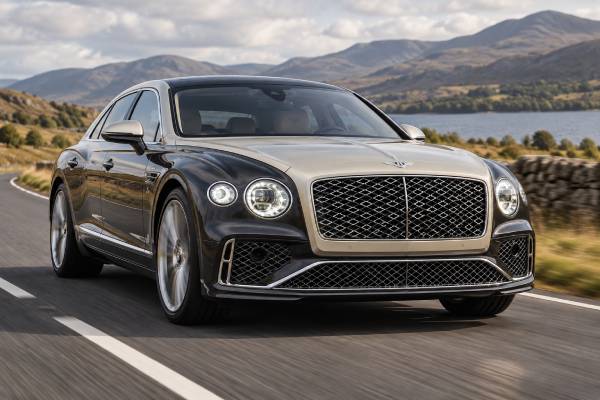
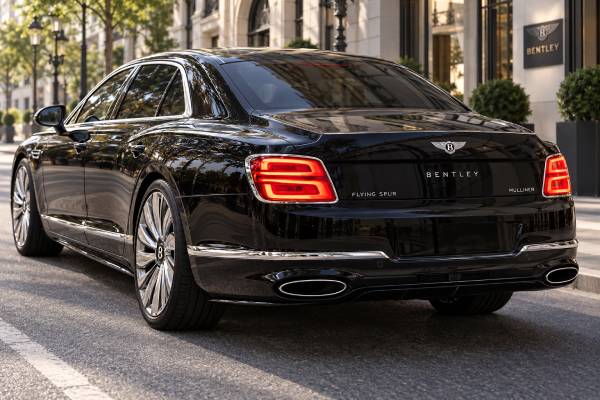
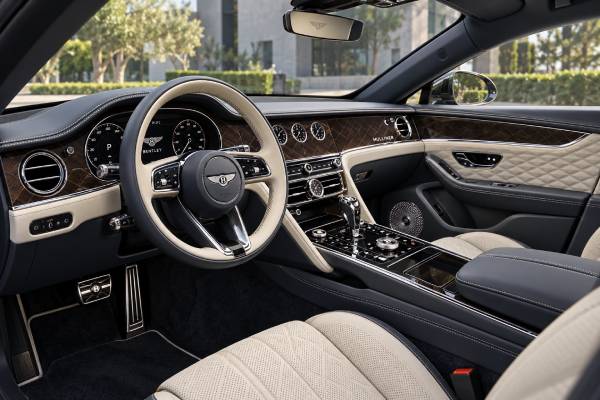
The 2024–present Bentley Flying Spur Mulliner with the Ultra Performance Hybrid is the most powerful series-production Mulliner sedan. A 600 PS twin-turbo V8 and 190 PS electric motor work through an eight-speed dual-clutch transmission to produce 782 PS, or 771 bhp, and 1,000 Nm. The same car can accelerate to 60 mph in 3.3 seconds, travel up to 76 km on the WLTP electric cycle, and surround its occupants with Mulliner’s Floating Diamond grille, tri-tone cabin, intricate quilting, wellness seating, and highly configurable materials.
Its range of abilities is the main attraction and the main source of complexity. This is not an older Flying Spur with a motor added. It uses a larger 25.9 kWh battery, 11 kW AC charging, new dampers, revised electronics, active chassis systems, and a different 4.0-liter V8 from the outgoing cylinder-deactivation engine. Buyers and owners must understand charge habits, battery condition, software, tires, brakes, coolant circuits, and bespoke trim. This guide separates the mechanical substance from Mulliner presentation and explains how to configure, maintain, and evaluate the flagship four-door PHEV.
Table of Contents
- Mulliner in the hybrid era
- Ultra Performance Hybrid technical data
- Two personalities from one powertrain
- Mulliner design and wellness
- Active chassis and touring ability
- Charging, service, and battery care
- Ordering or buying used
Mulliner in the hybrid era
The new Mulliner is no longer defined by choosing between V8 and W12 engines. It adopts the same maximum-output Ultra Performance Hybrid as the Speed, then builds a more formal, bespoke, and comfort-rich specification around it.
That change matters. Previous Flying Spur Mulliner buyers could choose the lighter V8, the twelve-cylinder flagship, or the earlier 2.9-liter PHEV. The 3S-era launch model consolidates flagship performance around one electrified V8. The powertrain is not a compromise inserted for emissions compliance; it exceeds the outgoing W12 Speed in power and torque and adds meaningful electric range.
Mulliner identity appears first in the Floating Diamond radiator grille, bright chrome exterior treatment, satin-silver mirror caps, wing vents with Double Diamond detailing, and 22-inch wheels with polished accents and self-leveling badges. A black exterior treatment can be commissioned, but the standard visual language is more jewel-like than the Speed’s darker approach.
Inside, three-color hide combinations, unique quilt patterns, embroidery, thick-pile carpeting, special veneers, and extensive personalization distinguish the model. Comfort Seat Specification and wellness functions align the car with rear-seat luxury, while the underlying Speed-derived chassis ensures that the driver does not receive a softened or less capable version.
The generation code in the assignment is 3S, while Bentley’s public communications describe the car as the fourth-generation Flying Spur. Buyers should use the VIN, model year, and build specification when ordering parts or service because colloquial generation names and internal codes can be used differently across databases.
This model best suits an owner who wants the fastest mechanical package and the widest factory personalization without adopting the Speed’s overt sports theme. It can be chauffeur-driven, owner-driven, or both. The commissioning decisions should reflect which role dominates: four-seat rear luxury, five-seat flexibility, bright or Blackline exterior, traditional veneer or technical finish, and wheel and brake choices that affect maintenance as well as appearance.
Ultra Performance Hybrid technical data
The Flying Spur Mulliner is a plug-in hybrid with a revised 4.0-liter twin-turbo V8, one powerful electric motor integrated into the dual-clutch transmission, and a 25.9 kWh high-voltage battery. Combined output is an official system rating and must not be recreated by adding component peaks.
| Specification | Value |
|---|---|
| Powertrain category | Plug-in hybrid electric vehicle |
| Combustion engine | 4.0-liter twin-turbocharged V8 |
| Engine displacement | 3,996 cc |
| Engine maximum output | 600 PS (about 592 bhp; 441 kW) |
| Engine maximum torque | 800 Nm (590 lb-ft) |
| Electric motor output | 190 PS (187 bhp) |
| Electric motor torque | 450 Nm (332 lb-ft) |
| Combined system power | 782 PS (771 bhp; 575 kW) |
| Combined system torque | 1,000 Nm (738 lb-ft) |
| Battery capacity | 25.9 kWh |
| Transmission | 8-speed dual-clutch automatic |
| Specification | Value | Condition |
|---|---|---|
| 0–60 mph | 3.3 seconds | Manufacturer figure |
| 0–100 km/h | 3.5 seconds | Manufacturer figure |
| Maximum speed | 285 km/h (177 mph) | Manufacturer figure |
| Electric range | Up to 76 km (47 miles) | EU/WLTP cycle |
| Maximum electric speed | 140 km/h (87 mph) | Conditions and power demand permitting |
| Total range | Up to 829 km (515 miles) | Manufacturer statement |
| Maximum AC charging | 11 kW | Compatible three-phase supply |
| Fastest stated full charge | About 2 hours 45 minutes | Suitable 11 kW source and conditions |
| DC fast charging | Not offered | AC charging only |
| Specification | Value |
|---|---|
| Length | 5,316 mm (209.3 in) |
| Width across mirrors | 2,220 mm (87.4 in) |
| Height | 1,474 mm (58.0 in) |
| Wheelbase | 3,194 mm (125.7 in) |
| Unladen weight | about 2,646 kg (5,833 lb) |
| Boot volume | 346 liters (12.2 cu ft) |
| Fuel tank | 80 liters (21.1 US gal) |
| Core suspension | Air springs with twin-valve dampers |
| Active systems | Dynamic Ride, all-wheel steering, active AWD, torque vectoring, eLSD |
The weight figure should retain its published definition; regional unladen values can differ by several kilograms. Equipment adds further variation. The practical consequence is clear: this is a heavy car with immense output, so tire load rating, brake condition, and suspension calibration are essential.
Two personalities from one powertrain
The Ultra Performance Hybrid works because electric operation and maximum performance are not competing modes. The motor provides quiet mobility by itself and also fills the low-speed and gear-change gaps that a high-output turbo engine would otherwise reveal.
The V8 is substantially different from the outgoing 542 bhp unit. Bentley increased fuel-injection pressure to 350 bar and adopted twin single-scroll turbochargers. Because the electric motor can cover response while the turbos build flow, the engine does not need the previous twin-scroll arrangement. Cylinder deactivation is also unnecessary: in suitable situations, the system can turn the entire engine off and continue electrically.
In EV mode, 190 PS and 450 Nm are sufficient for normal traffic. Bentley states that electric operation can continue up to 140 km/h and with substantial accelerator demand, provided battery state, temperature, and system conditions allow. The engine can still start for maximum acceleration, cabin heating, defrosting, battery protection, or other control reasons. “Electric range” is therefore a homologated capability, not a promise that the V8 will never start during the first 76 km.
When both sources engage, the motor’s immediate torque and the V8’s sustained output create a broad power curve. The 3.3-second 0–60 mph claim is remarkable for a sedan of this mass, but the most useful feature is response at ordinary road speed. The car can accelerate without waiting for multiple downshifts, and the e-motor can smooth the dual-clutch transmission’s torque handover.
The transmission still uses physical clutches. At very low speed, software blends electric torque and clutch engagement, which should feel controlled. Test reverse, inclines, repeated parking maneuvers, and warm operation. Shudder, delayed selection, or a warning message is not normal PHEV behavior.
The hybrid control strategy offers modes to prioritize EV driving, automatic blending, or charge retention. Save battery for a city-center arrival when that improves the trip. Avoid routinely using the engine as a generator to replace plugging in; conversion losses make that an inefficient normal practice.
Performance depends on battery charge and thermal condition. The car remains very fast with the displayed electric range exhausted because the system retains a protected buffer, but repeated full-power use can reduce available electrical assistance. Buyers should test a car with meaningful charge and confirm that power delivery remains consistent as it warms.
Mulliner design and wellness
Mulliner’s premium is justified by detail, material choice, and configuration coherence. A visually complicated commission is not automatically better; the strongest cars use color, texture, and hardware to support one clear theme.
The Floating Diamond grille combines a repeated diamond mesh with vertical vanes. Mulliner wing vents echo the motif, while the Flying B mascot is standard in chrome or black finish. Inspect alignment, stone damage, corrosion, and operation of the retractable mascot. Front-end repair on a car with radar and cameras also requires calibration evidence.
The 22-inch Mulliner wheels can be specified in Tungsten Grey or Gloss Black with polished accents. Self-leveling center badges keep the emblem upright. Their finish is difficult to reproduce perfectly after curb damage. Look for a changed spoke profile, cloudy clear coat, exposed machining lines, and inner-rim repairs.
Tri-tone hide schemes introduce a third accent color. The new quilt patterns and embroidery should be viewed in daylight, with special attention to driver bolsters, perforated ventilation areas, thread tension, and color transfer. Wellness seating can provide postural adjustment and automatic thermal management; test the complete cycle rather than only basic movement.
Air ionization and improved filtration are intended to maintain cabin air quality. The system can react to particulate levels and use navigation information to prepare for tunnels. These functions rely on sensors, software, climate hardware, and correct filters. A musty cabin or weak airflow deserves conventional inspection before assuming an advanced feature will solve it.
The My Bentley App Studio can install selected applications directly into the infotainment environment. Connected functions depend on market, account, licensing, and network support. Confirm what transfers to a second owner, how accounts are removed, and whether data services remain active.
Three audio levels and many veneer choices make specification important. A technical finish can complement the powertrain’s modernity; traditional wood can emphasize Mulliner heritage. The rotating display remains available and should operate silently, align precisely, and retain settings.
Four-seat configuration makes the rear cabin more ceremonial. Five seats improve flexibility. The reduced 346-liter trunk is smaller than the outgoing gasoline car’s, so rear-seat luxury should be considered alongside actual luggage needs.
Commissioning a Mulliner should begin with use rather than a color chart. A car driven daily needs finishes that tolerate frequent entry, luggage handling, children, or business passengers; a ceremonial or collection car can accept more delicate materials. View paint and hide samples in daylight as well as showroom lighting, because metallic depth, contrast stitching, and open-pore veneer can read differently outside. Consider how a three-color cabin will look with screens illuminated and doors open, and ask whether replacement material can be matched if damage occurs years later.
The rear compartment deserves its own specification session. Confirm whether the usual passengers value privacy blinds, wellness functions, audio, tables, refrigeration, or a simpler open layout. Extra equipment adds usefulness only when it matches the journey. Document every bespoke choice in the build record and keep high-resolution photographs at delivery; they can help a future repairer identify the intended finish and can distinguish factory work from later modification.
Active chassis and touring ability
Mulliner uses the same high-capability chassis foundation as the Speed, so its comfort does not come from deleting performance systems. The car can be supple in Comfort and highly controlled in Sport because multiple systems change independently.
Twin-valve dampers control compression and rebound through separate paths. This widens the difference between modes and allows the body to stay composed without making every wheel impact harsh. Air springs support load leveling and variable ride behavior. The car should remain level after standing and should change modes without compressor overactivity.
Bentley Dynamic Ride uses 48-volt active anti-roll control. It can resist roll strongly in corners and relax on a straight road. All-wheel steering makes the long wheelbase manageable at low speed and stabilizes lane changes at higher speed. Active all-wheel drive and brake-based torque vectoring distribute force, while an electronic limited-slip differential improves rear-axle control under power.
The combination is especially important because the hybrid powertrain creates a rear-biased 48.3:51.7 weight distribution. That is unusual for a large front-engined luxury sedan and gives the chassis a favorable starting point. The driver should feel secure rather than busy; electronics work best when they are not constantly noticed.
Tires remain the final link. Match all four for approved specification, age, and similar tread. A damaged 22-inch wheel, poor balance, or wrong tire can create vibration that no software can remove. Consider a separate winter package in cold climates.
Brake choice affects cost and feel. Iron brakes are powerful and serviceable but expensive at this scale. Carbon-silicon-carbide or carbon-ceramic options, where available, reduce unsprung mass and resist heat but require specialist inspection and much larger replacement budgets. Regeneration can reduce friction-brake use, so iron discs may corrode on cars driven gently.
For touring, the smaller trunk and need to plan AC charging are the only major compromises. The 80-liter tank and 829 km claimed combined range retain genuine long-distance ability. Charge at home or overnight destinations rather than designing a journey around rapid chargers the car cannot use.
Charging, service, and battery care
The best care plan combines frequent sensible charging with annual combustion-engine service and periodic inspection of both voltage systems. Low gasoline mileage does not eliminate oil aging, and low electric mileage does not prove the battery is healthy.
An 11 kW wallbox requires a compatible supply; many homes will charge at a lower rate. The car will accept what the installation can safely provide. Use a qualified electrician, avoid improvised adapters, and keep the cable connector clean and undamaged. During a purchase inspection, complete a real charge session and check the flap, lock, rate, schedule, and release.
Battery state of health cannot be inferred from the dashboard’s predicted range alone. Weather, cabin climate, speed, and recent driving change the estimate. A proper evaluation combines diagnostic data, fault history, cell-balance information, a full charge, and measured energy use. High-voltage service belongs to trained personnel.
The V8 still needs approved oil, filters, spark-plug attention, coolant inspection, and all time-based tasks. Its 350-bar injection, turbochargers, catalysts, and thermal systems should be assessed through operating data and physical inspection. Repeated short engine runs can contaminate oil even when total engine hours seem low.
The 12-volt battery remains critical because it wakes modules and connects the high-voltage system. The 48-volt network supports active chassis functions. Test both, maintain the 12-volt battery during storage, and avoid interpreting a collection of low-voltage faults as multiple failed components without diagnosis.
Brake fluid, tire age, alignment, air suspension, eLSD operation, rear steering, cooling circuits, and climate filters all need routine attention. Regenerative braking may leave disc surfaces underused; periodic safe friction braking helps, but existing corrosion still needs measurement.
Software is part of maintenance. Confirm updates and service campaigns, but do not accept “it needs an update” as a diagnosis for persistent charging or chassis faults. Record codes and symptoms first, then verify the result after programming.
Ordering or buying used
A new order should be configured around use; a used purchase should be judged around evidence. In both cases, the best Mulliner is coherent, serviceable, and suitable for the owner’s charging and passenger routine.
For a new commission, settle these decisions first:
- Rear layout: four individual seats for formal use or five seats for flexibility.
- Exterior theme: bright Mulliner jewelry, Blackline contrast, or a mixed treatment.
- Brake system: iron for conventional servicing or the high-cost lightweight option for specific needs.
- Wheel and seasonal plan: show wheels, winter set, and local road quality.
- Cabin purpose: rear wellness, driver-focused technical trim, or a balanced theme.
- Charging installation: safe parking, cable route, and available AC power before delivery.
For a used car, obtain the VIN, build sheet, service history, charging cables, both keys, warranty documents, and account-transfer information. Inspect from cold and with a meaningful battery charge. Test EV mode, combined acceleration, low-speed transmission behavior, every chassis setting, all comfort functions, and a full AC charging session.
A professional inspection should save diagnostic reports, assess high-voltage battery data, test 12- and 48-volt systems, measure tires and brakes, inspect cooling circuits, verify suspension height, evaluate wheel repairs, review paint depth, and confirm recall or campaign completion. Body repair requires calibration records for cameras, radar, and driver assistance.
Do not compare only with the Speed. The two share their powertrain and chassis, but Mulliner adds bright or bespoke design, richer material choices, and wellness equipment. Choose the Speed for the most overt performance identity; choose Mulliner for equal mechanical capability presented as a pinnacle luxury commission.
The High Performance Hybrid Flying Spur and Azure use 680 PS rather than 782 PS, have lower top speeds, and can be less expensive while retaining the same battery capacity and useful electric range. For many owners, that is enough. The Mulliner case is strongest when the buyer values its craftsmanship and specification depth, not merely the badge above the grille.
Keep a reserve even under warranty. Tires, wheel refinishing, cosmetic repairs, brake wear, and charging installation may not be covered. A 771 bhp PHEV can be a remarkably complete everyday car, but it remains a hand-finished, high-mass, high-complexity machine whose condition deserves continuous attention.
References
- Bentley News 2024 : Most powerful Mulliner models yet define pinnacle versions of Continental GT, GTC and Flying Spur 2024 (Model Launch)
- Bentley News 2024 : Flying Spur Mulliner makes European debut at 2024 Zoute Grand Prix 2024 (Mulliner Details)
- Bentley News 2024 : The new Flying Spur: The most powerful Bentley four-door ever 2024 (Technical Data)
- BENTLEY NEWSROOM : New Flying Spur 2026 (Model Overview)
- : Services: Flying Spur services 2026 (Connected Services)
- Check for Recalls: Vehicle, Car Seat, Tire, Equipment | NHTSA 2026 (Recall Database)
Disclaimer
This article is for informational purposes and is not a substitute for professional diagnosis, repair, high-voltage work, or a VIN-specific inspection. Specifications, torque values, charging rates, intervals, procedures, software, and equipment vary by market, model year, and factory configuration. Verify every requirement with official Bentley service documentation and qualified technicians. Please share this guide on Facebook, X/Twitter, or another platform if it helped you.