
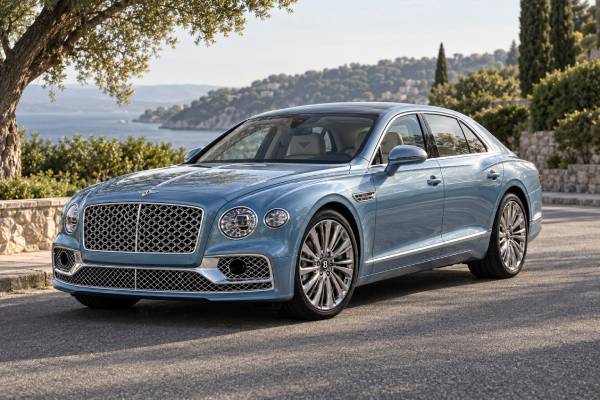
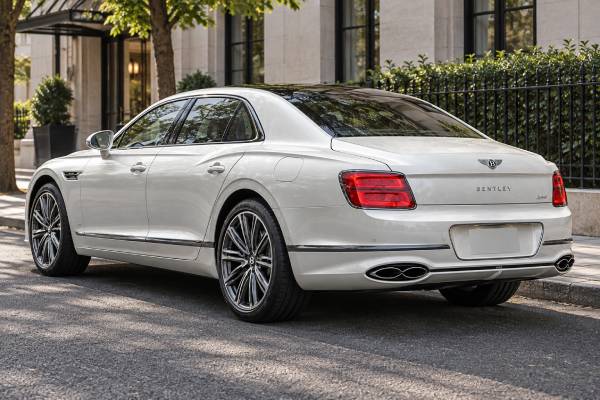
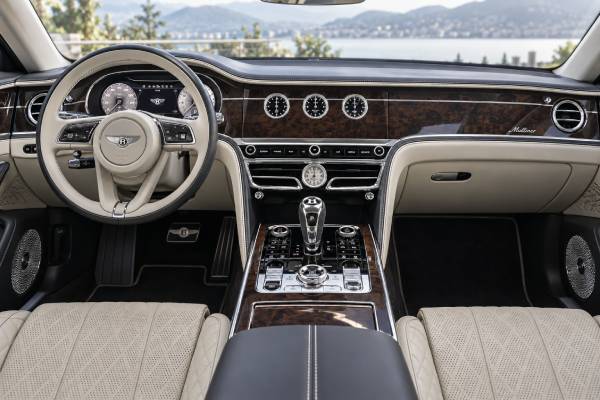
The Flying Spur Mulliner Hybrid combines two different kinds of complexity: Bentley’s 536 hp plug-in-hybrid system and Mulliner’s most elaborate series-production craftsmanship. Its 2.9-liter twin-turbo V6, integrated electric motor, 18.0 kWh usable battery, eight-speed transmission, active all-wheel drive, rear-wheel steering, and air suspension are shared in principle with the standard Hybrid. Its value, however, also depends on a Double Diamond grille, exclusive 22-inch wheels, wing vents, illuminated details, tri-tone hide, extensive quilting, diamond-milled metalwork, veneers, embroidery, and the accuracy of an individual commission. That makes the buying task different from evaluating a normal trim package. A mechanically excellent car with missing Mulliner pieces may be expensive to return to specification; a perfect cabin cannot compensate for weak battery health or charging faults. This guide explains what makes the Mulliner a genuine model, records its PHEV data, separates craftsmanship inspection from ordinary cosmetic appraisal, and creates a complete mechanical, high-voltage, originality, and valuation process for 2021–2024 examples.
Table of Contents
- Mulliner Model, Not Merely Mulliner Options
- Hybrid Performance and Technical Specifications
- The Mulliner Craftsmanship Audit
- How the Pinnacle Specification Should Drive
- Preservation, Charging, and Technical Service
- Authentication, Inspection, and Valuation
- Who the Mulliner Hybrid Is For
Mulliner Model, Not Merely Mulliner Options
The Flying Spur Mulliner is a defined flagship derivative. It should not be confused with a standard Hybrid ordered with the Mulliner Driving Specification, individual Mulliner options, or later-applied wheels and badges.
Bentley introduced the ZG2 Mulliner as the pinnacle four-door grand tourer, available with W12, V8, and V6 plug-in-hybrid powertrains. The Hybrid therefore combines the same 536 hp and 750 Nm system output as the standard PHEV with a distinct exterior and interior design program.
Factory exterior identifiers include the Double Diamond front grille and chrome lower-grille treatment, Mulliner wing vents, satin-silver mirror caps, and exclusive 22-inch Mulliner wheels. Self-leveling wheel badges keep the Bentley emblem upright when the car stops. Depending on specification, the radiator mascot, brightware, and Blackline choices can alter the visual result.
Inside, Mulliner used a three-color split, hand cross-stitching, extensive quilting, contrast piping, embroidered emblems, deep-pile overmats, illuminated sill plates, and diamond-milled technical-finish surfaces. The center console and rear picnic tables may carry distinctive milling or veneer work. Customers could choose many hide, veneer, and paint combinations, so originality cannot be judged against one publicity-car color scheme.
A build specification or factory record is essential. It should identify the derivative, powertrain, exterior paint, brightware, wheel finish, primary and secondary hides, accent color, stitching, piping, veneer, seat configuration, audio, rear entertainment, driver assistance, rotating display, and bespoke content. The more individual the commission, the harder an undocumented repair is to match.
Mulliner value comes from completeness and coherence. A missing self-leveling center cap, refinished wheel in the wrong tone, replaced seat panel with incorrect perforation, or ordinary treadplate may look minor but signal parts substitution. Inspect every special component before assigning a flagship premium.
The date range in the assignment covers the 536 hp V6 PHEV through 2024. It should not be mixed with later Ultra Performance Hybrid Mulliner specifications, which use different output, battery, electric range, and chassis data.
Hybrid Performance and Technical Specifications
The Mulliner Hybrid is a plug-in hybrid electric vehicle. External AC charging is part of its intended operation; the gasoline engine and electric motor can work separately or together through the transmission.
| Specification | Value | Explanation |
|---|---|---|
| Combustion engine | 2,894 cc twin-turbo V6 | Gasoline direct-injection component |
| Electric motor | Approximately 134 hp / 136 PS and 400 Nm | Integrated into the driveline |
| Combined maximum power | 536 hp (544 PS / 400 kW) | System output, not simple peak addition |
| Combined maximum torque | 750 Nm (553 lb-ft) | Electric torque supports initial response |
| Transmission | Eight-speed automatic | Coordinates engine, motor, and AWD |
| Drive system | Active all-wheel drive | Rear-led with front torque on demand |
| Item | Manufacturer figure | Inspection focus |
|---|---|---|
| Battery | Lithium-ion traction battery | Isolation, temperatures, module balance, impact protection |
| Usable energy | 18.0 kWh | Capacity report and measured EV use |
| Certified EV range | About 26 miles / 41 km WLTP | Weather-adjusted road verification |
| Approximate full charge | About 2.5 hours on suitable AC supply | Port, cable, onboard charger, timers |
| Certified total range | Approximately 500 miles / 805 km | Depends on fuel, charge, route, and climate |
| Powertrain category | PHEV | Not a self-charging-only hybrid |
| Measure | Published figure | Notes |
|---|---|---|
| 0–60 mph | 4.1 seconds | Combined-power operation |
| 0–100 km/h | 4.3 seconds | Battery temperature and state can influence output |
| Top speed | 285 km/h (177 mph) | Factory Hybrid rating |
| Certified CO2 | As low as 75 g/km WLTP | Assumes a charged test-cycle start |
| Electric operation | Available for suitable urban and local driving | Engine starts when conditions demand |
| Item | Approximate specification |
|---|---|
| Length | 5,316 mm (209.3 in) |
| Width across body | 1,978 mm (77.9 in) |
| Wheelbase | 3,194 mm (125.7 in) |
| Kerb weight | Approximately 2,505 kg (5,522 lb), option-dependent |
| Suspension | Adaptive air suspension |
| Steering | Electronic rear-wheel steering plus front rack |
| Area | Expected evidence | Common concern |
|---|---|---|
| Front exterior | Correct Double Diamond grille and lower treatment | Stone damage or substitute standard grille |
| Wheels | 22-inch Mulliner design and self-leveling badges | Wrong finish, bent barrels, missing caps |
| Interior color split | Matches factory hide and accent codes | Re-dye obscuring original contrast |
| Quilting and stitching | Consistent pattern, tension, and thread color | Panel repair that does not align |
| Metal and veneer | Correct diamond milling, engraving, and grain | Scratches or replacement with standard trim |
The Mulliner Craftsmanship Audit
A normal cosmetic inspection asks whether a cabin looks good. A Mulliner audit asks whether every material, pattern, finish, and mechanism matches the individual commission and retains the precision that created its value.
Begin with the exterior in diffuse daylight. The Double Diamond grille contains many edges that show chips, corrosion, polishing residue, or incorrect refinishing. Examine chrome or Blackline surfaces for consistent tone. Wing vents, mirror caps, mascot, window surrounds, and lower brightwork should match the build specification rather than a seller’s preferred appearance.
Inspect all four 22-inch wheels off-axis, including inner barrels. The elaborate finish is difficult to restore invisibly. Look for bends, welds, cracks, machined-face distortion, wrong clearcoat, and incorrect center caps. A self-leveling badge should rotate freely and settle upright; replacement cost should be included when it does not.
Paint inspection must account for Bentley’s broad standard, extended, and bespoke palette. Use paint-depth measurement appropriate to the substrate, then inspect metallic orientation, panel-edge masking, fasteners, glass dates, seals, and sensor mounting. A high-quality documented repair may be acceptable; a near-match on a special color can be extremely expensive to correct.
Inside, compare the tri-tone split with the build record. Leather panels should share consistent grain and gloss. Re-dyed areas can conceal abrasion but may feel stiff, block perforations, or alter color under natural light. Inspect piping for scuffs, stitch holes for repair, and embroidered emblems for pulled threads.
Quilting patterns should align across adjacent sections and remain evenly padded. A replacement seat insert that shifts one diamond row or uses different perforation is obvious once identified. Test every seat movement because failed motors or twisted frames can damage hand-finished panels.
Diamond-milled metal shows scratches, harsh cleaning, and polishing quickly. Check the center console, rear controls, vent knobs, organ stops, and door hardware. Veneer should have consistent book-matching, edge fit, lacquer, and grain direction. A standard replacement panel may function but reduce originality.
Illuminated treadplates, ambient light, rear picnic tables, blinds, screens, Naim or other audio, rotating display, and removable controls all need complete operation. Photograph special parts and record codes before any repair leaves the car, reducing the risk of substitution.
Smell and moisture matter. Deep carpets and underlay can hide water. Inspect beneath overmats, in the trunk, around modules, and at drain paths. Dampness can stain light hides, lift veneer, corrode connectors, and create odors that ordinary detailing cannot remove.
How the Pinnacle Specification Should Drive
The Mulliner Hybrid should drive like a standard Hybrid in excellent condition: nearly silent in EV mode, seamless as the V6 starts, composed over poor surfaces, and stable under combined 536 hp acceleration. Luxury trim must not be used to excuse mechanical weakness.
Begin in electric mode with a charged battery. Low-speed motion should be smooth, with no driveline clunk or repeated brake release noise. Listen for wheel bearings, pumps, tire roar, trim movement, and air-suspension sounds that an engine would mask.
The gasoline engine may start because of accelerator demand, temperature, climate settings, battery state, or system protection. Its arrival should be controlled. A jolt, flare, warning, or rough idle suggests engine-start control, mounts, transmission, combustion, battery power limits, or software requires diagnosis.
During blended acceleration, electric torque should fill the initial response and the V6 should build power linearly. Log fuel pressure, boost, ignition, misfires, hybrid power request, battery temperature, and power limits. A car can feel fast while delivering less than intended.
Regenerative and friction braking should produce a consistent pedal. The heavy Mulliner needs straight, repeatable stopping. Inspect both faces of steel discs for corrosion because gentle owners may use little friction braking. Compare wheel temperatures for dragging calipers or bearings.
Rear-wheel steering should make parking surprisingly manageable. The car should not hop, crab, or produce rear-axle knocks. At speed, it should change lanes as one body rather than feeling delayed at the rear. Alignment work must follow Bentley procedures and account for steering actuators and ride height.
Air suspension should distinguish Comfort, Bentley, and Sport settings. The 22-inch wheels reduce sidewall cushioning, but the ride should remain rounded. Crashing, tramlining, steering vibration, or continuous correction points to tires, wheel damage, geometry, arms, dampers, or level calibration.
A measured EV test is especially useful because wheel and tire drag, climate loads, and battery health influence range. Start fully charged, document temperature and route, and compare energy consumed with distance. Do not judge from the dashboard estimate alone.
The cabin should remain silent over diagonal bumps. Rattles from picnic tables, rotating display, rear screens, vents, or door trim reduce the flagship experience and can be labor-intensive to eliminate without damaging bespoke surfaces.
Preservation, Charging, and Technical Service
Mulliner Hybrid maintenance has two goals: keep a complex PHEV reliable and preserve irreplaceable or costly finishes. Workshop quality, handling procedures, and documentation matter as much as the service schedule.
High-voltage diagnosis belongs to trained personnel. The battery, orange cables, power electronics, motor, charger, and contactors can retain dangerous energy after shutdown. Proper isolation, personal protective equipment, test tools, and verification procedures are mandatory.
The 18.0 kWh usable battery depends on thermal management. Inspect coolant circuits, pumps, valves, sensors, heat exchangers, chiller operation, and refrigerant interaction. A charging or power limit may reflect temperature control rather than cell deterioration.
Test charging with a known-good AC source. Examine inlet pins, door, lock, cable, timer, indicator, and onboard-charger data. Use a professionally installed circuit with correct protection. Improvised adapters and extension leads create heat and safety risk.
The V6 still needs time-based oil service even when electric mileage is high. Short, intermittent engine runs can introduce moisture and fuel dilution. Keep gasoline fresh, use the specified octane, and operate the engine fully enough to reach stable temperature according to Bentley guidance.
Transmission service must account for the integrated electric motor and hybrid controls. Evaluate gear changes, reverse, engine starts, and low-speed clutch behavior at cold and hot temperatures. Follow exact fluid, fill, filter, diagnostic, and adaptation procedures.
Brake fluid ages even when regeneration reduces pad use. Inspect disc corrosion, pad movement, electronic parking brake, hoses, and calipers. Tire pressure, matching specification, and alignment affect both range and expensive wheel wear.
The 12-volt battery is the gateway to the high-voltage system because it powers controls and contactors. Load-test it, confirm charging and sleep current, and use stable support during programming. A weak 12-volt battery can create high-voltage messages without a failed traction battery.
Protect the cabin during service. Use clean, dye-safe covers; remove jewelry and sharp tools; specify approved cleaners; and photograph veneers and metal before work. Confirm wheel-protection equipment and lifting points. A technically correct repair that scratches a Mulliner console or wheel is not a successful service.
Maintain a provenance file containing build sheet, paint and hide codes, wheel finish, cable inventory, battery reports, software versions, invoices, calibration results, photographs, and replaced original parts. This supports future repairs and valuation.
Authentication, Inspection, and Valuation
Valuing a Mulliner Hybrid requires four separate judgments: genuine derivative, bespoke completeness, mechanical and battery health, and market desirability of the exact commission. A single guide price cannot replace those steps.
Obtain VIN-linked factory documentation before inspecting. Compare every listed feature with the car. Confirm that the Mulliner designation is factory-original, not a dealership description for a car with Mulliner Driving Specification.
Inventory special exterior and interior components. Note missing center caps, incorrect wheels, changed grilles, standard replacement trim, altered stitching, absent tables, non-original screens, and modified audio. Obtain replacement availability and exact finish cost; ordinary component prices may not apply.
Review service and warranty history chronologically. Look for recurring charging faults, battery cooling work, repeated 12-volt replacement, software campaigns, coolant top-ups, brake corrosion, suspension messages, or interior parts ordered multiple times. A completed major repair can be positive when supported by detailed evidence.
Inspect the battery enclosure and underside for impact. Incorrect lifting can damage protection or adjacent lines. Any deformation, scraping through protective layers, or missing fastener requires a high-voltage-qualified assessment before the car is energized or charged further.
Perform a full module scan before code clearing, followed by a controlled charge, measured EV route, combined-power drive, brake test, chassis-mode test, rear-steering evaluation, hot restart, and post-drive scan. Capture battery temperature spread, isolation status, charger performance, hybrid cooling, and relevant state-of-health data.
Test every Mulliner and comfort function. The rotating display should align in all three faces. Self-leveling badges should settle. Seats, massage, ventilation, blinds, tables, treadplate lighting, cameras, mascot, audio channels, and rear controls should work without intermittent faults.
Check recall and campaign completion by VIN through official sources. Verify any high-voltage warranty remaining in the registration country, transfer conditions, mileage limits, and exclusions. Do not assume coverage from a general brochure statement.
Build a valuation adjustment sheet. Deduct immediate safety and technical work first, then missing bespoke parts, visible wear, paint mismatch, non-original modifications, and incomplete provenance. Add value cautiously for rare colors or options only when they are authentic, well preserved, and desirable to the likely market.
A seller who refuses a charge test, factory build verification, paint inspection, or full diagnostic scan is asking the buyer to price uncertainty as perfection. The correct response is to obtain evidence or decline.
Who the Mulliner Hybrid Is For
The Mulliner Hybrid is for an owner who wants electric urban refinement, long-distance gasoline flexibility, and the most elaborate ZG2 series-production cabin—and who is willing to preserve both technology and craft.
It makes practical sense when the car can be charged regularly. Local trips within the electric range can be quiet and fuel-free, while longer travel does not depend on public fast charging. An owner who cannot plug in gains much less from the PHEV and still carries its battery mass.
It makes emotional sense when the Mulliner details matter. A buyer indifferent to tri-tone leather, diamond milling, exclusive wheels, and model provenance can obtain the same 536 hp powertrain in a standard Hybrid and may prefer simpler cosmetic ownership.
Compared with a V8 Mulliner, the Hybrid offers silent low-speed travel and potentially lower local fuel use but adds charging and battery assessment. Compared with a W12 Mulliner, it gives up twelve-cylinder status and maximum speed but can suit modern urban restrictions and chauffeured use better.
Ownership costs are not defined by fuel alone. Budget for home charging, annual specialist service, high-voltage diagnosis, air suspension, rear steering, large tires and brakes, battery support, software, secure storage, insurance, and repair of rare finishes. A scratched console or damaged wheel can be as financially meaningful as a mechanical service.
Choose the car with complete factory documentation, coherent specification, healthy battery, stable charging, smooth engine transitions, sound cooling, clean underside, matched tires, correct wheels, and every bespoke function operating. Low mileage without charging and maintenance records is not enough.
Reject high-voltage isolation faults, battery enclosure damage, persistent charge failure, coolant cross-contamination, rough source transitions, corroded brakes, rear-steering errors, damp electronics, major undocumented paintwork, missing Mulliner pieces, or a standard Hybrid misrepresented as the flagship model.
A correct Mulliner Hybrid is a rare synthesis. It can glide electrically through a city, accelerate with 750 Nm when the road opens, carry passengers in one of Bentley’s most intricate cabins, and travel far beyond its battery range without changing the journey. Its used value survives only when the PHEV works as designed and the commission remains complete. Buy both, because paying for only one produces an expensive compromise.
References
- Flying Spur Mulliner: The Pinnacle Four-Door Grand Tourer | Bentley Media 2021 (Manufacturer Launch Release)
- BENTLEY NEWSROOM : Flying Spur Mulliner 2026 (Manufacturer Model Archive)
- Bentley News 2021 : THE WORLD’S BEST LUXURY SEDAN MADE GREENER: INTRODUCING THE NEW FLYING SPUR HYBRID 2021 (Hybrid Powertrain Launch)
- Flying Spur Hybrid Certified as Most Efficient Bentley Yet | Bentley Media 2022 (Certified Range and Emissions)
- Search Safety Issues | NHTSA 2026 (VIN Recall Search)
Disclaimer
This article offers general research and buying guidance, not authentication, valuation, high-voltage repair instruction, or a condition report for an individual Mulliner. Verify build specification, battery warranty, procedures, fluids, software, recalls, and part availability by VIN with Bentley and qualified specialists.
Share this article on Facebook, X/Twitter, or a Bentley and hybrid owners’ community if it can help another buyer protect both the PHEV and the Mulliner craftsmanship.