
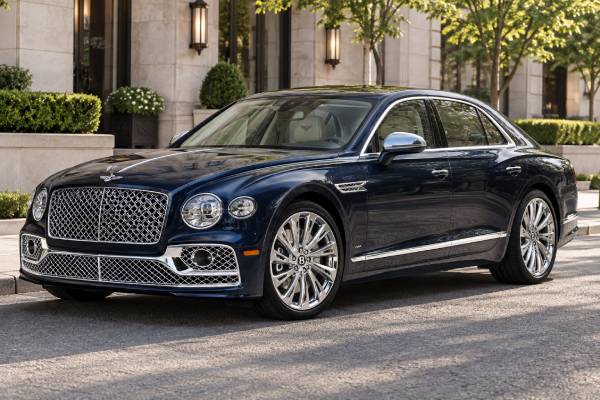
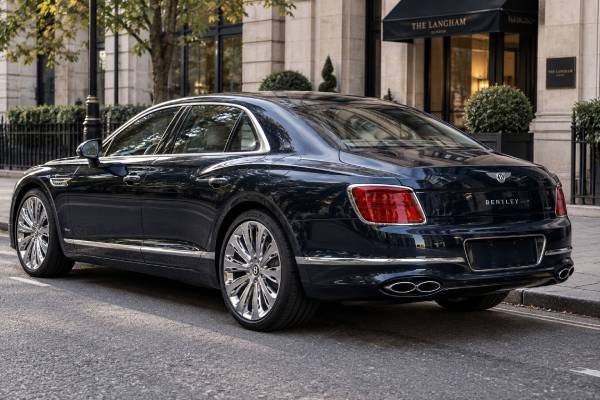
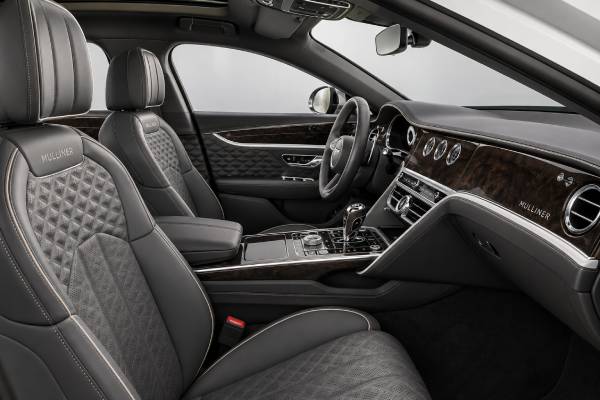
The 2021–2024 Bentley Flying Spur Mulliner V8 is the lavish, coachbuilt-looking version of Bentley’s third-generation luxury sedan, but its appeal is not limited to trim and embroidery. The 4.0-liter twin-turbo V8 removes roughly 100 kg from the nose compared with the contemporary W12, giving this very large four-door a lighter, more responsive character while retaining effortless speed. Mulliner specification then adds the visual and tactile details that make the car feel genuinely special: distinctive wheels, Double Diamond quilting, elaborate door trim, premium veneers, and a much wider commissioning palette.
For a buyer, the important distinction is that “Mulliner” describes the pinnacle specification, while the V8 defines the driving and ownership character. This guide explains how the engine, all-wheel-drive system, air suspension, optional active anti-roll hardware, cabin equipment, service needs, and used-car risks fit together. It also shows where the V8 makes more sense than the W12—and where an apparently perfect specification can hide expensive deferred maintenance.
Table of Contents
- What makes the Mulliner V8 distinct
- Technical specifications and dimensions
- V8 engineering and road character
- Mulliner cabin, equipment, and options
- Maintenance and running costs
- Inspection risks and common faults
- Buying the right example
What makes the Mulliner V8 distinct
The Mulliner V8 is best understood as the most ornate Flying Spur paired with the more agile of the two gasoline engines. It gives up the W12’s cylinder count, ultimate top speed, and historical significance, but it keeps nearly all of the real-world pace while bringing a less nose-heavy feel and, in many markets, lower fuel and tax exposure.
Bentley introduced the third-generation Flying Spur with the W12, added the 542 hp V8, and then placed Mulliner above the regular, Azure, S, and Speed-oriented interpretations. Depending on model year and market, the range and standard equipment changed, so a badge alone is not a complete specification sheet. A buyer should decode the vehicle identification number, obtain the factory build sheet, and inspect the actual hardware rather than assuming every Mulliner has every chassis or driver-assistance option.
Mulliner identification usually includes a Double Diamond front grille, Mulliner-branded wing vents, exclusive wheel treatments, self-leveling wheel badges, satin-silver mirror caps, and model-specific cabin details. Inside, the visual centerpiece is Double Diamond quilting. Bentley noted that the pattern required thousands of stitches and a long production process, which helps explain why damaged or poorly repaired upholstery can be costly to put right. The trim can be subtle in a monochrome cabin or theatrical in a three-color arrangement.
The V8 changes the car in a more fundamental way. Its hot-V layout places the turbochargers inside the cylinder banks, shortening the exhaust path to the turbines and helping torque arrive quickly. Cylinder deactivation can shut down four cylinders under suitable light-load conditions. The car remains extremely fast, yet the front axle carries less mass than in the W12 model. That does not turn a 5.3-meter luxury sedan into a small sports car, but it makes steering inputs feel cleaner and direction changes less deliberate.
The ideal owner is someone who wants top-level craftsmanship, uses the car for long distances, and expects to drive it rather than only occupy the rear seat. Chauffeur use still suits the Flying Spur’s wheelbase and rear accommodations, but the V8 Mulliner’s strongest case is its dual role: it can be quiet and formal in town, then cover a winding route with surprising composure.
Technical specifications and dimensions
This is a gasoline-only, all-wheel-drive luxury sedan with a twin-turbocharged 4.0-liter V8 and an eight-speed dual-clutch transmission. The figures below apply to the third-generation Flying Spur Mulliner V8 covered here; market certification, tires, optional equipment, and the source’s weight definition can change individual values.
| Specification | Value |
|---|---|
| Powertrain type | Gasoline internal-combustion engine |
| Engine | 4.0-liter twin-turbocharged V8 |
| Displacement | 3,996 cc |
| Maximum power | 550 PS (542 bhp; 404 kW) |
| Maximum torque | 770 Nm (568 lb-ft), approximately 2,000–4,500 rpm |
| Fuel-management feature | Four-cylinder deactivation under suitable light-load conditions |
| Transmission | 8-speed dual-clutch automatic |
| Drive system | Active all-wheel drive |
| Specification | Value | Condition |
|---|---|---|
| 0–60 mph | 4.0 seconds | Manufacturer figure |
| 0–100 km/h | 4.1 seconds | Manufacturer figure |
| Maximum speed | 318 km/h (198 mph) | Suitable tire and legal conditions required |
| Fuel tank | 90 liters (23.8 US gal) | Published regional specification |
| Luggage compartment | 420 liters (14.8 cu ft) | Gasoline model |
| Seating | Five seats; four-seat configuration optional | Equipment dependent |
| Specification | Value |
|---|---|
| Body style | Four-door luxury sedan |
| Overall length | 5,316 mm (209.3 in) |
| Width across mirrors | 2,220 mm (87.4 in) |
| Overall height | about 1,483 mm (58.4 in) |
| Wheelbase | 3,194 mm (125.7 in) |
| Standard suspension | Three-chamber adaptive air suspension |
| Steering | Electric power steering; all-wheel steering fitted on relevant specifications |
| Brakes | Large ventilated iron discs; carbon-ceramic system optional on some builds |
| Typical Mulliner wheels | 22-inch design with self-leveling center badges |
The car’s exact unladen or curb weight should be taken from the market-specific documentation because equipment, four- versus five-seat layout, wheel choice, and regional measurement rules matter. The useful comparison is Bentley’s own statement that the V8 Flying Spur was about 100 kg lighter than the equivalent W12, with most of that advantage benefiting front-end response.
V8 engineering and road character
The V8’s practical strength is not merely lower mass; it is the way broad torque, a quick-shifting transmission, and a sophisticated chassis make the car feel smaller than it is. Full acceleration is dramatic, but the more revealing test is a rolling overtake, where the engine can deliver strong thrust without a long downshift or theatrical delay.
The twin-scroll turbochargers separate exhaust pulses to improve response. Mounted in the valley of the V, they also keep the intake and exhaust paths compact. Peak torque arrives low in the rev range and remains available through the speeds used for normal passing. At a steady cruise, cylinder deactivation can reduce pumping losses by allowing the engine to operate temporarily as a four-cylinder. The transition is designed to be imperceptible; a vibration, warning light, or persistent roughness should therefore be treated as a fault, not a normal characteristic.
The eight-speed dual-clutch transmission deserves context. It can shift rapidly under load and contributes to the car’s sports-sedan side, yet it does not always imitate the liquid creep of a conventional torque-converter automatic. A small amount of clutch engagement feel during very low-speed maneuvering can be normal. Harsh thumps, delayed drive selection, warning messages, or repeated judder when warm are not. Software level, adaptation values, battery health, and mechanical condition all influence behavior.
Active all-wheel drive is rear-biased in normal running and can send torque forward as conditions demand. This helps the car retain a more natural steering feel than a permanently front-heavy layout. Torque Vectoring by Brake trims the inside wheels during cornering, while the air suspension varies spring behavior and ride height. Many cars also have Bentley Dynamic Ride, the 48-volt active anti-roll system that can resist body roll quickly while allowing each side of an axle to move more independently on a rough straight road.
All-wheel steering, where fitted, is another high-value feature. At parking speeds the rear wheels turn opposite the fronts, reducing the effective turning circle. At higher speeds they turn in the same direction, calming lane changes. The system is especially useful in a car this long, but it also adds actuators, sensors, alignment requirements, and repair expense. Uneven rear tire wear or a steering wheel that does not sit straight deserves a full four-wheel alignment and diagnostic scan.
Driving modes alter throttle, transmission, damping, steering, and chassis responses. Comfort is the natural limousine setting. Bentley mode provides the most convincing all-purpose balance. Sport keeps the V8 alert, adds weight and control to the chassis, and encourages the transmission to hold gears. A good test drive should use all modes on smooth and broken roads. The difference must be clear but not accompanied by knocks, suspension warnings, or a lopsided ride height.
Compared with the W12 Mulliner, the V8 sounds more obviously mechanical and sporting. Its cross-plane rhythm is present without dominating the cabin. The W12 delivers greater high-speed authority and a uniquely seamless surge, but the V8 is often more engaging below extreme speeds. That distinction matters more than the small difference in acceleration numbers.
Mulliner cabin, equipment, and options
Mulliner’s value lies in materials, execution, and specification depth, not in a single must-have gadget. Two cars with the same exterior badge can feel very different because hide colors, stitching, veneers, rear-seat layout, audio, driver-assistance packages, and brightware choices were highly configurable.
The Double Diamond pattern is the most recognizable feature. It extends across seats and door panels, with contrasting or accent stitching available. Inspect it in daylight. Look for stretched leather, broken threads, dye transfer, bolster wear, and panels that no longer match in sheen. A local cosmetic repair may be acceptable on an ordinary seat, but mismatched grain or stitch color is much more obvious in a Mulliner cabin.
The dashboard may carry high-gloss or open-pore wood, technical finishes, or the Bentley Rotating Display. The rotating unit can present the central touchscreen, a trio of analog instruments, or a clean veneer face. Operate it repeatedly from a cold start and after the cabin has warmed. It should rotate smoothly, align flush, and show no warning. A slow or noisy mechanism can turn a decorative option into a substantial repair.
Rear accommodation varies. The standard five-seat arrangement is more flexible, while the four-seat configuration extends a console between the rear occupants and creates a more formal environment. Rear picnic tables, powered blinds, touchscreen remote functions, heated and ventilated seating, massage, and removable entertainment screens may be present. Test every item. The complexity is manageable when maintained, but several small faults can quickly overwhelm the apparent saving on a used car.
Audio choices typically include the standard system, Bang & Olufsen for Bentley, and the high-output Naim for Bentley setup. Sound quality matters, but so does integration: listen for rattles, failed channels, distorted door speakers, and intermittent startup. Check wireless charging, USB ports, Bluetooth, navigation, cameras, head-up display, night vision, adaptive cruise functions, and keyless access. Connected-service availability can change by country, mobile-network support, subscription status, and model year.
Exterior choices can affect ownership as much as appearance. Polished or machined 22-inch wheels are vulnerable to curb damage and poor refinishing. Self-leveling center caps should remain upright and free of moisture. Blackline Specification replaces much of the chrome with dark trim, creating a very different look without changing the powertrain. Paint-to-sample and special Mulliner colors may be desirable, but any repair must match a complex finish across large panels. Measure paint depth and inspect panel edges rather than relying on a clean history report.
Maintenance and running costs
The safest ownership strategy is time-based, documented maintenance by a Bentley specialist or retailer familiar with the ZG2 Flying Spur. Low annual mileage does not make old oil, brake fluid, tires, batteries, seals, or air-conditioning refrigerant young, and long periods of storage can create more electrical and hydraulic issues than regular use.
Start with service history. The digital record and invoices should show annual attention, not only occasional stamps. Confirm the correct oil specification for the VIN and market, because a generic “premium synthetic” description is not enough. Ask whether spark plugs, air filters, cabin filters, brake fluid, drive belts, coolant work, transmission service, differential oils, and active-chassis inspections have been completed when due under the applicable schedule.
The 12-volt battery is disproportionately important. A weak battery can produce cascades of unrelated warning messages, disable convenience functions, and confuse diagnosis. Cars stored for weeks benefit from an approved maintainer connected correctly. Before purchase, test battery state of health rather than accepting a recent recharge as proof of condition. Also check that both keys are present and functioning; replacement and programming are not trivial.
Tires are a major running cost and a critical part of the chassis calibration. Confirm the correct size, load rating, speed rating, and approved specification on all four corners. Mixed brands, mismatched tread depths, old date codes, shoulder wear, or repeated puncture repairs are warning signs. The all-wheel-drive system and driver-assistance calibration depend on consistent rolling circumference. Large wheels also make alignment errors visible quickly.
Brake condition must be assessed by measurement, not appearance through the wheel. Iron discs can develop a lip, heat checking, corrosion on the inner face, or vibration under firm braking. Carbon-ceramic discs require specialist inspection for damage and remaining service life; replacing them can transform the economics of the car. Red or black calipers may look fresh even when the friction components are not.
Air suspension and active anti-roll systems should be checked cold, after an overnight stand, and again after a long drive. The body should not sink at one corner. The compressor should not run excessively. Any amber or red chassis message warrants fault-code investigation. Hydraulic or electrical active-chassis components are not suitable areas for guesswork.
Fuel use depends heavily on speed, route, temperature, and traffic. The V8 can deliver respectable long-distance range for its performance, but short urban trips and frequent acceleration will produce high consumption. Budget for premium fuel, specialist labor, quality tires, insurance, and preventive work rather than using the purchase price as the main affordability measure.
Inspection risks and common faults
There is no single defect that defines every Mulliner V8, so the correct approach is a system-by-system inspection plus a VIN recall check. The most expensive mistakes come from treating cosmetic perfection as proof of mechanical health.
Prioritize these areas:
- Diagnostic history: Scan every control module, save the report, and distinguish old low-voltage records from active or returning faults. Clearing codes immediately before a sale is a concern.
- Cooling and oil leaks: Inspect the hot-V engine, coolant circuits, hose connections, undertrays, and the area around turbo plumbing. A sweet smell, dried residue, or fresh cleaning deserves investigation.
- Transmission behavior: Test cold engagement, creeping, parking maneuvers, gentle shifts, and full-load changes after the car is warm.
- Air and active suspension: Look for corner sag, repeated compressor operation, knocks, warning messages, and mode changes that do not feel distinct.
- Steering and tires: Check for tramlining, vibration, off-center steering, uneven wear, and evidence of repeated wheel repairs.
- Electronics: Exercise the rotating display, rear screens, blinds, seat modules, cameras, radar-based assistance, audio, climate control, and every charging port.
- Water entry: Inspect the trunk floor, spare-tool area, door seals, sunroof drains where fitted, and carpets for dampness or staining.
- Recall completion: Use the VIN rather than model-year assumptions. Campaigns may apply only to narrow production ranges or equipment combinations.
A pre-purchase inspection should include paint-depth readings, underbody review, brake measurements, tire-age checks, battery test, full diagnostic scan, road test, and confirmation of software campaigns. Ask the inspecting shop to estimate immediate, one-year, and three-year needs. A car requiring tires, front brakes, a battery, and overdue service is not merely “due a few consumables”; on a Bentley, those items can represent a meaningful percentage of the transaction price.
Evidence of careful use matters. Correct cold tire pressures, clean drainage channels, matching quality tires, unmarked wheel bolts, orderly invoices, and a working trickle charger are small signs that often correlate with better stewardship. Conversely, bargain tires, missing tools, sticky controls, and multiple unresolved warnings suggest the owner prioritized presentation over upkeep.
Buying the right example
Buy condition and documented specification before color rarity. The best Mulliner V8 is the one whose options suit your use, whose maintenance is traceable, and whose costly systems work—not necessarily the car with the longest equipment list.
First decide whether you want four or five seats. The four-seat layout is special and works for chauffeur or couple-focused use, but it reduces flexibility. Then choose the chassis priorities. Dynamic Ride and all-wheel steering materially improve control and maneuverability; Touring Specification equipment can be valuable for long-distance driving; rear entertainment matters only if it will actually be used. An elaborate paint and trim combination cannot compensate for missing functional options that matter every day.
Compare the V8 with the W12 honestly. Choose the V8 for a slightly lighter nose, strong real-world pace, a more recognizable exhaust character, and potentially simpler long-term market acceptance. Choose the W12 for its extraordinary smoothness, higher maximum speed, flagship status, and significance as Bentley ended twelve-cylinder production. Neither is inexpensive to maintain. The V8 is not the “budget” Mulliner; it is a different dynamic interpretation.
Model-year changes can include infotainment, trim, option packaging, and connected services, so verify the build rather than relying on a registration date. A late car may carry desirable updates, but an earlier example with exceptional history can be the better purchase. Warranty coverage from an authorized retailer may justify a higher price, especially when it includes a rigorous inspection and clear exclusions.
Before paying a deposit, obtain the VIN, build sheet, service record, recall status, ownership history, finance and title checks, tire dates, brake measurements, diagnostic report, and an independent inspection. Confirm that the seller will allow a cold start and enough road time to warm the drivetrain. Photograph the car’s ride height before starting it if it has stood overnight.
Finally, keep a reserve after purchase. A well-bought Flying Spur Mulliner V8 can be remarkably usable, but deferred maintenance does not become cheaper because the car has depreciated. The right example delivers the core Bentley promise: craftsmanship that rewards close inspection, limousine comfort, and performance that feels abundant rather than strained.
References
- BENTLEY NEWSROOM : Flying Spur Mulliner 2021 (Model Overview)
- Flying Spur Now Available with Renowned V8 Powertrain | Bentley Media 2020 (Powertrain)
- Bentley News 2019: NEW FLYING SPUR – SPORTS SEDAN MEETS LUXURY LIMOUSINE 2019 (Engineering)
- Bentley News 2022 : THE FLYING SPUR MULLINER’S NEW DARK SIDE 2022 (Model Update)
- Bentley Motors Website: Set Up Guide: Flying Spur Set Up Guide 2026 (Connected Features)
- Check for Recalls: Vehicle, Car Seat, Tire, Equipment | NHTSA 2026 (Recall Database)
Disclaimer
This article is for informational purposes and is not a substitute for professional diagnosis, repair, or a VIN-specific pre-purchase inspection. Specifications, torque values, service intervals, fluids, procedures, software, and equipment can vary by VIN, market, model year, and factory options. Verify all work against official Bentley service documentation and the information supplied for the individual vehicle. If this guide helped, please share it on Facebook, X/Twitter, or another platform to support our work.