
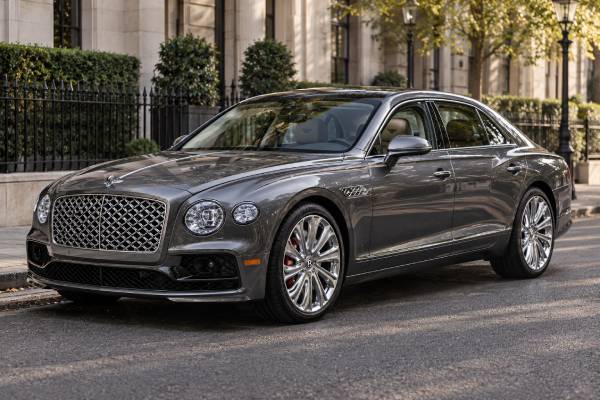
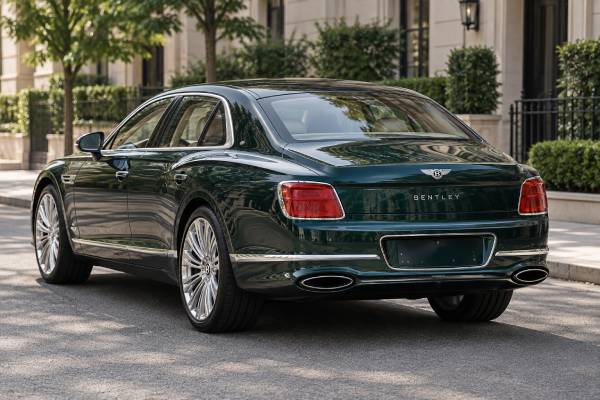
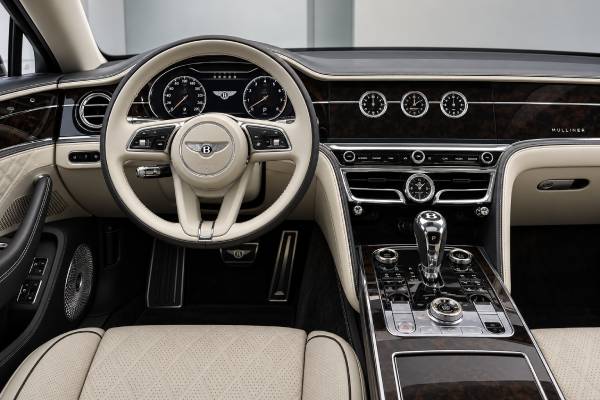
The 2021–2024 Bentley Flying Spur Mulliner W12 combines three ideas that are unlikely to return in the same form: a twelve-cylinder engine, a 333 km/h luxury sedan, and Mulliner’s most elaborate series-production cabin. Its performance figures are spectacular, but the car’s real signature is the absence of strain. The 6.0-liter twin-turbo W12 produces 900 Nm of torque, the eight-speed dual-clutch transmission keeps the engine in its broad working range, and the active chassis controls a body more than 5.3 meters long without destroying ride comfort.
This is also a car that demands disciplined buying. The W12’s rarity and end-of-era appeal can distract from tires, brakes, batteries, cooling systems, air suspension, electronic options, and incomplete servicing. A beautifully specified example can still be a poor purchase if its history is vague. The guide below separates the Mulliner design content from the W12 engineering, explains the systems that create the car’s pace, and gives a practical framework for inspecting, maintaining, and valuing one of Bentley’s final twelve-cylinder four-doors.
Table of Contents
- Why the W12 Mulliner matters
- W12 specifications and technical layout
- How the W12 delivers its speed
- Chassis, brakes, and high-speed stability
- Craftsmanship and configuration
- Long-term care for a W12
- Pre-purchase evaluation and value
Why the W12 Mulliner matters
The W12 Mulliner is the flagship expression of the third-generation Flying Spur, not simply a faster V8 with more decorative trim. Its engine architecture, 207 mph maximum speed, effortless midrange, and final-years production give it a different historical and emotional position.
Bentley’s W12 uses four banks of three cylinders arranged in a compact “double-V” form. Compared with a conventional V12, the package is shorter, allowing the engine to fit behind the front axle line more effectively than its cylinder count might suggest. It is still heavy, and the V8 Flying Spur carries less mass over the nose, but the W12’s compact length supports the car’s proportions and all-wheel-drive installation.
Mulliner specification sits above the conventional trim hierarchy. Exterior details include a Double Diamond grille, unique vents, satin-silver mirror caps, exclusive 22-inch wheels, and self-leveling center emblems. The cabin receives Double Diamond quilting, embroidered branding, model-specific door treatments, premium veneers, and extensive color choices. The result can range from formal and discreet to highly bespoke, depending on the original commission.
The dates in this assignment need interpretation. The Mulliner W12 was announced in 2021 and remained part of the third-generation range as Bentley prepared to end W12 production in 2024. Individual registration dates, model years, and regional availability do not always align exactly. For a used car, the VIN, factory build data, and first-delivery documentation are more reliable than a classified advertisement’s year field.
This variant makes sense for an owner who values mechanical significance and unforced high-speed capability. It is less compelling for someone seeking the lowest running cost, the lightest steering response, or frequent short urban use. The W12 performs best as a long-distance machine that is exercised regularly, serviced regardless of mileage, and kept on correct tires with all chassis systems working.
W12 specifications and technical layout
The Flying Spur Mulliner W12 is a gasoline-powered, all-wheel-drive sedan using a 6.0-liter twin-turbo W12 and an eight-speed dual-clutch transmission. The technical data below describes the 626 bhp third-generation model; special editions, market equipment, tire approvals, and weight definitions should be checked separately.
| Specification | Value |
|---|---|
| Engine configuration | 6.0-liter twin-turbocharged W12 |
| Displacement | 5,950 cc |
| Maximum power | 635 PS (626 bhp; 467 kW) |
| Maximum torque | 900 Nm (664 lb-ft) |
| Fuel system | Direct and port fuel injection |
| Cylinder management | Variable displacement under suitable conditions |
| Transmission | 8-speed dual-clutch automatic |
| Drivetrain | Active all-wheel drive |
| Measure | Value |
|---|---|
| 0–60 mph | 3.7 seconds |
| 0–100 km/h | 3.8 seconds |
| Maximum speed | 333 km/h (207 mph) |
| Maximum torque character | Broad plateau suited to high-gear acceleration |
| Fuel tank | 90 liters (23.8 US gal) |
| Boot capacity | 420 liters (14.8 cu ft) |
| Specification | Value |
|---|---|
| Body | Four-door, five-seat sedan; four-seat rear layout optional |
| Overall length | 5,316 mm (209.3 in) |
| Width across mirrors | 2,220 mm (87.4 in) |
| Height | about 1,483 mm (58.4 in) |
| Wheelbase | 3,194 mm (125.7 in) |
| Suspension | Adaptive three-chamber air suspension |
| Active chassis | 48-volt Bentley Dynamic Ride on applicable specification |
| Rear steering | Electronic all-wheel steering on applicable specification |
| Wheel size | 22-inch Mulliner design |
Bentley and regional documents use different forms of unladen or curb weight, so a single number can mislead. The W12 is approximately 100 kg heavier than the corresponding V8 Flying Spur, but options such as a four-seat rear cabin, large audio system, panoramic roof, rear entertainment, and carbon-ceramic brakes can alter an individual car’s measured weight.
How the W12 delivers its speed
The W12’s defining quality is sustained, low-effort acceleration rather than a dramatic rush concentrated at high rpm. Nine hundred newton-meters gives the transmission freedom to use tall gears, while the engine’s cylinder count keeps power delivery unusually smooth.
Each turbocharger feeds one side of the engine, and the compact exhaust arrangement helps the system respond without needing extreme revs. Direct injection supports precise fueling under load, while port injection can assist mixture preparation and reduce particulate formation in suitable operating conditions. Cylinder deactivation and start-stop strategies improve efficiency during gentle running, although no one should mistake the W12 for an economical powertrain.
The eight-speed dual-clutch unit links the engine to the driveline with fast, direct shifts. In normal driving, it works to keep the cabin calm and the engine unobtrusive. In Sport mode, it holds lower gears and responds more aggressively. Because dual clutches manage takeoff rather than a fluid torque converter, low-speed engagement may feel more deliberate than in a traditional limousine. Healthy operation should still be smooth and predictable.
At motorway speed, the W12’s reserve changes the way the car is driven. Overtakes can be completed with a small throttle movement, and steep gradients have little effect on progress. At legal speeds this reserve is primarily about refinement. The 333 km/h maximum matters as an engineering statement and as evidence of cooling, aero, tire, and stability requirements, not as a target for public roads.
Sound is deliberately restrained. The W12 does not produce the familiar pulse of a cross-plane V8 or the sharper note of a conventional V12. Instead, it creates a dense, muted surge. A buyer expecting a loud performance soundtrack may prefer the V8 or S model; a buyer who values near-silent authority will understand the W12 immediately.
Engine response should be clean from idle to full load. Misfires, uneven idle, blue smoke, fuel odor, coolant smell, reduced-power warnings, or inconsistent boost are not quirks. The complexity of two injection systems, twin turbochargers, many ignition components, and tightly packaged cooling circuits means diagnosis should begin with fault data and pressure tests, not parts substitution.
Chassis, brakes, and high-speed stability
The chassis is what makes the W12’s power usable. Air springs, adaptive damping, rear steering, active all-wheel drive, brake-based torque vectoring, and the optional or specification-dependent 48-volt anti-roll system coordinate to control mass without making the ride brittle.
The three-chamber air suspension can vary effective spring rate. Comfort mode allows a softer response over poor surfaces, while firmer settings reduce pitch and roll. Bentley Dynamic Ride uses electric actuators within the anti-roll system to generate counter-torque quickly. On a straight, the system can reduce the coupling that would otherwise make one wheel’s bump disturb the opposite side. In a corner, it can resist body movement and keep the tire contact patches better controlled.
All-wheel steering has two jobs. Opposite-phase rear steering at low speeds makes the long wheelbase easier to place in a parking structure. Same-phase movement at speed improves stability during lane changes. Because the system changes rear toe dynamically, alignment and tire condition are essential. A car that feels nervous, wanders, or wears one rear tire rapidly needs investigation even if no warning lamp is present.
The active all-wheel-drive system normally preserves a rear-led feel but can apportion torque forward for traction. On dry roads, this allows the car to accelerate hard without the steering feeling dominated by front-axle drive. On wet or cold surfaces, it provides security, but it cannot overcome old or unsuitable tires.
Standard iron brakes are exceptionally large. Carbon-ceramic discs were available on some configurations and reduce unsprung mass while offering high-temperature durability. For ordinary ownership, the key difference is replacement exposure. Iron components are expensive; carbon-ceramic components can be dramatically more so. Ask for measured disc thickness or a specialist condition report. Surface appearance alone is not sufficient, especially on the inner faces.
A road test should include repeated gentle braking, one controlled firm stop where safe, a rough-road section, a tight parking maneuver, and a steady highway run. Listen for suspension knocks, wheel-bearing hum, brake vibration, trim rattles, and changes as the car warms. The W12 should feel planted, quiet, and consistent. If it feels merely impressive because it accelerates hard, the test has been too short.
Craftsmanship and configuration
A Mulliner purchase should be judged as both a vehicle and a commission. Color harmony, material condition, rear-seat arrangement, and option usefulness can affect long-term satisfaction more than a small mileage difference.
Double Diamond quilting is stitched into the seats and door panels, and Mulliner offered three-color interior combinations that divide the cabin into primary, secondary, and accent hides. Inspect thread tension, perforation alignment, piping, and panel color under natural light. Heavily cleaned leather can appear shiny or stiff. Dye repairs may hide wear but also flatten grain and block perforations used for ventilation.
Veneer choice changes the atmosphere. High-gloss wood emphasizes traditional luxury; open-pore finishes look more contemporary; engine-turned metal and carbon fiber make the cabin more technical. The Bentley Rotating Display is a signature option, hiding the central screen behind either veneer or analog gauges. Test all three positions several times, verify that the panel sits flush, and inspect the surrounding veneer for cracking or stress marks.
Four-seat cars use a full-length rear console and suit owners who prioritize two individual rear positions. Five-seat cars offer a center belt and folding armrest, making them more practical. Neither layout is universally superior. Check powered picnic tables, rear blinds, detachable or integrated entertainment screens, the touchscreen remote, massage, ventilation, heated surfaces, climate zones, and all memory functions.
Mulliner wheels use self-leveling badges that keep the “B” upright. This small feature is easy to overlook but costly enough to check. Look for corrosion behind refinished faces, incorrect diamond-cut machining, mismatched center caps, and damage around wheel bolts. A flawless exterior photographed from several meters away may still have poorly repaired wheels and paint.
The Blackline Specification replaced many chrome elements with gloss black and became available on Mulliner models. It changes resale appeal because some buyers want traditional brightwork while others prefer a darker appearance. Originality is important: verify that black trim is factory equipment rather than wrapped or painted later.
Driver-assistance equipment was packaged differently by market. Adaptive cruise, lane assistance, head-up display, night vision, traffic-sign recognition, surround cameras, and parking systems should be tested in conditions where they can operate safely. A windscreen replacement can affect camera calibration; bumper or grille damage can affect radar alignment. Check for calibration invoices after body repairs.
Long-term care for a W12
The W12 rewards preventive maintenance and regular, fully warmed use. It punishes neglect that is disguised by low mileage. An annual service, battery support, correct fluids, fresh tires, and early response to leaks or warnings are the foundation of sensible ownership.
Oil must meet the Bentley-approved specification for the exact VIN and climate. Ask for invoices showing brand, viscosity, quantity, filter, and date rather than a generic service stamp. Short journeys can leave moisture and fuel dilution in the oil, while long storage periods allow seals to dry and the battery to decline. A low-mileage car used only for events may therefore need more scrutiny than a regularly driven example.
Cooling-system condition is critical because the W12 is tightly packaged and produces substantial heat. Inspect coolant level only when safe, look for dried pink or white residue, check auxiliary pumps and fans through diagnostics, and examine the underbody for evidence of previous leaks. A recent top-up without a documented repair is not reassuring.
Ignition components, injectors, turbo controls, and vacuum or pressure lines must operate consistently across twelve cylinders. A slight misfire can be masked by the engine’s smoothness. Review misfire counters and fuel trims during a specialist inspection. An illuminated malfunction lamp is obvious; a stored pending fault or one weak cylinder is easier to miss.
The 12-volt electrical system supports a large number of modules. Use an approved maintainer during storage and replace the battery with the correct type and coding procedure. Low voltage can cause suspension, driver-assistance, infotainment, seat, and convenience faults that appear unrelated. Diagnose the power supply first, but do not assume every fault is “just the battery.”
Tires should match in brand, model, specification, and similar tread depth. Check age as well as wear. A high-speed-rated tire can harden long before the tread reaches its legal limit. The car’s performance and mass justify conservative replacement. Alignment should be performed by a shop familiar with all-wheel steering and Bentley ride-height requirements.
Budget beyond routine servicing. Brake components, air-suspension parts, active anti-roll hardware, rear-steering components, cooling repairs, infotainment modules, and bespoke trim can each be significant. A maintenance reserve is part of the purchase, not an optional afterthought.
A W12 also rewards preventive planning around parts availability. Keep invoices that identify the exact oil, filters, ignition components, coolant work, and software campaigns used, because a future technician should not have to reconstruct the car’s history from mileage stamps alone. Inspect heat shields, underbody panels, intake plumbing, and fluid residue during every major visit; the densely packaged engine bay can hide small problems until they affect nearby components. If the car is used only occasionally, base care on time as well as distance. Warm it fully during proper drives, avoid repeated short starts merely to move it a few meters, and maintain the 12-volt battery with Bentley-approved equipment when stored. This approach protects the qualities that make the W12 special without pretending that low mileage eliminates aging.
Pre-purchase evaluation and value
The best W12 Mulliner is a verified, mechanically quiet car with a coherent factory specification and complete records. Mileage, rarity, and color should refine the decision only after condition is established.
Use this evaluation sequence:
- Confirm identity. Match the VIN across the car and documents, obtain the build sheet, and verify that the model is a factory Mulliner W12 rather than a cosmetically altered Flying Spur.
- Review history. Look for annual servicing, recall completion, warranty work, body repairs, tire replacement, brake measurements, and ownership periods.
- Inspect cold. Observe ride height before unlocking, start from cold, listen for abnormal mechanical noise, and watch for smoke or warning messages.
- Scan all modules. Record active, stored, and intermittent faults before anything is cleared. Check readiness data and low-voltage history.
- Road-test fully. Use every drive mode, warm the drivetrain, test low-speed clutch behavior, highway stability, rear steering, braking, and cabin equipment.
- Price immediate work. Obtain written estimates for tires, brakes, service, battery, alignment, cosmetic repairs, and any diagnostic follow-up.
Recall status must be checked by VIN. Third-generation Flying Spurs have been included in campaigns involving specific seat-belt assemblies and certain rear entertainment-screen retention brackets, among other production-specific actions. A model-year match does not prove that an individual car is affected, and the absence of an open campaign today does not replace reviewing its completed history.
Rarity adds interest but does not eliminate depreciation or maintenance. The end of W12 production gives the car genuine significance, especially in an elegant original specification, yet future value will favor complete, correct, documented examples. Non-original wheels, heavily modified exhausts, wrapped brightwork, missing accessories, and incomplete service records narrow the buyer pool.
Compare it with the W12 Speed and V8 Mulliner. The Speed emphasizes a darker, more aggressive dynamic identity; the Mulliner emphasizes craftsmanship and rear-cabin luxury. The V8 Mulliner feels lighter and may suit frequent driving better. The W12 Mulliner is the choice for maximum smoothness, flagship status, and twelve-cylinder finality.
A purchase from an authorized retailer with meaningful warranty coverage may cost more but reduce uncertainty. Read exclusions carefully, especially for trim, infotainment, wear items, batteries, brakes, tires, and pre-existing faults. Independent purchases can be excellent when the inspection is rigorous and the price leaves room for preventive work.
Once bought, preserve the records and original components. Keep the battery supported, exercise the car, avoid long periods on old fuel, maintain tire pressures, and address small leaks or warnings early. That approach protects both the driving experience and the historical value of one of the last great W12 sedans.
References
- BENTLEY NEWSROOM : Flying Spur Mulliner 2021 (Model Overview)
- Bentley News 2019: NEW FLYING SPUR – SPORTS SEDAN MEETS LUXURY LIMOUSINE 2019 (Engineering)
- Bentley News 2022 : THE FLYING SPUR MULLINER’S NEW DARK SIDE 2022 (Mulliner Update)
- Bentley News 2023 : TRIBUTE TO AN ENGINEERING ICON: BENTLEY SPEED EDITION 12 2023 (W12 History)
- Bentley Motors Website: FAQs: Flying Spur FAQs 2026 (Connected Services)
- Check for Recalls: Vehicle, Car Seat, Tire, Equipment | NHTSA 2026 (Recall Database)
Disclaimer
This article is for informational purposes only and does not replace professional diagnosis, repair, or a VIN-specific inspection. Specifications, torque values, service intervals, fluids, procedures, campaigns, and fitted equipment vary by VIN, market, model year, and options. Always verify requirements in the official Bentley service documentation for the individual car. Please share this guide on Facebook, X/Twitter, or another platform if it was useful and you would like to support our work.