
The 2022–2024 Bentley Flying Spur S Hybrid is a rare combination: Bentley’s first S-badged plug-in hybrid, a 536 bhp luxury sedan, and a model that uses visual and chassis tuning to feel more driver-focused without abandoning electric urban travel. Its 2.9-liter twin-turbo V6 and transmission-mounted motor deliver 750 Nm, while an 18.0 kWh battery supports up to 41 km of WLTP electric range. The S treatment adds dark exterior trim, red brake calipers, Dinamica cabin details, sport-themed graphics, and a more purposeful identity than the comfort-led Azure.
The car makes the most sense for an owner who can charge regularly but does not want the Hybrid to look or feel like the quietest member of the range. It also needs careful evaluation. The high-voltage system, dual-clutch transmission, large wheels, air suspension, 12-volt network, and extensive cabin electronics all need evidence of use and maintenance. This guide explains how the S Hybrid differs from the S V8, what the official figures mean in practice, and how to test the car as both a PHEV and a high-performance Bentley.
Table of Contents
- S Hybrid identity and positioning
- System specifications and dimensions
- Hybrid performance behavior
- S design and driver interface
- Charging, range, and energy use
- Maintenance for two power sources
- Inspection and purchase decision
S Hybrid identity and positioning
The Flying Spur S Hybrid is not a higher-output version of the regular Hybrid. Its combined output is the same 536 bhp, but the S package changes presentation and driver focus. The value lies in character, equipment, and styling rather than a power increase.
Bentley launched the Flying Spur S with a choice of V8 or plug-in-hybrid powertrains. That made the badge unusually broad. The V8 supplied the sound, lighter front-end response, and 198 mph maximum speed expected of a traditional sport derivative. The Hybrid provided immediate electric torque, quiet local operation, lower official emissions, and a 177 mph maximum speed. Both wore dark detailing and shared the S model’s visual vocabulary.
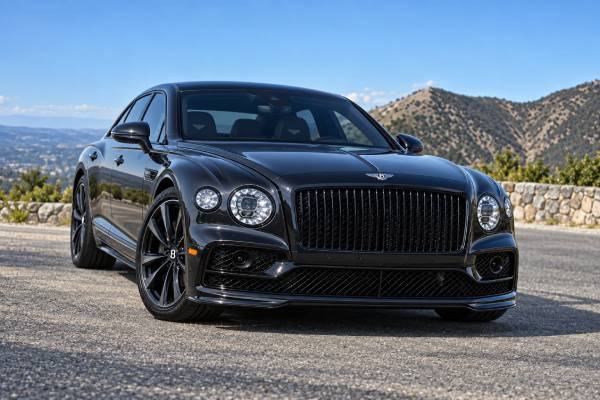
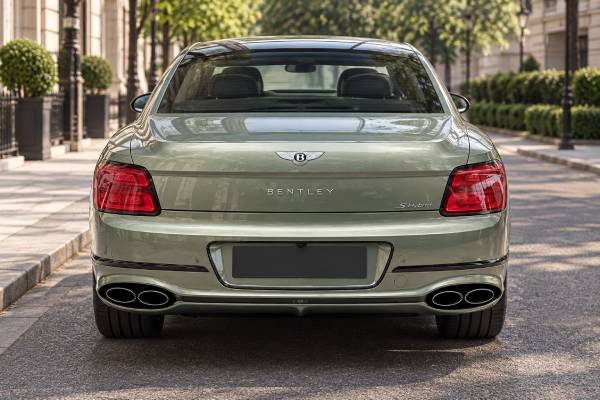
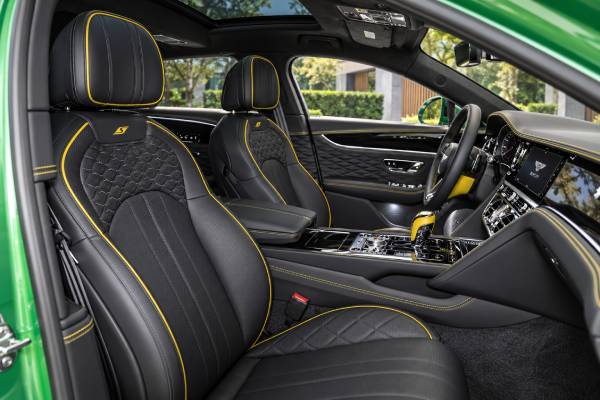
Outside, expect gloss-black grille elements and brightware, dark-tinted lamps, S badging, red brake calipers, and an S-specific 22-inch wheel design in black and Pale Brodgar Satin. Later design updates could alter grille treatment or trim, so photographs should be checked against the build sheet. Inside, S-branded sports seats combine leather and Dinamica, with a distinctive color split, embroidered emblems, treadplates, fascia badging, and performance-style instrument graphics.
The Hybrid’s personality is more layered than the appearance suggests. It can leave a residential street nearly silently, then deliver strong combined acceleration when the engine joins. It is only one tenth slower to 60 mph than the S V8 in Bentley’s claims, although the sensations differ. The V8 builds its identity through exhaust note and engine response; the Hybrid creates an initial electric push and then blends in the V6.
This model suits a buyer who wants the S look, values electric access to city centers, and has dependable charging. It is less suitable for someone who will never plug in, needs the full gasoline car’s trunk volume, or expects the S badge to include the V8 model’s Dynamic Ride and rear-steering specification automatically. Equipment must be verified car by car.
System specifications and dimensions
The S Hybrid is a PHEV with one gasoline engine, one traction motor, an externally chargeable battery, an eight-speed dual-clutch transmission, and all-wheel drive. The official combined output is calibrated at system level and should be quoted as published rather than calculated from component peaks.
| Specification | Value |
|---|---|
| Powertrain category | Plug-in hybrid electric vehicle |
| Engine | 2.9-liter twin-turbocharged V6 gasoline engine |
| Engine displacement | 2,894 cc |
| Electric motor arrangement | Single permanent-magnet motor integrated with transmission |
| Combined power | 544 PS (536 bhp; 400 kW) |
| Combined torque | 750 Nm (553 lb-ft) |
| Traction battery | 18.0 kWh gross |
| Transmission | 8-speed dual-clutch automatic |
| Drive system | Active all-wheel drive |
| Specification | Value | Condition |
|---|---|---|
| 0–60 mph | 4.1 seconds | Manufacturer claim |
| 0–100 km/h | 4.3 seconds | Manufacturer claim |
| Maximum speed | 285 km/h (177 mph) | Manufacturer claim |
| Electric range | Up to 41 km (26 miles) | WLTP |
| AC charging rate | Up to 7.2 kW | Supply and market dependent |
| Approximate AC full-charge time | About 2.5 hours | Suitable maximum-rate source |
| DC charging | Not available | AC-only PHEV |
| Specification | Value |
|---|---|
| Body style | Four-door luxury sports sedan |
| Overall length | 5,316 mm (209.3 in) |
| Width across mirrors | 2,220 mm (87.4 in) |
| Wheelbase | 3,194 mm (125.7 in) |
| Fuel tank | 80 liters (21.1 US gal) |
| Boot capacity | 351 liters (12.4 cu ft) |
| Suspension | Adaptive three-chamber air suspension |
| Standard S wheel design | 22-inch alloy wheel |
The smaller 351-liter luggage compartment is a structural consequence of hybrid packaging, not an S-specific styling choice. Buyers moving from a V8 Flying Spur should test their normal cases or sports equipment before assuming the rear cabin’s generous space is matched by the trunk.
Hybrid performance behavior
The S Hybrid is quickest and most convincing when the battery has useful charge and both power sources can cooperate. Electric torque sharpens the first response, the V6 sustains speed, and the motor can smooth transitions that would otherwise reveal turbo or gear-change delay.
The motor sits between the engine and gearbox. Clutches allow the system to disconnect or connect the V6, drive electrically, regenerate, and combine output. This architecture retains stepped gears rather than using an eCVT. The driver therefore feels conventional shifts, especially in Sport mode, but the motor can fill torque as clutches exchange load.
At low speed, electric operation suits the Flying Spur’s refinement. Pedal response is clean, and the car moves without the engine’s cold-start vibration. Strong throttle, low temperature, high climate demand, or battery-protection limits can start the V6. The event should be smooth. A heavy jolt, repeated hunting between sources, warning message, or pronounced shudder needs diagnosis.
The official 4.1-second 0–60 mph time shows that the Hybrid is not a token economy model. Its extra mass becomes more noticeable in repeated direction changes and braking than in straight-line acceleration. The S styling may suggest the most agile chassis in the family, but the V8 S’s standard Dynamic Ride and rear steering gave that model a clearer mechanical advantage in the original launch specification. Verify whether a particular Hybrid has those systems rather than relying on trim name.
The eight-speed dual-clutch transmission needs separate attention. Electric creep can mask clutch behavior at first, so test the car with the engine cycling normally and after the drivetrain is warm. Reverse up a mild incline, perform several parking maneuvers, and accelerate gently from a stop. Engagement should be controlled, not delayed or rough.
Regenerative braking blends motor deceleration with the friction brakes. The pedal should feel consistent across the transition. Because the car may use less friction braking in gentle driving, discs can corrode on lightly used examples. A pulsing pedal, scraping sound, or rusty inner disc face is not cured by the S badge or red calipers.
Sport mode keeps the system more alert and makes the digital display’s motorsport-inspired graphics relevant. It cannot alter battery physics. With a depleted or overheated battery, peak electric assistance may be limited. Performance claims are achieved under suitable charge and temperature conditions, so a test drive should begin with meaningful state of charge.
S design and driver interface
The S package succeeds when it makes the large sedan feel intentional rather than decorated. Its dark brightware, wheel finish, upholstery texture, and display graphics create a coherent performance theme, but each item also creates specific inspection points.
Gloss-black exterior trim shows swirl marks, chips, poor polishing, and water spotting more readily than chrome. Examine the grille vanes, window surrounds, lower bumper pieces, mirror caps, and lamp edges under angled light. Wrapped or repainted trim can look acceptable in photographs but lift at corners or differ in gloss.
The 22-inch S wheels use contrasting finishes and sit close to curbs. Look for machine marks that no longer match the factory pattern, overspray on tire beads, corrosion beneath clear coat, cracks on the inner rim, and missing self-leveling or correct center caps. Red brake calipers should have even finish and legible branding; fresh paint can conceal previous heat or chemical damage.
Dinamica is used on touch points and seat areas to add grip and visual contrast. It can become matted, shiny, or crushed through use and poor cleaning. Compare the driver’s bolster, steering wheel, gear selector, and passenger-side material. Leather-and-Dinamica joins should be straight, with intact stitching and no lifted edges.
The digital instrument panel uses S-specific graphics, but its practical functions remain more important. Verify hybrid energy flow, charge level, navigation prompts, assistance warnings, tire pressure, and service messages. The central infotainment system should pair with a phone, load cameras quickly, and retain settings after restart.
A four-seat rear configuration is possible, but the S is often chosen as a driver’s car and may use the five-seat layout. Rear massage, ventilation, powered blinds, touchscreen remote, picnic tables, and entertainment screens can still be present. Test everything rather than assuming little-used rear equipment is healthy.
The soundtrack differs from the S V8. In EV mode there is no combustion note; when the V6 starts, the sound is smoother and less theatrical. That is a feature for some owners and a disappointment for others. A test drive with the audio off is the only useful way to decide.
Charging, range, and energy use
Regular AC charging is the difference between owning the S Hybrid as designed and carrying unused hardware. Its modest battery is quick to replenish at home or work, but the absence of DC charging means motorway rapid-charge stops are not part of the strategy.
The best routine is simple: plug in after local use, schedule charging if electricity pricing favors certain hours, and pre-condition the cabin while connected where supported. A 7.2 kW wallbox can complete a full charge in roughly 2.5 hours under suitable conditions. Lower-powered supplies take longer but can still finish overnight.
The charge flap and connector lock should work without force. During a viewing, begin an actual session. Watch for communication errors, intermittent starts, a cable that will not release, or a charge rate far below what the source can provide after normal ramp-up. Confirm that the portable or mode cable supplied matches the market and is undamaged.
WLTP’s 41 km figure is a standardized comparison point. Weather, heating, cooling, speed, elevation, wheels, traffic, and driver demand alter the result. The dashboard estimate is based partly on recent history, so one low number does not prove battery degradation. A proper assessment uses diagnostic information and measured energy over a full charge-and-drive cycle.
The system offers modes to favor electric use, blend sources, retain charge, or use the engine to increase battery level. Holding charge for a city center can be sensible. Routinely generating electricity from gasoline is not a substitute for plugging in because conversion losses make it less efficient.
Track electricity and fuel separately. Wall energy includes charging losses, while the vehicle’s battery display refers to stored or usable energy through its own management logic. Do not compare dashboard consumption directly with a utility meter without acknowledging the difference.
On a long tour, the 80-liter fuel tank provides substantial range even after the battery’s initial electric contribution is used. The Hybrid can continue operating normally with the display at its lower buffer; “zero” electric range does not mean the high-voltage battery is physically empty. It retains energy for system protection and hybrid assistance.
Route planning can make the smaller 18.0 kWh battery far more useful than its headline range suggests. Reserve electric driving for slow urban sections, hotel departures, residential streets, and stop-start traffic, where quiet response and regenerative braking have the greatest value. On a motorway leg, it can be more sensible to let the gasoline engine work efficiently rather than consuming the full charge at sustained high speed. Enter the destination in the factory navigation when energy-management functions depend on route data, and pre-condition the cabin while connected when conditions permit. The goal is not to force every mile into EV mode, but to deploy limited electrical energy where it most improves refinement and consumption. Owners who repeat the same commute can compare charge used, temperature, traffic, and climate settings over several weeks to build a realistic routine.
Maintenance for two power sources
A complete maintenance plan treats the S Hybrid as a gasoline car, an electric-drive system, and a complex luxury chassis at the same time. Neglect in any one area can create warning cascades or expensive secondary damage.
The V6 requires the correct oil and filter at the time interval specified for the VIN, even when electric driving keeps engine mileage low. Repeated brief starts can be harder on oil than a fully warmed journey. Review plug, filter, coolant, brake-fluid, transmission, differential, and belt requirements with a Bentley-trained specialist.
The high-voltage battery and power electronics have dedicated cooling and monitoring. Technicians can inspect fault memory, charge history, cell balance indicators, isolation status, software, and coolant circuits without opening the pack. Owners should not handle orange high-voltage wiring or attempt isolation procedures.
The 12-volt battery is still the gateway to the entire car. It powers control units and initiates the sequence that connects the traction battery. A weak 12-volt unit can leave a fully charged PHEV unable to enter ready mode. Storage should include an approved maintainer, and replacement should use the correct battery type and coding.
Brake fluid ages with time, while iron discs can rust because regeneration handles part of the deceleration. Inspect disc faces, pad thickness, caliper condition, and parking-brake operation. Conduct occasional safe friction-brake use rather than allowing the system to remain polished only at the outer edge.
The heavy PHEV places high demand on tires and alignment. Use matching approved tires with correct load ratings and close tread depth. Bent wheels can cause vibration that appears only at highway speed. A four-wheel alignment should account for ride height and any rear-steering system.
Air suspension needs an overnight height check and a warm road test. Listen for compressor overrun, knocks, and changes between modes. If Dynamic Ride is present, scan its 48-volt system separately. Do not clear chassis faults before recording them.
Finally, maintain the charging equipment. Keep connectors dry and clean, avoid household extension leads, inspect the cable jacket, and replace damaged seals or pins through approved channels. A PHEV cable is a piece of electrical equipment, not just an accessory.
Inspection and purchase decision
Buy the S Hybrid only after proving that it charges, drives electrically, blends its engine smoothly, and has complete records. A cosmetic S package is easy to see; the expensive health indicators require time and diagnostic access.
Ask for the VIN, build sheet, service invoices, charging cables, both keys, warranty information, and recall completion before traveling. Confirm whether the car has rear entertainment, because specific 2021–2023 Flying Spurs were subject to a campaign involving screen-retention brackets. Check applicability by VIN, not by visual guess.
At the viewing, leave the car connected long enough to observe charging, then disconnect and start in EV mode. Listen for bearing or tire noise that combustion sound would mask. Drive in traffic, on a rough road, and at highway speed. Use strong acceleration once safe and legal, then assess braking and straight-line stability.
The inspection should include:
- saved diagnostic scans of all modules before and after the road test;
- high-voltage battery data and charging fault history;
- 12-volt battery health;
- cooling-system pressure and visual checks;
- tire age, matching specification, wheel runout, and alignment clues;
- brake thickness and inner-face condition;
- air-suspension leak and compressor behavior;
- paint-depth measurements and sensor-calibration records after body repair;
- operation of every seat, screen, camera, blind, table, and climate zone.
Compare it with the S V8 based on use. The V8 offers the classic sound, a lower curb mass, a larger 420-liter trunk, standard dynamic hardware in its launch specification, and no need to plug in. The Hybrid offers electric local travel, lower official emissions, and strong acceleration with the flexibility of gasoline touring. Neither is universally better.
Price immediate needs before negotiation. Four 22-inch tires, brake work, annual service, battery replacement, wheel refinishing, and missing charging equipment can exceed the gap between two advertised cars. High-voltage or transmission warnings should be diagnosed before purchase, not discounted with a hopeful estimate.
A well-bought S Hybrid has a particular appeal. It can arrive silently, look assertive without imitating the Speed, and cover long distances without charging anxiety. Its success depends on an owner who will use both halves of the powertrain and maintain all of them.
References
- Bentley News 2022 : NEW FLYING SPUR S – SPORTING STYLE TO DEBUT AT GOODWOOD FESTIVAL OF SPEED 2022 (Model Launch)
- Bentley News 2022 : FLYING SPUR HYBRID CERTIFIED AS MOST EFFICIENT BENTLEY YET 2022 (WLTP Data)
- Bentley News 2021 : THE WORLD’S BEST LUXURY SEDAN MADE GREENER: INTRODUCING THE NEW FLYING SPUR HYBRID 2021 (Hybrid Engineering)
- Bentley News 2023 : BRINGING HARMONY TO AZURE, S AND SPEED 2023 (Design Update)
- : Set Up Guide: Flying Spur Set Up Guide 2026 (Charging and Connectivity)
- Check for Recalls: Vehicle, Car Seat, Tire, Equipment | NHTSA 2026 (Recall Database)
Disclaimer
This article is for informational purposes and does not replace professional diagnosis, high-voltage service, repair, or a VIN-specific inspection. Specifications, torque values, intervals, software, charging equipment, and procedures vary by market, model year, options, and individual vehicle. Use official Bentley service information and qualified technicians. Please share the guide on Facebook, X/Twitter, or another platform if it was helpful.